DSEAR Risk Assessment vs Hazardous Area Classification
Published 04 Nov 2026

DSEAR Risk Assessment vs Hazardous Area Classification: What’s the Difference?
Guest Blog From Tal Hopkins | Vital Ex Engineering
By Tal Hopkins, Managing Director of Vital Ex Engineering
This guest article by Tal Hopkins of Vital Ex Engineering explains the difference between hazardous area classification and a DSEAR risk assessment, highlighting why zoning drawings alone cannot demonstrate how explosion risks are managed on site.
One of the things I come across quite regularly is a site telling me they’ve “done the DSEAR” and then handing me a hazardous area drawing.
There may be absolutely nothing wrong with the drawing. In many cases it’s technically sound and represents a significant amount of good engineering work. What it represents, however, is a Hazardous Area Classification (HAC), and while HAC is an important part of managing explosion risks under DSEAR, it isn’t the same thing as a DSEAR risk assessment.
That distinction might sound like a matter of terminology, but it matters in practice because HAC tends to produce the outputs people can actually see and use. Drawings showing zone types, zone extents and allowable EPLs, together with a report setting out ventilation calculations, tables of flammable substances and sources of release, and the justification for zone selection and extent, are tangible things. They influence design decisions, equipment selection and maintenance activities, so they often become the visible focus of the entire exercise. The risk is that once those pieces are in place, there can be an assumption that the DSEAR work is essentially complete. I’ve lost count of the number of times I’ve reviewed a site with a perfectly respectable HAC study only to find that some of the wider questions around training, emergency arrangements or ignition-source management had never really been explored in the same depth.
The Assessment Starts Before the Zoning
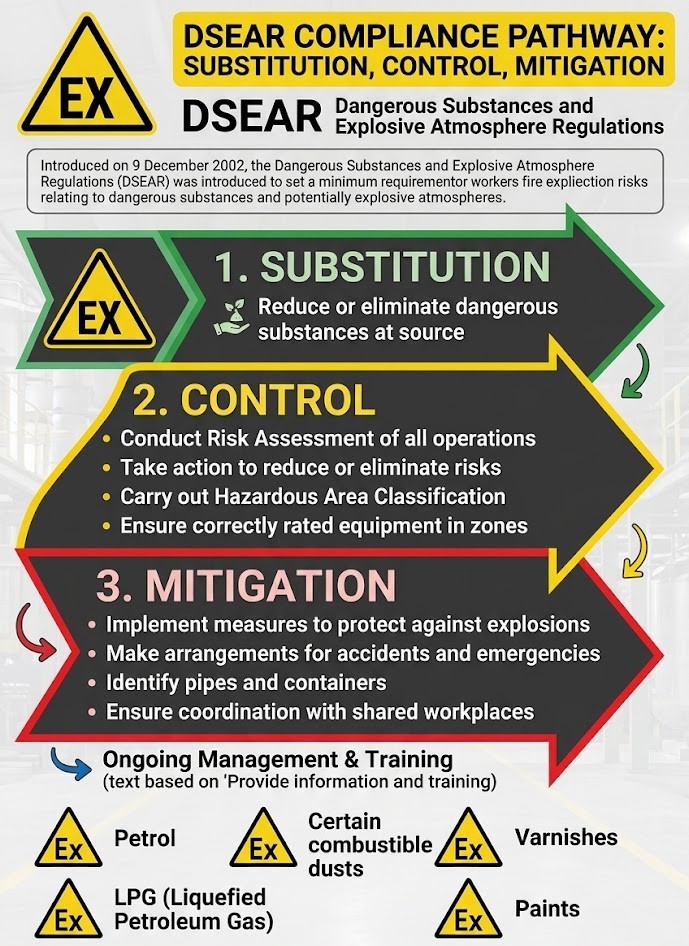
One of the most useful ways of understanding the difference is to think about the order in which the risk should be considered.
Before getting into hazardous areas, zones or Ex equipment, the first question should be whether the conditions that create the risk can be removed or reduced in the first place. In broad terms, the hierarchy is substitution, control and then mitigation.
If a dangerous substance can reasonably be replaced with a non-flammable or less flammable alternative, or the process can be changed so that an explosive atmosphere is less likely to form, that should always be considered first. Where that isn’t reasonably practicable, attention turns to controlling the risk of explosion through measures such as containment, ventilation, operating procedures and the management of ignition sources. Mitigation then sits behind those measures and is concerned with reducing the consequences should an explosion occur, perhaps through explosion relief, physical separation, blast protection or limiting the number of people who could be exposed. An important distinction between control and mitigation is that control seeks to reduce the likelihood of an explosion occurring, whilst mitigation measures are put in place to reduce the consequences if an explosion occurs.
I think this is one of the most important aspects of DSEAR because discussions can sometimes start further down the chain than they should. If the first conversation is about what equipment is suitable for a Zone 1 area, there is a possibility that nobody has properly challenged whether the conditions creating that Zone 1 could have been reduced or avoided beforehand. In my experience, those are often the most useful conversations to have because once a zone exists, attention naturally shifts towards managing it rather than asking whether it needed to exist at all.
The same principle applies to ignition sources, where electrical equipment is clearly important and often receives the greatest attention, but represents only one part of the ignition-risk picture. EN 1127-1 identifies 13 potential sources of ignition, including familiar hazards such as hot surfaces, flames, mechanically generated sparks and static electricity, but also less obvious risks such as stray currents, lightning, ultrasonics, electromagnetic radiation, adiabatic compression and exothermic reactions.
Not every site will have every one of those hazards, but a suitable assessment should consider which of them are credible. There is a significant difference between managing ignition risk and simply checking that the electrical equipment carries the correct Ex marking. This is another area where the distinction between HAC and the wider DSEAR assessment can become blurred, because electrical equipment is relatively straightforward to identify and inspect, while other ignition mechanisms require a broader understanding of how the plant is operated and maintained.
Where HAC Fits into the Picture
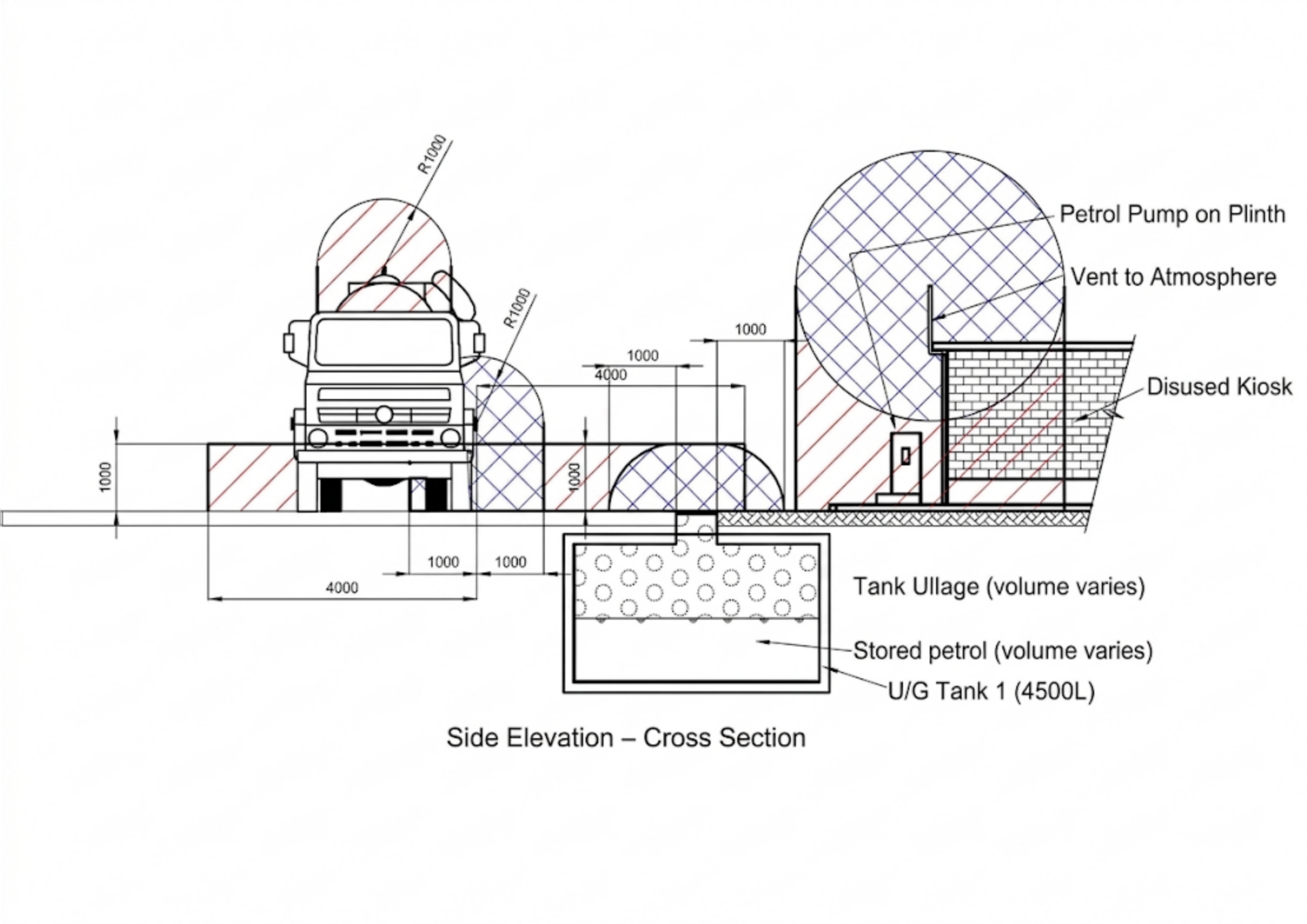
As part of the risk assessment, where an explosive atmosphere may occur in quantities requiring special precautions, HAC is used to determine where those hazardous areas exist and how they should be classified.
For gases and vapours, classification is carried out using IEC 60079-10-1, while IEC 60079-10-2 applies to combustible dusts. The assessment considers the substances involved, potential sources and grades of release, operating conditions, ventilation and dispersion, using that information to establish where hazardous areas exist and, where necessary, what zones should be assigned.
For gases and vapours, those are Zones 0, 1 and 2, while combustible dusts are classified as Zones 20, 21 and 22.
When I’m reviewing a site, the HAC drawing is often one of the first things produced because it’s the most tangible output of the work. That’s entirely understandable, but I also want to know what sits behind it and whether the rest of the assessment has received the same level of attention. That’s where the written HAC report comes in.
What the Drawing Doesn’t Tell You
A site can have an accurate hazardous area drawing, correctly selected Ex equipment and a well-managed inspection regime and still have important weaknesses elsewhere in its DSEAR arrangements.
Emergency preparedness is a good example because it raises questions that can’t be answered by a HAC drawing alone. If an incident occurs, people need to know how they will be warned, what actions they are expected to take and what information emergency responders will need if they are called to site.
One practical question I often use is to consider what an attending emergency crew would do if they arrived tomorrow. Would they understand what dangerous substances were present, where they were located and what sort of hazards they might be facing, or would they be trying to establish all of that information for the first time at the gate? If the answer is, “Someone will explain it when they get here,” there is usually more work to do!
The same logic applies to the people already working on the site, because operators, maintenance personnel and contractors need to understand the substances they are working with, the risks involved and why particular controls have been put in place. An excellent HAC drawing sitting in an engineering office has limited value if the people working in the area do not understand what the classification means or how their own activities might introduce an ignition source.
Some of the strongest DSEAR arrangements I’ve seen have not necessarily been the ones with the thickest folders or the most drawings, but the ones where operators and maintenance teams could clearly explain the hazards they were managing and the reasons behind the controls they were expected to follow.
There are other practical considerations too. Dangerous substances may need to be identified within containers and pipework, while sites involving multiple employers or contractors need to ensure that explosion-protection measures are properly coordinated. The employer responsible for the workplace can’t simply assume that each contractor will manage their own element of the risk independently and that everything will somehow align.
In practice, those interfaces are often where misunderstandings emerge, particularly during maintenance work, shutdowns and other non-routine activities when normal arrangements are already being stretched. These are not always the most visible parts of DSEAR, but they are important parts of the overall framework and are often where I find some of the more significant gaps.
Why Getting HAC Right Still Matters
None of this diminishes the importance of hazardous area classification; in fact, the distinction matters precisely because a sound classification is so important.
Once an area has been classified, the zone, gas group, dust group, temperature class and Equipment Protection Level all influence whether equipment is suitable for the application. A product can be correctly certified for use in explosive atmospheres and still be wrong for the particular installation.
For that reason, equipment selection should start with an understanding of the process and a technically justified classification rather than a catalogue search for products that appear to fit. The same principle extends beyond permanently installed electrical equipment because mechanical equipment, portable equipment, personal equipment, maintenance activities, tools and electrostatic risks can all introduce potential ignition sources that need to be understood and controlled.
Specifying Ex equipment everywhere “just to be safe” isn’t particularly good engineering either. Over-classification can introduce unnecessary cost and complexity, while under-classification can leave genuine ignition hazards inadequately controlled. The objective isn’t to maximise the amount of Ex equipment on site but to understand the risk properly and make proportionate decisions based on the actual process and operating conditions.
The Drawing Must Reflect the Plant You Have
One of the more common issues I see isn’t that the HAC was wrong when it was carried out, but that the process has changed since the assessment was completed. Substances change, operating pressures increase, ventilation arrangements are modified, vents are relocated and temporary modifications somehow become permanent. Over time, a classification that was entirely valid when it was produced can gradually stop reflecting what is actually happening on the plant.
I have seen hazardous area drawings that look perfectly reasonable on paper but no longer quite match reality. Usually it isn’t because the original classification was poor; it’s the accumulation of relatively small changes over several years that gradually moves the plant away from the assumptions on which the classification was based. In my experience, that sort of drift is far more common than an obviously incorrect classification.
Management of Change should provide the mechanism that keeps those things aligned. That does not mean reopening the entire DSEAR assessment every time a valve is replaced, but it does mean somebody should stop and consider whether a modification affects the existing risk assessment, hazardous area classification or any of the controls that depend upon it. The HAC and the engineering decisions behind it should be reviewed where a change could affect the assumptions on which they were based.
Otherwise, it’s surprisingly easy to end up maintaining an excellent hazardous area drawing of the plant you used to have.
Even if the plant itself hasn’t changed significantly, the assessment shouldn’t simply be left on the shelf indefinitely. DSEAR requires risk assessments to be reviewed regularly, with the appropriate interval depending on the nature of the risk and how much change is likely. A review should also be brought forward where there is reason to think the assessment is no longer valid, following significant changes or an incident, or where developments in relevant standards or guidance call the assumptions behind the classification into question.
So, Have You Actually “Done the DSEAR”?
What the drawing can’t tell me on its own is whether the explosive atmosphere could have been avoided or reduced in the first place, whether all credible ignition sources have been considered, whether people understand the risks they are working with, whether the emergency arrangements are adequate or whether everyone involved is properly coordinated.
Those questions sit within the wider DSEAR assessment, and in many respects they are the questions I’m most interested in once the drawing is on the table. A hazardous area drawing can tell me a great deal about the process, but it can’t tell me how well the risks are understood by the people working there, whether emergency arrangements would stand up to a real incident or whether the assumptions behind the assessment are still valid.
So if somebody tells me they’ve “done the DSEAR” and hands me their HAC drawing, I’ll certainly want to look at it. But what I’m really interested in is the conversation that follows.
About Our Guest Author: Tal Hopkins
Tal Hopkins is Managing Director and founder of Vital Ex Engineering, an independent engineering consultancy specialising in hazardous area compliance, functional safety and explosion protection. A Chartered Engineer and international CompEx trainer, Tal supports organisations working in high-hazard industries with DSEAR risk assessments, hazardous area classification, Ex equipment assessments and training. In this guest article for Thorne & Derrick, he draws on his experience of reviewing industrial sites to explain the difference between a hazardous area classification and the wider DSEAR risk assessment.
Hazardous Area Equipment from Specialists You Can Trust
Choosing suitable equipment starts with understanding your hazardous area classification. Thorne & Derrick are trusted specialists in equipment for explosive atmospheres, supplying ATEX & IECEx lighting, heating, ventilation and electrical equipment from leading manufacturers.
With expert technical support and extensive stock, we help you select products suited to your application and keep your project moving.
Contact our technical sales team for product advice, availability and a competitive quotation.