Hazardous Area Control Panels Explained: Ex d, Ex e & ATEX
Published 13 Nov 2026
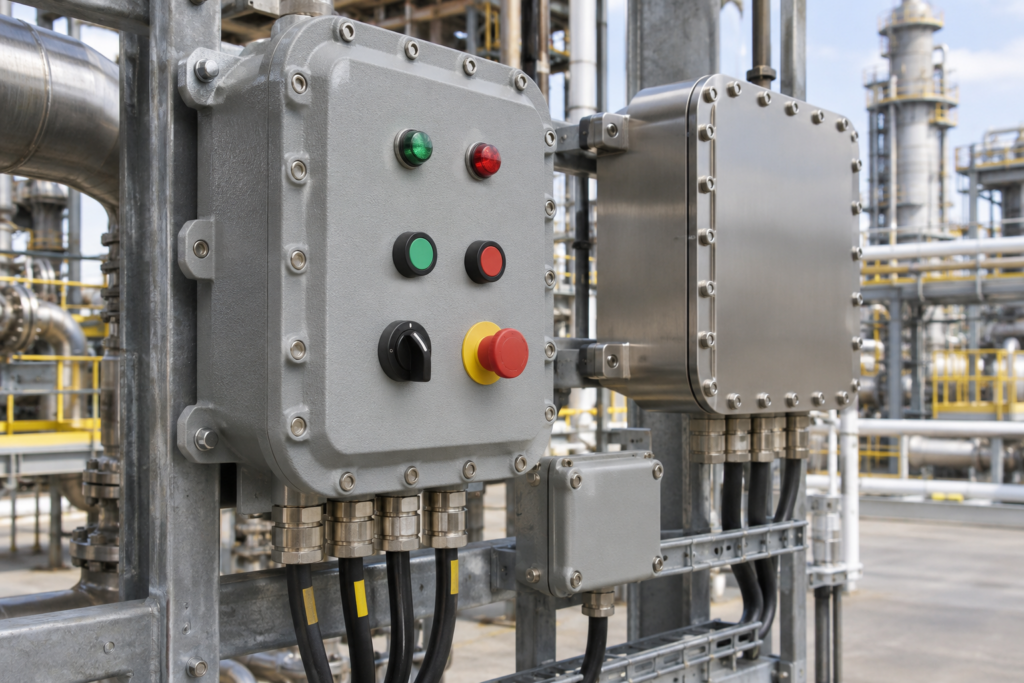
Hazardous area control panels house electrical equipment used to control, monitor and protect industrial processes in potentially explosive atmospheres. Depending on their design, they can operate machinery, distribute electrical power and control equipment such as lighting, pumps and heating systems.
However, an ordinary industrial control panel is not automatically suitable for a hazardous area. Where flammable gases, vapours or combustible dusts may be present, the complete assembly must meet the relevant explosion protection requirements.
For example, a certified panel may use Ex d flameproof, Ex e increased safety or a combination of protection methods. These approaches manage ignition risks differently, so the correct design depends on the application.
In addition, engineers must consider the hazardous area zone, electrical ratings, gas or dust group, temperature classification and environmental conditions.
Thorne & Derrick supply ATEX and IECEx control and distribution panel solutions for industrial and process applications, working with specialist manufacturers including Pepperl+Fuchs.
This guide explains how industrial control panels work, the difference between Ex d and Ex e protection, their main components and the factors to consider when specifying equipment for hazardous areas.
Quick Navigation – Control Panel Guide
- What Is a Control Panel?
- How Do Control Panels Work?
- Main Components of a Control Panel
- Standard vs Hazardous Area Panels
- Ex d vs Ex e Control Panels
- Types of Industrial Control Panels
- ATEX and IECEx Certification
- Zone 1, Zone 2 and Dust Areas
- Control Panel Enclosure Materials
- Common Industrial Applications
- Pepperl+Fuchs Control Panel Ranges
- Control Panel Selection Checklist
- Installation and Maintenance
- Common Specification Mistakes
- Frequently Asked Questions
- Conclusion and Product Support
What Is a Control Panel?
A control panel is an electrical assembly containing components that operate, monitor or protect equipment and processes. It provides a central location for electrical control functions and may include switching, protection and monitoring devices.
For example, a panel might control a pump motor, operate industrial lighting or regulate an electric heating system. More complex assemblies can also incorporate programmable controllers and process instrumentation.
However, the internal components depend on the intended function. A simple distribution panel may contain protective devices, while an automation panel could include a PLC, relays and control circuits.
What Makes a Control Panel Suitable for a Hazardous Area?
In potentially explosive atmospheres, the complete assembly must use a suitable explosion protection method. This helps prevent electrical or thermal ignition sources from igniting the surrounding atmosphere.
Therefore, engineers cannot simply install ordinary components inside any enclosure and assume the result is ATEX compliant.
Instead, the completed panel must meet the relevant design, assessment, marking and installation requirements.
Control Panels – Quick Summary
| Question | Explanation |
|---|---|
| What is it? | An electrical assembly used for control, protection, switching or monitoring. |
| Main functions | Operate machinery, manage electrical circuits and monitor industrial processes. |
| Typical components | Switches, circuit breakers, terminals, relays, contactors and controllers. |
| Ex protection | Ex d, Ex e or other suitable certified protection methods. |
| Hazardous areas | Suitable Zone 1, Zone 2, Zone 21 and Zone 22 applications, depending on certification. |
| Applications | Power distribution, lighting, heat tracing, machinery and process control. |
How Do Industrial Control Panels Work?
Industrial control panels bring electrical control and protection functions together in one assembly. They receive electrical power and signals, then use their internal components to operate connected equipment.
For example, an operator might press a start button to activate a pump. The control circuit then operates a suitable contactor or motor starter, allowing the equipment to run under the required conditions.
However, the precise arrangement depends on whether the panel provides simple manual control, automatic sequencing or a combination of functions.
1. Power Supply and Distribution
First, the assembly receives its specified electrical supply. Protective devices and internal conductors then distribute power to the relevant circuits.
For example, a panel may supply lighting, control circuits or an electric heating installation.
2. Switching and Control
Next, switches, relays, contactors or electronic controllers operate the connected equipment.
Depending on the design, control commands may come from an operator, sensor, PLC or wider automation system.
3. Monitoring and Feedback
Many systems receive signals from instruments or sensors. These signals help determine whether the process is operating within its required conditions.
For example, temperature feedback may allow a controller to regulate a heating system.
4. Electrical Protection
Suitable protection devices can disconnect or limit electrical circuits when specified abnormal conditions occur.
However, protective device selection depends on fault levels, circuit design and applicable electrical requirements.
Therefore, the panel must be engineered as a complete system rather than assembled from unrelated components.
What Are the Main Components of a Control Panel?
Different industrial panels contain different electrical components. However, many assemblies use a combination of switching, protection, control and connection equipment.
The following table explains common components and their functions.
Control Panel Components Explained
| Component | Function |
|---|---|
| Circuit Breakers | Provide specified electrical circuit protection and switching functions. |
| Isolators | Provide an appropriate means of electrical isolation when correctly specified. |
| Contactors | Switch electrical loads through a control circuit. |
| Relays | Perform control or switching functions in response to electrical signals. |
| PLCs | Control automated sequences and process functions. |
| Terminal Blocks | Provide organised electrical connections between internal and external circuits. |
| Push Buttons | Allow operators to issue control commands. |
| Indicator Lamps | Display equipment status, operating conditions or alarms. |
| Temperature Controllers | Control heating equipment using relevant temperature information. |
| Cable Glands | Provide suitable cable entries, retention and environmental or Ex protection functions. |
Can Ordinary Electrical Components Be Used Inside an ATEX Panel?
In some certified protection arrangements, an appropriately engineered assembly may incorporate components that do not have individual Ex certification.
For example, suitable Ex d flameproof enclosures can accommodate specified internal equipment within the approved design.
However, this does not mean that any component can be installed freely. Electrical loading, thermal performance, enclosure integrity and the complete certification must support the final assembly.
Standard Industrial vs Hazardous Area Control Panels
Standard industrial panels and hazardous area panels may perform similar control functions. However, the requirements for explosion protection create important differences.
For example, an industrial enclosure may offer suitable environmental protection without having any approval for use in an explosive atmosphere.
Key Differences
| Feature | Standard Industrial Panel | Hazardous Area Panel |
|---|---|---|
| Primary Function | Industrial electrical control or distribution. | Electrical control or distribution with suitable explosion protection. |
| Explosion Protection | Not necessarily provided. | Uses appropriate certified protection methods. |
| Certification | Applicable general electrical equipment requirements. | Applicable Ex equipment requirements in addition to relevant electrical requirements. |
| Cable Entries | Suitable general electrical cable entries. | Cable entries compatible with the certified explosion protection arrangement. |
| Modifications | Controlled by applicable electrical and manufacturer requirements. | Changes must also preserve explosion protection and certification. |
Important: An IP66 enclosure is not automatically ATEX certified. Ingress protection and explosion protection are separate requirements.
Ex d vs Ex e Control Panels – What’s the Difference?
Ex d and Ex e are two recognised explosion protection methods used in suitable hazardous area electrical equipment.
Although both address ignition hazards, they work differently. Therefore, the appropriate method depends on the internal equipment and complete panel design.
Ex d – Flameproof Control Panels
Ex d flameproof protection uses a specially constructed enclosure designed to contain an internal explosion and prevent flame transmission to the surrounding atmosphere.
This method can support suitable switching and control equipment within an approved enclosure design.
However, flamepaths, cover arrangements, cable entries and other construction details are critical to maintaining the protection.
Ex e – Increased Safety Control Panels
Ex e increased safety uses additional design measures to reduce the likelihood of ignition sources arising in the protected equipment.
For example, suitable terminal assemblies may use increased safety protection where the complete electrical design meets the relevant requirements.
However, ordinary sparking components cannot simply be placed inside an Ex e enclosure without appropriate additional protection.
Can Ex d and Ex e Be Combined?
Yes. Some certified assemblies combine different protection methods.
For example, a panel may incorporate flameproof components alongside suitable increased safety connections.
Nevertheless, the final assembly must follow its approved certification and installation requirements.
Ex d vs Ex e Comparison
| Characteristic | Ex d Flameproof | Ex e Increased Safety |
|---|---|---|
| Protection Principle | Contains an internal explosion and prevents flame transmission. | Reduces the likelihood of ignition sources developing. |
| Enclosure Requirements | Special flameproof construction and flamepaths. | Design and construction measures appropriate to increased safety. |
| Typical Applications | Suitable assemblies containing ignition-capable electrical devices. | Suitable terminal and connection assemblies. |
| Maintenance Considerations | Flamepaths, joints, fasteners and approved entries. | Terminal integrity, clearances and approved components. |
What Are the Different Types of Industrial Control Panels?
Industrial panels are often classified by the function they perform rather than their enclosure construction.
For example, a process plant may use separate panels for electrical distribution, heating, motor control and automation.
Electrical Distribution Panels
Distribution panels provide power to designated electrical circuits. They may incorporate suitable circuit breakers, switches, terminals and other protective devices.
In hazardous areas, the completed assembly must also meet the relevant explosion protection requirements.
Lighting Control Panels
Lighting panels control electrical lighting circuits across an industrial installation.
For example, they may incorporate switching arrangements for suitable hazardous area lighting systems.
Heat Tracing Control Panels
Heat tracing panels provide control and electrical protection functions for electric trace heating installations.
Depending on the system, they may include temperature controllers, switching equipment, alarms and protective devices.
However, hazardous area heat tracing requires suitable system design, temperature control and equipment certification.
Explore electric heat tracing equipment and systems.
Motor Control Panels
Motor control panels operate motors used by industrial equipment such as pumps and ventilation systems.
For example, the design may include motor starters, contactors, protective relays and control devices.
However, the electrical ratings and switching duty must match the connected motor and installation.
Automation and PLC Panels
Automation panels incorporate control equipment that manages industrial processes.
For example, a PLC may receive signals from sensors before operating valves, pumps or other devices.
Where the assembly is installed within a hazardous area, the complete protection concept must accommodate the chosen control equipment.
ATEX and IECEx Certification for Hazardous Area Control Panels
Hazardous area electrical equipment must meet the relevant requirements for its intended installation and market.
For example, ATEX and IECEx are important frameworks used for explosion-protected equipment. However, they have different roles.
ATEX Certification
ATEX refers to European requirements for equipment and protective systems intended for potentially explosive atmospheres.
In the European Union, Directive 2014/34/EU establishes requirements for equipment within its scope.
Great Britain has its own applicable product regulations. Therefore, the correct conformity assessment and product marking must be established for the destination market.
IECEx Certification
IECEx is an international conformity assessment system based on relevant IEC standards.
For example, an IECEx certificate can provide evidence of assessment against specified explosion protection requirements.
However, national regulatory requirements may still apply.
Does a Certified Empty Enclosure Make the Complete Panel Certified?
No. An empty enclosure certificate does not automatically establish certification of a fully populated assembly.
For example, fitting circuit breakers, contactors or other components can introduce new electrical and thermal considerations.
Therefore, the final assembly must undergo the applicable assessment and documentation process.
Control Panels for Zone 1, Zone 2, Zone 21 and Zone 22
Hazardous area zones describe how often an explosive atmosphere may occur and how long it may remain present.
However, the zone alone does not determine equipment suitability. Gas or dust group, temperature and Equipment Protection Level must also be considered.
Hazardous Area Zone Selection
| Zone | Atmosphere | Normally Applicable EPL |
|---|---|---|
| Zone 0 | Gas, vapour or mist atmosphere present continuously, frequently or for long periods. | Ga |
| Zone 1 | Gas atmosphere likely to occur occasionally during normal operation. | Ga or Gb |
| Zone 2 | Gas atmosphere unlikely during normal operation and short-lived if it occurs. | Ga, Gb or Gc |
| Zone 20 | Dust atmosphere present continuously, frequently or for long periods. | Da |
| Zone 21 | Dust atmosphere likely to occur occasionally during normal operation. | Da or Db |
| Zone 22 | Dust atmosphere unlikely during normal operation and short-lived if it occurs. | Da, Db or Dc |
Important: A control panel certified for Zone 2 must not automatically be used in Zone 1. The complete equipment marking and certification must support the intended installation.
What Materials Are Hazardous Area Control Panels Made From?
Enclosure materials influence mechanical strength, corrosion resistance and suitability for the surrounding environment.
However, material alone does not establish explosion protection. The construction and complete certification remain essential.
Stainless Steel Control Panels
Stainless steel can provide corrosion resistance for selected demanding industrial environments.
For example, suitable stainless steel enclosures may be specified for offshore or corrosive processing locations.
Aluminium Control Panels
Aluminium offers a different balance of weight, strength and corrosion properties.
For example, selected Pepperl+Fuchs flameproof enclosure ranges use suitable aluminium construction.
Cast Iron Control Panels
Cast iron is another material used in certain flameproof enclosure designs.
However, mechanical characteristics, corrosion protection and installation weight must be considered.
GRP and Polymer Enclosures
GRP and suitable polymers are used in selected hazardous area enclosure designs.
Nevertheless, the material and construction must suit the certified protection method and operating conditions.
Where Are Hazardous Area Control Panels Used?
Certified control assemblies are used where electrical equipment must operate in potentially explosive atmospheres.
Typical installations include industrial processing, petrochemical production, offshore facilities and other classified areas.
Oil and Gas
Oil and gas facilities may require control and distribution equipment in classified areas.
For example, suitable panels can support pumps, process equipment or local electrical distribution.
Chemical and Petrochemical Processing
Chemical and petrochemical facilities may contain flammable gases, vapours or other dangerous substances.
Therefore, electrical equipment must match the relevant hazardous area classification and operating conditions.
Pharmaceutical Manufacturing
Some pharmaceutical manufacturing processes involve flammable solvents or combustible dusts.
As a result, suitable certified equipment may be required in the relevant classified locations.
Industrial Heating and Heat Tracing
Heating systems may require electrical control and protection within hazardous areas.
For example, suitable panels can provide temperature control and electrical switching functions for heat tracing installations.
Offshore and Marine Facilities
Selected offshore and marine installations require electrical equipment that can withstand demanding environmental conditions.
However, corrosion resistance and Ex certification must both be assessed independently.
Pepperl+Fuchs Hazardous Area Control Panel Ranges
Thorne & Derrick work with specialist manufacturers including Pepperl+Fuchs to provide hazardous area control and distribution equipment.
The existing range includes various Ex d flameproof enclosure families. However, individual products differ in construction, certification and possible configurations.
EJB Flameproof Enclosures
The EJB range includes suitable flameproof enclosure designs for control and distribution applications.
Depending on the configuration, the panels may incorporate switching equipment, operator controls and other approved components.
Explore Pepperl+Fuchs EJB Flameproof Panels
EJBX Stainless Steel Enclosures
EJBX designs provide stainless steel enclosure options for suitable hazardous area applications.
As a result, they may be considered where the installation requires particular corrosion-resistant material characteristics.
GUB Flameproof Enclosures
The GUB range offers selected flameproof panel configurations for suitable industrial applications.
However, the gas group, temperature classification and electrical ratings must match the exact approved product.
Explore Pepperl+Fuchs GUB Flameproof Panels
GUBX Stainless Steel Enclosures
GUBX variants provide stainless steel construction within the relevant flameproof enclosure family.
However, engineers must confirm the available sizes, certification and approved internal configurations before specification.
Can Hazardous Area Panels Be Customised?
Yes. Certain product families support customised electrical control and distribution assemblies.
For example, a project may require specified operator controls, circuit protection, terminals or monitoring windows.
Nevertheless, any customisation must remain within the applicable engineered and certified design.
Browse the complete hazardous area control and distribution range.
How to Select a Hazardous Area Control Panel
Correct panel selection starts with the electrical function and hazardous area requirements.
However, other factors such as ambient conditions, component configuration and cable entries can also affect suitability.
Step 1 – Establish the Panel Function
First, determine whether the assembly will control motors, distribute power, operate heating equipment or perform another function.
Then, identify the required internal components and operating controls.
Step 2 – Confirm Hazardous Area Requirements
Next, establish the zone, Equipment Protection Level, gas or dust group and temperature requirements.
For example, an application involving a Zone 1 gas atmosphere may have different requirements from a Zone 22 dust location.
Step 3 – Review Electrical Ratings
Check the supply voltage, current, fault levels, switching duty and connected equipment.
In addition, review the heat generated by internal components and its effect on the complete enclosure design.
Step 4 – Select the Enclosure
Choose a suitable material, construction and protection method.
Furthermore, consider ambient temperature, corrosion, ingress protection and available installation space.
Step 5 – Verify the Final Assembly
Finally, confirm the certificate, Ex marking, electrical documentation and applicable installation instructions.
Where necessary, review any special conditions of use before installation.
Control Panel Selection Checklist
| Requirement | What to Confirm |
|---|---|
| Application | Motor control, lighting, heat tracing, distribution or automation. |
| Hazardous Area | Zone and required Equipment Protection Level. |
| Gas or Dust Group | Compatibility with the identified explosive atmosphere. |
| Protection Method | Ex d, Ex e or another suitable certified concept. |
| Electrical Ratings | Voltage, current, fault rating and operating duty. |
| Internal Components | Required switches, breakers, relays, terminals and controllers. |
| Enclosure Material | Mechanical and environmental suitability. |
| Cable Entries | Suitable glands, entry positions and installation arrangements. |
| Certification | Full assembly approval and applicable documentation. |
Installation and Maintenance of Hazardous Area Control Panels
Correct installation is essential to preserve explosion protection and electrical safety.
However, the required procedures depend on the protection concept and complete assembly design.
Installation Requirements
Competent installers must follow the applicable electrical requirements and manufacturer instructions.
For example, cable glands, sealing arrangements, earthing and bonding must suit the certified assembly.
In addition, the installation must accommodate the specified ambient conditions and electrical ratings.
Inspection Requirements
Regular inspection helps identify damage or deterioration that may affect protection.
For example, personnel may need to check enclosure fasteners, cable entries, seals, markings and signs of corrosion.
BS EN IEC 60079-17 addresses inspection and maintenance of electrical installations in explosive atmospheres.
Can Control Panels Be Modified After Installation?
Modifications may affect the original protection method and certification.
For example, adding a new cable entry or replacing an internal component can change important design characteristics.
Therefore, changes must follow the applicable approval, engineering and documentation procedures.
Common Mistakes When Specifying Control Panels
Incorrect specification can compromise the intended explosion protection and create additional electrical or operational risks.
However, many problems can be prevented by reviewing the complete design before ordering.
Certification Mistakes
- Assuming an IP66 enclosure is ATEX certified: Ingress protection does not establish explosion protection.
- Choosing by zone alone: Gas group, temperature and EPL must also match.
- Using an empty enclosure certificate for a complete assembly: The final panel may need further assessment.
- Assuming all Ex protection methods are interchangeable: Different protection concepts have different requirements.
Electrical and Installation Mistakes
- Ignoring heat generated inside the enclosure: Internal components may affect thermal performance.
- Using unsuitable cable glands: Cable entries must preserve the specified protection method.
- Overlooking fault levels: Electrical protection and withstand ratings must suit the installation.
- Making unauthorised modifications: Changes can compromise certification and protection.
- Ignoring ambient temperature limits: The panel must operate within its approved conditions.
Control Panels – Frequently Asked Questions
These answers cover common questions about industrial control panels, ATEX certification and hazardous area equipment selection.
Control Panel Basics
Q1. What is a control panel?
A control panel is an electrical assembly that contains equipment used to operate, monitor or protect industrial systems. For example, it may control motors, heating or lighting.
Q2. What does an industrial control panel do?
It brings control and electrical protection functions together. Depending on its design, the panel may distribute power, operate equipment or monitor process conditions.
Q3. What is an ATEX control panel?
An ATEX control panel is an electrical control assembly that meets applicable explosion protection requirements for a specified potentially explosive atmosphere.
Q4. What components are inside a control panel?
Typical components include circuit breakers, switches, relays, contactors, terminals and controllers. However, the exact configuration depends on the intended function.
Q5. What is the difference between a control panel and a distribution board?
A distribution board primarily distributes electrical power to circuits. By comparison, a control panel focuses on operating or monitoring equipment, although some assemblies combine both functions.
Hazardous Area Protection and Certification
Q6. What is the difference between Ex d and Ex e control panels?
Ex d uses flameproof enclosure protection, while Ex e uses increased safety measures. Therefore, the two protection methods have different construction and installation requirements.
Q7. Can a control panel be used in Zone 1?
Yes, where the complete assembly certification supports the Zone 1 application. However, the gas group, temperature classification, EPL and installation conditions must also match.
Q8. Does IP66 mean a control panel is explosion proof?
No. IP66 describes ingress protection against dust and powerful water jets. However, it does not establish ATEX or IECEx explosion protection.
Q9. Can a hazardous area control panel be customised?
Yes. Certain certified product families support custom control and distribution arrangements. However, modifications must remain within the applicable engineered and certified design.
Q10. Is IECEx certification the same as ATEX?
No. ATEX refers to European regulatory requirements, while IECEx is an international conformity assessment system. Although both relate to explosion protection, they operate under different frameworks.
Selection and Maintenance
Q11. What materials are available for hazardous area control panels?
Suitable product ranges may use stainless steel, aluminium, cast iron or approved polymer materials. The correct choice depends on the certified enclosure design and operating environment.
Q12. Can control panels operate electric heat tracing?
Yes. Suitable panels can provide electrical switching, protection and temperature control for heat tracing systems. However, the complete design must meet the relevant heating and hazardous area requirements.
Q13. Can an ordinary PLC be installed in a hazardous area panel?
Some approved protection arrangements may accommodate standard internal electronic equipment. However, the complete panel design and certification must support the chosen components.
Q14. What information is needed to specify an ATEX control panel?
First, confirm the panel function and hazardous area classification. Next, provide the electrical ratings, component requirements and environmental conditions. Finally, verify the certification and installation requirements.
Conclusion – Understanding Hazardous Area Control Panels
Hazardous area control panels combine electrical control and protection functions with suitable explosion protection for potentially explosive atmospheres.
However, correct specification depends on more than enclosure material or hazardous area zone. The complete assembly must suit the intended electrical duty, protection concept and operating conditions.
For example, Ex d flameproof and Ex e increased safety panels use different protection methods. Therefore, engineers must confirm the complete certification and equipment requirements before installation.
Thorne & Derrick supply specialist ATEX and IECEx control panels and distribution equipment for industrial, process and infrastructure applications.
Our technical sales team can help identify suitable products based on the required panel function, electrical ratings, hazardous area classification and project specification.
Need a Control Panel for Your Project?
Contact our team with the required electrical configuration, location and certification requirements. We can discuss suitable hazardous area control and distribution solutions.