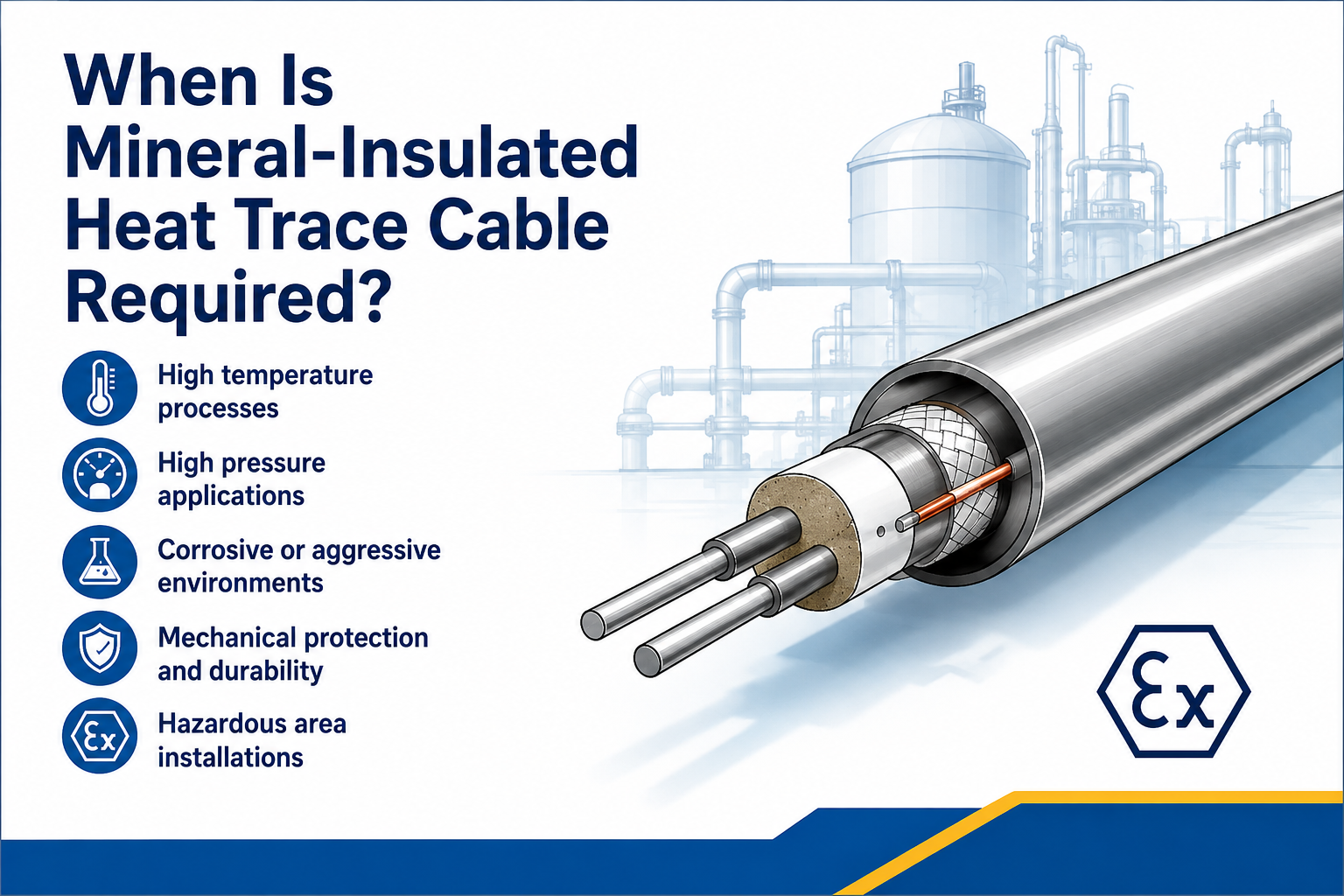
When Is Mineral-Insulated Heat Trace Cable Required?
Published 25 Aug 2026
High-Temperature and Demanding Electrical Heat Tracing Applications
Quick Navigation
How MI Cable Is Constructed
High-Temperature Duties
High Output & Heat-Up Duties
Long Circuits & Engineered Resistance
Harsh Industrial Environments
Hazardous-Area Applications
MI vs Other Cable Technologies
When MI Cable May Not Be Required
Design & Installation Considerations
MI Cable Selection Checklist
Frequently Asked Questions
MI Cable Design Support
When Is Mineral-Insulated Heat Trace Cable Required?
Mineral-insulated heat trace cable is generally considered when the required temperature, power output, circuit length or operating environment exceeds the practical capability of polymeric self-regulating or constant wattage cables.
To understand where MI fits within the wider technology range, see the guide to electrical trace heating technologies. This article focuses specifically on the selection conditions that justify an MI system.
MI cable is commonly considered for:
- High maintain or exposure temperatures
- High power-density and controlled heat-up duties
- Long engineered circuits
- Severe chemical, mechanical or environmental exposure
- Pipelines, vessels and equipment in demanding process plants
- Hazardous-area systems requiring a suitable certified assembly
How Is Mineral-Insulated Heating Cable Constructed?
A mineral-insulated heater uses a metallic resistance conductor electrically insulated from a metal sheath by compacted mineral insulation, commonly magnesium oxide. The metal sheath provides mechanical and environmental protection while the conductor generates heat when current flows.
MI trace heaters may be supplied in single- or twin-conductor configurations and normally include engineered cold leads, joints and end terminations. The heating section is designed for the required resistance, voltage, length and output rather than cut freely from a reel on site.
1. High Maintain or Exposure Temperatures
MI cable is frequently selected where the operating or exposure temperature is above the rating of suitable polymeric heating cables.
- High-temperature chemical and petrochemical lines
- Hot process transfer pipework
- Steam-cleaned or steam-purged equipment
- Bitumen, sulphur and heavy-product lines
- Vessels, reactors and process equipment
- Applications exposed to high temperatures while the heater is de-energised
Check Two Temperature Limits
The required maintain temperature and the maximum exposure temperature are different design values. Cable, joints, cold leads and terminations must all remain suitable for the highest credible operating, cleaning, upset or shutdown condition.
2. High Output and Controlled Heat-Up Duties
A system that must raise the temperature of a cold pipe, vessel or process product within a defined period can require substantially more power than a steady-state maintenance duty.
The starting point is an accurate heat-loss and heat-up assessment. MI cable may then be selected where a high engineered output is required and the equipment can safely accept the resulting sheath temperature.
High-output design must consider:
- Steady-state heat loss
- Initial and final temperatures
- Product mass and specific heat capacity
- Required heat-up time
- Maximum permissible surface and sheath temperatures
- Cable spacing and heat distribution
- Temperature control and independent limiting
3. Long Circuits and Engineered Resistance
MI heating cable is a series-resistance heater. Its resistance, length, conductor material and supply voltage are selected together to produce the required output.
This engineered approach can be useful for long pipe runs or duties where parallel-circuit cable limits would require multiple shorter circuits. However, a long MI circuit is not automatically the best solution; voltage, output distribution, cold leads, power supplies and control architecture must all be assessed.
4. Harsh Industrial Environments
The metal sheath and mineral insulation can provide strong resistance to heat, fire and mechanical damage. Different sheath alloys are available for different corrosive environments.
| Environmental Requirement | Why MI May Be Considered |
|---|---|
| High ambient or process heat | Metal and mineral construction can tolerate temperatures beyond many polymeric cables |
| Mechanical exposure | Metal sheath provides robust protection, subject to routing and bend-radius limits |
| Chemical or corrosive atmosphere | A suitable sheath alloy can be selected for the environment |
| Fire resistance | Inorganic insulation and metal construction offer strong high-temperature stability |
| Outdoor or offshore service | Engineered sheath, joints and terminations can suit severe environments |
| High-pressure or critical process plant | Factory-engineered assemblies provide controlled resistance and documented construction |
Sheath selection must be based on the actual chemical exposure. No single metal alloy is universally resistant to every acid, chloride, sulphur compound or process contaminant.
5. Mineral-Insulated Trace Heating in Hazardous Areas
MI heaters are available as certified systems for explosive atmospheres, but the complete assembly must be selected and installed for the area classification.
- Area classification and equipment protection level
- Gas or dust group
- Temperature class or maximum surface temperature
- Stabilised design or controlled design method
- Approved joints, cold leads, glands and enclosures
- Controller and independent temperature limiter requirements
- Ambient, maintain and exposure temperatures
View the ATEX trace heating range and obtain technical confirmation for the proposed MI assembly.
MI Cable Compared with Self-Regulating and Constant Wattage Cable
| Selection Factor | Mineral-Insulated | Self-Regulating | Constant Wattage / Resistance |
|---|---|---|---|
| Typical reason for selection | High temperature, high output, long engineered circuit or severe environment | Variable-temperature response and convenient field installation | Defined output and controlled process heating |
| Construction | Metal conductor, mineral insulation and metal sheath | Parallel bus wires with conductive polymer core | Parallel heating zones or series resistance conductor |
| Field cutting | Normally supplied as an engineered heater unit | Usually cut to length within product limits | Depends on parallel-zone intervals or engineered series length |
| Local output response | No self-regulating response | Output changes locally with temperature | Defined output when energised |
| Temperature control | Engineered controller and often limiter required | May still require controller or limiter | Normally requires suitable control |
| Installation skill | Specialist handling, termination and testing | Commonly field terminated with approved kits | Depends on cable construction and system design |
For a detailed comparison of the two common polymeric cable types, see self-regulating vs constant wattage trace heating.
When May MI Cable Not Be Required?
MI cable should not be specified simply because it is the most robust or highest-temperature technology available.
- Low-temperature frost protection may be served more simply by self-regulating cable
- A standard process-maintenance duty may fall comfortably within a polymeric cable range
- Complex valves and fittings may be easier to trace with a flexible parallel cable
- Projects requiring simple cut-to-length field installation may favour self-regulating or parallel-zone cable
- High output may be unnecessary when insulation can be improved
- The pipe or product may not tolerate the surface temperature associated with a high-output MI design
Select the Lowest Suitable Technology
The preferred cable is the one that meets the thermal, electrical, environmental and certification requirements with appropriate control—not automatically the cable with the highest temperature or output rating.
MI Trace Heating Design and Installation Considerations
- Calculate the duty: establish steady-state heat loss and any heat-up requirement.
- Confirm temperatures: maintain, maximum exposure, ambient and permitted sheath temperatures.
- Select sheath material: match the alloy to the chemical and mechanical environment.
- Design resistance and length: coordinate voltage, conductor resistance, cable length and output.
- Plan cold leads and joints: position transitions and enclosures within their temperature limits.
- Specify control and limiting: use sensors, controllers and independent limiters where required.
- Check installation geometry: bend radius, spacing, attachment and heat distribution are critical.
- Test throughout installation: complete the specified resistance and insulation checks before and after insulation.
- Document the heater: retain factory data, circuit drawings, settings and commissioning readings.
Mineral-Insulated Heat Trace Cable Selection Checklist
Provide these details for design:
- Pipe, vessel or equipment dimensions and material
- Required maintain temperature
- Minimum ambient temperature
- Maximum operating, cleaning and upset temperature
- Insulation material and thickness
- Required heat-up time, where applicable
- Available voltage and power-supply arrangement
- Required circuit length
- Chemical, corrosion and mechanical exposure
- Safe-area or hazardous-area classification
- Control, alarm and temperature-limiting requirements
- Preferred junction-box and cold-lead locations
Explore the available mineral-insulated trace heating cables and engineered systems.
Mineral-Insulated Heat Trace Cable FAQs
Is MI Cable Only Used for Very High Temperatures?
No. High temperature is a common reason for selecting MI, but high output, long engineered circuits, fire resistance, mechanical strength and chemical resistance can also influence the decision.
Can Mineral-Insulated Heating Cable Be Cut to Length on Site?
MI heaters are normally designed and manufactured to a specific resistance, length, voltage and output. They should not be treated as bulk cut-to-length parallel cable.
Does MI Cable Require a Thermostat?
A suitable controller is normally required, and an independent temperature limiter may also be necessary where maximum sheath or surface temperature must be controlled. The exact arrangement comes from the system design.
Can MI Heating Cable Be Used in Hazardous Areas?
Yes, certified MI heater systems are available. The complete assembly, controls, terminations and installation must match the area classification and certification conditions.
Is MI Cable More Durable Than Polymeric Heating Cable?
Its metal sheath and inorganic insulation can provide excellent heat, fire and mechanical resistance. Durability still depends on choosing the correct sheath alloy, installing it within bend limits and protecting joints and terminations.
When Should Self-Regulating Cable Be Chosen Instead?
Self-regulating cable may be more suitable for lower-temperature frost protection, irregular pipework, changing ambient conditions and projects requiring straightforward cut-to-length installation.
Need an Engineered MI Trace Heating System?
Thorne & Derrick supports mineral-insulated heating cable selection for high-temperature, high-output, long-line and hazardous-area applications.
- Heat-loss and heat-up calculations
- MI heater resistance and circuit design
- Sheath alloy and temperature selection
- Cold leads, joints and terminations
- Controllers and temperature limiters
- ATEX and IECEx system specification