Self-Regulating vs Constant Wattage Trace Heating
Published 11 Aug 2026
Choosing Between Two Common Electrical Heat Tracing Technologies
Quick Navigation
The Key Difference
How Self-Regulating Cable Works
How Constant Wattage Cable Works
Cable Comparison Table
Output & Temperature Control
Installation & Circuit Design
Typical Applications
Energy Use & Maintenance
Hazardous-Area Selection
Which Cable Should Be Selected?
Information Required for Selection
Frequently Asked Questions
Cable Selection Support
Self-Regulating vs Constant Wattage Trace Heating: Overview
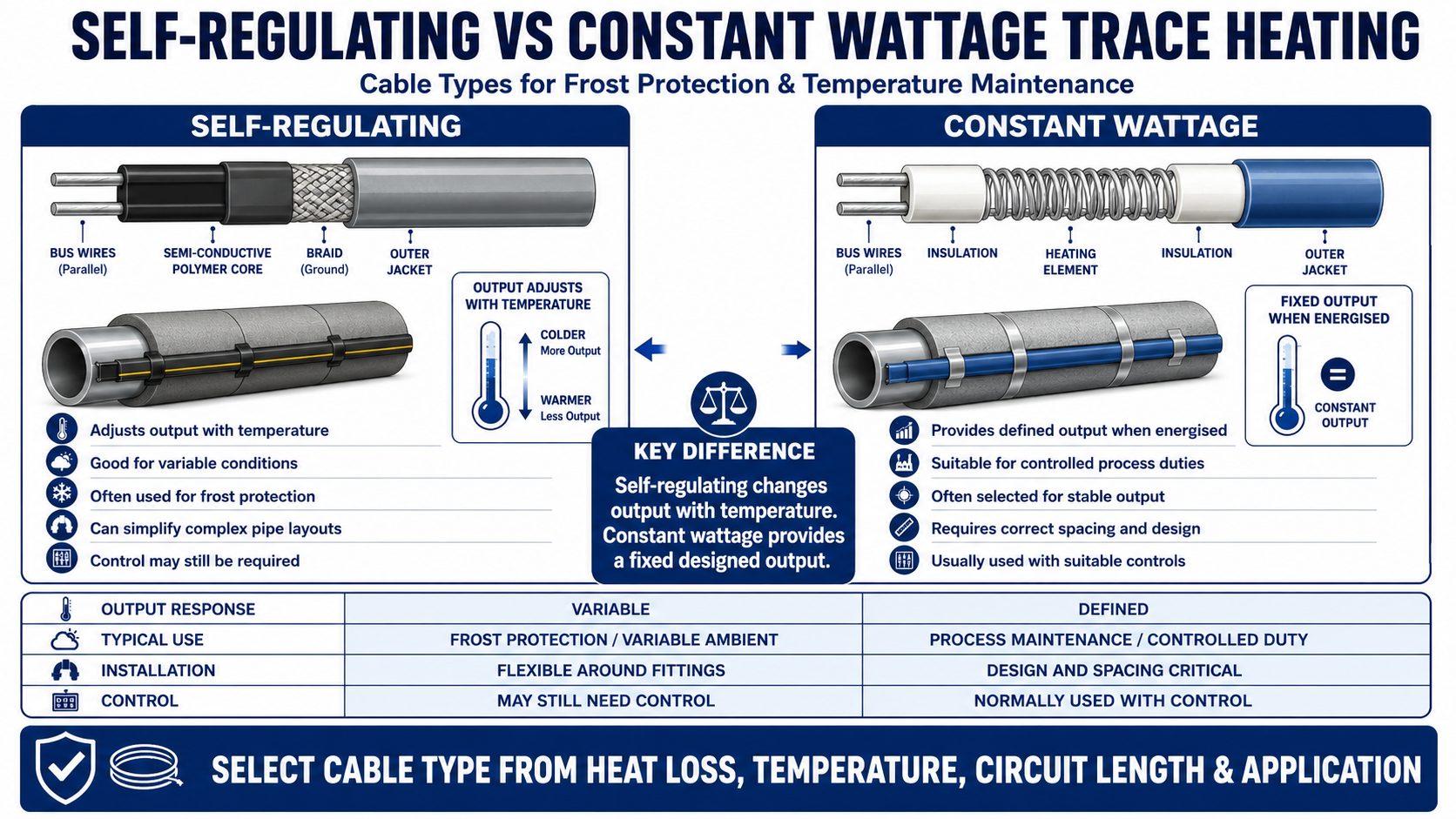
Self-regulating vs constant wattage trace heating is a cable-technology comparison. Both can provide frost protection and process temperature maintenance, but they regulate output differently and have different installation, control and temperature capabilities.
For a broad introduction to the complete system, read how electrical trace heating works. This article concentrates only on the differences that affect cable selection.
The decision should consider:
- Calculated heat loss and required watts per metre
- Maintain and maximum exposure temperatures
- Pipe or equipment material
- Required circuit length and supply voltage
- Need for precise temperature control
- Likelihood of cable crossing or complex fittings
- Safe-area or hazardous-area classification
- Energy, maintenance and lifecycle requirements
What Is the Key Difference?
| Cable Type | How Output Behaves |
|---|---|
| Self-regulating | Electrical resistance within the conductive core changes locally with temperature, so heat output increases as the cable cools and decreases as it warms. |
| Constant wattage | The heating circuit provides a defined output when energised. Temperature is managed through system design and suitable control equipment rather than local self-regulation. |
Important Distinction
Self-regulating does not mean that every system can operate without a thermostat, controller or limiter. Control may still be required for process accuracy, energy management, alarms, equipment protection or hazardous-area temperature classification.
How Does Self-Regulating Trace Heating Cable Work?
A self-regulating cable normally contains two parallel bus wires embedded in a conductive polymer heating core. As the local temperature changes, the resistance of the core changes and alters the heat generated at that point along the cable.
- Colder areas of the cable can produce more heat
- Warmer areas reduce their heat output
- The cable can usually be cut to the required length within its product limitations
- Local output response can help with irregular pipework and changing ambient conditions
- Many products permit limited overlap, but only where the manufacturer explicitly allows it
Explore the available self-regulating trace heating cables for safe-area and hazardous-area applications.
How Does Constant Wattage Trace Heating Cable Work?
Constant wattage cables use a resistance heating element to deliver a defined power output while energised. Parallel-zone designs contain repeated heating zones, while series-resistance cables are engineered to a specific circuit resistance and length.
- Output does not automatically reduce locally as the surface warms
- A suitable control method is normally required
- Parallel-zone cable is cut only at the permitted contact or module intervals
- Series-resistance cable output depends on its designed length, resistance and supply voltage
- Cable crossing or overlap is generally prohibited unless specifically approved
View the constant wattage trace heating cable range for process and industrial applications.
Self-Regulating and Constant Wattage Cable Comparison
| Selection Factor | Self-Regulating Cable | Constant Wattage Cable |
|---|---|---|
| Output response | Varies locally with cable temperature | Defined output while energised |
| Cut-to-length | Usually cut to length within maximum circuit limits | Parallel-zone types cut at contact intervals; series types are engineered lengths |
| Overlap | Some products permit overlap subject to instructions | Normally must not touch, cross or overlap unless specifically approved |
| Temperature control | May still require control depending on duty | Normally requires suitable thermostatic or electronic control |
| Complex fittings | Often convenient around valves, flanges and irregular surfaces | Requires careful spacing and routing to prevent local overheating |
| Energy behaviour | Output reduces as the cable warms | Energy use is governed mainly by output, operating time and control strategy |
| Temperature capability | Available across low, medium and some high-temperature duties | Available for wider specialist or higher-temperature duties depending on construction |
| Circuit design | Maximum circuit length affected by cable, voltage, start-up temperature and protection | Affected by cable construction, zone spacing, resistance, voltage and control |
| Typical selection reason | Variable ambient conditions, simple field installation and frost protection | Stable output, specific process duty or temperature range |
Heat Output and Temperature Control
Neither technology should be selected from its nominal watts-per-metre rating alone. The required output should first be established through a trace heating heat loss calculation.
For self-regulating cable, confirm the output available at the required maintain temperature using the manufacturer’s power-output curves or design software. The nominal output may be stated at a different reference temperature.
For constant wattage cable, confirm that the fixed output and control arrangement can maintain the required temperature without exceeding the pipe, product, cable or area-classification limits.
Control Options
- Ambient-sensing thermostat for basic frost-protection groups
- Pipe-sensing thermostat for direct temperature maintenance
- Electronic controller for improved accuracy, alarms and monitoring
- Independent temperature limiter where a maximum surface temperature must not be exceeded
- Multi-circuit control panel for larger industrial systems
Installation and Circuit Design Differences
Installation convenience depends on the cable construction, pipework layout and approved accessory system.
| Design Point | Self-Regulating | Constant Wattage |
|---|---|---|
| Valves and flanges | Flexible routing and permitted overlap may simplify allowances | Spacing and contact must be carefully controlled |
| Branching | Approved splice and tee components are used where permitted | Must follow the cable’s zone or circuit design |
| Long circuits | Maximum length can be limited by start-up current | Parallel or series designs may suit different long-line duties |
| Termination | Field termination kits are commonly available | Termination depends on parallel-zone or engineered series construction |
| Protection | Circuit-breaker and earth-fault selection must consider start-up behaviour | Protection must match designed current, output and control method |
| Repair | Approved field repair systems may be available | Repairability depends strongly on the cable construction |
Installation should follow the cable-specific instructions and the existing trace heating installation guide.
Typical Applications for Each Cable Type
Self-Regulating Cable Is Often Considered For
- Water-pipe frost protection
- Plant winterisation
- Hot-water temperature maintenance
- Process lines with changing ambient conditions
- Valves, pumps and complex fittings
- Projects requiring cable to be cut from a reel on site
Constant Wattage Cable Is Often Considered For
- Processes requiring defined, uniform heating output
- Higher temperature-maintenance duties
- Longer industrial pipe circuits where a suitable design is available
- Tanks, vessels, silos and specialist equipment
- Applications using detailed thermostatic or electronic control
- Projects where cable construction and chemical resistance match a demanding environment
These are general patterns rather than automatic choices. The correct technology depends on the calculated duty and the performance limits of the individual cable.
Energy Use, Reliability and Maintenance
Self-regulating cable can reduce local output as temperatures rise, but total energy use still depends on cable output, circuit length, insulation, control strategy and operating time.
A constant wattage system can also operate efficiently when correctly sized and controlled. Oversizing either technology or operating it continuously when heat is not required can increase energy consumption.
Lifecycle considerations:
- Quality and condition of thermal insulation
- Accessibility of power connections and terminations
- Availability of compatible replacement components
- Controller accuracy and alarm capability
- Exposure to chemicals, moisture and mechanical damage
- Required inspection and maintenance intervals
Self-Regulating and Constant Wattage Cables in Hazardous Areas
Both technologies may be available as certified systems for explosive atmospheres. Selection must address more than the cable certificate.
- Area classification and equipment protection level
- Gas or dust group
- Temperature class or maximum surface temperature
- Ambient and exposure temperature range
- Approved power connections, terminations, splices and junction boxes
- Control and limiting method
- Installation, inspection and maintenance requirements
See the dedicated ATEX trace heating range for certified cables, controls and components.
Which Trace Heating Cable Should Be Selected?
| Application Characteristic | Technology Commonly Considered |
|---|---|
| Low-temperature frost protection with variable ambient conditions | Self-regulating |
| Complex pipe fittings and field cut-to-length installation | Self-regulating |
| Defined process output with active temperature control | Constant wattage |
| Higher temperature or specialist industrial duty | Constant wattage or mineral-insulated, subject to design |
| Very high temperature, high output or severe mechanical environment | Mineral-insulated may be required |
| Long pipeline | Cable technology should be selected from heat loss, voltage, circuit length and control requirements |
The table is a starting point only. Product data, design software and technical review are required before final specification.
Information Required Before Comparing Cable Types
Provide the following design data:
- Frost protection or process temperature-maintenance duty
- Required maintain and maximum exposure temperatures
- Minimum ambient temperature
- Pipe diameter, material and length
- Insulation material and thickness
- Valves, flanges, pumps and other local heat sinks
- Available voltage and preferred circuit arrangement
- Safe-area or hazardous-area classification
- Required control, alarm and monitoring functions
- Environmental, chemical and mechanical exposure
Self-Regulating vs Constant Wattage Trace Heating FAQs
Is Self-Regulating Cable Always More Energy Efficient?
It can reduce its local output as temperature rises, but total system efficiency also depends on correct sizing, insulation, control, circuit length and operating time. A correctly designed constant wattage system can also be efficient.
Does Self-Regulating Mean No Thermostat Is Required?
No. A thermostat, controller or limiter may still be required for process accuracy, energy management, alarms, equipment protection or hazardous-area temperature control.
Can Constant Wattage Cable Be Cut to Any Length?
Not always. Parallel-zone cable is cut at defined contact intervals, while series-resistance cable is designed to a specific length and resistance. Follow the individual product instructions.
Can Trace Heating Cable Be Overlapped?
Some self-regulating products allow overlap within their stated limits. Constant wattage and series-resistance cables generally must not touch or overlap unless the manufacturer explicitly approves it.
Which Cable Is Better for Frost Protection?
Self-regulating cable is commonly selected because it responds to local temperature and can be convenient to install. The final choice still depends on heat loss, pipe material, circuit length, environment and approvals.
Which Cable Is Better for High-Temperature Process Heating?
Constant wattage, series-resistance or mineral-insulated cable may offer suitable temperature capability, but the selection depends on maintain temperature, exposure temperature, output, circuit length and environment.
Need Help Comparing Trace Heating Cable Types?
Thorne & Derrick provides heat-loss calculation, cable selection and complete electrical heat tracing system support for frost protection, process maintenance and hazardous areas.
- Self-regulating cable selection
- Constant wattage and resistance cable selection
- Heat-loss calculations and circuit design
- Controls, sensors and temperature limiters
- Safe-area and ATEX component specification
- Complete bills of materials