Frost Protection vs Process Temperature Maintenance
Published 13 Oct 2026
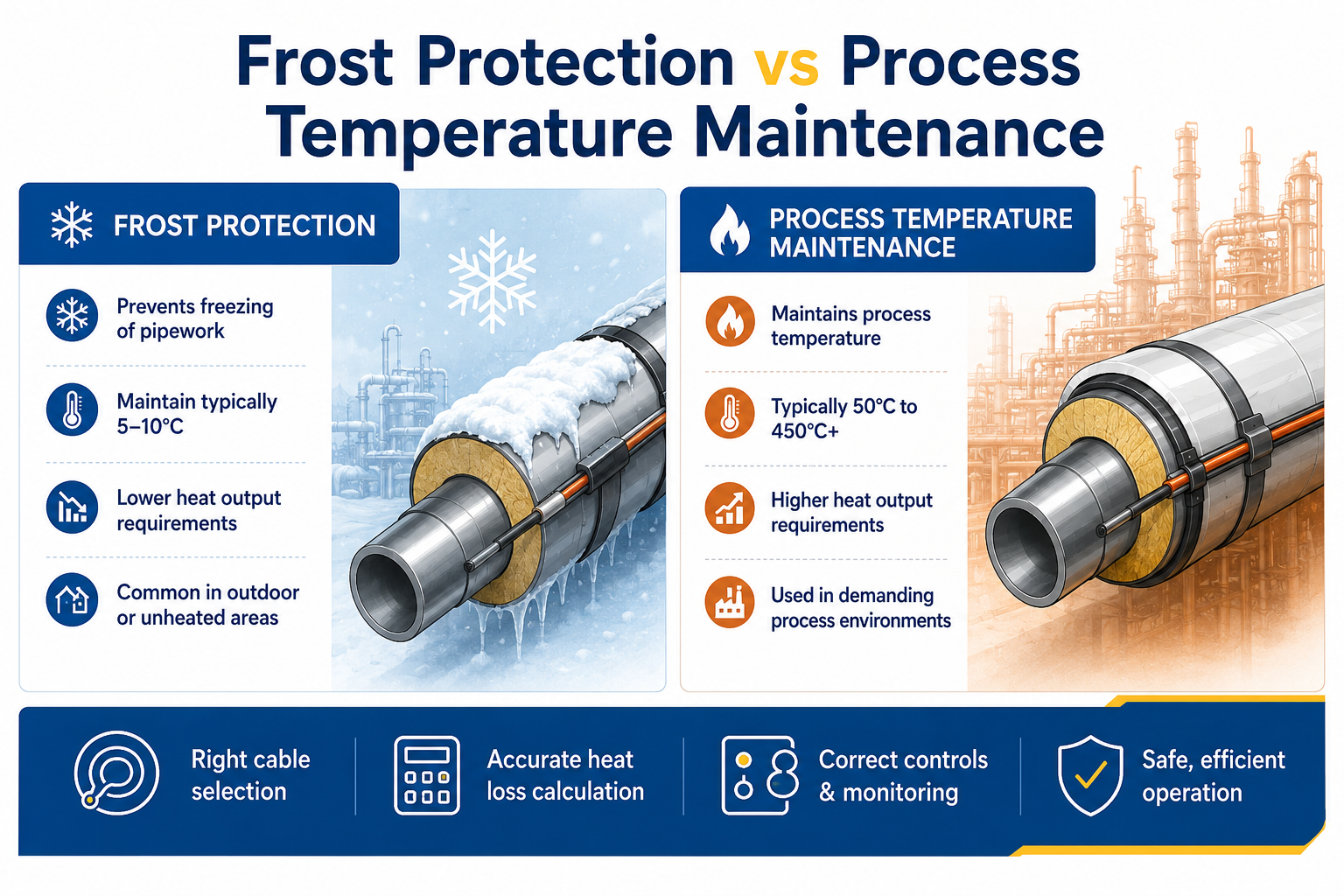
Two Different Electrical Heat Tracing Duties Explained
Quick Navigation
The Key Difference
Frost vs Process Comparison Table
Frost Protection Design
Process Temperature Maintenance Design
Maintain Temperature & Heat Loss
Cable Technology Selection
Control & Monitoring
Insulation & Weatherproofing
Typical Applications
Consequences of Failure
Winterisation Programmes
Combined & Changing Duties
Design Information Checklist
Frequently Asked Questions
System Design Support
Frost Protection vs Process Temperature Maintenance: Overview
Frost protection vs process temperature maintenance describes two different electrical heat tracing duties. Frost protection prevents freezing during low ambient conditions, while process maintenance holds a product or equipment surface within a temperature range needed for flow, quality or production.
Both duties use the same wider principles described in the guide to electrical trace heating systems, but they should not be designed from the same assumptions.
- Frost protection: what minimum temperature prevents freezing or cold-weather damage?
- Process maintenance: what temperature preserves the required viscosity, phase, flow or process condition?
What Is the Key Difference?
| Duty | Primary Objective | Typical Temperature Basis |
|---|---|---|
| Frost protection | Prevent water or process material freezing during the minimum ambient condition | A protective maintain temperature above the verified freezing point |
| Process temperature maintenance | Keep product or equipment within the temperature range required for operation | A process-defined maintain temperature based on viscosity, crystallisation, reaction or quality |
Do Not Use One Setpoint for Every Line
Different fluids, concentrations, pipe sizes and process duties can require different maintain temperatures. The correct value should come from the process or project requirement, not a generic frost-protection setting.
Frost Protection and Process Maintenance Compared
| Design Factor | Frost Protection | Process Temperature Maintenance |
|---|---|---|
| Main risk | Freezing, burst pipework, blocked lines and winter damage | Viscosity increase, crystallisation, solidification, poor flow or process instability |
| Maintain temperature | Usually relatively low but product-specific | Can range from modest to high depending on the process |
| Operating pattern | Often seasonal or ambient-controlled | May operate continuously with production |
| Control method | Ambient or pipe sensing may be suitable | Pipe or product sensing with closer control is often required |
| Cable technology | Self-regulating frequently considered | Self-regulating, constant wattage, series or MI depending on temperature and output |
| Monitoring | Useful for critical winterisation circuits | Often important for product quality and production continuity |
| Heat-up requirement | Usually maintenance rather than deliberate warm-up | May include start-up heat-up as a separate duty |
| Failure consequence | Cold-weather damage and service interruption | Lost production, damaged product, blocked process and safety risk |
Designing Trace Heating for Frost Protection
Frost protection compensates for heat lost from pipework or equipment when the surrounding temperature falls.
- Confirm the actual freezing point of the fluid or mixture
- Set a maintain temperature with an appropriate project margin
- Use the minimum site design ambient temperature
- Include outdoor wind and weather exposure
- Account for pipe diameter, material and insulation
- Include valves, flanges, supports and stagnant branches
- Identify lines that drain, stop flowing or remain out of service
- Plan seasonal testing before cold weather
View the dedicated trace heating for winterisation range for exposed industrial and hazardous-area plant.
Designing Trace Heating for Process Temperature Maintenance
Process temperature maintenance preserves the physical or operating condition required by the process.
- Minimum pumpable viscosity
- Crystallisation or solidification temperature
- Required transfer or filling temperature
- Product quality or consistency
- Reaction or separation process conditions
- Condensation prevention
- Instrument and sampling-line performance
The process engineer or product owner should confirm the acceptable operating range, maximum product temperature and consequences of local overheating.
Maintain Temperature, Minimum Ambient and Heat Loss
Both duties require a trace heating heat loss calculation. The difference is the maintain-temperature basis and often the consequence of failing to hold it.
| Input | Frost Protection | Process Maintenance |
|---|---|---|
| Required maintain temperature | Set above the verified freezing point | Set by process, viscosity, phase or product requirement |
| Minimum ambient temperature | Critical cold-weather design condition | Still required to establish maximum heat loss |
| Maximum process temperature | Checks cable exposure during normal operation or cleaning | Critical for cable, control and product protection |
| Heat-up time | Usually not central unless thawing is required | May require a separate transient heat-up calculation |
| Design margin | Protects against credible environmental and installation variation | Must not create product overheating or excessive sheath temperature |
Selecting Cable Technology for Each Duty
Frost Protection
Self-regulating cable is frequently selected because its output responds locally to temperature and it can be convenient around irregular pipework. Constant wattage cable may also be suitable where the design and controls support it.
Process Temperature Maintenance
The technology range is broader because temperatures, outputs and circuit lengths vary. Self-regulating, constant wattage, series-resistance and mineral-insulated cables may all be appropriate.
Use the structured guide on how to select heat trace cable to compare the duty against cable output, temperature and circuit limits.
Control and Monitoring Differences
| Control Feature | Frost Protection | Process Maintenance |
|---|---|---|
| Ambient thermostat | Can control groups of similar frost-protection circuits | Usually insufficient where exact process temperature matters |
| Pipe sensor | Useful where direct pipe-temperature control is needed | Common for maintaining a defined surface temperature |
| Electronic controller | Supports alarms, monitoring and energy management | Supports closer control, alarms, logging and communications |
| Temperature limiter | May be required for equipment or hazardous-area protection | Important where high output or product sensitivity creates an overtemperature risk |
| End-of-line monitoring | Helps identify loss of power before severe cold | Supports visibility of critical process circuits |
See available trace heating temperature controllers, limiters and end-of-line monitoring devices.
Thermal Insulation and Weatherproofing
Both duties rely on thermal insulation to reduce heat loss. Process-maintenance systems may require insulation suited to higher continuous temperatures, while outdoor frost-protection systems require reliable weatherproofing.
- Confirm insulation material and thickness
- Protect insulation from water ingress
- Use removable jackets around maintained valves and instruments
- Seal cable and sensor penetrations through cladding
- Inspect insulation after maintenance or plant modification
- Recalculate the duty if the insulation specification changes
Typical Applications
| Frost Protection Applications | Process Temperature-Maintenance Applications |
|---|---|
| Potable, service and fire-water pipes | Oil, fuel and lubricant lines |
| Drains and condensate lines | Resins, adhesives and polymer lines |
| Safety showers and eyewash units | Bitumen, wax and heavy-product transfer |
| Valves, instruments and small-bore tubing | Chemical dosing and sampling lines |
| Outdoor tanks and vessels | Food, chocolate, fats and edible-oil lines |
| Roof, gutter and ramp systems | Analytical and emissions-monitoring lines |
| Winterised offshore and process plant | Process vessels, hoppers and silos |
How Do the Consequences of Failure Differ?
Frost-Protection Failure
- Frozen or burst pipework
- Blocked drains or instruments
- Unavailable fire-water or safety systems
- Plant damage and winter shutdown
- Loss of utilities and difficult emergency repairs
Process-Maintenance Failure
- Product thickening, crystallisation or solidification
- Loss of flow or pumpability
- Off-specification product
- Blocked production or transfer lines
- Extended cleaning, thawing or plant downtime
- Potential process or safety consequences
The consequence of failure should influence redundancy, alarms, maintenance intervals and monitoring—not only cable wattage.
Frost Protection as Part of a Winterisation Programme
Plant winterisation is wider than installing heating cable. It should identify critical exposed systems, verify insulation, test circuits and define responsibility for alarms and maintenance.
- List critical water, fire, instrument and process lines
- Verify minimum ambient and wind design conditions
- Inspect cable, controls, insulation and cladding
- Test circuits before winter
- Review generator or emergency-power requirements
- Confirm alarm response and spare-component availability
- Record cold-weather failures and improve the design
A structured trace heating testing and maintenance programme should be completed before the seasonal risk period.
Can One System Provide Both Frost Protection and Process Maintenance?
A system may protect against freezing during shutdown and maintain a higher process temperature during operation, but the control and cable design must address both conditions.
- Confirm separate normal-operation and shutdown temperature requirements
- Check cable output across the full temperature range
- Assess cold start-up current and heat-up time
- Avoid overheating during empty-pipe or no-flow conditions
- Use control modes or setpoints authorised by the process design
- Confirm maximum exposure during steam cleaning or process upset
Thawing Is a Separate Duty
A cable designed only to prevent freezing may not have enough power to thaw a fully frozen line safely or within an acceptable time. Do not assume frost protection is also a thawing system.
Information Required for Either Duty
- Frost protection, process maintenance or combined duty
- Fluid or product and its critical temperatures
- Required maintain temperature
- Minimum ambient temperature
- Maximum operating and exposure temperatures
- Pipe or equipment dimensions and material
- Insulation type and thickness
- Valves, flanges and local heat sinks
- Available voltage and circuit arrangement
- Required control, alarm and monitoring functions
- Safe-area or hazardous-area classification
- Required heat-up time, if any
Frost Protection vs Process Temperature Maintenance FAQs
Is Frost Protection the Same as Temperature Maintenance?
Frost protection is a form of temperature maintenance, but its objective is specifically to prevent freezing. Process maintenance holds a product at a temperature required for flow, quality or production.
What Temperature Should Be Used for Frost Protection?
The design temperature should be based on the actual freezing point of the fluid or mixture and an appropriate project margin. It should not be copied from another application without verification.
Does Process Temperature Maintenance Also Heat a Cold Product?
Not necessarily. A steady-state system may maintain temperature but provide a slow heat-up. A defined warm-up time requires a separate transient heat-up calculation.
Which Cable Is Best for Frost Protection?
Self-regulating cable is commonly considered, but the correct product depends on heat loss, pipe material, insulation, circuit length, voltage and location.
Which Cable Is Best for Process Temperature Maintenance?
Any of the main cable technologies may be suitable. Maintain and exposure temperatures, output, circuit length, control accuracy and environmental conditions determine the selection.
Can an Ambient Thermostat Control a Process-Maintenance Circuit?
Ambient sensing may not accurately represent the process temperature. Pipe or product sensing and a suitable electronic controller are often required where close process control matters.
Need Frost Protection or Process Temperature-Maintenance Support?
Thorne & Derrick designs and supplies electrical heat tracing systems for plant winterisation, frost protection, process temperature maintenance and hazardous areas.
- Heat-loss and duty assessment
- Frost-protection system specification
- Process-maintenance cable selection
- Controls, sensors, alarms and monitoring
- Winterisation system review
- Safe-area and ATEX component supply