Explosion Proof Equipment Explained: ATEX, IECEx, Ex d & Ex e
Published 13 Nov 2026
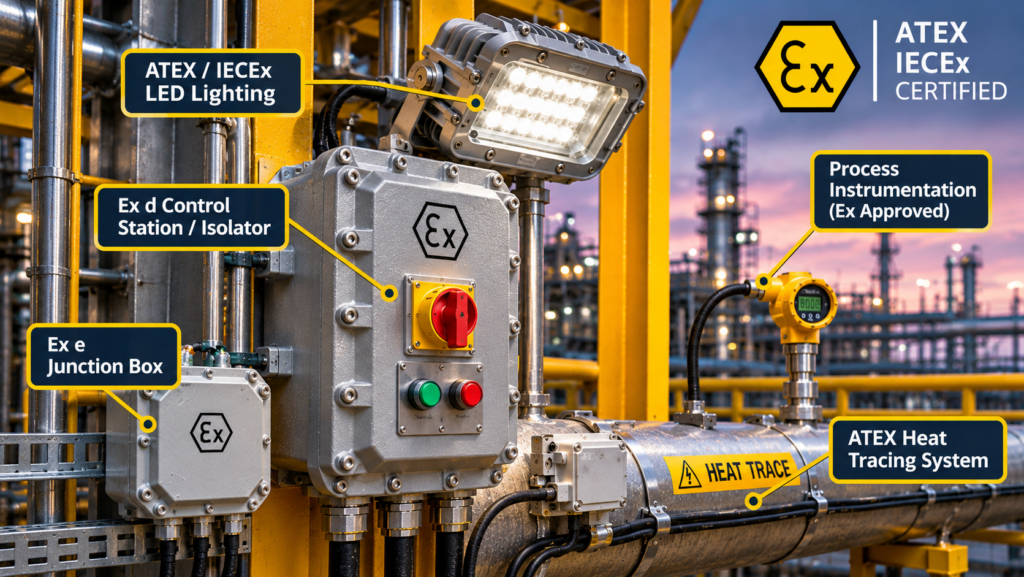
Explosion proof equipment helps prevent ignition in potentially explosive atmospheres. It controls electrical or mechanical ignition sources through a suitable protection method. These environments may contain flammable gases, vapours, mists or combustible dusts.
Industries such as oil and gas, petrochemical processing and pharmaceutical manufacturing use explosion-protected equipment. Common examples include hazardous area lighting, junction boxes, isolators, plugs, sockets, control stations, heaters and ventilation fans.
However, not all equipment certified for explosive atmospheres uses the same protection method. For example, Ex d flameproof equipment contains an internal explosion. By comparison, Ex e increased safety reduces the likelihood of ignition sources developing.
Other protection methods include Ex i intrinsic safety and Ex p pressurisation. Each works differently and has specific certification requirements.
Equipment intended for hazardous areas may require ATEX, IECEx or other applicable certification. In addition, selection depends on the hazardous area zone, gas or dust group, temperature classification and Equipment Protection Level (EPL).
Thorne & Derrick supply explosion-protected electrical, heating, ventilation and process equipment for UK and international projects.
This guide explains the main protection methods, certification requirements and equipment markings. It also covers hazardous area zones, product selection and common specification mistakes.
Quick Navigation – Explosion Proof Equipment Guide
- What Is Explosion Proof Equipment?
- How Does Explosion Proof Equipment Work?
- Explosion Proof vs Flameproof vs ATEX
- Ex d, Ex e, Ex i, Ex p and Ex m Explained
- ATEX vs IECEx Certification
- Hazardous Area Zones
- Types of Explosion Proof Equipment
- Equipment Markings Explained
- Temperature Classes and Gas Groups
- How to Select Explosion Proof Equipment
- Common Specification Mistakes
- Inspection and Maintenance
- Frequently Asked Questions
- Conclusion
What Is Explosion Proof Equipment?
Explosion proof equipment uses a recognised protection method to prevent ignition of a specified explosive atmosphere. Its design and certification must suit the hazardous conditions in which it operates.
Potentially explosive atmospheres can develop when flammable gases, vapours or mists mix with air. Similarly, suspended combustible dust may create an explosion risk under certain conditions.
Electrical sparks, arcs, hot surfaces and electrostatic discharges can act as ignition sources. Meanwhile, mechanical equipment may generate ignition hazards through friction, impact or overheating.
Therefore, manufacturers use specific design and construction measures to control these risks.
Explosion Proof Equipment – Quick Summary
| Question | Explanation |
|---|---|
| What is it? | Equipment that uses a suitable protection method to prevent ignition of a specified explosive atmosphere. |
| Where is it used? | Hazardous areas in industrial, chemical, petrochemical and other facilities. |
| Protection methods | Ex d, Ex e, Ex i, Ex p, Ex m, Ex t and other recognised methods. |
| Certification | ATEX, IECEx, relevant UK conformity requirements or other national approvals. |
| Hazardous zones | Gas Zones 0, 1 and 2, and dust Zones 20, 21 and 22. |
| Equipment types | Lighting, junction boxes, heaters, fans, isolators, plugs, sockets and instrumentation. |
Important: Explosion proof does not mean equipment is indestructible. It also does not mean that every product can withstand any explosion. Protection depends on the certified design, ratings and conditions of use.
How Does Explosion Proof Equipment Work?
Explosion-protected equipment manages ignition risks using different engineering methods. The correct approach depends on the equipment and surrounding explosive atmosphere.
Main Explosion Protection Principles
Common protection principles include:
- Explosion containment: Preventing an internal explosion from igniting the surrounding atmosphere.
- Ignition prevention: Reducing the likelihood of electrical arcs, sparks or excessive temperatures.
- Energy limitation: Restricting electrical and thermal energy under specified conditions.
- Separation: Preventing the surrounding explosive atmosphere from contacting potential ignition sources.
- Pressurisation: Using protective gas to prevent an explosive atmosphere entering an enclosure.
- Encapsulation: Protecting ignition-capable components using a suitable certified compound.
Although these methods have the same general objective, they use different construction and testing requirements. Therefore, they are not automatically interchangeable.
Example – Explosion Proof Junction Box
A certified hazardous area junction box provides an enclosure for electrical connections. Depending on its design, it may use Ex d flameproof, Ex e increased safety or another approved protection method.
However, the enclosure alone does not determine whether the installation is suitable. The terminals, cable glands, stopping plugs and other components must also meet the relevant requirements.
Example – Explosion Proof Electric Heater
An ATEX or IECEx hazardous area heater must control potential ignition risks from electrical components and hot surfaces.
For example, the heater’s temperature classification must suit the hazardous atmosphere. In addition, the heating duty, ambient temperature and process conditions must remain within the approved limits.
Therefore, certification alone does not confirm suitability for every heating application.
Explosion Proof vs Flameproof vs ATEX – What’s the Difference?
The terms explosion proof, flameproof and ATEX certified often appear together. However, they have different technical meanings.
What Does Explosion Proof Mean?
Explosion proof is a commonly used term for equipment intended to reduce ignition risks in potentially explosive atmospheres.
However, North American hazardous location standards can use the term “explosionproof” more specifically when describing particular enclosure designs.
What Is Flameproof Equipment?
Ex d flameproof equipment uses an enclosure designed to contain an internal explosion. It also prevents the explosion from igniting the surrounding atmosphere through flame transmission.
For example, flamepaths and enclosure joints form important parts of the protection system.
What Is ATEX Certified Equipment?
ATEX refers to European requirements covering equipment and protective systems intended for potentially explosive atmospheres.
ATEX equipment may use several recognised protection methods. Therefore, an ATEX-certified product does not necessarily use Ex d flameproof protection.
Explosion Protection Terminology Compared
| Term | Meaning | Important Distinction |
|---|---|---|
| Explosion Proof | Common description of equipment intended to prevent ignition in explosive atmospheres. | The exact meaning depends on certification and market terminology. |
| Flameproof – Ex d | A defined enclosure protection method. | Contains an internal explosion and prevents external flame transmission. |
| Increased Safety – Ex e | A method that reduces the likelihood of ignition sources. | Does not rely on containing an internal explosion like Ex d. |
| ATEX | European regulatory framework. | Covers several recognised explosion protection methods. |
| IECEx | International conformity assessment system. | Does not automatically replace every national approval requirement. |
When specifying equipment, use the complete Ex marking and certification information. This is more reliable than relying on the term “explosion proof” alone.
Ex d, Ex e, Ex i, Ex p and Ex m – Protection Methods Explained
Hazardous area equipment can use several recognised protection methods. Each controls ignition risks in a different way.
Therefore, the correct method depends on the equipment function, hazardous atmosphere and required protection level.
Ex d – Flameproof Protection
Ex d uses an enclosure designed to contain an internal explosion and prevent flame transmission to the surrounding atmosphere.
For example, manufacturers use this method for suitable electrical enclosures, switching devices and other equipment containing ignition-capable components.
Ex e – Increased Safety Protection
Ex e uses additional construction measures to reduce the likelihood of ignition sources developing.
In particular, this method is common in suitable terminal enclosures, connection equipment and other certified electrical assemblies.
Ex i – Intrinsic Safety
Ex i limits electrical and thermal energy within specified circuits. As a result, the circuit cannot cause ignition under the relevant certified conditions.
For example, manufacturers frequently use intrinsic safety in measurement and instrumentation systems.
Ex p – Pressurised Equipment
Ex p uses protective gas pressurisation to prevent an explosive atmosphere from reaching ignition sources inside an enclosure.
Applications can include suitable control cabinets, analyser systems and electrical equipment.
Ex m – Encapsulation
Ex m protects ignition-capable components by enclosing them within a suitable certified compound.
For example, encapsulation may protect selected electronic devices and electrical components.
Ex ec – Increased Safety for EPL Gc
Ex ec is an increased safety protection level commonly associated with suitable Zone 2 gas installations.
However, older equipment may use legacy Ex n markings. Therefore, assess these products using their actual certification and applicable installation requirements.
Ex t – Protection by Enclosure for Dust
Ex t uses enclosure protection and temperature limitations to control ignition risks in combustible dust atmospheres.
Consequently, equipment must meet the applicable requirements for dust ingress protection and surface temperature.
Explosion Protection Methods Compared
| Protection Method | How It Works | Example Application |
|---|---|---|
| Ex d | Contains an internal explosion and prevents flame transmission. | Flameproof electrical enclosures. |
| Ex e | Reduces the likelihood of ignition sources. | Certified terminals and connection equipment. |
| Ex i | Limits electrical and thermal energy. | Instrumentation circuits. |
| Ex p | Uses protective gas pressurisation. | Control cabinets and analysers. |
| Ex m | Encapsulates ignition-capable components. | Selected electronic devices. |
| Ex ec | Uses increased safety measures for EPL Gc. | Suitable Zone 2 electrical equipment. |
| Ex t | Controls dust ingress and surface temperature. | Equipment in combustible dust areas. |
Some certified assemblies combine protection methods. Therefore, a complete product may carry several Ex markings.
ATEX vs IECEx Certification – What Is Required?
ATEX and IECEx certification help demonstrate that equipment meets specified explosion protection requirements.
However, they operate under different frameworks. Therefore, the correct approval depends on the installation location and applicable regulations.
ATEX Certification
ATEX covers European requirements for equipment and protective systems intended for potentially explosive atmospheres.
Within the European Union, the principal equipment directive is 2014/34/EU.
Great Britain has its own applicable product regulations. Consequently, manufacturers and suppliers must establish the required conformity assessment, marking and documentation for the relevant market.
IECEx Certification
IECEx is an international conformity assessment system based on applicable IEC standards.
For example, an IECEx certificate can provide evidence that a product has undergone assessment against specified explosion protection requirements.
However, national legislation and installation requirements may still apply.
Can Equipment Have Both ATEX and IECEx Certification?
Yes. Many manufacturers provide products with both ATEX and IECEx approval.
This can support international projects. Nevertheless, specifiers must review the complete certificate scope, equipment markings and any special conditions of use.
Important: IECEx certification does not automatically replace every legally required national conformity assessment or product marking.
Explosion Proof Equipment for Hazardous Area Zones
Hazardous areas are classified according to how often an explosive atmosphere is expected to occur and how long it may remain present.
For gas and vapour atmospheres, the classifications are Zones 0, 1 and 2. Meanwhile, combustible dust areas use Zones 20, 21 and 22.
Gas and Vapour Hazardous Area Zones
| Zone | Classification | Normally Applicable EPL |
|---|---|---|
| Zone 0 | Explosive gas atmosphere present continuously, frequently or for long periods. | Ga |
| Zone 1 | Explosive gas atmosphere likely to occur occasionally during normal operation. | Ga or Gb |
| Zone 2 | Explosive gas atmosphere unlikely during normal operation and normally short-lived if it occurs. | Ga, Gb or Gc |
Combustible Dust Hazardous Area Zones
| Zone | Classification | Normally Applicable EPL |
|---|---|---|
| Zone 20 | Explosive dust atmosphere present continuously, frequently or for long periods. | Da |
| Zone 21 | Explosive dust atmosphere likely to occur occasionally during normal operation. | Da or Db |
| Zone 22 | Explosive dust atmosphere unlikely during normal operation and normally short-lived if it occurs. | Da, Db or Dc |
Does the Hazardous Area Zone Determine Equipment Suitability?
Not entirely. The zone helps establish the required Equipment Protection Level, but other factors also matter.
For example, equipment must match the relevant gas or dust group, temperature classification and ambient conditions.
Furthermore, the complete installation must meet the applicable electrical, mechanical and environmental requirements.
Zone suitability alone is not enough to confirm that equipment is safe for an installation.
Types of Explosion Proof Equipment Used in Industrial Hazardous Areas
Explosion-protected equipment is available for many electrical and industrial applications.
Thorne & Derrick supply products for lighting, heating, ventilation, electrical distribution, control and instrumentation.
1. Explosion Proof Lighting
Explosion proof lighting describes lighting designed and certified for suitable hazardous area applications.
However, individual luminaires may use flameproof, increased safety or another recognised protection method.
Available products include LED floodlights, linear lights, bulkheads, high bay fittings, emergency lighting, portable handlamps and torches.
Thorne & Derrick supply hazardous area lighting from manufacturers including Raytec, Eaton CEAG and Appleton.
Explore ATEX and IECEx Hazardous Area Lighting
2. Explosion Proof Junction Boxes and Enclosures
Explosion proof junction boxes provide suitable protection for electrical terminals and cable connections in hazardous areas.
For example, an enclosure may use Ex d flameproof or Ex e increased safety protection.
However, the complete assembly must suit the equipment, cable entries and hazardous area classification.
Thorne & Derrick supply certified enclosure ranges from manufacturers including Abtech.
Explore ATEX Enclosures and Junction Boxes
3. Explosion Proof Isolators and Switches
Explosion proof isolators and hazardous area switches provide electrical isolation or switching functions in suitable installations.
Important selection factors include current rating, voltage, switching duty and protection concept.
In addition, the complete equipment must meet the relevant electrical and operational safety requirements.
View Hazardous Area Electrical Equipment
4. Explosion Proof Plugs and Sockets
Explosion proof plugs and sockets provide electrical connections in hazardous areas while maintaining the required explosion protection.
Depending on the design, products may include mechanical interlocking or switch-rated disconnection features.
Thorne & Derrick supply hazardous area connection equipment from manufacturers including Marechal and Eaton CEAG.
Explore ATEX Plugs, Sockets and Connectors
5. Explosion Proof Electric Heaters
Explosion proof heaters provide suitable space heating, frost protection and process heating in hazardous area applications.
Products include electric fan heaters, convection heaters, immersion heaters and specialist process heating equipment.
However, the heating duty and surface temperature must match the application. Furthermore, the selected equipment must meet the relevant certification requirements.
Thorne & Derrick supply hazardous area heating equipment from manufacturers including EXHEAT.
Explore ATEX Electric and Process Heaters
6. Explosion Proof Ventilation Fans
Explosion proof fans provide suitable air movement, extraction and ventilation in potentially explosive atmospheres.
For example, applications may include industrial tanks, vessels, offshore installations and process facilities.
However, ventilation equipment can create electrical and mechanical ignition hazards. Therefore, the complete assembly must meet the applicable protection requirements.
Thorne & Derrick distribute certified ATEX ventilation equipment, including the Woodcock & Wilson ExStream range.
Explore ATEX and IECEx Ventilation Fans
7. Hazardous Area Control Stations
Certified control stations provide local push-button controls, selector switches and other operating functions.
For example, they may operate alongside suitable motor starters, electrical distribution systems and process controls.
However, the complete assembly must match the required electrical ratings and hazardous area classification.
Explore Hazardous Area Control Equipment
8. Explosion Protected Gas Detection and Instrumentation
Gas detectors and process instruments may operate within potentially explosive atmospheres.
Examples include fixed gas detectors, portable detectors, pressure transmitters and level measurement equipment.
However, the protection method depends on the device and intended application.
Explore Gas Detection Equipment
9. ATEX Trace Heating Systems
Certified electric heat tracing systems provide frost protection and temperature maintenance in suitable hazardous area applications.
However, the complete system must meet the relevant design requirements.
For example, specifiers must consider the heat trace cable, power connections, controls, protective devices and temperature classification.
Thorne & Derrick supply specialist trace heating equipment for industrial and hazardous area projects.
Explore Heat Trace Cables and Systems
Explosion Proof Equipment Markings Explained
Explosion proof equipment markings provide important information about a product’s certified protection.
For example, markings can identify the protection concept, gas group, temperature class and Equipment Protection Level.
However, the marking must be read alongside the complete certificate and manufacturer’s instructions.
Example – II 2G Ex db IIC T4 Gb
Consider the following illustrative equipment marking:
II 2G Ex db IIC T4 Gb
| Marking | Explanation |
|---|---|
| II | ATEX Group II, for applicable non-mining explosive atmospheres. |
| 2G | Category 2 equipment intended for gas, vapour or mist atmospheres. |
| Ex | Recognised explosion protection marking. |
| db | Flameproof enclosure protection level db. |
| IIC | Gas group IIC. |
| T4 | Maximum surface temperature classification of 135°C under the applicable conditions. |
| Gb | Equipment Protection Level Gb for gas atmospheres. |
What Else Should You Check?
The example explains the individual marking elements. However, it does not represent a complete product nameplate or proof of certification.
In addition, actual products may display conformity marks, certificate numbers and specific operating limits.
Therefore, always inspect the equipment marking and review the supporting certification before installation.
Read Our Complete ATEX Marking Guide
Temperature Classes and Gas Groups for Explosion Proof Equipment
Temperature classification and gas group are important considerations when selecting hazardous area equipment.
However, they describe different properties. Therefore, both must match the intended installation.
Temperature Classes T1 to T6 Explained
Gas equipment temperature classes indicate maximum surface temperatures under the relevant certified conditions.
| Temperature Class | Maximum Surface Temperature |
|---|---|
| T1 | 450°C |
| T2 | 300°C |
| T3 | 200°C |
| T4 | 135°C |
| T5 | 100°C |
| T6 | 85°C |
The required temperature class depends on the ignition characteristics of the gas or vapour.
However, combustible dust equipment normally specifies maximum surface temperature directly rather than using the gas T-class system.
Gas Groups IIA, IIB and IIC
Gas groups describe characteristics of explosive atmospheres relevant to equipment protection.
For example, Group IIC includes demanding gas applications involving substances such as hydrogen.
However, IIA, IIB and IIC suitability must be established using the complete equipment certification.
Does IIC Certification Mean Equipment Is Suitable Everywhere?
No. Although IIC certification addresses the specified gas group requirements, other characteristics must also match.
For example, the equipment must have a suitable temperature class, protection level and ambient operating range.
Therefore, gas group alone cannot confirm overall suitability.
How to Select Explosion Proof Equipment for a Hazardous Area
Correct equipment selection involves more than choosing a product labelled explosion proof or ATEX.
First, establish the hazardous area classification and protection requirements. Then, review the electrical, mechanical and environmental conditions.
Finally, confirm the complete certification and installation requirements.
Step 1 – Confirm the Hazardous Area Classification
Identify the gas or dust zone and required Equipment Protection Level.
In addition, check the gas or dust group and relevant temperature requirements.
Step 2 – Review Electrical and Mechanical Requirements
Confirm the equipment’s voltage, current, power and intended operating duty.
For example, a hazardous area isolator must meet the applicable switching and electrical requirements.
Step 3 – Check Environmental Conditions
Assess the operating temperature, corrosion exposure and ingress protection requirements.
Furthermore, any accessories must be compatible with the equipment and installation environment.
Step 4 – Verify Certification and Documentation
Review the complete Ex marking, certification documents and manufacturer’s instructions.
Where applicable, check any special conditions of use before installation.
Explosion Proof Equipment Selection Checklist
| Selection Requirement | What to Check |
|---|---|
| Area Classification | Confirm Zone 0, 1, 2, 20, 21 or 22. |
| Equipment Protection Level | Verify Ga, Gb, Gc, Da, Db or Dc as appropriate. |
| Protection Concept | Confirm Ex d, Ex e, Ex i, Ex p or another suitable method. |
| Gas or Dust Group | Verify compatibility with the identified atmosphere. |
| Temperature Classification | Check maximum surface temperature and operating conditions. |
| Certification | Review the applicable ATEX, IECEx or other required approvals. |
| Ambient Temperature | Confirm the certified operating temperature range. |
| Electrical Rating | Check voltage, current, power and other relevant characteristics. |
| Environmental Conditions | Review corrosion resistance, ingress protection and installation conditions. |
| Accessories | Verify compatibility of cable glands, adaptors, plugs and other components. |
| Documentation | Check certificates, instructions and special conditions of use. |
| Inspection Requirements | Confirm the applicable installation and maintenance arrangements. |
Equipment selection should be carried out by competent personnel who understand the relevant hazardous area requirements.
Common Mistakes When Selecting Explosion Proof Equipment
Incorrect specification can compromise explosion protection and increase risks to workers and plant.
However, many problems can be avoided by checking the complete equipment requirements.
Certification and Protection Method Mistakes
- Assuming explosion proof always means Ex d: Equipment may use other recognised protection methods.
- Selecting by zone alone: Gas group, temperature class and EPL also matter.
- Confusing IP ratings with Ex certification: IP66 and IP68 do not automatically indicate explosion protection.
- Assuming all ATEX products are interchangeable: Certification categories and conditions differ.
- Ignoring certificate conditions: Special conditions of use may restrict installation or operation.
Installation and Maintenance Mistakes
- Ignoring non-electrical ignition sources: Mechanical equipment can generate heat, friction or impact hazards.
- Using incorrect cable entries: Unsuitable glands and accessories may compromise the installation.
- Ignoring ambient temperature limits: Equipment may only be approved for a specified temperature range.
- Using unsuitable replacement parts: Unauthorised changes can affect explosion protection.
- Assuming IECEx replaces all national approvals: Regulatory requirements vary between countries.
Why Is DSEAR Relevant?
In the UK, employers must also consider their responsibilities under the Dangerous Substances and Explosive Atmospheres Regulations (DSEAR).
These requirements address risks from dangerous substances, including fire and explosion hazards.
Therefore, correct equipment selection must form part of wider hazardous area risk management.
Inspection and Maintenance of Explosion Proof Equipment
Explosion-protected equipment must remain suitable throughout its operational life.
However, corrosion, physical damage and unauthorised modifications can affect the protection method.
Therefore, organisations need appropriate inspection and maintenance arrangements.
What Should an Inspection Include?
Depending on the equipment and applicable procedure, inspection may include:
- Condition and legibility of equipment markings.
- Enclosure joints and fastening arrangements.
- Correct installation of cable glands and stopping plugs.
- Signs of corrosion, overheating or physical damage.
- Condition of seals and environmental protection.
- Earthing and bonding arrangements.
- Suitability of replacement parts and accessories.
- Compliance with manufacturer maintenance instructions.
- Changes to hazardous area classification or process conditions.
Which Standard Covers Inspection and Maintenance?
BS EN IEC 60079-17 addresses inspection and maintenance of electrical installations in explosive atmospheres.
However, the inspection requirements depend on the equipment and installation.
Consequently, appropriately competent personnel must follow the relevant standard, documentation and approved procedures.
Can Damaged Ex Equipment Be Repaired?
Some equipment may be repaired using approved methods. However, not every damaged component can be repaired or replaced freely.
For example, unauthorised changes to flamepaths or enclosure components can compromise flameproof protection.
Therefore, repairs must follow the applicable manufacturer guidance and relevant requirements.
Explosion Proof Equipment – Frequently Asked Questions
The following answers cover common questions about hazardous area equipment, certification and Ex protection methods.
General Explosion Protection Questions
Q1. What is explosion proof equipment?
Explosion proof equipment is designed to prevent ignition of a specified potentially explosive atmosphere. For example, certified equipment may use flameproof protection, increased safety, intrinsic safety or pressurisation.
Q2. What is the difference between explosion proof and flameproof equipment?
Flameproof Ex d is a defined protection method that contains an internal explosion and prevents flame transmission. By comparison, explosion proof is often a broader commercial term, although some North American standards use it more specifically.
Q3. Is ATEX equipment explosion proof?
ATEX equipment is designed and assessed for specified explosive atmospheres. However, not every ATEX product uses Ex d flameproof protection. Other recognised protection methods may apply.
Q4. What is Ex d explosion proof equipment?
Ex d equipment uses flameproof enclosure protection. The enclosure contains an internal explosion and prevents flame transmission to the surrounding atmosphere.
Q5. What is the difference between Ex d and Ex e?
Ex d uses flameproof enclosure protection, whereas Ex e uses increased safety measures to reduce the likelihood of ignition sources. Therefore, their technical requirements differ.
Q6. What is Ex p equipment?
Ex p equipment uses protective gas pressurisation to prevent an explosive atmosphere from reaching potential ignition sources inside an enclosure.
Hazardous Area Classification and Certification Questions
Q7. Can explosion proof equipment be used in Zone 1?
Yes, provided the complete certification supports the Zone 1 application. However, the EPL, gas group, temperature classification and installation conditions must also match.
Q8. Can Zone 2 equipment be used in Zone 1?
Equipment suitable only for Zone 2 must not automatically be used in Zone 1. Instead, the certified protection level must support the intended hazardous area.
Q9. Does IP66 mean explosion proof?
No. IP66 describes dust-tight protection and resistance to powerful water jets under specified test conditions. However, it does not establish explosion protection certification.
Q10. What is the difference between ATEX and IECEx?
ATEX refers to European regulatory requirements, while IECEx is an international conformity assessment system. Although both address equipment for explosive atmospheres, their frameworks differ.
Equipment Selection and Applications
Q11. What equipment is available for explosive atmospheres?
Certified products include hazardous area lighting, junction boxes, isolators, control stations, plugs, sockets, heaters, ventilation fans, gas detectors and instrumentation. In addition, suitable trace heating systems are available.
Q12. How do I know whether explosion proof equipment is genuine?
Check the equipment marking, certification details, manufacturer documentation and applicable declaration of conformity. Furthermore, verify that the documents correspond to the actual product and any conditions of use.
Q13. What industries require explosion proof electrical equipment?
Such equipment is commonly used in classified areas within oil and gas, petrochemical, chemical, pharmaceutical, offshore and other industrial facilities.
Q14. What information is needed to specify explosion proof equipment?
First, confirm the hazardous area classification and required EPL. Next, check the gas or dust group, temperature limits and operating conditions. Finally, verify the electrical duty and applicable certification.
Conclusion – Selecting Explosion Proof Equipment for Hazardous Areas
Explosion proof equipment helps control ignition risks in potentially explosive atmospheres containing flammable gases, vapours, mists or combustible dusts.
However, different equipment types use different protection methods. For example, Ex d flameproof protection contains an internal explosion, while Ex e increased safety reduces the likelihood of ignition sources.
Other recognised methods include Ex i intrinsic safety, Ex p pressurisation and Ex m encapsulation.
Therefore, correct specification requires an understanding of the hazardous area classification, Equipment Protection Level, gas or dust group and temperature requirements.
Furthermore, electrical ratings, environmental conditions and certification must match the intended application.
Thorne & Derrick supply ATEX and IECEx certified hazardous area equipment for industrial and process applications.
Our product range includes lighting, electrical enclosures, isolators, plugs and sockets, heating equipment, ventilation fans and instrumentation.
Need Explosion Proof Equipment for Your Project?
Our technical sales team can help identify suitable equipment based on your application and certification requirements.
For example, provide the hazardous area zone, equipment protection requirements and relevant operating conditions to help us identify suitable options.