Gas Groups IIA, IIB & IIC Explained | Hazardous Area Guide
Published 12 Jun 2026
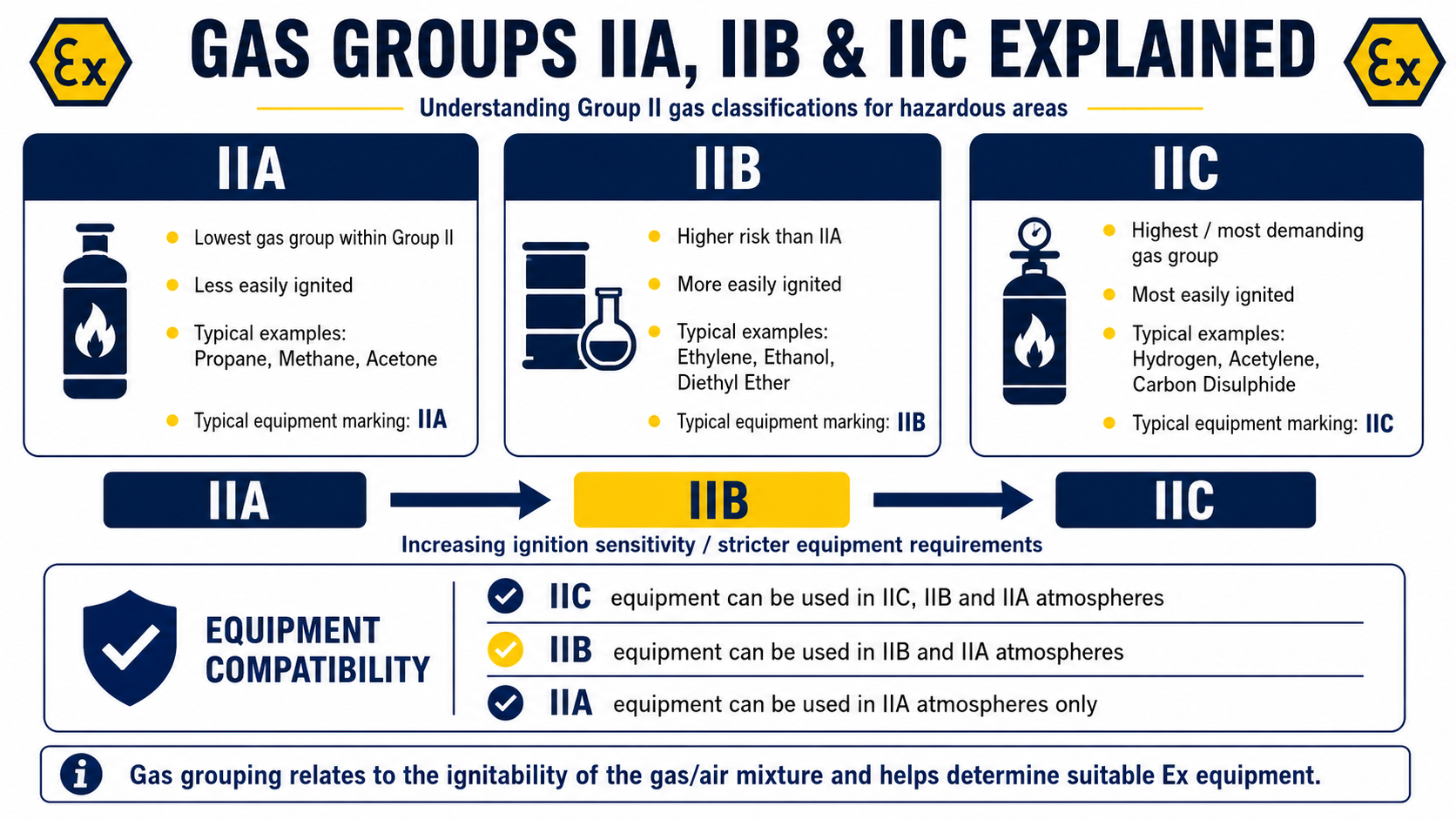 Gas groups IIA, IIB and IIC are hazardous area classifications used to group flammable gases and vapours according to their explosion characteristics. They help engineers, buyers and safety teams confirm whether hazardous area equipment is suitable for the explosive atmosphere present on site.
In simple terms, IIA, IIB and IIC show how easily a gas or vapour may ignite and how demanding the equipment protection needs to be. IIC is generally the most severe gas group, commonly associated with gases such as hydrogen and acetylene, while IIA is commonly associated with propane-type atmospheres.
Quick Answer: Gas Groups IIA, IIB & IIC
Gas groups IIA, IIB and IIC classify flammable gases and vapours by their explosion characteristics. They are used in hazardous area equipment markings to show whether equipment is suitable for the gas atmosphere present. IIA is commonly associated with propane-type gases, IIB with ethylene-type gases, and IIC with the most severe gas group, commonly including hydrogen and acetylene.
What Are Hazardous Area Gas Groups?
Hazardous area gas groups classify gases and vapours according to how easily they can ignite and how demanding the explosion protection requirements are. They are used to help match certified equipment to the explosive atmosphere present in a classified area.
For surface industries, gas atmospheres fall under Group II. Group II is then divided into:
- IIA – commonly associated with propane or gases and vapours of similar characteristics.
- IIB – commonly associated with ethylene or gases and vapours of similar characteristics.
- IIC – commonly associated with hydrogen, acetylene or gases and vapours of similar characteristics.
These gas groups appear in ATEX markings and IECEx certification to show what atmosphere the equipment has been assessed for.
They are especially important for equipment such as:
- ATEX lighting
- Hazardous area heaters
- ATEX enclosures and junction boxes
- ATEX plugs, sockets and connectors
- ATEX isolators
- Process instrumentation
- Static grounding systems
Gas group selection should always be based on the actual substances present on site and the hazardous area classification, not assumptions based on the industry or product type.
IIA, IIB & IIC Explained
The three Group II gas subgroups are used to classify explosive gas atmospheres in surface industries. The higher the gas group severity, the more demanding the explosion protection requirements usually become.
A useful rule of thumb is that equipment certified for IIC may often cover IIB and IIA atmospheres, provided all other certification requirements are met. Equipment certified only for IIA should not be assumed suitable for IIB or IIC areas.
This does not mean gas group is the only factor. The product must also match:
- the hazardous area zone;
- the equipment category or EPL;
- the temperature class or maximum surface temperature;
- the ambient temperature range;
- the installation method;
- the certificate conditions.
Why Gas Groups Matter for ATEX Equipment
Gas groups matter because equipment that is safe for one flammable atmosphere may not be safe for another. Different gases and vapours have different ignition characteristics, flame transmission behaviour and explosion properties.
If equipment is not certified for the gas group present, it may not provide the required level of protection. This can create serious ignition risk in hazardous areas.
For example:
- An IIA product should not be assumed suitable for an IIB or IIC gas atmosphere.
- An IIB product should not be assumed suitable for IIC gases such as hydrogen or acetylene.
- An IIC product may often be suitable for IIA and IIB atmospheres if the full certificate, zone rating, T-class and conditions of use are also suitable.
This is especially important when selecting equipment for applications involving hydrogen, acetylene, ethylene, solvents, fuels, petrochemical vapours and other flammable substances.
Gas Groups in ATEX & Ex Marking
Gas groups are usually shown as part of the product’s ATEX, IECEx or Ex marking. A typical marking may include the equipment group, category, protection method, gas group, temperature class and EPL.
For a full breakdown of equipment markings, read our guide: ATEX Marking Explained.
Gas Groups & Minimum Ignition Energy
Gas groups are closely linked to ignition sensitivity. One important concept is Minimum Ignition Energy, often shortened to MIE. MIE is the minimum spark energy required to ignite a flammable atmosphere under defined test conditions.
In general:
- IIA gases are usually less easily ignited than IIB and IIC gases.
- IIB gases are more demanding than IIA gases.
- IIC gases are generally the most easily ignited and require the most demanding equipment compatibility.
This is why IIC atmospheres require particular care. Hydrogen and acetylene are commonly associated with IIC because they have demanding ignition and explosion characteristics.
Read more in our technical guide to Minimum Ignition Energy.
MIE should not be used alone to select equipment. The final selection must consider the full hazardous area classification, Ex marking, gas group, temperature class, EPL, certificate and installation conditions.
Gas Groups vs Temperature Class Ratings
Gas group and temperature class are different parts of hazardous area equipment selection.
Gas group tells you about the type of gas or vapour explosion characteristics. Temperature class tells you the maximum surface temperature the equipment can reach under certified conditions.
For example, equipment marked IIC T4 may have a suitable gas group for hydrogen or acetylene-type atmospheres, but the T4 temperature class must still be suitable for the auto-ignition temperature of the specific gas or vapour present.
Read more in our guide to Temperature T-Class Ratings.
Gas Groups vs Hazardous Area Zones
Gas groups and hazardous area zones are also different. The zone tells you how likely an explosive atmosphere is to occur. The gas group tells you about the type of gas or vapour hazard.
For example, an area may be classified as Zone 1 IIC T4. This means the equipment must be suitable for Zone 1, the IIC gas group and the required temperature class.
Read more: Zone 1 vs Zone 2 Hazardous Areas.
Gas Groups vs Dust Groups
Gas groups IIA, IIB and IIC apply to flammable gas, vapour and mist atmospheres. Combustible dust atmospheres use different groupings and zone classifications.
For dust atmospheres, Group III may be subdivided into:
- IIIA – combustible flyings.
- IIIB – non-conductive dust.
- IIIC – conductive dust.
Dust zones are normally identified as Zone 20, Zone 21 and Zone 22, rather than Zone 0, Zone 1 and Zone 2.
Related product range: Dust Protected Enclosures for Zone 21 & Zone 22.
How Gas Groups Affect Equipment Selection
When selecting hazardous area equipment, gas group compatibility must be checked against the actual site hazard. This is especially important when replacing existing equipment, changing suppliers, upgrading lighting or adding new electrical systems to a classified area.
A practical equipment selection process should include:
- Confirm the hazardous area classification – identify the zone, gas group, temperature class and environmental conditions.
- Identify the flammable substances present – confirm whether the atmosphere is IIA, IIB, IIC or a dust group.
- Check the Ex marking – confirm the gas group is clearly shown and suitable.
- Check the certificate – make sure the certificate covers the exact product model and gas group.
- Check the temperature class – ensure the T-class is suitable for the ignition temperature of the atmosphere.
- Check the ambient temperature range – certification may only apply within defined ambient limits.
- Check accessories – cable glands, plugs, stopping plugs, adaptors and entries must maintain the certified protection method.
- Check installation requirements – manufacturer instructions and any special conditions of safe use must be followed.
For applications involving hydrogen, acetylene, solvents, fuels, petrochemical vapours or mixed gas environments, gas group confirmation is particularly important.
Example ATEX Product Ranges
Gas group suitability appears across a wide range of hazardous area equipment. The correct product depends on the zone, gas group, T-class, protection method and site conditions.
Typical product ranges include:
- ATEX Lighting – hazardous area LED lighting for Zone 1, Zone 2, Zone 21 and Zone 22 environments.
- ATEX & IECEx Heaters – certified heaters for process, space, enclosure and frost protection applications.
- Heat Trace Systems – trace heating cables, controls and junction boxes for hazardous area temperature maintenance.
- ATEX Enclosures & Junction Boxes – certified enclosures for power, control and instrumentation circuits.
- ATEX Plugs, Sockets & Connectors – electrical connection systems for hazardous area installations.
- ATEX Isolators – local isolation and control equipment for classified areas.
- Process Pressure Measurement – instrumentation used in industrial process and hazardous area applications.
- Static Grounding Systems – equipment used to help control electrostatic ignition risks during transfer, loading and blending operations.
Thorne & Derrick support the supply of hazardous area equipment for demanding industrial applications where gas group, T-class, zone suitability and certificate compliance must be carefully reviewed.
Common Gas Group Mistakes
Gas group mistakes can lead to incorrect equipment selection and serious safety risks. The most common errors include:
- Assuming all ATEX equipment is suitable for all gases – the gas group must match the atmosphere present.
- Using IIA equipment in IIB or IIC areas – IIA equipment should not be assumed suitable for more severe gas groups.
- Assuming IIB equipment is suitable for hydrogen – hydrogen is commonly associated with IIC, so the certificate must be checked carefully.
- Checking the gas group but ignoring T-class – both must be correct for the hazardous substance.
- Confusing gas groups with dust groups – IIA, IIB and IIC are for gas atmospheres, while IIIA, IIIB and IIIC relate to dust atmospheres.
- Checking the product label but not the certificate – the certificate must match the exact product model and conditions of use.
- Ignoring ambient temperature limits – the product may only be certified within a specific temperature range.
- Forgetting accessories – cable glands, plugs, stopping plugs and adaptors can affect the certified installation.
For hazardous area applications, equipment should always be selected by competent personnel using the site classification, manufacturer documentation and certification records.
Gas Groups IIA, IIB & IIC FAQs
Q: What are gas groups IIA, IIB and IIC?
A: Gas groups IIA, IIB and IIC classify flammable gases and vapours according to their explosion characteristics. They are used in ATEX and IECEx equipment markings to show whether equipment is suitable for the gas atmosphere present in a hazardous area.
Q: Which gas group is most severe?
A: IIC is generally the most severe Group II gas subgroup. It is commonly associated with hydrogen and acetylene, which have demanding ignition and explosion characteristics.
Q: What gases are associated with IIA, IIB and IIC?
A: IIA is commonly associated with propane-type atmospheres, IIB with ethylene-type atmospheres, and IIC with hydrogen or acetylene-type atmospheres. The actual classification should always be confirmed against the site hazardous area assessment and relevant standards.
Q: Can IIC equipment be used in IIB or IIA areas?
A: IIC equipment may often be suitable for IIB and IIA atmospheres if all other certification requirements are also suitable, including zone rating, T-class, EPL, ambient temperature and certificate conditions. The certificate and manufacturer instructions should always be checked.
Q: Can IIA equipment be used in IIC areas?
A: No. Equipment marked only for IIA should not be assumed suitable for IIC atmospheres. IIC is a more severe gas group and requires equipment certified for that group.
Q: Is hydrogen IIC?
A: Hydrogen is commonly associated with gas group IIC. Equipment used in hydrogen atmospheres should be checked carefully for IIC suitability, correct T-class, zone rating, EPL and certificate conditions.
Q: Are gas groups the same as hazardous area zones?
A: No. Hazardous area zones describe how likely an explosive atmosphere is to occur. Gas groups describe the explosion characteristics of the gas or vapour. Equipment must be suitable for both the zone and the gas group.
Q: Are gas groups the same as temperature classes?
A: No. Gas group identifies the type of gas or vapour hazard, while temperature class identifies the maximum surface temperature of the equipment. Both must be suitable for the hazardous atmosphere.
Conclusion
Gas groups IIA, IIB and IIC are essential for selecting safe and suitable hazardous area equipment. They identify the explosion characteristics of flammable gases and vapours and help confirm whether ATEX or IECEx certified equipment is compatible with the site atmosphere.
IIA is commonly associated with propane-type atmospheres, IIB with ethylene-type atmospheres, and IIC with the most severe Group II gas subgroup, commonly including hydrogen and acetylene. However, gas group is only one part of equipment selection. The hazardous area zone, temperature class, EPL, certificate, ambient temperature, accessories and special conditions of use must also be checked.
Thorne & Derrick supply ATEX and IECEx certified equipment for hazardous area lighting, heating, heat trace, enclosures, plugs, connectors, isolators, process instrumentation and static control applications, with technical support to help customers select equipment suitable for demanding industrial environments.