Mechanical Ignition Sources in ATEX Fan Systems
Published 20 May 2026
Why Hazardous Area Ventilation Requires More Than Electrical Certification
When discussing explosion protection in hazardous areas, the focus is often placed on electrical equipment such as motors, switches and junction boxes. While these components remain critical, ATEX fans must also be assessed for non-electrical ignition risks created by the mechanical operation of the fan itself.
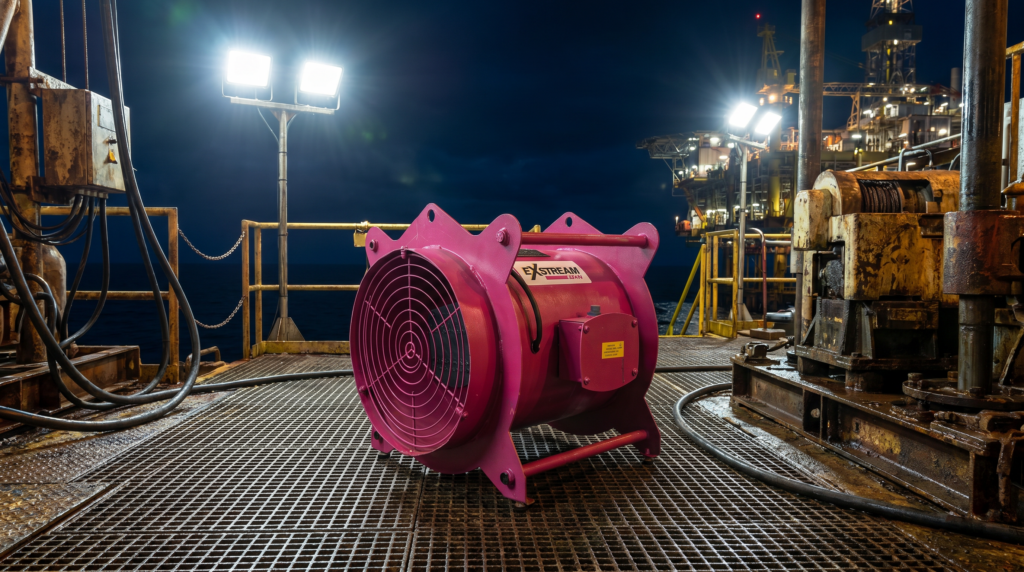
The ExStream 300 & ExStream 400 ATEX fan is manufactured by Woodcock & Wilson for hazardous area ventilation applications where both electrical and mechanical ignition sources must be carefully controlled. In explosive atmospheres, ignition prevention extends beyond the motor terminal box and across the complete ventilation assembly.
Mechanical Ignition Sources in ATEX Fans
Non-electrical ignition sources are recognised within international hazardous area standards including ISO 80079-36 and ISO 80079-37. These standards provide frameworks for identifying and assessing ignition hazards associated with mechanical equipment operating within explosive atmospheres.
Unlike electrical faults, mechanical ignition hazards can develop progressively over time through wear, contamination, vibration, misalignment or changing operating conditions.
Within ATEX fans, potential non-electrical ignition risks may include:
- Friction between rotating and stationary components
- Mechanical sparks caused by debris ingress
- Bearing overheating or lubrication failure
- Surface temperature rise under abnormal loading
- Electrostatic discharge from non-conductive materials
- Impeller contact with fan casings
- Shaft vibration or mechanical imbalance
- Long-term operational wear and contamination
This is why hazardous area fan systems should always be assessed as complete mechanical and electrical assemblies rather than simply focusing on motor certification alone.
ATEX fan Compliance Vs Ignition Prevention
One of the most important distinctions in hazardous area engineering is the difference between regulatory compliance and genuine ignition prevention.
ATEX and IECEx certification schemes demonstrate that equipment meets recognised technical requirements. However, certification alone does not automatically eliminate every possible ignition source within a complete fan assembly.
Even with a certified motor, ignition risks may still arise from:
- Mechanical contact between rotating parts
- Excessive vibration or imbalance
- Restricted airflow causing heat build-up
- Static electricity accumulation
- Particle ingress into the fan assembly
- Long-term wear or bearing degradation
Safe hazardous area ventilation depends on understanding how the complete ATEX fan system behaves during both normal operation and foreseeable fault conditions.
why Non-Electrical Ignition Prevention is important
Effective non-electrical ignition prevention relies on disciplined engineering practice throughout the equipment lifecycle.
Key considerations include:
- Systematic ignition risk identification
- Assessment of normal and fault operating conditions
- Management of surface temperatures
- Mechanical clearance control
- Material selection and compatibility
- Static electricity mitigation
- Treatment of coatings and finishes
- Documentation of operational limitations
Where ignition risks are controlled through operational limits or design features, these controls must remain effective throughout the equipment’s service life.
Thorne & Derrick distribute the following ATEX & IECEx hazardous area ventilation fans approved for explosive atmospheres:
- Tank Vent Fan 575
- Tank Vent Fan 575 With 6 Outlets
- Tank Vent Fan 710
- Tank Vent Fan 800 With 6 Outlets

Further Reading
-
 Mechanical Ignition Sources – A Industry Blind Spot
Size: 1.18 MB
Mechanical Ignition Sources – A Industry Blind Spot
Size: 1.18 MB