What Is Intrinsic Safety? | Ex i Protection Explained
Published 12 Jun 2026
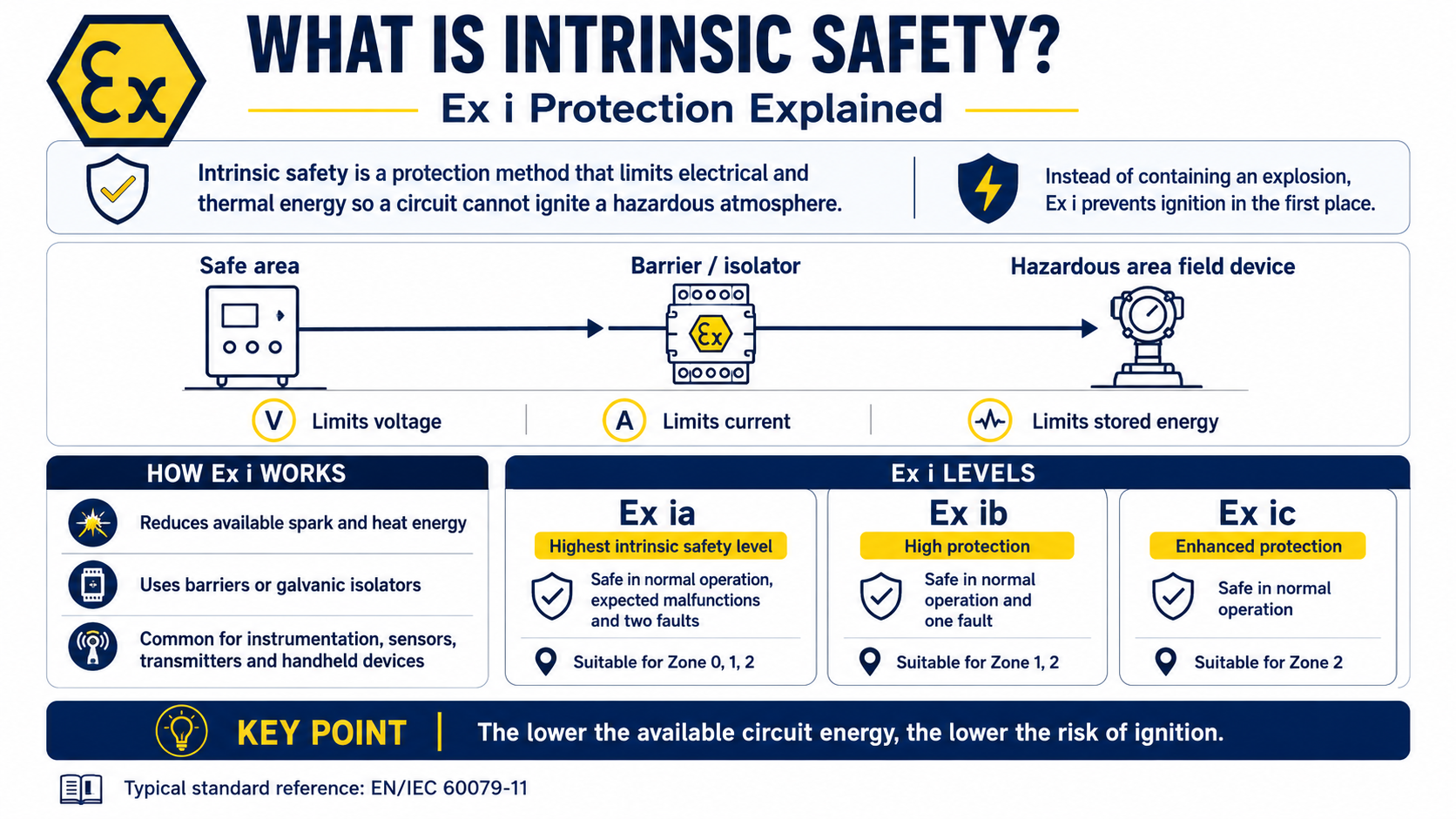
Intrinsic safety is an explosion protection technique used in hazardous areas to prevent electrical equipment and circuits from releasing enough energy to ignite a flammable gas, vapour, mist or dust atmosphere. In Ex markings, intrinsic safety is shown as Ex i, with common protection levels including Ex ia, Ex ib and Ex ic.
In simple terms, intrinsically safe equipment is designed so that sparks, arcs or heat produced by the electrical circuit cannot ignite the specified explosive atmosphere under the certified conditions. This makes intrinsic safety especially important for process instrumentation, sensors, transmitters, communication devices, control circuits and other low-power hazardous area equipment.
Quick Answer: What Is Intrinsic Safety?
Intrinsic safety is a method of explosion protection that limits the electrical and thermal energy in a circuit so it cannot ignite a specified explosive atmosphere. It is commonly used for low-power equipment such as transmitters, sensors, switches, communication devices and instrumentation circuits installed in hazardous area zones.
What Is Intrinsic Safety?
Intrinsic safety is a type of explosion protection used for electrical equipment and circuits in potentially explosive atmospheres. Instead of containing an explosion inside an enclosure, intrinsic safety prevents ignition by ensuring that the electrical energy available in the circuit is too low to cause ignition.
This is achieved by controlling:
- voltage – limiting the electrical potential in the circuit;
- current – restricting the available current under normal and fault conditions;
- power – keeping the available energy below ignition-capable levels;
- capacitance and inductance – controlling stored energy in cables and connected devices;
- surface temperature – ensuring equipment does not exceed the permitted temperature class.
Intrinsic safety is most commonly used for low-energy control and measurement circuits rather than high-power equipment. It is widely used across oil and gas, petrochemical, chemical processing, pharmaceutical, food and beverage, water treatment, utilities, energy and other industries where explosive atmospheres may occur.
External reference: HSE explains that electricity can create hot surfaces or sparks capable of igniting explosive atmospheres, which is why suitable protection methods are required in hazardous areas.
How Does Intrinsic Safety Work?
Intrinsic safety works by designing the circuit so it cannot release enough energy to ignite the hazardous atmosphere, even under defined fault conditions. This means the complete circuit must be assessed, not just the field device.
An intrinsically safe loop may include:
- field equipment installed in the hazardous area, such as a transmitter, sensor or switch;
- associated apparatus installed in the safe area or suitably protected area, such as a safety barrier or galvanic isolator;
- interconnecting cable with controlled capacitance and inductance values;
- earthing and bonding arrangements where required by the system design;
- documentation proving that the circuit remains intrinsically safe.
The key point is that intrinsic safety is a system concept. A device may be marked as intrinsically safe, but the complete installation must still be checked to confirm the loop remains within certified limits.
What Does Ex i Mean?
Ex i is the marking used for equipment or circuits protected by intrinsic safety. The letter “i” identifies intrinsic safety as the protection method.
You may see markings such as:
- Ex ia – very high level of intrinsic safety protection;
- Ex ib – high level of intrinsic safety protection;
- Ex ic – enhanced level of intrinsic safety protection.
These markings appear as part of a wider Ex marking that may also include the gas group, temperature class and Equipment Protection Level.
Example:
This example indicates intrinsic safety protection, IIC gas group suitability, T4 temperature class and Ga Equipment Protection Level, subject to the full certificate and conditions of use.
Read more: ATEX Marking Explained.
Ex ia, Ex ib & Ex ic Explained
Intrinsic safety is divided into different levels depending on the level of protection required. The three common levels are Ex ia, Ex ib and Ex ic.
A product or circuit marked Ex ia may provide a higher level of protection than Ex ib or Ex ic, but the complete marking must still be checked. It is not enough to look at “ia”, “ib” or “ic” alone.
Other essential checks include:
- gas group – such as IIA, IIB or IIC;
- temperature class – such as T1 to T6;
- EPL – such as Ga, Gb or Gc;
- certificate number – including any “X” suffix conditions;
- entity parameters – such as voltage, current, capacitance and inductance limits;
- installation requirements – including cable and associated apparatus compatibility.
Intrinsic Safety, Zones & EPLs
Intrinsic safety levels are commonly linked to hazardous area zones and Equipment Protection Levels. The zone identifies how likely the explosive atmosphere is to occur, while the EPL identifies the level of ignition protection provided by the equipment.
This relationship is useful, but it must not replace a full assessment. Equipment suitability depends on the complete marking, the certificate, the gas group, T-class, ambient temperature, circuit design and installation conditions.
Related guides:
Intrinsically Safe Apparatus & Associated Apparatus
Intrinsic safety often involves more than one device. A complete intrinsically safe system may include intrinsically safe apparatus in the hazardous area and associated apparatus that limits the energy entering the hazardous area circuit.
Examples of intrinsically safe field equipment may include pressure transmitters, temperature transmitters, level sensors, proximity switches, handheld devices and certain communication equipment.
Examples of associated apparatus may include safety barriers, galvanic isolators and interface modules that limit the energy supplied to the hazardous area circuit.
Barriers, Galvanic Isolators & IS Loops
Many intrinsically safe systems use a safety barrier or galvanic isolator between the safe area and the hazardous area. These devices help limit the energy that can pass into the intrinsically safe circuit.
Intrinsic safety loop design must consider entity parameters such as maximum voltage, current, power, capacitance and inductance. The cable itself can store energy, so cable length and cable characteristics may affect whether the loop remains within safe limits.
For critical installations, loop calculations and documentation should be completed by competent personnel.
Intrinsic Safety vs Explosion-Proof Protection
Intrinsic safety is often confused with explosion-proof or flameproof protection. They are not the same.
Intrinsic safety prevents ignition by limiting energy. Explosion-proof or flameproof protection, commonly marked Ex d, is designed to contain an internal explosion and prevent flame transmission to the external atmosphere.
The correct protection method depends on the equipment type, power level, hazardous area zone, gas group, temperature class, maintenance requirements and installation conditions.
Intrinsic Safety in ATEX & IECEx Marking
Intrinsic safety may appear in both ATEX and IECEx markings. The marking should be read carefully to confirm the protection method, gas group, temperature class and Equipment Protection Level.
This example should not be used as a universal marking. Actual markings vary depending on the equipment type, standard, certificate and manufacturer. Always check the product certificate, datasheet and instructions.
Related guides:
Where Is Intrinsic Safety Used?
Intrinsic safety is especially useful for low-power equipment and signal circuits where energy limitation is practical. It is widely used in measurement, control, communication and monitoring applications.
Typical applications include:
- Process pressure measurement using transmitters, pressure sensors and instrumentation loops.
- Process instrumentation for temperature, level, flow, pressure and control applications.
- Gas detection systems and monitoring circuits used in hazardous process environments.
- Intrinsically safe switches and sensors used for machine, process and safety monitoring.
- Hazardous area mobile devices used for inspections, maintenance, communication and digital workflows.
- Control and signalling circuits connected to field devices in Zone 0, Zone 1 or Zone 2 applications.
- Static grounding and monitoring systems used to help control electrostatic ignition risks.
Intrinsic safety is generally not used for high-power loads such as large motors, high-output lighting circuits or power heating equipment. Those applications usually require other protection methods and certified equipment designs.
Common Intrinsic Safety Mistakes
Intrinsic safety is effective when designed and installed correctly, but it is easy to misunderstand. Common mistakes include:
- Assuming one intrinsically safe device makes the whole system safe – the complete loop must be assessed.
- Ignoring associated apparatus – barriers or galvanic isolators must be compatible with the field device and circuit.
- Forgetting cable parameters – cable capacitance and inductance can affect stored energy in the loop.
- Confusing Ex ia, Ex ib and Ex ic – each level has different protection implications and zone suitability.
- Checking the Ex i marking but ignoring gas group – the circuit must be suitable for IIA, IIB or IIC as required.
- Ignoring temperature class – equipment must not exceed the permitted surface temperature for the atmosphere.
- Using non-approved replacement components – substitution can invalidate the certified loop design.
- Not reviewing certificate conditions – an “X” suffix may indicate special conditions of safe use.
For intrinsically safe systems, documentation, verification and competent installation are just as important as the equipment marking.
External reference: HSE states that areas classified into zones must be protected from sources of ignition and that equipment used in zoned areas should be selected to meet the relevant regulations.
Intrinsic Safety FAQs
Q: What is intrinsic safety?
A: Intrinsic safety is an explosion protection technique that limits electrical and thermal energy in a circuit so it cannot ignite a specified explosive atmosphere. It is commonly used for low-power hazardous area instrumentation, sensors, communication devices and control circuits.
Q: What does Ex i mean?
A: Ex i means the equipment or circuit uses intrinsic safety as its explosion protection method. The “i” identifies intrinsic safety in the Ex marking.
Q: What is the difference between Ex ia, Ex ib and Ex ic?
A: Ex ia provides a very high level of intrinsic safety protection and is commonly associated with Zone 0 gas applications. Ex ib provides a high level of protection and is commonly associated with Zone 1. Ex ic provides an enhanced level of protection and is commonly associated with Zone 2. Full certification must always be checked.
Q: Is intrinsically safe the same as ATEX?
A: No. ATEX is a European legal framework for equipment used in potentially explosive atmospheres. Intrinsic safety is one specific explosion protection method that may be used within ATEX or IECEx certified equipment. Read more in our guide to ATEX vs IECEx.
Q: Is intrinsically safe the same as explosion-proof?
A: No. Intrinsic safety prevents ignition by limiting energy in the circuit. Explosion-proof or flameproof protection contains an internal explosion inside a certified enclosure and prevents flame transmission to the surrounding atmosphere.
Q: Can intrinsically safe equipment be used in Zone 1?
A: Intrinsically safe equipment may be suitable for Zone 1 if it has the correct Ex marking, protection level, gas group, T-class, EPL and certificate conditions. Ex ib or higher is commonly associated with Zone 1 gas applications, but the full certification must be checked.
Q: Do intrinsically safe circuits need barriers?
A: Many intrinsically safe circuits use a safety barrier or galvanic isolator to limit the energy entering the hazardous area circuit. The correct device depends on the field equipment, circuit parameters, installation design and certification requirements.
Q: Is intrinsic safety suitable for high-power equipment?
A: Intrinsic safety is generally used for low-power circuits such as instrumentation, sensors and communication devices. High-power equipment usually requires other explosion protection methods such as flameproof, increased safety, pressurisation or protection by enclosure, depending on the application.
Conclusion
Intrinsic safety is one of the most important explosion protection methods for hazardous area instrumentation, sensors, communication devices and low-power control circuits. By limiting voltage, current, power, stored energy and surface temperature, intrinsically safe circuits are designed so they cannot ignite the specified explosive atmosphere under certified conditions.
However, intrinsic safety must always be treated as a complete system. The field device, associated apparatus, cable, entity parameters, gas group, T-class, EPL, certificate and installation conditions must all be checked carefully.
Thorne & Derrick supply ATEX and IECEx certified hazardous area equipment for process instrumentation, mobile devices, static grounding, isolators, lighting, heating, trace heating, enclosures and electrical control applications, with technical support to help customers select equipment suitable for demanding industrial environments.