ATEX Manual Call Points Explained: Break Glass vs Push Button
Published 16 Nov 2026
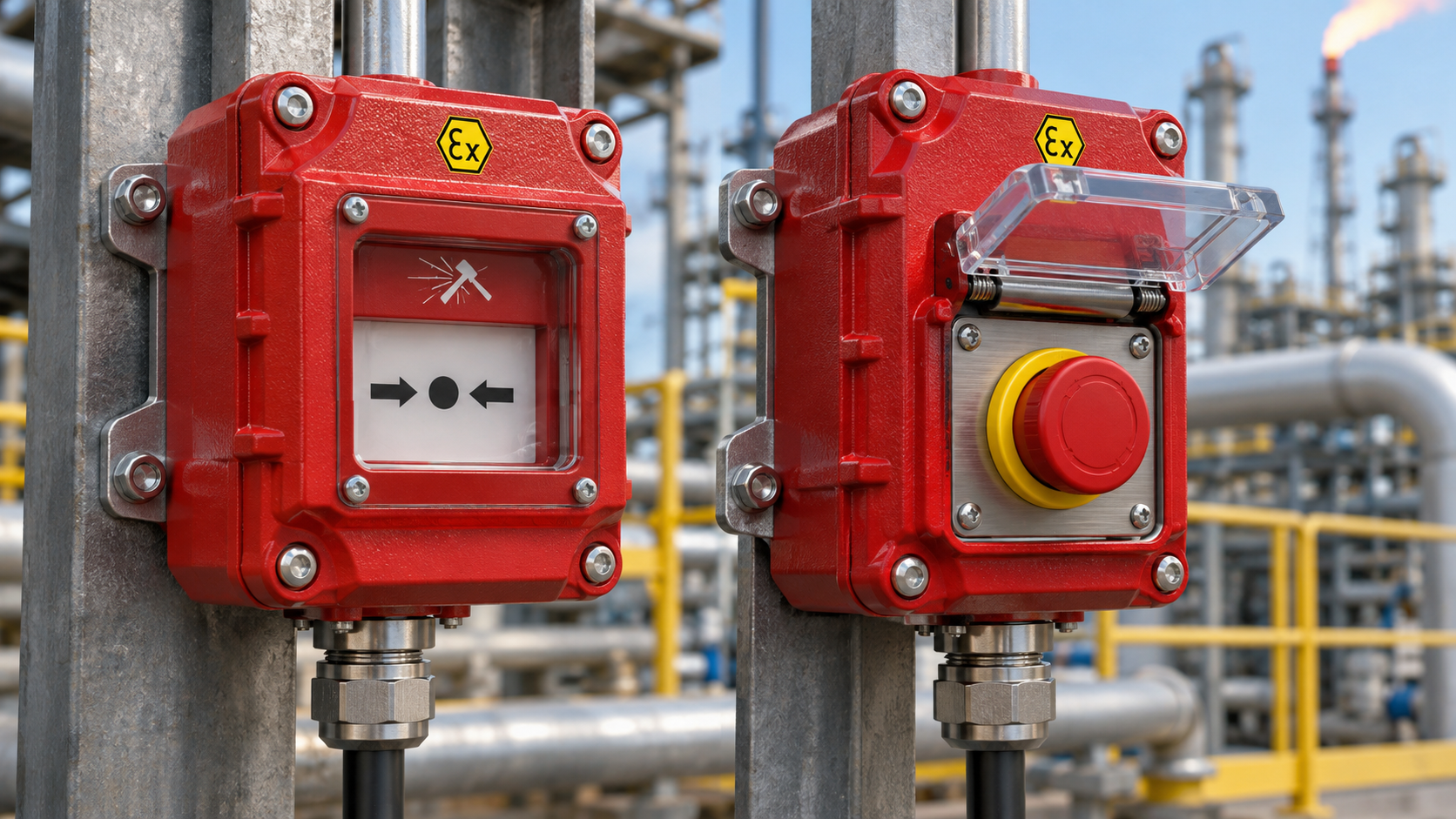 ATEX manual call points allow personnel to activate an alarm or initiate a specified emergency signal in potentially explosive atmospheres. They are commonly used in hazardous-area fire alarm, emergency shutdown and industrial signalling systems where electrical equipment must be suitable for the relevant gas or dust classification.
Manual call points are available with different operating mechanisms, including break glass, push button, latching and resettable designs. Although their basic purpose is similar, the way each device is operated, reset and integrated into a control system can vary considerably.
For electrical engineers, E&I contractors and industrial maintenance teams, understanding these differences is important when specifying equipment for chemical plants, oil and gas installations, petrochemical facilities and other classified hazardous areas.
This guide explains how ATEX manual call points work, compares break glass and push button operation, outlines Ex d and Ex ia protection concepts and identifies the key considerations when selecting equipment for hazardous-area applications.
Thorne & Derrick supply ATEX and IECEx certified manual call points, including Eaton MEDC and other specialist hazardous-area signalling equipment.
Quick Answer: What Is an ATEX Manual Call Point?
An ATEX manual call point is a manually operated electrical signalling device designed and certified for specified potentially explosive atmospheres. It allows a person to raise an alarm or activate a designated emergency circuit by operating a break glass element, push button or another approved actuator.
These devices are used in applications such as fire alarm systems, emergency shutdown arrangements and industrial warning systems.
The main differences between manual call point types are their operating mechanism, reset method, electrical switching arrangement and explosion protection certification.
How Do ATEX Manual Call Points Work?
A manual call point enables a person to activate an electrical circuit through a deliberate manual action.
Depending on the system design, operating the call point may change the state of an electrical contact or provide a signal that can be interpreted by a connected control or monitoring system.
The receiving system may then initiate an alarm, indicate the location of the activation, trigger an approved emergency response or perform another specified function.
What Happens When a Call Point Is Activated?
A typical manual activation sequence involves:
- Identifying an emergency: A person identifies a fire, hazardous condition or another event requiring manual intervention.
- Operating the call point: The user presses the actuator or operates the break glass mechanism.
- Changing the electrical signal: The device’s contact arrangement changes state according to its design.
- Receiving the signal: The connected fire alarm, safety or control system interprets the input.
- Initiating the response: The system performs its programmed function, where the relevant conditions are met.
Not every manual call point operates in the same way. The electrical contacts, supervision arrangements, reset mechanism and system response depend on the device and the wider control-system design.
Are Manual Call Points Only Used for Fire Alarms?
No. Although break glass call points are widely associated with fire detection and alarm systems, industrial manual call points can also be used for other clearly identified emergency functions.
For example, certain products are configured for emergency shutdown, evacuation signalling or other designated industrial safety actions.
The duty of the device must be clearly identified, and the product must be suitable for the applicable safety system.
What Are the Different Types of ATEX Manual Call Points?
ATEX manual call points can be distinguished by how the device is operated and how it is returned to its normal state.
The most common configurations include break glass, push button and resettable mechanisms.
1. Break Glass Manual Call Points
A break glass manual call point uses a glass or similar approved operating element associated with the activation mechanism.
The user operates the device by breaking or displacing the designated element, depending on the product design.
Break glass call points are commonly used where a clearly visible and deliberate emergency activation method is required.
Many industrial models use a latching mechanism, meaning the device remains operated until it has been appropriately reset.
2. Push Button Manual Call Points
A push button manual call point is activated by pressing an actuator rather than breaking a glass element.
Some models incorporate a protective lift flap to reduce unintended activation.
Push button call points may have different operating actions, including momentary or latching operation.
They are used in applications where a defined manual electrical signal is required, including industrial emergency and alarm systems.
3. Resettable Manual Call Points
A resettable manual call point can be returned to its normal condition using the reset method specified by the manufacturer.
Some designs require a key, tool or particular actuator movement.
Resettable designs may help reduce the need for replacement operating elements after authorised testing or activation, depending on the model.
4. Protected or Lift-Flap Call Points
Certain manual call points incorporate a hinged or spring-loaded protective cover.
This creates an additional deliberate action before the actuator can be operated.
Protective covers may be useful where accidental contact is a concern, provided the arrangement is appropriate to the intended emergency function and applicable requirements.
Break Glass vs Push Button Manual Call Points: What’s the Difference?
The main distinction between break glass and push button manual call points is the mechanism used to initiate the electrical signal.
Both can be incorporated into hazardous-area signalling systems when suitably certified, but their operating actions, reset requirements and available configurations differ.
Which Type Should Be Selected?
Selection should be based on the required emergency function, operating procedure, electrical interface, applicable system standards and the hazardous-area classification.
For example, the intended system may require a device that remains operated until deliberately reset. In another application, a momentary electrical input may be specified.
Neither mechanism should be treated as universally better or safer. The correct configuration is the one that meets the verified system requirements.
Latching vs Momentary vs Resettable Call Points
Beyond the visible actuator, an important distinction is how the electrical contacts behave during and after operation.
Latching Operation
A latching manual call point remains mechanically operated after activation until it is reset using the required method.
This may be useful where a persistent indication of manual operation is required.
Momentary Operation
A momentary push button changes its contact state while the actuator is operated and normally returns when released.
Whether the alarm or shutdown system retains the resulting signal depends on the connected control arrangement.
Key Reset and Tool Reset
Some products require a key or tool to return the actuator to its normal condition.
This can help ensure that resetting is performed deliberately by authorised personnel.
ATEX and IECEx Certification for Manual Call Points
Manual call points intended for potentially explosive atmospheres must be selected according to their certified protection characteristics and the installation’s hazardous-area requirements.
ATEX and IECEx certification provides information about equipment suitability under defined conditions, but certification alone does not mean every call point can be installed in every hazardous area.
What Does the ATEX Marking Tell You?
Depending on the equipment, the marking and documentation identify characteristics such as:
- Equipment group and category.
- Equipment Protection Level (EPL).
- Applicable gas or dust group.
- Explosion protection concept.
- Temperature class or maximum surface temperature.
- Permitted ambient temperature range.
- Any special conditions for safe use.
All of these must be considered alongside the site’s hazardous-area classification and applicable installation requirements.
Can an ATEX Manual Call Point Be Used in Zone 1?
Yes, where the individual device has the appropriate certification and equipment marking for the intended Zone 1 gas atmosphere.
However, a product suitable for Zone 1 is not necessarily suitable for every gas group, temperature requirement or environmental condition.
What About Dust Hazardous Areas?
Combustible dust environments require appropriate dust explosion protection marking.
A gas-rated device should not automatically be assumed suitable for Zone 21 or Zone 22 without confirming the relevant dust classification and certification.
Ex d vs Ex e vs Ex ia Manual Call Points
Different explosion protection concepts may be used in hazardous-area manual call points, depending on the internal electrical arrangement and the certified equipment design.
Ex d – Flameproof Protection
Ex d flameproof protection uses an enclosure designed to withstand an internal explosion under specified conditions and prevent flame transmission to the surrounding explosive atmosphere.
Some hazardous-area manual call points use flameproof switching components within their certified construction.
Ex e – Increased Safety
Ex e increased safety employs measures intended to prevent ignition-capable arcs, sparks or excessive temperatures in the parts of equipment to which that protection concept applies.
Some assemblies combine different protection concepts, such as Ex d switching components with Ex e terminal arrangements.
Ex ia – Intrinsic Safety
Ex ia intrinsic safety limits electrical and thermal energy under the applicable fault conditions so that ignition cannot occur within the assessed intrinsic safety system.
Intrinsically safe manual call points must be installed as part of an appropriately designed system, including any required associated apparatus and circuit parameters.
Ex ia is not simply a substitute for flameproof equipment. The protection concept must suit the complete system.
For a broader explanation of protection concepts, see Ex d vs Ex e: Flameproof and Increased Safety Explained.
Where Are Hazardous Area Manual Call Points Used?
ATEX and IECEx manual call points are used where personnel need a reliable means of initiating an alarm or emergency signal from a classified hazardous area.
Oil and Gas Installations
Offshore platforms, terminals and onshore processing facilities may require manual alarm or shutdown initiation at specified locations.
Equipment must be compatible with the hazardous-area classification and the relevant safety system.
Petrochemical and Chemical Processing
Manual call points can form part of fire alarm, emergency warning or process shutdown arrangements in classified production and storage environments.
Pharmaceutical Manufacturing
Where flammable solvents or other substances create classified hazardous areas, suitably certified electrical signalling equipment may be required.
Marine and Industrial Facilities
Industrial and marine environments may introduce additional requirements for corrosion resistance, ingress protection and mechanical durability.
These environmental requirements must be considered alongside explosion protection certification.
Eaton MEDC and Other ATEX Manual Call Points
Thorne & Derrick supply hazardous-area call points from specialist manufacturers, including Eaton MEDC and other approved signalling equipment brands.
Eaton MEDC SM87 Break Glass and Push Button
The Eaton MEDC SM87 range includes manual call point configurations for demanding industrial and hazardous-area applications.
Depending on the selected model and certification, options include:
- Break glass operating mechanisms.
- Push button configurations.
- Latching and momentary operating actions.
- Key-reset arrangements.
- Protective lift flaps.
- Optional electrical components and duty labels.
The available configurations, electrical ratings and Ex certification vary by model and must be confirmed against the correct technical documentation.
Explore ATEX and IECEx hazardous-area call points from Thorne & Derrick.
Pepperl+Fuchs Manual Call Points
Pepperl+Fuchs also supplies manual call points for specified hazardous-area applications, including aluminium and GRP enclosure designs.
These are available in different certified configurations to suit relevant alarm and signalling requirements.
View Pepperl+Fuchs hazardous-area manual call points.
How to Select an ATEX Manual Call Point
Correct specification begins with the required alarm or emergency function, followed by the electrical system and hazardous-area requirements.
The following information should be confirmed before selecting a device.
Electrical Compatibility Matters
The selected manual call point must be compatible with the receiving system.
Different devices can use normally open, normally closed or changeover contacts, depending on the model and configuration.
Some systems also require end-of-line resistors, monitoring components or specific electrical arrangements.
These requirements must be established from the control-system design rather than assumed from the mechanical appearance of the device.
Installation, Testing and Maintenance Considerations
ATEX manual call points must be installed and maintained in accordance with their certified construction, manufacturer instructions and the applicable electrical and safety-system requirements.
Installation considerations include:
- Correct hazardous-area equipment marking.
- Suitable cable glands and approved entry arrangements.
- Correct electrical connections and terminal ratings.
- Protection against unsuitable mechanical or environmental exposure.
- Appropriate accessibility and device identification.
- Correct testing and reset procedures.
- Inspection and maintenance by competent personnel.
Can an ATEX Manual Call Point Be Modified?
Unauthorised modifications can compromise equipment certification and operation.
Changes to actuators, switches, cable entries, enclosure components or internal electrical arrangements must not be undertaken unless they are permitted by the relevant approved documentation or appropriately assessed.
Why Testing Is Important
Periodic inspection and functional testing help confirm that the device remains suitable and can provide the intended signal to the connected system.
Testing must follow the approved site procedure and account for any alarms, shutdown functions or other operational consequences.
ATEX Manual Call Points – Frequently Asked Questions
Q: What is an ATEX manual call point?
A: An ATEX manual call point is a manually operated electrical signalling device certified for specified potentially explosive atmospheres. It allows personnel to activate an alarm or other designated emergency circuit.
Q: What is the difference between break glass and push button call points?
A: Break glass devices are operated through a glass or approved operating element, whereas push button devices use a manually pressed actuator. Their reset and switching actions depend on the specific design.
Q: Can ATEX manual call points be used in Zone 1?
A: Yes, where the complete equipment certification and marking demonstrate suitability for the intended Zone 1 gas atmosphere, including the relevant gas group and temperature requirements.
Q: Are all ATEX manual call points explosion proof?
A: They must use appropriate explosion protection measures, but different products may use different protection concepts. Not every hazardous-area call point uses an Ex d flameproof enclosure; intrinsically safe and combined protection designs are also available.
Q: What does latching mean on a manual call point?
A: Latching means the operating mechanism remains in its activated position until reset. This differs from a momentary actuator, which normally returns when released.
Q: Can a push button manual call point be reset?
A: Many push button models have resettable mechanisms. The method may involve a key, tool or specified mechanical action, depending on the device.
Q: What is the difference between Ex d and Ex ia call points?
A: Ex d uses flameproof enclosure construction to contain an internal explosion, while Ex ia uses intrinsic safety principles to limit electrical and thermal energy in the assessed system. Selection depends on the device certification and installation design.
Q: Can a manual call point activate an emergency shutdown?
A: Certain manual call points can be specified for emergency shutdown signalling, provided their operating characteristics, electrical interface and associated safety-system design are suitable for the intended function.
Q: Who should install ATEX manual call points?
A: Installation must be undertaken by competent personnel familiar with the applicable hazardous-area electrical requirements, equipment certification and associated fire alarm or safety-system arrangements.
Conclusion: Selecting the Correct ATEX Manual Call Point
ATEX manual call points provide a means of activating alarms and designated emergency signals in potentially explosive atmospheres.
The difference between break glass and push button manual call points lies primarily in their operating mechanisms, switching actions and reset arrangements. The appropriate device must also meet the electrical, environmental and hazardous-area requirements of the installation.
For industrial projects, correct specification should consider the required emergency function, control-system interface, Ex certification, enclosure material and maintenance arrangements.
Thorne & Derrick supply ATEX and IECEx hazardous-area manual call points, including Eaton MEDC and other specialist products, for industrial fire alarm and signalling applications.
Technical note: This article provides general information. The actual product certification, manufacturer instructions, applicable standards and approved fire alarm or safety-system design must govern equipment selection, installation, maintenance and testing.