Ex d vs Ex e | Flameproof vs Increased Safety Explained
Published 12 Jun 2026
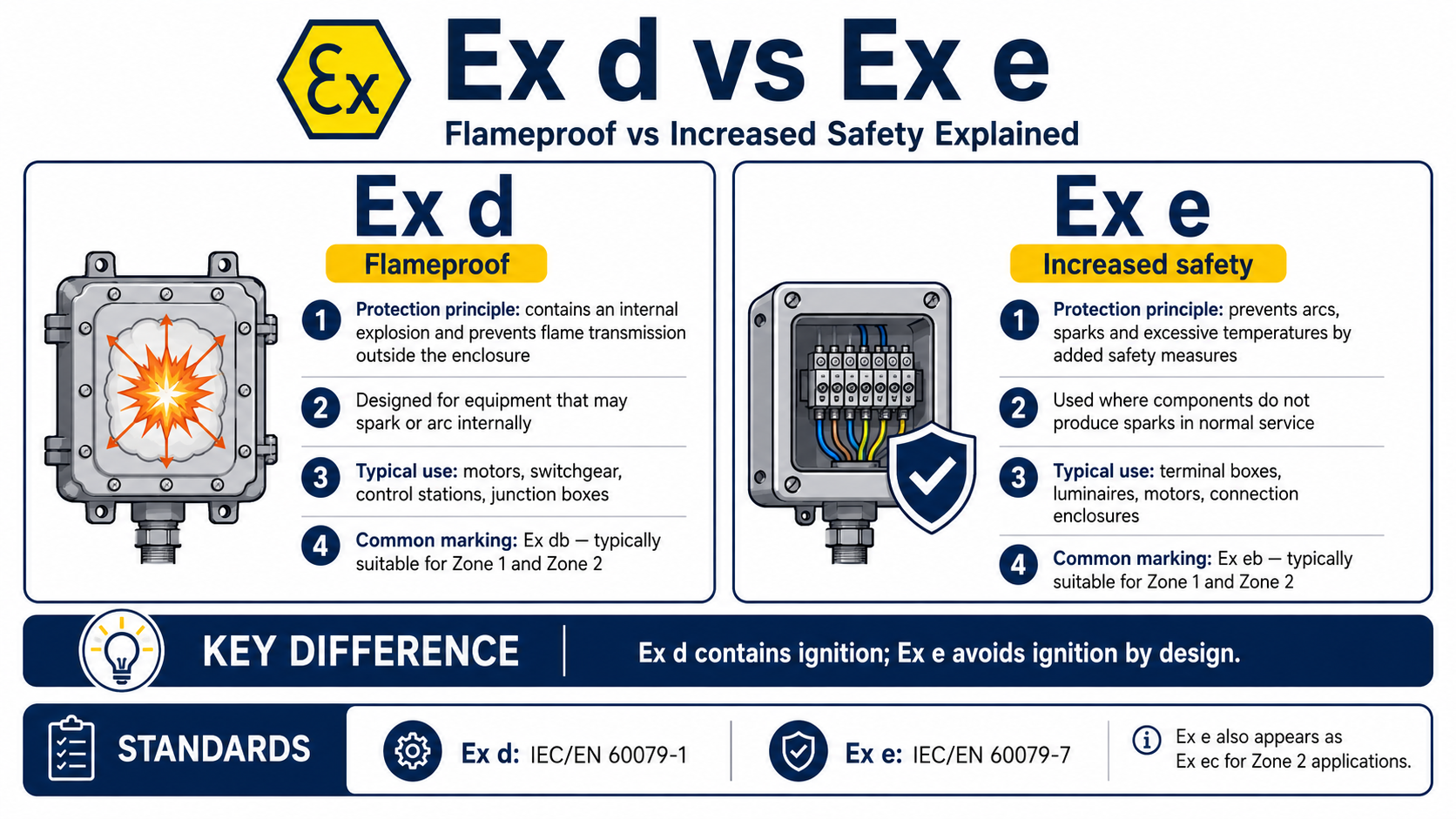
Ex d and Ex e are two common explosion protection methods used for electrical equipment in hazardous areas. Ex d refers to flameproof protection, where an enclosure is designed to contain an internal explosion and prevent flame transmission to the surrounding atmosphere. Ex e refers to increased safety protection, where equipment is designed to prevent arcs, sparks and excessive temperatures during normal operation.
Understanding the difference between Ex d vs Ex e is essential when selecting hazardous area equipment, including ATEX lighting, junction boxes, enclosures, control stations, isolators, plugs, sockets and electrical distribution equipment for Zone 1 and Zone 2 applications.
Quick Answer: Ex d vs Ex e
Ex d is flameproof protection. It allows the possibility of an internal ignition inside a certified enclosure, but the enclosure is designed to contain the explosion and prevent flames from escaping into the surrounding hazardous atmosphere. Ex e is increased safety protection. It is designed to prevent ignition from occurring in the first place by avoiding arcs, sparks and excessive temperatures during normal operation.
What Is Ex d Flameproof Protection?
Ex d flameproof protection is an explosion protection method where equipment is housed inside an enclosure designed to withstand an internal explosion without rupturing. The enclosure also prevents flames, hot gases or ignition from transmitting to the surrounding explosive atmosphere.
This protection concept is often used where electrical equipment may contain components capable of producing sparks, arcs, hot surfaces or other ignition sources. Instead of relying only on preventing ignition inside the enclosure, Ex d assumes an internal explosion could occur and ensures the enclosure safely contains it.
Ex d equipment may be used for products such as:
- flameproof control stations;
- hazardous area lighting with certified flameproof construction;
- motor starters and switchgear where the certificate permits;
- flameproof enclosures containing electrical components;
- certain plugs, sockets, isolators and control equipment used in hazardous areas.
Ex d equipment must be installed and maintained carefully because the flamepath, cable entries, enclosure integrity, fasteners and accessories are all critical to the certified protection method.
Related guide: ATEX Marking Explained.
What Is Ex e Increased Safety?
Ex e increased safety is an explosion protection method where equipment is designed to reduce the risk of arcs, sparks and excessive temperatures during normal operation. Unlike Ex d, Ex e does not rely on containing an internal explosion inside a heavy flameproof enclosure. Instead, it focuses on preventing ignition-capable conditions from arising.
Ex e is commonly used for equipment that does not normally produce arcs or sparks, such as terminals, junction boxes and certain electrical assemblies designed with additional insulation, creepage, clearance, temperature and connection security measures.
Ex e equipment may be used for:
- Ex e increased safety equipment;
- ATEX junction boxes and enclosures;
- terminal boxes and connection chambers;
- selected hazardous area luminaires;
- increased safety motors and electrical assemblies, where certified.
Because Ex e relies on preventing ignition, equipment that normally produces sparks or arcs should not be placed in an Ex e enclosure unless the complete assembly and protection concept have been specifically assessed and certified.
Ex d vs Ex e: Key Differences
The main difference between Ex d and Ex e is the way each protection method controls ignition risk. Ex d contains an internal explosion. Ex e prevents ignition sources from occurring during normal operation.
Both protection methods can be suitable in hazardous areas when correctly certified, selected, installed and maintained. The correct choice depends on the equipment type, hazardous area classification, electrical function, gas group, temperature class and certificate conditions.
How Ex d Flameproof Equipment Works
Ex d flameproof equipment is designed so that if an explosive gas atmosphere enters the enclosure and is ignited internally, the enclosure can contain the explosion pressure and prevent the flame from igniting the surrounding atmosphere.
Key design features may include:
- flameproof enclosure strength – designed to withstand internal explosion pressure;
- flamepaths – precision gaps or joints that cool hot gases before they can exit the enclosure;
- certified cable entries – glands, stopping plugs and adaptors must match the protection requirements;
- correct fasteners – cover bolts and fixings must be present, tightened and compatible;
- temperature control – the equipment must not exceed its certified temperature class.
Because flameproof protection depends heavily on mechanical integrity, installation and inspection are critical. Damaged threads, missing bolts, incorrect glands, corrosion or paint on flamepaths can compromise safety.
How Ex e Increased Safety Equipment Works
Ex e increased safety equipment works by reducing the risk of ignition during normal operation. It does this through design features that improve electrical security, reduce overheating and prevent arcs or sparks.
Key design features may include:
- increased creepage and clearance distances to reduce electrical tracking and breakdown risk;
- secure terminals and connections to reduce loosening, overheating or arcing;
- controlled surface temperatures to remain within the certified T-class;
- reinforced insulation and improved electrical separation;
- ingress protection to prevent contamination that could affect electrical safety;
- certified components selected for increased safety use.
Ex e equipment is commonly used where the electrical components do not normally create arcs or sparks. It is especially common for terminal boxes and junction boxes used in hazardous area wiring systems.
Related page: Ex e Increased Safety Equipment.
Ex d & Ex e in ATEX and IECEx Marking
Ex d and Ex e appear as part of a wider ATEX or IECEx marking. The protection method should never be read in isolation. The full marking must also include suitability for the zone, gas group, temperature class and Equipment Protection Level.
Read more in our guides:
Ex d, Ex e, Zones & EPLs
Ex d and Ex e equipment can be used in hazardous areas when the equipment is certified for the relevant zone and protection level. The zone tells you how likely an explosive atmosphere is to occur, while the EPL identifies the level of ignition protection.
Ex d and Ex e protection methods are often used for Zone 1 and Zone 2 equipment, depending on the full certification. The protection concept alone does not confirm suitability. Equipment must also have the correct category or EPL, gas group, temperature class and certificate conditions.
Related guide: Zone 1 vs Zone 2 Hazardous Areas.
Gas Groups & T-Class Ratings
Ex d and Ex e markings often include a gas group and temperature class. These are essential for confirming equipment suitability.
For example, an Ex d enclosure marked IIC T4 may be suitable for IIC gas atmospheres with a T4 temperature class, subject to the full certificate. However, it must still be suitable for the zone, ambient temperature, cable entries and any special conditions of safe use.
Related guides:
Can Equipment Use Both Ex d and Ex e?
Yes. Some hazardous area equipment uses more than one protection method. A product may use Ex d for one part of the equipment and Ex e for another, depending on the design and certification.
For example:
- an Ex d enclosure may contain sparking components inside a flameproof chamber;
- an Ex e terminal chamber may be used for cable termination where the terminals are designed for increased safety;
- a hazardous area luminaire may use different protection concepts for different parts of the fitting;
- a control station may combine flameproof and increased safety construction depending on the components used.
In these cases, the marking may show multiple protection concepts. The installation and maintenance requirements for each part must be followed.
How to Choose Between Ex d and Ex e
The correct choice between Ex d and Ex e depends on the equipment function, hazardous area classification and installation requirements. Neither protection method is automatically “better” than the other. They are designed for different types of ignition risk.
A practical selection process should include:
- Confirm the hazardous area zone – for example Zone 1 or Zone 2.
- Identify the gas group – such as IIA, IIB or IIC.
- Confirm the temperature class – such as T4, T5 or T6.
- Identify whether the equipment contains sparking components – Ex d may be appropriate where certified flameproof containment is required.
- Check whether the equipment normally avoids arcs and sparks – Ex e may be suitable for terminals, junction boxes and selected equipment where certified.
- Check the certificate and marking – the exact product variant must be covered.
- Check cable entries and accessories – glands, plugs, adaptors and stopping plugs must maintain the certified protection concept.
- Review installation and maintenance requirements – especially flamepath inspection for Ex d and terminal integrity for Ex e.
For critical applications, equipment selection should be reviewed by competent personnel using the site hazardous area classification, manufacturer data and certification documentation.
Example Ex d and Ex e Product Applications
Ex d and Ex e protection methods are used across a wide range of hazardous area products. The correct product depends on the zone, gas group, T-class, ambient temperature, protection concept and installation conditions.
Typical product ranges include:
- ATEX Lighting – hazardous area LED lighting using certified protection methods suitable for Zone 1, Zone 2, Zone 21 and Zone 22 applications.
- ATEX Enclosures & Junction Boxes – Ex d, Ex e or combined protection enclosures for power, control and instrumentation circuits.
- ATEX Plugs, Sockets & Connectors – hazardous area connection systems for certified electrical installations.
- ATEX Isolators – local isolation and switching equipment for hazardous environments.
- Ex e Increased Safety Equipment – increased safety components and assemblies for hazardous area installations.
- Process Instrumentation – measurement and control equipment where suitable protection methods must be selected for the classified area.
- Heat Trace Systems – hazardous area trace heating circuits, junction boxes, controls and accessories where certification must match the application.
Thorne & Derrick supply ATEX and IECEx certified hazardous area equipment with technical support to help customers select products suitable for demanding industrial and process environments.
Common Ex d and Ex e Mistakes
Mistakes with Ex d and Ex e equipment can compromise hazardous area safety. Common errors include:
- Assuming Ex d and Ex e are interchangeable – they use different protection principles and have different installation requirements.
- Using Ex e enclosures for uncertified sparking components – increased safety equipment should not contain components that normally spark unless the complete assembly is certified for that use.
- Damaging Ex d flamepaths – corrosion, paint, dirt or mechanical damage can compromise flameproof protection.
- Using incorrect cable glands or stopping plugs – accessories must maintain the certified protection method.
- Ignoring gas group – Ex d or Ex e equipment still needs the correct IIA, IIB or IIC suitability.
- Ignoring T-class – the surface temperature must be suitable for the hazardous atmosphere.
- Not checking the certificate number – the certificate must cover the exact product, model and configuration.
- Overlooking special conditions of use – an “X” suffix may indicate important restrictions.
Correct Ex equipment selection should always be supported by the site hazardous area classification, product certificate, manufacturer instructions and competent installation practices.
External reference: HSE explains that equipment used in zoned hazardous areas should be selected to meet the relevant equipment regulations.
Ex d vs Ex e FAQs
Q: What is the difference between Ex d and Ex e?
A: Ex d is flameproof protection, where an enclosure is designed to contain an internal explosion and prevent flame transmission to the surrounding atmosphere. Ex e is increased safety protection, where equipment is designed to prevent arcs, sparks and excessive temperatures during normal operation.
Q: What does Ex d mean?
A: Ex d means flameproof protection. It is used for equipment with an enclosure designed to withstand an internal explosion and prevent flames or hot gases from igniting the external hazardous atmosphere.
Q: What does Ex e mean?
A: Ex e means increased safety protection. It is used for equipment designed to prevent arcs, sparks and excessive temperatures during normal operation by using enhanced insulation, secure terminals, controlled temperatures and suitable construction.
Q: Is Ex d better than Ex e?
A: Not necessarily. Ex d and Ex e are different protection methods for different applications. Ex d is suitable where flameproof containment is required, while Ex e is suitable for equipment designed to avoid arcs, sparks and excessive temperatures. The correct choice depends on the equipment function and hazardous area classification.
Q: Can Ex e equipment be used in Zone 1?
A: Ex e equipment may be suitable for Zone 1 if the full marking, certificate, EPL, gas group, temperature class and conditions of use confirm suitability. The protection concept alone is not enough to confirm zone suitability.
Q: Can Ex d equipment be used in Zone 2?
A: Ex d equipment may be suitable for Zone 2 if the full certification confirms suitability for the zone, gas group, temperature class, ambient temperature and installation conditions. Equipment should always be selected based on the complete marking and certificate.
Q: Can equipment be both Ex d and Ex e?
A: Yes. Some equipment uses combined protection concepts. For example, a product may have a flameproof chamber for sparking components and an increased safety terminal chamber for cable connections. The marking and certificate should explain the protection methods used.
Q: Is Ex d the same as explosion-proof?
A: Ex d is commonly referred to as flameproof protection. In some markets, similar concepts are described as explosion-proof, but terminology and certification requirements vary by region. For ATEX and IECEx equipment, the exact Ex marking and certificate should be checked.
Conclusion
Ex d and Ex e are both important explosion protection methods for hazardous area electrical equipment, but they work in different ways. Ex d flameproof protection contains an internal explosion and prevents flame transmission to the surrounding atmosphere. Ex e increased safety protection prevents ignition by reducing the risk of arcs, sparks and excessive temperatures during normal operation.
The correct protection method depends on the hazardous area zone, equipment function, gas group, T-class, EPL, certificate conditions and installation requirements. Ex d and Ex e should never be selected by name alone. The full ATEX or IECEx marking, certificate and manufacturer instructions must always be reviewed.
Thorne & Derrick supply ATEX and IECEx certified hazardous area equipment, including lighting, enclosures, junction boxes, plugs, sockets, isolators, process instrumentation, heat tracing and control equipment for demanding industrial environments.