Zone 1 vs Zone 2 Hazardous Areas | What’s the Difference?
Published 12 Jun 2026
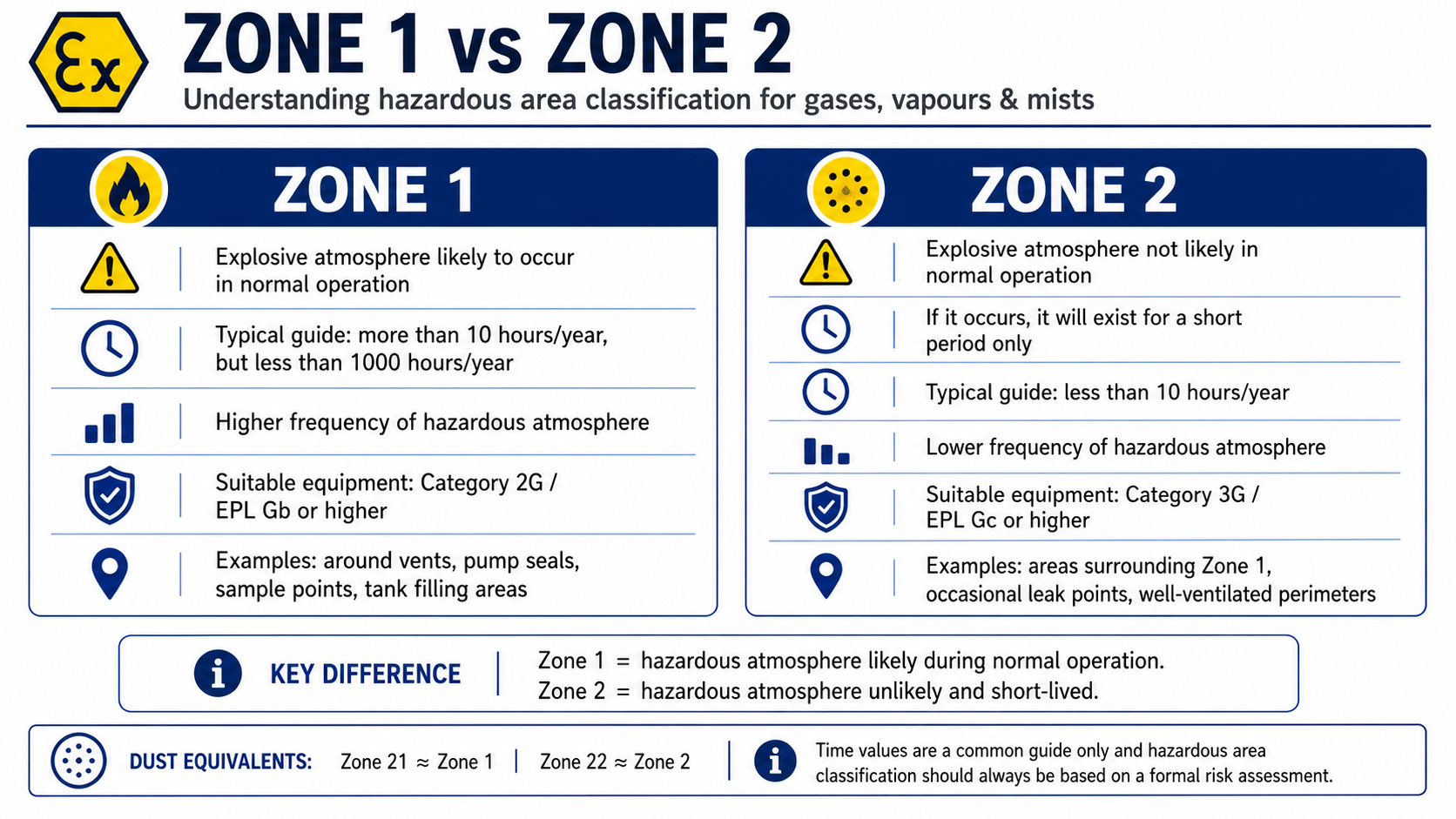
Zone 1 and Zone 2 hazardous areas are classified locations where flammable gases, vapours or mists may create an explosive atmosphere. The main difference is how likely the explosive atmosphere is to occur during normal operation. Zone 1 is higher risk because an explosive atmosphere is likely to occur occasionally, while Zone 2 is lower risk because an explosive atmosphere is not likely during normal operation and, if it occurs, should only exist for a short time.
Understanding the difference between Zone 1 vs Zone 2 is essential when selecting hazardous area equipment, including ATEX lighting, heaters, enclosures, plugs, sockets, isolators, gas detection, heat trace and static grounding systems.
Quick Answer: Zone 1 vs Zone 2
Zone 1 is a hazardous area where an explosive gas, vapour or mist atmosphere is likely to occur occasionally during normal operation. Zone 2 is a hazardous area where an explosive atmosphere is not likely to occur during normal operation, and if it does occur, it is expected to exist only for a short time.
What Is a Zone 1 Hazardous Area?
A Zone 1 hazardous area is a location where an explosive atmosphere consisting of flammable gas, vapour or mist is likely to occur occasionally during normal operation. This does not mean that an explosive atmosphere is always present, but it means the risk is credible enough during normal site activity to require carefully selected certified equipment.
Zone 1 areas may be found near process equipment, vents, filling points, pumps, valves, sampling points, tanker loading areas, chemical handling areas, fuel transfer systems and other locations where flammable substances may be released during normal operation.
Typical examples may include:
- Areas around pump seals where flammable vapours may be released occasionally.
- Filling or transfer points where vapour release is possible during routine operation.
- Process plant areas where gases or vapours may be present during normal production or maintenance cycles.
- Chemical and petrochemical processing areas where flammable materials are handled regularly.
- Offshore and marine environments where gas or vapour release risks must be controlled.
Because Zone 1 carries a higher likelihood of explosive atmosphere than Zone 2, equipment used in Zone 1 must be selected with particular care. Products should be checked for the correct ATEX marking, certificate scope, gas group, temperature class and any special conditions of safe use.
What Is a Zone 2 Hazardous Area?
A Zone 2 hazardous area is a location where an explosive gas, vapour or mist atmosphere is not likely to occur in normal operation. If it does occur, it is expected to exist only for a short time.
Zone 2 areas are still hazardous areas. They require suitable ignition control, certified equipment and correct installation practices, but the likelihood and expected duration of explosive atmosphere is lower than Zone 1.
Typical Zone 2 examples may include:
- Areas surrounding Zone 1 locations where vapours could spread under abnormal or short-duration conditions.
- Well-ventilated process areas where flammable release is not expected during normal operation.
- Storage and handling areas where flammable substances are present but releases are normally controlled.
- Outdoor process plant where ventilation may reduce the persistence of explosive atmospheres.
- Secondary release areas where failure or abnormal operation could create a temporary hazard.
Although Zone 2 is lower risk than Zone 1, it still requires certified equipment. A standard industrial product should not be used in Zone 2 unless it is specifically certified and marked as suitable for that hazardous area.
Zone 1 vs Zone 2: Key Differences
The difference between Zone 1 and Zone 2 is based on the likelihood and expected duration of the explosive atmosphere. This is important because it directly affects the required level of equipment protection.
A product that is suitable for Zone 1 may also be suitable for Zone 2 in many cases, provided the full marking, certificate and installation conditions are appropriate. However, the reverse is not normally true: equipment certified only for Zone 2 should not be assumed suitable for Zone 1.
Zone Classification & Equipment Selection
Hazardous area classification is the process of identifying where explosive atmospheres may occur and classifying those areas into zones. The classification should consider the type of flammable substance, release source, ventilation, operating conditions, duration of release and likelihood of explosive atmosphere formation.
Equipment selection should then be based on the classified zone and the full hazardous area conditions, including:
- Zone classification – Zone 0, Zone 1, Zone 2, Zone 20, Zone 21 or Zone 22.
- Gas, vapour, mist or dust risk – the product must be suitable for the specific atmosphere.
- Gas group or dust group – for example IIA, IIB or IIC for gas atmospheres.
- Temperature class – the maximum equipment surface temperature must be suitable for the hazardous substance.
- Equipment Protection Level – the EPL must match the required level of protection.
- Ambient temperature range – certification may only apply within defined temperature limits.
- Special conditions of safe use – shown by an “X” suffix on some certificates.
Read more in our full guide to Hazardous Area Zones Definitions.
External reference: HSE guidance explains that areas where hazardous explosive atmospheres may occur must be classified into zones.
ATEX Categories for Zone 1 & Zone 2
ATEX equipment categories help identify the level of protection provided by equipment. For gas atmospheres, the common relationship between categories and zones is shown below.
For combustible dust atmospheres, the equivalent zone structure uses Zone 20, Zone 21 and Zone 22, with equipment categories commonly identified as 1D, 2D and 3D.
Related guide: ATEX Marking Explained.
Equipment Protection Levels
An Equipment Protection Level, or EPL, identifies the level of ignition protection provided by equipment. EPL markings are commonly used in Ex markings and help show whether equipment is suitable for different hazardous area zones.
EPL should not be checked in isolation. It must be reviewed alongside the full Ex marking, certificate number, gas or dust group, temperature class, ambient temperature and installation requirements.
Gas, Vapour, Mist & Dust Zones
Zone 1 and Zone 2 normally refer to gas, vapour or mist hazardous areas. For combustible dust atmospheres, the equivalent classifications are Zone 21 and Zone 22.
A product marked for gas atmospheres should not automatically be assumed suitable for dust atmospheres. The marking must specifically confirm dust suitability, and the equipment must be assessed against the dust classification, maximum surface temperature and installation environment.
Related guide: Dust Protected Enclosures for Zone 21 & Zone 22.
Zone 1 Equipment Examples
Zone 1 hazardous area equipment is used where explosive atmospheres are likely to occur occasionally during normal operation. These environments normally require equipment with a high level of protection and the correct ATEX or IECEx certification for the application.
Examples of Zone 1 equipment include:
- ATEX lighting for hazardous area illumination in chemical, petrochemical, offshore and process environments.
- Hazardous area heaters for Zone 1 and Zone 2 applications.
- ATEX enclosures and junction boxes for certified power, control and instrumentation circuits.
- ATEX plugs, sockets and connectors for hazardous area power connection and disconnection.
- ATEX isolators for safe local isolation in hazardous environments.
- Hazardous area heat trace systems for frost protection and process temperature maintenance.
- Static grounding systems for controlling electrostatic ignition risks during transfer and process operations.
When selecting Zone 1 equipment, the marking may include references such as II 2G and Gb, depending on the certification route and equipment type. Always check the product certificate and datasheet.
Zone 2 Equipment Examples
Zone 2 hazardous area equipment is used where explosive atmospheres are not expected during normal operation, and if they do occur, they should only exist for a short period. Zone 2 is lower likelihood than Zone 1, but it is still a classified hazardous area.
Examples of Zone 2 equipment include:
- Hazardous area lighting for Zone 2 industrial and process environments.
- Ex n reduced risk equipment for suitable Zone 2 applications.
- Hazardous area connectors for certified connection systems.
- Process pressure measurement equipment for industrial process control applications.
- Trace heating systems for Zone 2 frost protection and temperature maintenance applications.
Zone 2-only equipment should not be installed in Zone 1 unless the certificate and marking clearly confirm suitability for Zone 1. The correct selection must be based on the full site classification and product certification.
Common Zone 1 & Zone 2 Mistakes
Misunderstanding hazardous area zones can lead to unsafe equipment selection, poor compliance and unnecessary project risk.
Common mistakes include:
- Assuming Zone 2 equipment can be used in Zone 1 – Zone 1 requires a higher level of protection because explosive atmospheres are more likely.
- Selecting equipment based only on the word “ATEX” – the full marking, certificate and conditions of use must be checked.
- Ignoring gas group – equipment suitable for IIA should not automatically be used in IIB or IIC atmospheres.
- Overlooking temperature class – the equipment surface temperature must be suitable for the ignition temperature of the hazardous atmosphere.
- Confusing gas zones and dust zones – Zone 1 and Zone 2 relate to gas, vapour and mist; Zone 21 and Zone 22 relate to combustible dust.
- Ignoring accessories – cable glands, plugs, stopping plugs, adapters and other accessories must maintain the integrity of the certified installation.
- Missing special conditions of use – certificates with an “X” suffix require specific conditions to be followed.
- Relying on old assumptions – hazardous area classification should be reviewed if processes, substances, ventilation or plant layout change.
For critical applications, equipment selection should be supported by competent hazardous area assessment, correct documentation and manufacturer guidance.
Zone 1 vs Zone 2 FAQs
Q: What is the difference between Zone 1 and Zone 2?
A: Zone 1 is a hazardous area where an explosive gas, vapour or mist atmosphere is likely to occur occasionally during normal operation. Zone 2 is a hazardous area where an explosive atmosphere is not likely during normal operation, and if it occurs, it should only exist for a short time.
Q: Is Zone 1 more hazardous than Zone 2?
A: Yes. Zone 1 generally represents a higher likelihood of explosive atmosphere than Zone 2. This is why Zone 1 equipment normally requires a higher level of protection than equipment intended only for Zone 2.
Q: Can Zone 1 equipment be used in Zone 2?
A: Zone 1 equipment may often be suitable for Zone 2 if the full marking, certificate, gas group, temperature class, ambient rating and installation conditions are suitable. However, equipment should never be selected on zone alone; the full certification must be checked.
Q: Can Zone 2 equipment be used in Zone 1?
A: No, not unless the equipment is also certified and marked as suitable for Zone 1. Equipment certified only for Zone 2 should not be used in Zone 1 because Zone 1 has a higher likelihood of explosive atmosphere.
Q: What ATEX category is required for Zone 1?
A: Category 2G equipment is commonly associated with Zone 1 gas atmospheres. The final selection must also consider the gas group, T-class, equipment protection level, ambient temperature and certificate conditions.
Q: What ATEX category is required for Zone 2?
A: Category 3G equipment is commonly associated with Zone 2 gas atmospheres. However, the product must still be suitable for the gas group, temperature class, ambient conditions and application.
Q: Are Zone 1 and Zone 2 only for gas?
A: Zone 1 and Zone 2 usually refer to gas, vapour or mist explosive atmospheres. For combustible dust atmospheres, the equivalent classifications are Zone 21 and Zone 22.
Q: Is ATEX certification enough to confirm suitability?
A: No. The product must be ATEX or IECEx certified for the correct zone, gas or dust group, temperature class, EPL, ambient temperature and installation conditions. The certificate and manufacturer instructions should always be checked.
Conclusion
Zone 1 and Zone 2 hazardous areas are both classified locations where explosive atmospheres may occur, but the likelihood and duration of the hazard are different. Zone 1 is higher risk because an explosive atmosphere is likely to occur occasionally during normal operation. Zone 2 is lower risk because an explosive atmosphere is not expected in normal operation and, if it occurs, should only exist for a short time.
When selecting equipment for Zone 1 or Zone 2, the safest approach is to check the complete certification picture: ATEX marking, IECEx certification where applicable, equipment category, EPL, gas group, temperature class, ambient temperature, accessories, installation instructions and any special conditions of safe use.
Thorne & Derrick supply ATEX and IECEx certified equipment for Zone 1 and Zone 2 hazardous areas, including lighting, heaters, heat trace systems, enclosures, isolators, plugs, sockets, gas detection, process instrumentation and static grounding systems.