What Is an ATEX Explosion Proof Fan? | Hazardous Area Fans
Published 13 Oct 2026
An ATEX explosion proof fan is a ventilation fan designed and certified for use in hazardous areas where flammable gases, vapours, mists or combustible dusts could create a potentially explosive atmosphere. These fans are more accurately described as ATEX fans, Ex fans, hazardous area fans or explosion-protected ventilation fans.
Unlike a standard industrial fan, an ATEX certified fan must be designed to control both electrical and mechanical ignition risks. This includes the motor, electrical components, fan casing, impeller, rotating parts, static electricity, surface temperature and potential contact between moving and stationary components. ATEX fans are commonly used for hazardous area ventilation, extraction and air movement in Zone 1 and Zone 2 environments.
Quick Answer: What Is an ATEX Explosion Proof Fan?
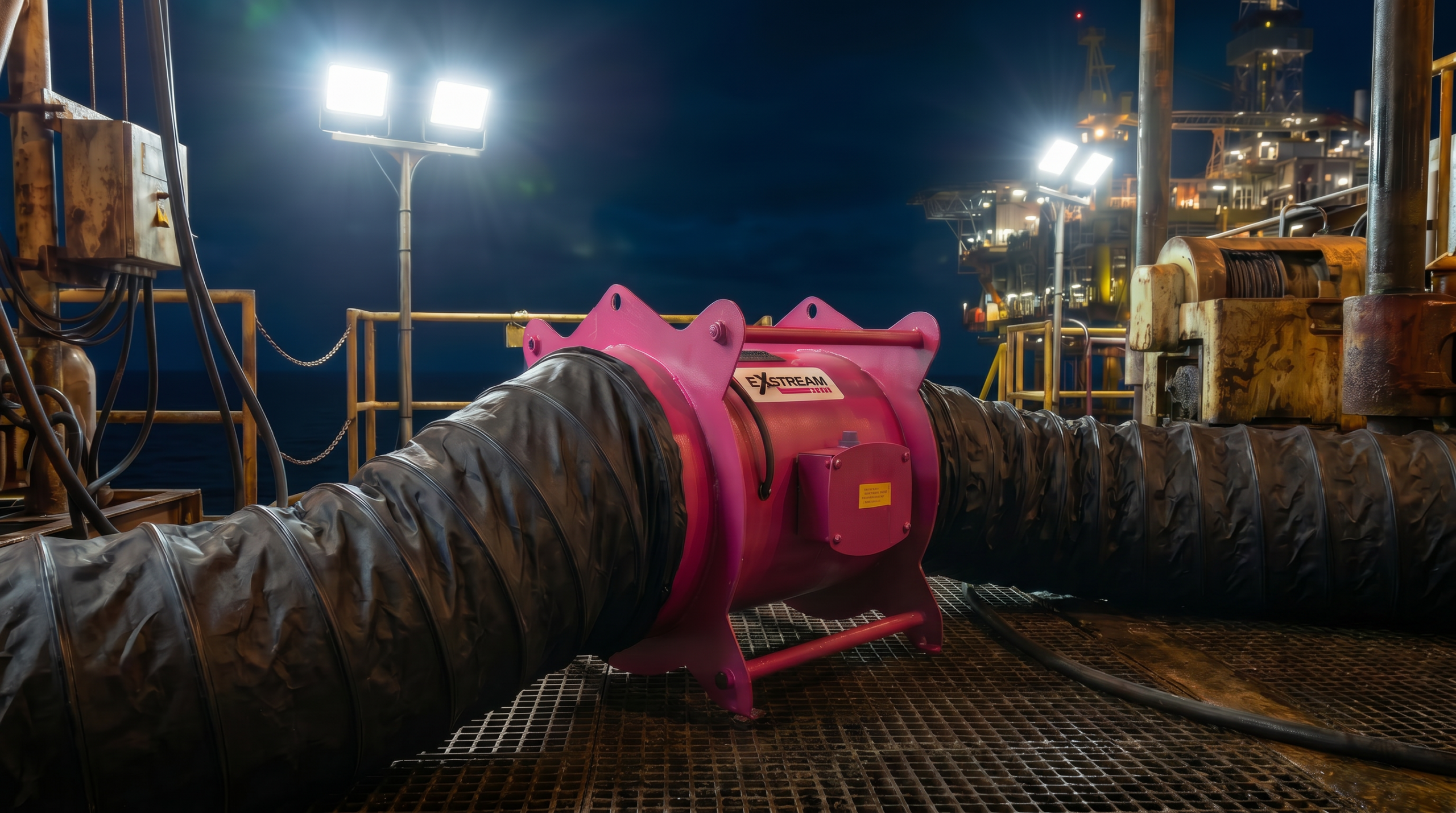
An ATEX explosion proof fan is a fan certified for use in potentially explosive atmospheres where ordinary ventilation equipment could become an ignition source. It is designed to reduce the risk of ignition from electrical sparks, hot surfaces, static electricity, mechanical friction, impact, overheating or contact between rotating and stationary parts.
The term “explosion proof fan” is widely searched, but in ATEX and IECEx environments the more accurate term is usually ATEX certified fan, Ex fan or hazardous area ventilation fan. The fan must be selected according to the hazardous area zone, gas or dust group, temperature class, equipment category, Equipment Protection Level and application.
What Is an ATEX Fan?
An ATEX fan is a ventilation fan designed for use in areas where an explosive atmosphere may occur. The fan must be manufactured, certified and marked for the hazardous area conditions where it will be used.
ATEX fans are used to move air safely in environments where flammable gases, vapours, mists or combustible dusts may be present. Depending on the application, they may be used to:
- extract hazardous vapours from a tank, vessel, room or process area;
- supply fresh air into a confined space or working area;
- support forced ventilation before, during or after maintenance work;
- reduce the persistence of a flammable atmosphere where ventilation is part of the control strategy;
- support safe working conditions in hazardous industrial environments.
ATEX fans are different from ordinary industrial fans because they must consider both electrical ignition sources and mechanical ignition sources. A certified motor alone does not automatically make a complete fan assembly suitable for hazardous area use.
Related guide: The ATEX Fan Guide.
Does “Explosion Proof Fan” Mean the Fan Cannot Explode?
No. The phrase “explosion proof fan” can be misleading if it is taken literally. It does not mean a fan is impossible to damage, impossible to fail or guaranteed to prevent every explosion. In hazardous area terminology, it normally means the fan has been designed and certified to reduce ignition risks when used within its certified limits.
In UK and European ATEX terminology, the safer and more accurate wording is usually:
- ATEX fan;
- ATEX certified fan;
- Ex fan;
- hazardous area fan;
- explosion-protected fan;
- ATEX/IECEx portable ventilation fan.
The fan must still be selected, installed, operated and maintained correctly. Using the wrong fan, wrong ducting, wrong accessories or wrong certification for the zone can create a serious ignition risk.
Related guide: ATEX vs IECEx: What’s the Difference?.
Why Standard Fans Are Unsafe in Hazardous Areas
A standard fan should not be used in a hazardous area unless it has been specifically assessed and certified for that environment. Ordinary industrial fans can create ignition sources through both electrical and mechanical mechanisms.
Potential ignition risks include:
- electrical sparks from motors, switches, controls or damaged components;
- hot surfaces caused by overheating, restricted airflow or motor faults;
- mechanical friction between rotating and stationary parts;
- impact sparks from foreign objects, damaged impellers or casing contact;
- static electricity generated by airflow, ducting, flexible hoses or material movement;
- bearing failure, imbalance or vibration leading to heat or mechanical contact;
- incorrect accessories such as non-certified plugs, cables, ducts or control equipment.
A hazardous area fan must therefore be treated as a complete system. The motor may be certified, but the fan assembly, impeller, casing, clearances, materials, earthing, ducting and accessories also matter.
Related technical article: Mechanical Ignition Sources in ATEX Fan Systems.
How ATEX Fans Reduce Ignition Risk
ATEX fans reduce ignition risk by controlling the potential ignition sources that can arise during fan operation. Because fans contain rotating parts and create airflow, explosion protection is not only about electrical certification.
An ATEX fan may use a combination of:
- certified electrical components suitable for the hazardous area zone;
- anti-static or conductive materials where required by the design;
- controlled clearances between rotating and stationary parts;
- suitable impeller and casing materials to reduce friction or impact ignition risks;
- temperature control to prevent surfaces exceeding the certified T-class;
- earthing and bonding arrangements to help control static electricity;
- certified plugs, cables and controls suitable for the installation;
- maintenance requirements to prevent imbalance, wear, blockage and bearing failure.
ATEX Fans for Zone 1 & Zone 2
ATEX fans are selected according to the hazardous area zone and the type of explosive atmosphere present. For gas, vapour or mist atmospheres, the most common zones are Zone 0, Zone 1 and Zone 2.
Most portable hazardous area ventilation applications involve Zone 1 or Zone 2 environments, but the exact classification must always be confirmed by the site risk assessment and hazardous area classification.
A fan suitable for Zone 1 may often be suitable for Zone 2 if the full certification, gas group, T-class and operating conditions are appropriate. However, a Zone 2-only fan should not be assumed suitable for Zone 1.
Related guide: Zone 1 vs Zone 2 Hazardous Areas.
ATEX Fan Certification & Marking Explained
An ATEX fan should have clear certification and marking showing where it can be used. The marking may include the equipment group, category, gas or dust suitability, protection method, gas group, temperature class and Equipment Protection Level.
Example markings vary depending on the fan type and certification, but may include elements such as:
- II – equipment for surface industries, rather than mining;
- 2G – Category 2 equipment for gas atmospheres, commonly associated with Zone 1;
- 3G – Category 3 equipment for gas atmospheres, commonly associated with Zone 2;
- IIA, IIB or IIC – gas group suitability;
- T1 to T6 – temperature class;
- Gb or Gc – Equipment Protection Level for gas atmospheres.
Related guides:
Electrical & Mechanical Ignition Risks
One of the most important things to understand about ATEX fans is that a fan is not only an electrical product. It is also a mechanical rotating machine. This means a compliant hazardous area fan must consider mechanical ignition risks as well as electrical ignition risks.
Potential mechanical ignition sources include:
- impeller contact with the fan casing;
- bearing failure causing heat, friction or imbalance;
- foreign object impact inside the fan;
- excessive vibration from imbalance, damage or incorrect installation;
- blocked airflow causing overheating;
- static electricity from airflow, ducting or material movement;
- incorrect maintenance affecting clearances, fasteners or rotating parts.
This is why a fan should not be treated the same as a fixed electrical enclosure or junction box. The complete fan system must be suitable for the hazardous area duty.
Related technical article: Mechanical Ignition Sources in ATEX Fan Systems.
Portable ATEX Fans & Confined Space Ventilation
Portable ATEX fans are commonly used where temporary ventilation is needed in hazardous areas or confined spaces. They may be used for extraction, blowing or air movement during inspection, maintenance, cleaning, shutdown work, tank entry or emergency preparation.
Portable ATEX fan applications may include:
- tank and vessel ventilation before or during confined space work;
- removal of flammable vapours from process areas;
- temporary airflow during shutdowns and maintenance;
- ventilation of pits, sumps, ducts or enclosed workspaces;
- support for gas freeing or purging activities where appropriate procedures are in place;
- air movement in Zone 1 or Zone 2 areas where certified equipment is required.
When using portable fans, the fan is only one part of the system. The ducting, cable, plug, controller, earthing, bonding and operating position must also be suitable for the hazardous area and the task.
Related products:
How to Choose an ATEX Explosion Proof Fan
Choosing an ATEX fan is not simply a case of buying the highest airflow fan available. The fan must be suitable for the hazardous area, the atmosphere, the work activity and the complete ventilation setup.
A practical selection process should include:
- Confirm the hazardous area zone – for example Zone 1, Zone 2, Zone 21 or Zone 22.
- Confirm the atmosphere – gas, vapour, mist, dust or a combination of hazards.
- Check the gas or dust group – for example IIA, IIB, IIC or relevant dust group.
- Check the temperature class – the fan must not exceed the permitted surface temperature.
- Confirm the required airflow – including extraction rate, air changes, duct losses and work area size.
- Check whether the fan is for supply or extraction – the position of the fan can affect certification requirements and risk.
- Check ducting compatibility – duct material, length, static build-up and airflow resistance must be considered.
- Check electrical supply and accessories – plugs, cables, isolators and controls must be suitable for the hazardous area.
- Check certification documents – the certificate must match the exact fan model and application.
- Review inspection and maintenance requirements – portable and fixed fans require suitable checks before use.
For hazardous area ventilation, it is often better to speak to a specialist before specifying equipment. The wrong fan can create a false sense of safety.
Common Applications for ATEX Fans
ATEX fans are used across industries where flammable gases, vapours, mists or dusts may be present. They are often used during maintenance, inspection, production, shutdown and confined space activities.
Typical applications include:
- oil and gas facilities – offshore platforms, refineries, terminals and process areas;
- chemical and petrochemical plants – solvent handling, process rooms and maintenance areas;
- fuel storage and transfer areas – tank farms, tanker loading and fuel distribution sites;
- pharmaceutical manufacturing – solvent-based production and cleaning processes;
- water and wastewater treatment – process areas where flammable gases may occur;
- marine and shipyard work – tank entry, cleaning and confined space ventilation;
- industrial shutdowns – temporary ventilation during inspection, maintenance and repair;
- paint, coating and solvent areas – controlled ventilation where flammable vapours may be present.
Thorne & Derrick support hazardous area industries with ATEX and IECEx equipment for ventilation, lighting, heating, power, process instrumentation and safety applications.
ATEX Fan vs Standard Industrial Fan
The difference between an ATEX fan and a standard industrial fan is not just the label. ATEX fans are designed and certified for use where explosive atmospheres may occur. Standard fans are not designed for those risks unless they have specific hazardous area certification.
A standard fan should never be used as a substitute for an ATEX fan in a classified hazardous area.
Common ATEX Fan Mistakes
ATEX fan selection mistakes can create serious safety risks. Common errors include:
- assuming a certified motor makes the whole fan ATEX compliant – the complete fan assembly must be suitable;
- using a Zone 2 fan in a Zone 1 area – equipment must match the zone classification;
- ignoring mechanical ignition risks – fans have rotating parts, bearings, clearances and vibration risks;
- using unsuitable ducting – duct material, static build-up and airflow resistance must be considered;
- forgetting gas group and T-class – certification must match the actual atmosphere;
- assuming “explosion proof” is enough – the actual certificate and marking must be checked;
- using non-certified plugs or cables – accessories can compromise the installation;
- not inspecting the fan before use – damage, blockage, vibration or wear can affect safety;
- placing the fan in the wrong location – supply/extract position and fan location can affect risk;
- not checking certificate conditions – special conditions of safe use may apply.
A safe ATEX ventilation setup requires the correct fan, correct accessories, correct application and correct operating procedure.
ATEX Explosion Proof Fan FAQs
Q: What is an ATEX explosion proof fan?
A: An ATEX explosion proof fan is a fan certified for use in potentially explosive atmospheres. It is designed to control ignition risks from electrical components, mechanical movement, hot surfaces, static electricity and other sources that could ignite flammable gases, vapours, mists or dusts.
Q: Is “explosion proof fan” the correct term?
A: “Explosion proof fan” is a common search term, but in ATEX and IECEx environments the more accurate terms are ATEX fan, Ex fan, hazardous area fan or explosion-protected ventilation fan. The important factor is the actual certification and marking, not the phrase used to describe it.
Q: Can I use a normal fan in a hazardous area?
A: No. A normal industrial fan should not be used in a classified hazardous area unless it is specifically certified and marked as suitable. Standard fans can create ignition risks from sparks, hot surfaces, static electricity, mechanical contact or overheating.
Q: What is a Zone 1 ATEX fan?
A: A Zone 1 ATEX fan is certified for use in areas where an explosive gas, vapour or mist atmosphere is likely to occur occasionally during normal operation. The fan must have the correct equipment category, EPL, gas group, T-class and certificate conditions for the application.
Q: What is a Zone 2 ATEX fan?
A: A Zone 2 ATEX fan is certified for use where an explosive atmosphere is not likely during normal operation, and if it occurs, it should only exist for a short time. Zone 2-only equipment should not be assumed suitable for Zone 1.
Q: Does an ATEX motor make a fan ATEX certified?
A: No. An ATEX motor alone does not automatically make the complete fan assembly suitable for hazardous area use. The fan casing, impeller, clearances, materials, static control, accessories and mechanical ignition risks must also be considered and certified as part of the fan system.
Q: What should I check before buying an ATEX fan?
A: Check the hazardous area zone, gas or dust group, T-class, required airflow, fan duty, ducting, power supply, accessories, certificate number, ATEX marking and manufacturer instructions. The complete ventilation system must be suitable for the application.
Q: Are ATEX fans used for confined spaces?
A: Yes. Portable ATEX fans are commonly used for confined space ventilation where flammable gases, vapours or mists may be present. The fan, ducting, electrical supply, controls and operating procedure must all be suitable for the hazardous area and task.
Q: What is the difference between an ATEX fan and an IECEx fan?
A: ATEX relates to European equipment requirements for potentially explosive atmospheres, while IECEx is an international certification system. Many hazardous area fans may be supplied with both ATEX and IECEx certification. Read more in our guide to ATEX vs IECEx.
Conclusion
An ATEX explosion proof fan is a certified hazardous area fan designed to provide ventilation or extraction in potentially explosive atmospheres while controlling ignition risks. Although “explosion proof fan” is a common search term, the more technically accurate wording is usually ATEX fan, Ex fan, hazardous area ventilation fan or explosion-protected fan.
The key point is that a hazardous area fan must be selected as a complete certified system. The motor, fan casing, impeller, clearances, ducting, electrical accessories, gas group, temperature class, zone suitability and certificate conditions all matter.
Thorne & Derrick supply ATEX and IECEx certified hazardous area fans for demanding industrial, offshore, petrochemical, confined space and process ventilation applications, with technical support to help customers select suitable equipment for explosive atmosphere environments.