Sounder vs Beacon vs Combination Unit | Guide
Published 07 Sep 2026
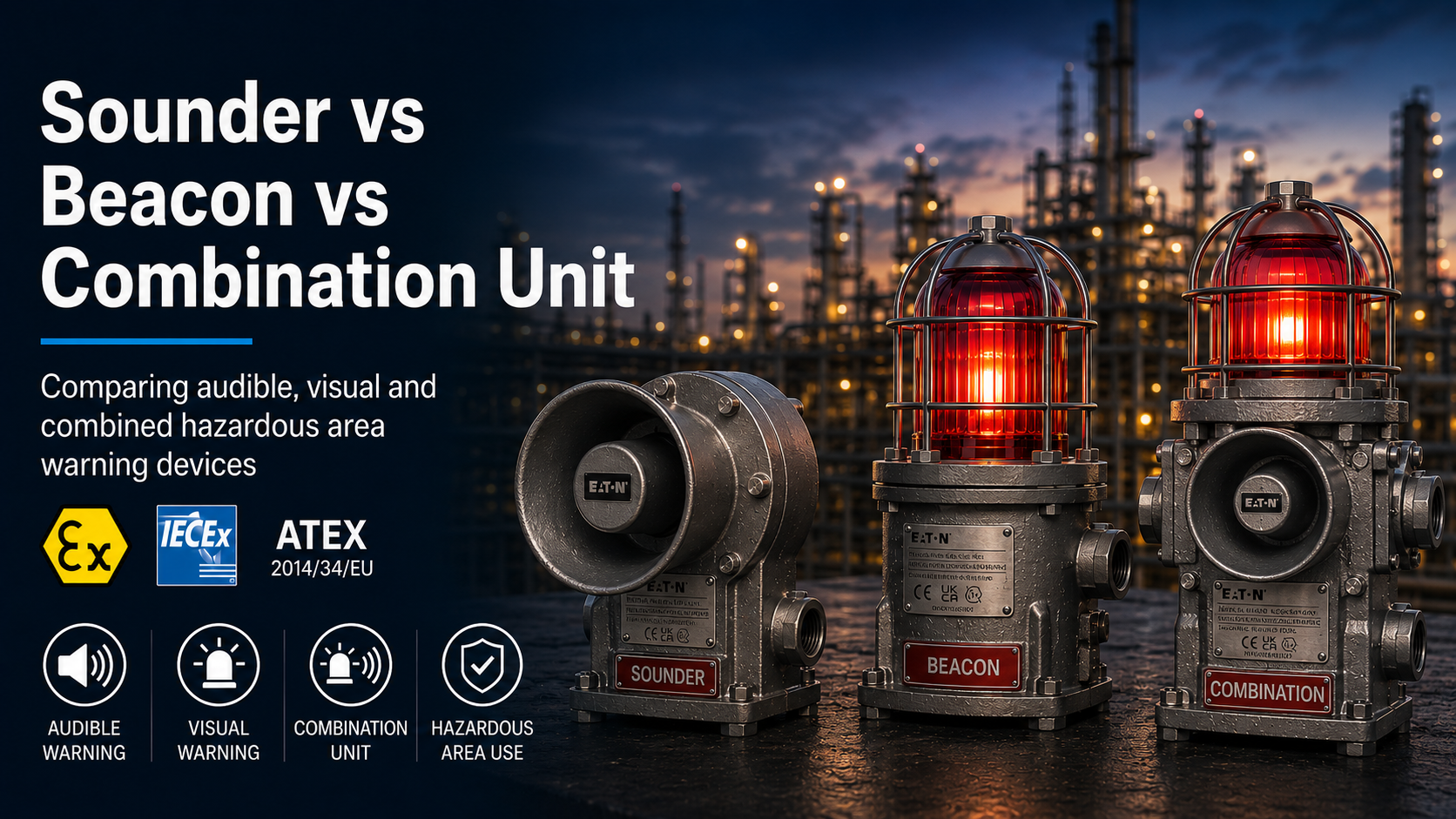
Sounders, beacons and combination units communicate alarms and equipment conditions in different ways. A sounder produces an audible warning, a beacon provides a visual signal, and a combination unit brings both warning methods together within one assembly.
The correct choice depends on who must receive the warning, the surrounding noise and lighting conditions, the required alarm response and the hazardous area classification.
Thorne & Derrick supplies a comprehensive range of hazardous area sounders, beacons and combination units for audible, visual and combined signalling in potentially explosive atmospheres.
Quick answer: select a sounder where personnel must hear the alarm, a beacon where they must see it, and a combination unit where audible and visual warning should be provided from the same signalling point. The final choice must follow the site alarm philosophy and hazardous area specification.
In This Comparison
Sounder vs Beacon vs Combination Unit: Quick Comparison
| Device | Warning Method | Main Strength | Potential Limitation | Key Selection Data |
|---|---|---|---|---|
| Sounder | Audible alarm tone, horn or bell | Can alert personnel who are not looking towards the device | Recognition can be affected by high noise, distance or hearing protection | Sound output, tone, frequency, coverage, voltage and current |
| Beacon | Visual light signal | Provides a visible warning or persistent status indication | Requires a suitable line of sight and sufficient contrast | Light source, signal mode, colour, visibility, voltage and current |
| Combination Unit | Audible and visual signals | Provides two warning methods from one signalling location | Electrical demand, control logic and certification can be more complex | Sounder data, beacon data, input arrangement, mounting and total load |
Important: a combination unit is not automatically required for every alarm. The selected warning method should be based on the risk assessment, alarm philosophy, personnel needs and environmental conditions.
What Is a Hazardous Area Sounder?
A sounder is an audible signalling device that produces a tone, horn, siren or bell output when activated.
The signal can warn personnel of an emergency, communicate an evacuation instruction, indicate an equipment condition or distinguish between different alarm states.
Typical Sounder Applications
- Fire and gas detection alarms
- Evacuation or shelter-in-place warnings
- Process trip or shutdown alarms
- Machinery start-up warnings
- General emergency notification
- Site-specific coded alarm tones
Sound Output
Sounders are commonly specified using a sound-pressure level stated in dB(A) at a defined distance. The test distance and tone should be checked because output can vary between tone settings.
A higher stated sound output does not automatically guarantee that the alarm will be understood throughout the area. Machinery noise, walls, pipework, distance, hearing protection and the frequency content of the alarm can all affect recognition.
Tone Selection
Many electronic sounders provide several selectable tones. The chosen tone should remain recognisable against the background noise and distinct from other plant alarms.
Explore ATEX sounders for hazardous area audible warning.
What Is a Hazardous Area Beacon?
A beacon is a visual signalling device that uses light to communicate an alarm, warning, process event or equipment status.
Depending on the product, the visual output may be steady, blinking, flashing, strobe or rotating. LED, xenon, filament and fluorescent technologies can be available.
Typical Beacon Applications
- Visible fire or gas alarm indication
- Process fault or trip indication
- Machine, valve or plant status
- Emergency warning in high-noise areas
- Persistent visual status indication
- Colour-coded site alarm conditions
Visibility
Beacon visibility is influenced by the optical output, signal pattern, lens colour, ambient lighting, mounting position, viewing distance and surrounding obstructions.
A beacon may be particularly useful where personnel wear hearing protection, the background noise is high or a persistent visual status must remain available.
Explore ATEX beacons for hazardous area visual signalling.
What Is a Sounder-Beacon Combination Unit?
A combination unit provides audible and visual warning from one assembled signalling point.
The sounder and beacon may be incorporated within one enclosure or assembled together on a common mounting plate. Backplate-mounted units can combine separate certified sounder and beacon products into one pre-arranged assembly.
Combined vs Independent Operation
Some combination units are pre-wired so that one input activates the sounder and beacon simultaneously. Other configurations can provide separate inputs or multi-stage control, allowing the audible and visual signals to operate independently.
The required input arrangement must therefore be confirmed before ordering. It should not be assumed from the product description alone.
Benefits of a Combination Unit
- Audible and visual warning from the same location
- Can reduce the number of separate mounting positions
- Can simplify installation where a pre-wired assembly is specified
- Provides complementary warning methods
- Can support personnel affected by either noise or visibility limitations
- Can be configured around different sounder and beacon technologies
Combination-Unit Considerations
- Total current consumption
- Single or independent activation inputs
- Required sound output and visual output
- Overall dimensions and mounting loads
- Cable-entry and termination arrangements
- Certification of the complete assembly
- Maintenance access to both signalling devices
Explore hazardous area sounder-beacon combination units.
When Should You Select a Sounder, Beacon or Combination Unit?
Consider a Sounder When:
- Personnel may not be looking towards the alarm point
- An evacuation tone or audible instruction is required
- The warning must extend beyond direct line of sight
- The alarm philosophy uses distinctive audible tones
- Background noise conditions have been properly assessed
Consider a Beacon When:
- A visual alarm or status indication is required
- The surrounding area is particularly noisy
- Personnel regularly wear hearing protection
- A persistent equipment or process state must remain visible
- Line of sight and visual contrast can be maintained
Consider a Combination Unit When:
- Both audible and visual notification are required
- Different personnel may recognise different warning methods
- One assembled signalling point is preferred
- Noise and visibility conditions vary across the area
- The control system supports the required input and electrical load
Audibility and Background Noise
Audible warning performance depends on more than the sounder’s maximum stated dB(A) output.
Consider:
- Normal and maximum background-noise levels
- Distance between the sounder and personnel
- Walls, enclosures, vessels and process equipment
- Frequency content of the background noise
- Hearing protection worn by personnel
- Other alarm tones operating in the area
- Required alarm coverage and response time
Where the audible alarm could be masked or misunderstood, a beacon or combination unit may provide an additional visual warning method.
Visibility and Line of Sight
A beacon must be positioned so that the intended personnel can see and interpret its signal from the required working locations.
Consider:
- Viewing distance
- Mounting height and orientation
- Direct sunlight and ambient lighting
- Structures or equipment blocking the signal
- Required horizontal and vertical field of view
- Lens or LED colour
- Steady, flashing, strobe or rotating operation
- Other visible alarms in the same area
Read Steady vs Flashing vs Rotating ATEX Beacons for a comparison of visual signal modes.
Control and Wiring Requirements
The alarm-system design must support the selected product’s voltage, current consumption, switching and monitoring requirements.
| Control Requirement | Sounder | Beacon | Combination Unit |
|---|---|---|---|
| Electrical load | Sounder current at selected voltage and tone | Beacon current for selected colour and signal mode | Combined or independently switched load |
| Inputs | Single-stage or multi-stage tone activation | Fixed, selectable or remotely controlled mode | Common input or independent sounder and beacon inputs |
| Monitoring | Confirm system supervision and end-of-line requirements | Confirm monitoring compatibility and polarity | Confirm supervision for both circuits or the combined assembly |
Do not assume simultaneous operation: some combination units use one common input, while others support independent or multi-stage activation. Confirm the wiring arrangement from the current product documentation.
Hazardous Area Certification
Sounder, beacon or combination-unit selection must begin with the complete hazardous area specification.
Check:
- Zone 1, Zone 2, Zone 21 or Zone 22 classification
- Gas, vapour, mist or combustible-dust atmosphere
- Gas or dust group
- Equipment category and equipment protection level
- Protection concept
- Temperature class or maximum surface temperature
- Permitted ambient-temperature range
- Required ATEX, UKEX, IECEx or other regional approval
Read the guide to ATEX and IECEx certification of hazardous area equipment.
See also hazardous area zones and explosive atmosphere classification.
Environmental and Installation Conditions
Hazardous area certification does not automatically establish suitability for every outdoor, offshore, marine or corrosive location.
Review:
- Ingress-protection rating
- Enclosure material and corrosion resistance
- Salt spray and marine exposure
- Chemical or hydrocarbon exposure
- UV and weather conditions
- Vibration and mechanical impact
- Minimum and maximum ambient temperature
- Mounting arrangement and structural support
Sounder, Beacon or Combination Unit Selection Checklist
| Question | Selection Consideration |
|---|---|
| Who must receive the warning? | Personnel location, duties, hearing protection and line of sight |
| What response is required? | Evacuate, stop, investigate, acknowledge or continue normal operation |
| Is the area noisy? | Check whether an audible signal will remain recognisable |
| Is the beacon visible? | Assess mounting, viewing distance, lighting and obstructions |
| Are both signals required? | Determine whether separate or combined devices are more suitable |
| How will the unit be controlled? | Single input, independent inputs, multi-stage operation and monitoring |
| What is the hazardous area? | Zone, atmosphere, group, temperature and complete certification |
| What environment will it face? | Outdoor, offshore, chemical, dust, corrosion, vibration and temperature |
Information Required When Specifying the Equipment
Related Hazardous Area Signalling Guides
Common Selection Mistakes
Sounder, Beacon and Combination Unit FAQs
Is a beacon a replacement for a sounder?
Not automatically. A beacon provides a visual signal while a sounder provides an audible signal. The required alarm method should be determined by the risk assessment and alarm philosophy.
Is a combination unit always safer?
Not in every application. It provides two notification methods, but coverage, positioning, control, electrical load and the required personnel response must still be assessed.
Can the sounder and beacon operate independently?
Some combination units support independent or multi-stage control, while others use one common input. The required arrangement must be confirmed before ordering.
Is the loudest sounder always the best choice?
No. The tone must be audible and recognisable in the intended area without creating unsuitable sound levels. Background noise, distance and frequency are all relevant.
Should high-noise areas always use a beacon?
A visual signal can support alarm recognition in high noise, but its visibility and line of sight must also be assessed. A combination of warning methods may be appropriate.
Does the warning method determine the hazardous area zone?
No. Zone suitability is determined by the complete equipment certification and marking, not by whether the product is audible, visual or combined.
Need Help Selecting an Audible or Visual Alarm?
Send Thorne & Derrick the hazardous area classification, required warning method, sound and visibility conditions, voltage and installation environment for product selection support.
Compare Hazardous Area Signalling Equipment
Explore audible, visual and combined warning devices for Zone 1, Zone 2, Zone 21 and Zone 22 installations.