LED vs Xenon ATEX Beacons
Published 10 Aug 2026
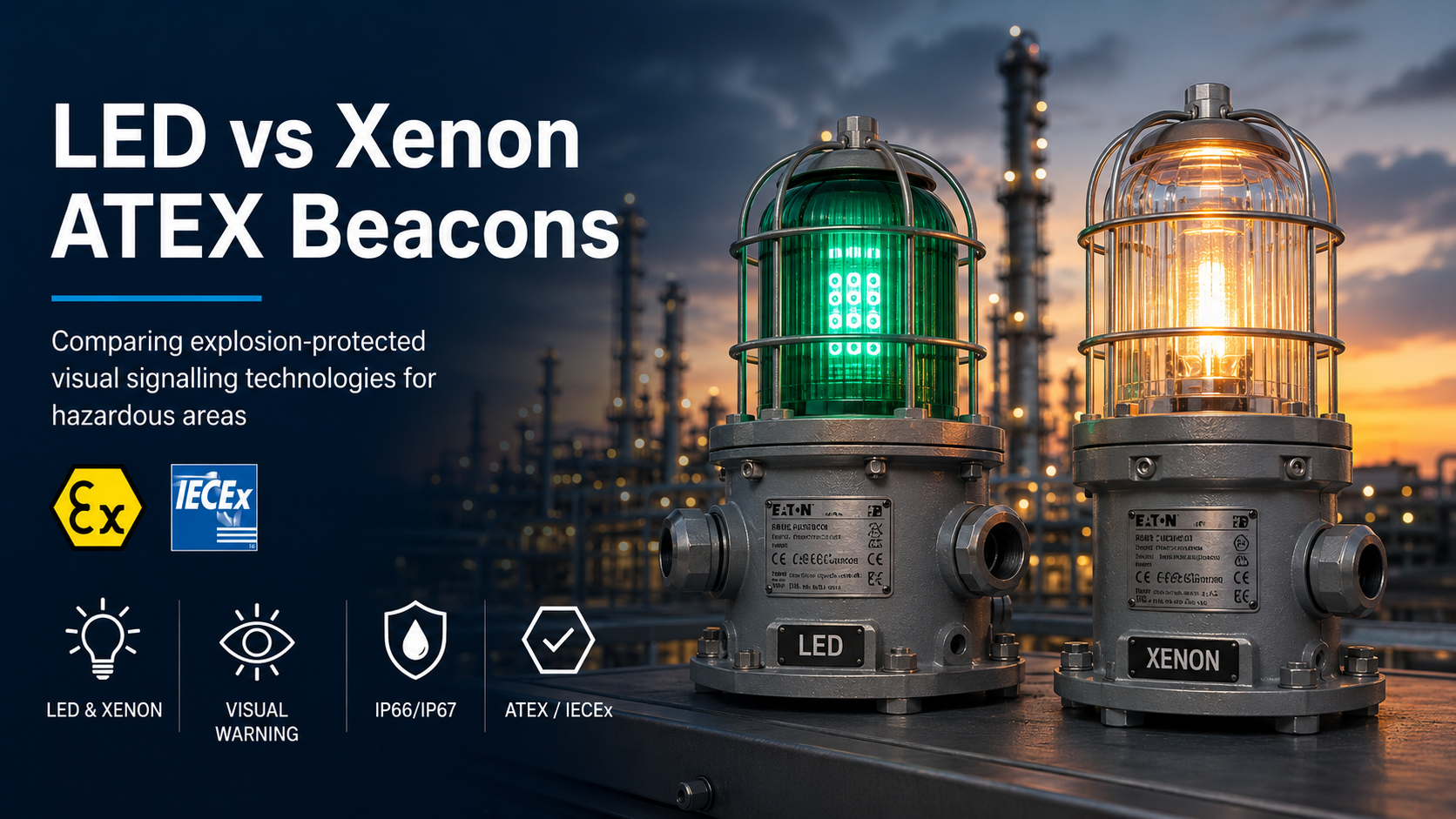
LED and xenon are two of the principal light-source technologies used in hazardous area visual signalling. Both can provide an effective warning, but they produce different signal patterns and are selected using different performance criteria.
An LED ATEX beacon can provide continuous or electronically controlled signalling, depending on the model. A xenon ATEX beacon uses a flash tube to produce a brief, high-intensity pulse and is normally specified by its flash energy in joules.
Thorne & Derrick supplies a comprehensive range of ATEX beacons incorporating LED, xenon, steady, flashing, strobe and electronically rotating visual signals. For a wider introduction to hazardous area visual signalling, read What Is an ATEX Beacon?
Quick answer: select LED where configurable signal modes, continuous indication or long solid-state operating life are priorities. Consider xenon where the specification calls for a defined high-intensity flash measured in joules. Certification and application suitability must be confirmed separately.
In This Comparison
LED vs Xenon ATEX Beacons: Quick Comparison
| Selection Factor | LED Beacon | Xenon Beacon |
|---|---|---|
| Light source | Light-emitting diodes | Xenon flash tube |
| Typical signal | Steady, blinking, strobe or electronically rotating, depending on model | Brief, high-intensity flashing signal |
| Common performance data | Optical intensity, operating pattern, frequency and current consumption | Flash energy in joules, flash frequency and current consumption |
| Continuous indication | Available on suitable models | Not the normal function of a xenon strobe |
| Configurable modes | Multiple electronic modes may be available | Normally a defined flash pattern |
| Service consideration | Solid-state light source with no xenon flash tube | Flash-tube operating life should be considered |
| Typical reason for selection | Flexible signalling, steady status indication or electronic rotating effect | Defined high-intensity pulsed warning |
Important comparison point: an LED beacon’s optical output and a xenon beacon’s flash energy are not directly interchangeable measurements. A stated number of joules should not be compared directly with a candela or lumen figure.
How Does an LED Hazardous Area Beacon Work?
An LED beacon uses an array of light-emitting diodes to generate the required visual signal. The LEDs may remain continuously illuminated or be controlled electronically to create blinking, pulsed or rotating effects.
The exact capabilities depend on the product. Some models provide only a single steady or flashing output, while others offer several modes selected during installation.
Typical LED Operating Modes
- Steady: continuous illumination for a persistent warning or equipment-status signal
- Blinking: a regular electronic on-and-off pattern
- Strobe: a rapid sequence of electronically controlled LED pulses
- Electronically rotating: LED segments illuminate in sequence to create the appearance of movement
Advantages of LED Signalling
- Multiple signal patterns may be available from one product platform
- Continuous visual indication can be provided
- Solid-state light source with no mechanical rotating assembly
- Suitable for alarm, notification and process-status applications
- Long operating life may reduce routine light-source replacement
These advantages should not be treated as universal. The actual power consumption, visibility, operating life and available modes depend on the selected model, voltage and colour.
How Does a Xenon Hazardous Area Beacon Work?
A xenon beacon stores electrical energy and discharges it through a xenon-filled flash tube. This creates a brief, intense pulse of light.
Xenon strobe performance is commonly described using flash energy in joules and flash frequency. A higher joule figure indicates greater energy released during each flash, but it does not independently determine visibility in every installation.
Advantages of Xenon Signalling
- Produces a distinct high-intensity pulsed signal
- Flash energy can be selected against a defined project specification
- Provides a clearly recognisable strobe-style warning
- Available in different energy, voltage and lens-colour configurations
The flash-tube operating life, current consumption and required energy level should be considered during selection. A higher-energy xenon strobe can require more electrical current than a lower-energy version.
Signal Patterns, Intensity and Visibility
The most important difference between LED and xenon is not simply which technology is brighter. The two technologies communicate visually in different ways.
LED Visual Signals
An LED signal can remain visible continuously or create a repeating electronic pattern. This can make LED suitable for process-status indication, persistent warnings or applications where several different modes are needed.
Xenon Visual Signals
A xenon strobe produces a short pulse followed by a period without illumination. This creates a visually distinctive alarm pattern, particularly where the project specifies a flash energy and frequency.
Site Conditions Affect Visibility
Visibility depends on more than the light source. Consider:
- Viewing distance
- Ambient lighting and direct sunlight
- Mounting height and orientation
- Obstructions, structures and process equipment
- Required field of view
- Lens or LED colour
- Flash or signal frequency
- Site alarm philosophy
Power Consumption, Service Life and Maintenance
Electrical Demand
LED is often associated with lower energy consumption, but this should not be assumed for every hazardous area beacon. Current demand can vary significantly according to voltage, LED colour, signal mode and optical output.
A high-output LED strobe mode may draw more current than a lower-output LED rotating pattern. Likewise, a 15J xenon beacon will normally have different electrical requirements from a 5J version.
The control-panel output, power supply, relay capacity, cable size and voltage-drop calculation should use the data for the exact ordered configuration.
Light-Source Life
LEDs are solid-state components and are frequently selected for applications where long service life and reduced routine replacement are priorities.
Xenon flash tubes have a stated or expected operating life based on the number of flashes. The anticipated alarm duty and testing schedule should therefore be considered.
Inspection Requirements
Neither technology removes the need for hazardous area inspection and maintenance. The enclosure, cable entries, seals, fasteners, lens, guard, earthing arrangements and equipment marking must remain in serviceable condition.
Does Lens Colour Affect LED and Xenon Performance?
Yes. The signal colour can affect the apparent output and visibility of both technologies.
Some LED products use coloured LEDs with a matching or transparent lens. Xenon products normally use a broad-spectrum flash tube with a coloured lens or dome.
Manufacturer performance data should be checked for the exact colour. The intended meaning must also be established by the site alarm philosophy or project specification rather than assumed from the colour alone.
Does the Light Source Affect ATEX Certification?
LED or xenon technology does not independently determine whether a beacon is suitable for a hazardous area. The complete certified product construction must be assessed.
Check:
- Hazardous area zone
- Gas or combustible-dust group
- Equipment category and protection level
- Protection concept
- Temperature class or maximum surface temperature
- Permitted ambient-temperature range
- Required ATEX, UKEX, IECEx or destination-market approval
Read the H&P guide to ATEX and IECEx certification of hazardous area equipment.
Should You Choose an LED or Xenon ATEX Beacon?
Consider LED When:
- A steady or persistent indication is required
- Several selectable electronic modes are beneficial
- An electronically rotating signal is required without moving components
- Long solid-state operating life is a project priority
- The signal is being used for both alarm and process-status functions
Consider Xenon When:
- The project specifies a flash energy in joules
- A distinct high-intensity pulsed warning is required
- The existing alarm philosophy is based on xenon strobes
- A defined flash frequency is required
- The supply and control system can support the required current
Neither technology is universally better. The correct choice is the one that satisfies the hazardous area specification, signal requirements, viewing conditions, electrical design and maintenance strategy.
For a complete step-by-step selection process, read How to Select an ATEX Beacon.
LED and Xenon Product Comparison: Eaton FHF dSLB20
The Eaton FHF dSLB20 family provides a useful example of the practical differences between the two technologies.
Eaton FHF dSLB20 LED
Provides steady, blinking, strobe and two electronically rotating operating patterns. It is suitable where configurable visual signalling is required.
Eaton FHF dSLB20 Xenon
Provides a xenon strobe signal with 5J and 15J options and an approximate flash frequency of 60 flashes per minute.
These examples do not replace product selection. Confirm the complete certification, temperature range, voltage, current, colour and installation requirements for the ordered version.
Common LED and Xenon Selection Mistakes
Information Required Before Selecting LED or Xenon
LED vs Xenon Beacon FAQs
Is an LED beacon brighter than a xenon beacon?
Not necessarily. The two technologies produce different signal characteristics and are often specified using different measurements. Compare the manufacturer’s optical data, signal pattern and intended viewing conditions.
Does LED use less power than xenon?
It can, but this is not universal. Current consumption depends on the product, voltage, LED colour, signal mode and required output. Use the exact electrical data for the selected configuration.
Can an LED beacon reproduce a xenon strobe?
Some LED products provide a strobe-style electronic pattern. However, its optical characteristics are not automatically equivalent to a xenon flash with a specified energy in joules.
Which technology requires less maintenance?
LED is frequently chosen for long solid-state light-source life. Both technologies still require routine hazardous area inspection, functional testing and enclosure maintenance.
Can LED and xenon beacons be used in the same alarm system?
Potentially, provided the control system supports their voltage, current, monitoring and switching requirements and each product is correctly certified for its installation location.
Which technology is better for a status light?
LED is normally more suited to continuous status indication because suitable products can remain steadily illuminated. A xenon beacon is primarily used for a flashing warning signal.
Need Help Choosing LED or Xenon?
Send Thorne & Derrick the hazardous area classification, required signal pattern, voltage, colour, viewing conditions and installation environment for product selection support.
Compare Hazardous Area Beacon Technologies
Explore LED, xenon, steady, flashing and rotating signalling devices for Zone 1, Zone 2, Zone 21 and Zone 22 installations.