What is an ATEX Beacon?
Published 27 Jul 2026
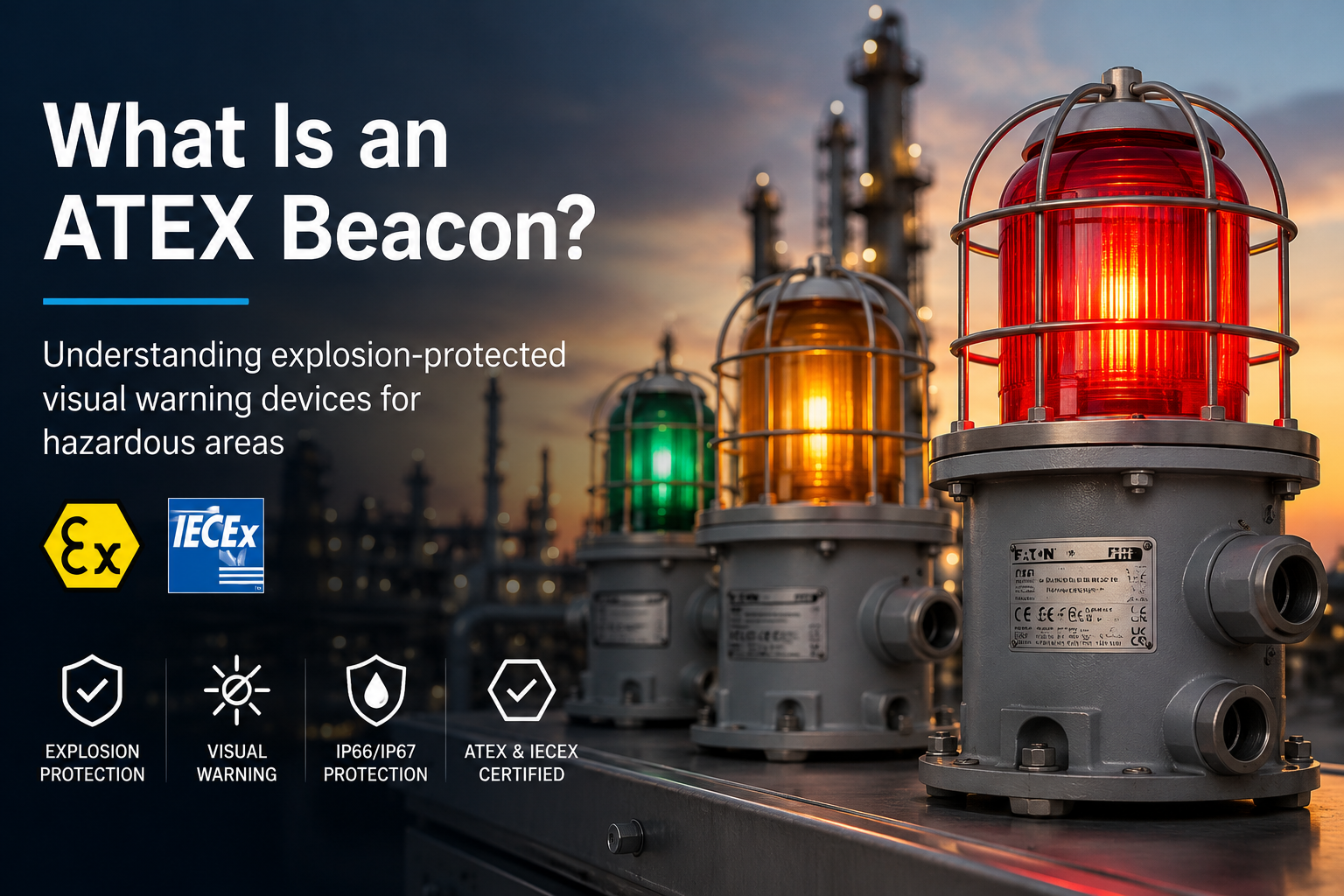
An ATEX beacon is a visual signalling device designed and certified for use where flammable gas, vapour, mist or combustible dust could create a potentially explosive atmosphere.
Depending on its design, the beacon may produce a steady, flashing, strobe, blinking or rotating visual signal. It can communicate an emergency alarm, evacuation condition, process event or equipment status without introducing unsuitable electrical equipment into the classified area.
Thorne & Derrick supplies a complete range of ATEX beacons with LED, xenon, steady-state, flashing and electronically rotating options for hazardous area signalling applications.
In brief: an ATEX beacon provides a visible warning or status signal while using a certified construction intended for a defined explosive atmosphere. Its complete certification and product marking must match the installation.
In This Guide
What Does an ATEX Beacon Do?
The purpose of an ATEX beacon is to provide a visible signal in a location where an ordinary industrial light or beacon may not be suitable.
The beacon does not normally detect gas, prevent a release or extinguish a fire. Instead, it communicates information generated by a fire and gas system, process-control system, emergency alarm, machine control or other monitoring equipment.
Typical applications include:
- Warning personnel of a fire, gas release or emergency condition
- Supporting evacuation or shelter-in-place alarms
- Indicating a process fault, trip or shutdown
- Showing machine, valve or equipment status
- Providing a visible warning where high noise levels affect audible-alarm recognition
- Distinguishing between different site conditions through signal patterns or lens colours
Visual signalling devices can operate independently or form part of a broader range of hazardous area sounders and beacons, including audible alarms, combination units, status lights and loudspeakers.
ATEX Beacon vs Ordinary Industrial Beacon
Both products may provide a similar visible warning, but their construction, testing and intended installation conditions are different.
| Comparison | ATEX Beacon | Ordinary Industrial Beacon |
|---|---|---|
| Intended environment | Defined potentially explosive atmospheres | Non-classified industrial locations |
| Certification | Certified and marked for stated hazardous area conditions | Not necessarily certified for explosive atmospheres |
| Selection basis | Zone, atmosphere, group, temperature and protection concept | Voltage, light output, ingress protection and environment |
| Installation | Requires appropriate hazardous area installation practices | Standard industrial installation practices may apply |
Why Does a Beacon Need Hazardous Area Certification?
Flammable gases, vapours, mists and combustible dusts can form an explosive mixture when combined with air. If this atmosphere encounters a sufficient ignition source, an explosion may occur.
Electrical equipment installed in a classified area must therefore be designed and selected to reduce the possibility of ignition.
Depending on the protection concept, this may involve containing an internal explosion, preventing ignition-capable sparks or temperatures, limiting electrical energy or preventing combustible dust from entering the enclosure.
The required approval can depend on the destination market, project specification and installation. ATEX, UKEX, IECEx and other regional approvals should not be treated as interchangeable without checking the applicable requirements.
Read the complete guide to ATEX and IECEx certification of hazardous area equipment.
Which Hazardous Area Zones Use ATEX Beacons?
Hazardous areas are classified according to the type of explosive atmosphere and how frequently it is expected to occur.
Gas, vapour and mist atmospheres use Zones 0, 1 and 2. Combustible-dust atmospheres use Zones 20, 21 and 22.
| Zone | Atmosphere | General Definition |
|---|---|---|
| Zone 1 | Gas, vapour or mist | An explosive atmosphere is likely to occur occasionally during normal operation. |
| Zone 2 | Gas, vapour or mist | An explosive atmosphere is not likely during normal operation and, if it occurs, will normally exist only briefly. |
| Zone 21 | Combustible dust | A combustible-dust atmosphere is likely to occur occasionally during normal operation. |
| Zone 22 | Combustible dust | A combustible-dust atmosphere is not likely during normal operation and, if it occurs, will normally exist only briefly. |
A beacon described as suitable for Zone 1 should not automatically be assumed suitable for every gas, combustible dust or temperature condition. Its complete product marking must match the hazardous area specification.
Read the H&P guide to hazardous area zones and explosive atmosphere classification.
What Types of Hazardous Area Beacon Are Available?
LED Beacons
LED beacons use light-emitting diodes and may provide steady, flashing, blinking or electronically rotating signals. They are often selected where long operating life, defined signal patterns or reduced maintenance requirements are important.
Xenon Strobe Beacons
Xenon beacons use a xenon flash tube to produce a high-intensity visual pulse. They are commonly specified according to flash energy in joules, flash frequency, supply voltage and lens colour.
Steady Beacons
A steady beacon provides continuous visual indication. It may show a persistent warning, plant condition, equipment state or process status.
Rotating Beacons
Rotating beacons create a moving visual signal. Some use a mechanical rotating assembly, while others reproduce the effect electronically using sequenced LED segments.
Examples of Different Beacon Technologies
The following products illustrate steady, configurable LED and xenon-strobe signalling technologies.
Are All ATEX Beacons Flameproof?
No. “Explosion proof” is often used as a general search term, but equipment for explosive atmospheres can use several different protection concepts.
- Ex d or Ex db flameproof: an enclosure is designed to contain an internal explosion and prevent flame propagation outside it.
- Ex e or Ex eb increased safety: additional measures reduce the possibility of excessive temperatures, arcs or sparks during normal operation.
- Ex ia intrinsic safety: electrical energy is limited to a level intended to prevent ignition under defined conditions.
- Ex tb protection by enclosure: the enclosure helps prevent combustible-dust ingress and controls the maximum surface temperature.
Some products combine protection concepts. For example, the light chamber may use flameproof protection while the terminal compartment uses increased safety.
What Information Is Shown on the Beacon?
The product label and certification documents provide the information required to assess whether the equipment is suitable for a particular installation.
Depending on the product, its marking may identify:
- Equipment group and category
- Gas or combustible-dust suitability
- Equipment protection level
- Explosion-protection concept
- Gas or dust group
- Temperature class or maximum surface temperature
- Permitted ambient-temperature range
- Certificate number
- Ingress-protection rating
- Electrical supply and manufacturer information
The marking must be read as a complete specification. Selecting a product using only its zone number, ingress rating or product name is not sufficient.
Where Are Hazardous Area Beacons Used?
Visual signalling devices are used wherever an alarm or status indication is required within a classified environment.
How Is an ATEX Beacon Selected?
Product selection should begin with the hazardous area specification rather than the preferred manufacturer, colour or signalling technology.
Important selection criteria include:
- Hazardous area zone
- Gas, vapour, mist or combustible-dust atmosphere
- Gas or dust group
- Required protection concept and equipment category
- Temperature class and ambient-temperature range
- LED, xenon, steady, flashing, strobe or rotating signal
- Required light intensity, flash energy and viewing distance
- Operating voltage and control arrangement
- Lens colour and site alarm philosophy
- Ingress protection, enclosure material and corrosion exposure
- Indoor, outdoor, offshore or marine installation conditions
- Required regional and project approvals
Hazardous Area Beacon Selection Support
Send Thorne & Derrick the hazardous area classification, required signal type, operating voltage, lens colour and installation conditions for product selection support.
Frequently Asked Questions
What does ATEX mean?
ATEX is the name commonly used for the European framework relating to equipment and protective systems intended for use in potentially explosive atmospheres.
What is the difference between a Zone 1 and Zone 2 beacon?
The difference relates to the classified area and the expected frequency of an explosive gas atmosphere. The beacon must carry certification suitable for the specified zone and complete application.
Can the same beacon be used for gas and dust?
Only when the product carries the required certification and markings for both the gas and combustible-dust application.
Is an ATEX beacon always flashing?
No. Hazardous area beacons can provide steady, flashing, strobe, blinking, mechanically rotating or electronically rotating signals, depending on the product.
Do beacon lens colours have fixed meanings?
The intended meaning should be defined by the site alarm philosophy or project specification. It should not be assumed from the lens colour alone.
Can a beacon connect to a fire or gas detection system?
Many models can be integrated into wider alarm and control systems. Compatibility must be checked against the supply voltage, current, control method, certification and overall system design.
Compare Hazardous Area Visual Signalling Devices
Explore LED, xenon, steady, flashing and rotating signalling options for Zone 1, Zone 2, Zone 21 and Zone 22 installations.