Steady vs Flashing vs Rotating ATEX Beacons
Published 17 Aug 2026
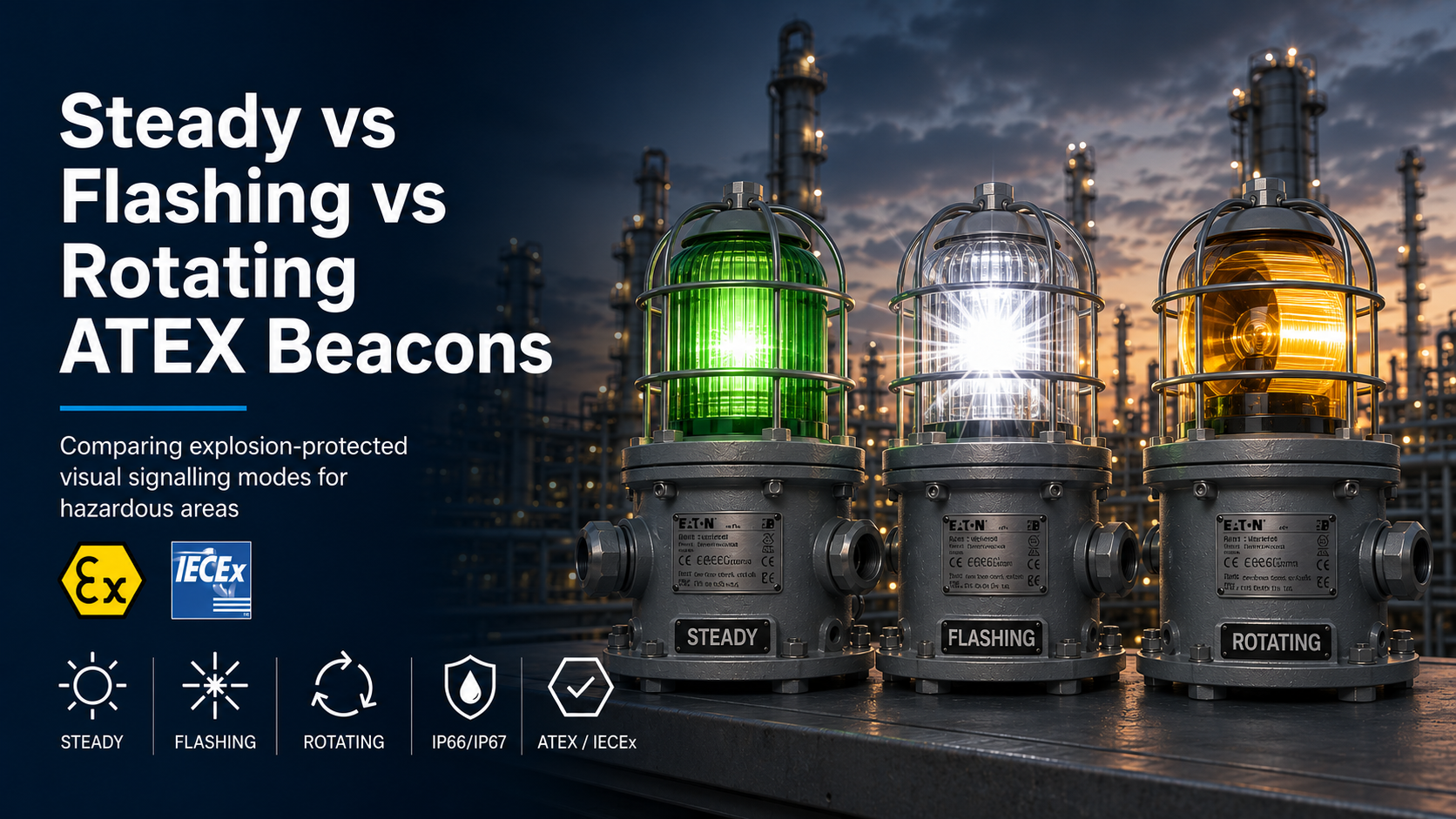
Steady, flashing, strobe and rotating beacons communicate different types of warning and status information. Although each produces a visible signal, the way that signal attracts attention and conveys meaning can vary considerably.
A steady beacon provides continuous illumination. A flashing beacon switches between illuminated and non-illuminated states. A strobe beacon produces brief, high-intensity pulses, while a rotating beacon creates the appearance of a moving light.
Thorne & Derrick supplies a comprehensive range of hazardous area ATEX beacons with steady, blinking, strobe, xenon-flash and electronically rotating visual signals.
For an introduction to hazardous area visual signalling, read What Is an ATEX Beacon?
Quick answer: use steady illumination for persistent status indication, flashing or strobe signals where increased attention is required, and rotating signals where a distinctive moving visual warning supports the site alarm philosophy.
In This Comparison
Steady vs Flashing vs Rotating Beacons: Quick Comparison
| Signal Mode | Visual Behaviour | Typical Purpose | Important Selection Data |
|---|---|---|---|
| Steady | Continuous illumination | Persistent equipment, plant or process status | Optical output, colour, viewing distance and continuous-duty rating |
| Flashing or Blinking | Repeating on-and-off pattern | Warning, changing condition or attention signal | Flash frequency, duty cycle, colour and control method |
| Strobe | Brief, rapid or high-intensity pulses | Prominent alarm or emergency warning | Flash energy or optical intensity, frequency and current consumption |
| Rotating | Moving beam or electronically sequenced segments | Distinctive warning or recognisable plant-status signal | Rotation rate, field of view, mechanism and maintenance requirements |
Important: the most attention-grabbing signal is not automatically the correct choice. The selected mode must agree with the site alarm philosophy and remain distinguishable from other alarms and equipment-status indicators.
When Should a Steady Beacon Be Used?
A steady beacon remains illuminated while the electrical supply or control signal is present. It provides a continuous reference rather than repeatedly attracting attention through movement or flashing.
This makes steady signalling particularly useful for showing a persistent operating state or condition.
Typical Steady-Beacon Applications
- Equipment running or stopped indication
- Valve open or closed status
- Process available, isolated or inhibited condition
- Persistent local warning
- Plant or machinery status indication
- A visual signal designed to remain active for an extended period
Advantages of Steady Illumination
- Provides a constant visual reference
- Suitable for persistent process and equipment states
- Can be easier to interpret where several flashing alarms are present
- Available using filament, fluorescent or LED technologies, depending on the product
Limitations of a Steady Signal
Continuous illumination may attract less immediate attention than a changing or moving signal. A steady beacon can also become part of the visual background where several continuously illuminated indicators are present.
Viewing distance, mounting position, lens colour and contrast against the surrounding environment should therefore be assessed.
When Should a Flashing or Blinking Beacon Be Used?
A flashing or blinking beacon changes between illuminated and non-illuminated states at a defined frequency. The changing light level can attract more attention than a steady signal.
In many LED products, the pattern is produced electronically. The flash rate may be fixed or selected from the modes available within the product.
Typical Flashing-Beacon Applications
- Process alarm or fault condition
- Equipment trip or abnormal status
- Gas, fire or evacuation warning
- Attention signal before machinery starts
- Condition requiring operator acknowledgement
Flash Frequency
Flash frequency describes how often the signal repeats. The correct frequency should be determined by the product capability and site alarm philosophy.
Two alarms with similar colours and flash frequencies may be difficult to distinguish. Signal patterns should therefore be coordinated across the installation.
What Is the Difference Between Flashing and Strobe?
“Flashing” is a broad description for a light that repeatedly switches on and off. A strobe is a more specific type of flashing signal that produces brief and often high-intensity pulses.
A xenon strobe discharges stored electrical energy through a xenon flash tube. Its output is commonly specified using flash energy in joules and flash frequency.
An LED strobe creates its pulse electronically. Its optical performance is not automatically equivalent to a xenon flash with a stated joule rating.
| Comparison | LED Strobe | Xenon Strobe |
|---|---|---|
| Light source | Light-emitting diodes | Xenon flash tube |
| Signal generation | Electronically controlled LED pulses | Discharge of stored electrical energy |
| Common performance data | Optical intensity, pattern and pulse frequency | Flash energy in joules and flash frequency |
For a fuller technology comparison, read LED vs Xenon ATEX Beacons.
How Does a Rotating Beacon Work?
A rotating beacon creates a moving visual signal that appears to sweep around the installation. This movement can make the signal recognisable even where several fixed lights are present.
Rotating signals can be produced mechanically or electronically.
Mechanically Rotating Beacons
A mechanically rotating design uses a motor and rotating reflector or light assembly to direct the beam around the beacon.
Rotation speed, motor life and moving-part maintenance should be considered when specifying this type of product.
Electronically Rotating LED Beacons
An electronically rotating beacon illuminates LED segments in sequence. This creates the appearance of movement without a motor-driven reflector.
Different electronic rotation patterns or speeds may be available, depending on the model.
Typical Rotating-Beacon Applications
- Distinctive plant or machinery warning
- Vehicle, loading or movement indication
- Process condition requiring a recognisable moving signal
- Replacement of an established rotating-beacon alarm convention
Which Signal Is Most Visible?
No single signal mode is the most visible under every condition. Visibility depends on the product output, signal pattern and installation environment.
Consider:
- Viewing distance
- Ambient lighting and direct sunlight
- Mounting height and orientation
- Structures and process equipment that may obstruct the signal
- Required horizontal and vertical field of view
- Lens or LED colour
- Flash or rotation frequency
- Other visual signals in the same area
The product should be positioned so that the intended audience can see and interpret the signal from the required working locations.
Does Each Signal Mode Have a Fixed Meaning?
A signal mode does not automatically carry one universal meaning across every site. Its purpose should be defined within the alarm philosophy, operating procedure or project specification.
For example, one installation may use steady illumination for normal equipment status and flashing red for an alarm. Another site may reserve flashing signals for evacuation and use rotating amber for machinery movement.
The meaning must therefore be documented, communicated to personnel and applied consistently.
How Does Lens Colour Affect the Signal?
Lens or LED colour helps distinguish between alarm and status conditions, but it can also affect the apparent optical output.
The visibility of red, amber, green, blue, yellow or clear signals can differ according to the light source, lens construction and surrounding lighting.
Manufacturer performance data should be checked for the exact ordered colour.
Electrical Supply and Control Considerations
Signal mode can affect the beacon’s current consumption and control requirements. The exact electrical data should be checked for the selected voltage, colour and operating pattern.
Confirm:
- Nominal operating voltage
- Permitted voltage range
- Current consumption for the selected mode
- Control-panel or relay capacity
- Whether the mode is fixed or internally selectable
- Whether remote switching between modes is required
- Required fault monitoring or end-of-line arrangements
Check the ordered variant: a product family may offer several modes, but this does not necessarily mean that every configuration can change modes remotely while in service.
Does the Signal Mode Affect Hazardous Area Suitability?
The visual signal alone does not determine whether a beacon is suitable for an explosive atmosphere. The complete certified construction and equipment marking must match the installation.
Check:
- Hazardous area zone
- Gas or combustible-dust group
- Equipment category and equipment protection level
- Explosion-protection concept
- Temperature class or maximum surface temperature
- Permitted ambient-temperature range
- Required ATEX, UKEX, IECEx or destination-market approval
Read more about ATEX and IECEx certification of hazardous area equipment.
The installation zone should also be confirmed using the guide tohazardous area zones and explosive atmosphere classification.
Examples of Steady, Strobe and Rotating Signals
These products illustrate different signal behaviours. The complete technical and certification requirements must still be checked for each application.
Steady Visual Signal
The MEDC FB11 filament and FL11 fluorescent units provide steady illumination for persistent warning or status indication.
Configurable LED Modes
The Eaton FHF dSLB20 LED provides steady, blinking, strobe and electronically rotating operating patterns.
Xenon Strobe Signal
The Eaton FHF dSLB20 xenon version provides 5J and 15J strobe options with an approximate frequency of 60 flashes per minute.
How Should the Signal Mode Be Selected?
Selection should begin with the hazardous area and site alarm requirements rather than a preference for the most visually dramatic product.
| Requirement | Signal to Consider | Reason |
|---|---|---|
| Persistent equipment or process state | Steady | Provides continuous status indication |
| Abnormal condition requiring attention | Flashing or Blinking | Changing signal can attract attention |
| Defined high-intensity pulsed warning | Strobe | Produces brief and distinctive visual pulses |
| Recognisable moving visual signal | Rotating | Creates an identifiable sweeping or sequenced effect |
For the complete selection process, including zone, certification, temperature, voltage and environmental conditions, read How to Select an ATEX Beacon.
Common Signal-Mode Selection Mistakes
Should a Visual Signal Be Supported by a Sounder?
A beacon may form only one part of the alarm arrangement. Audible and visual signals are often combined where personnel may not always be looking towards the beacon or where high noise, hearing protection or visibility restrictions affect alarm recognition.
The alarm design should establish whether a beacon, sounder or combined unit is required.
Explore the wider range of hazardous area sounders, beacons and combination units.
Steady, Flashing and Rotating Beacon FAQs
Is a flashing beacon more visible than a steady beacon?
A changing signal can attract more attention, but actual visibility depends on optical output, viewing distance, colour, ambient lighting, mounting position and surrounding visual conditions.
Is a strobe the same as a flashing beacon?
A strobe is a type of flashing signal characterised by brief pulses. The term flashing can also describe slower or less intense on-and-off patterns.
Does an electronically rotating beacon contain moving parts?
Normally, no. Electronically rotating products create the effect by illuminating LED segments in sequence rather than using a motor-driven reflector.
Can one beacon provide several signal modes?
Some LED products provide several internally selectable modes. Confirm whether the selected variant supports the required patterns and whether they are chosen during installation or controlled remotely.
Which mode is best for process status?
Steady illumination is commonly suited to persistent status indication. Flashing or rotating modes may be more appropriate where the condition needs to attract immediate attention.
Does a beacon mode determine its hazardous area zone?
No. Zone suitability is determined by the complete equipment certification and marking, not by whether the visual signal is steady, flashing or rotating.
Need Help Selecting a Beacon Signal Mode?
Send Thorne & Derrick the hazardous area classification, required alarm behaviour, viewing conditions, voltage, colour and installation environment for product selection support.
Compare Hazardous Area Visual Signal Options
Explore steady, flashing, strobe and rotating signalling devices for Zone 1, Zone 2, Zone 21 and Zone 22 installations.