Hazardous Area Beacon Lens Colours Explained
Published 24 Aug 2026
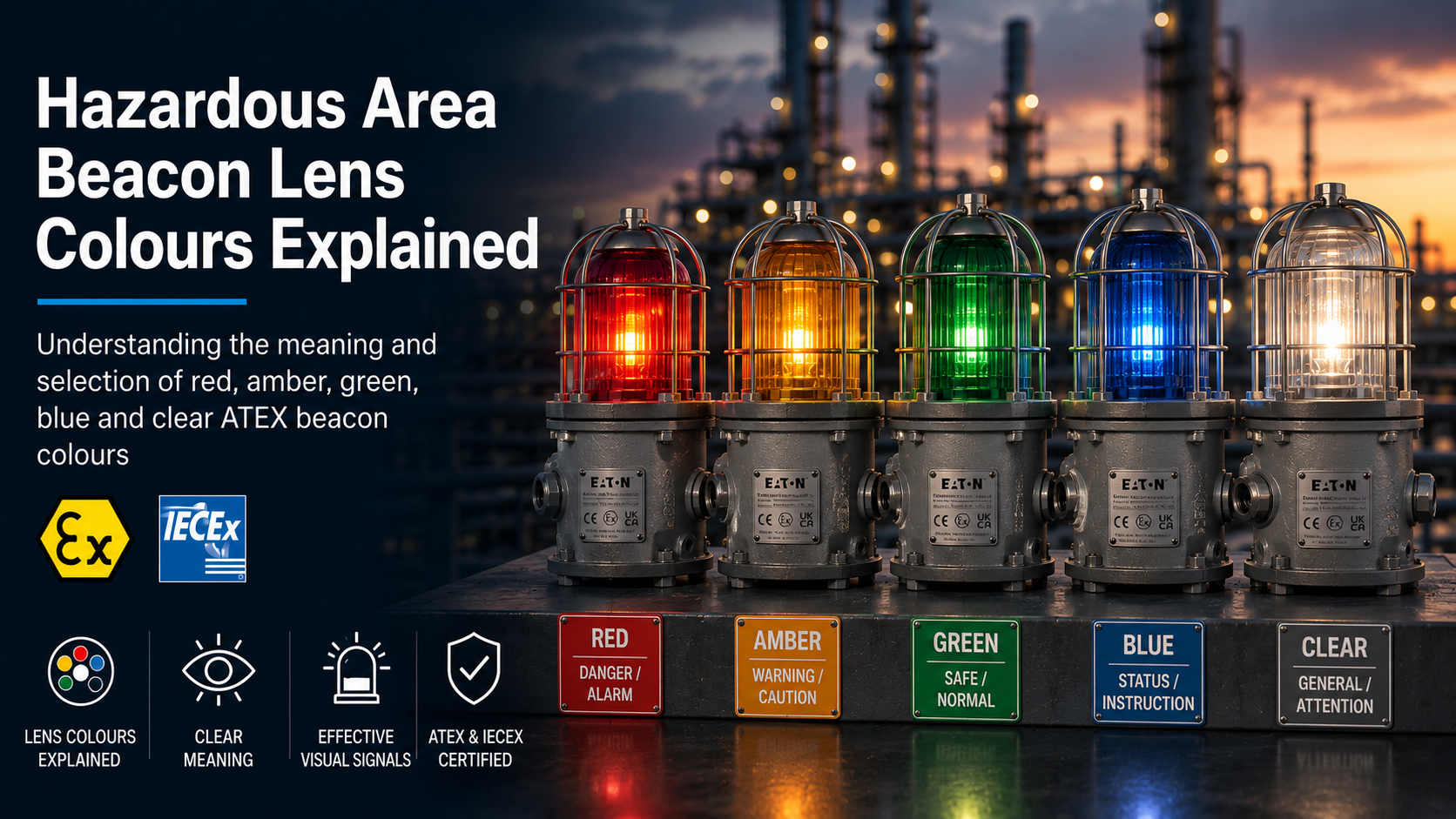
Hazardous area beacon lens colours help personnel distinguish between alarms, warnings, equipment states and process conditions. Red, amber, green, blue and clear signals can each communicate a different message when used within a properly defined alarm philosophy.
However, a beacon colour does not have one fixed meaning in every industry or on every site. The intended response should be established through the project specification, operating procedures and site-specific visual signalling system.
Thorne & Derrick supplies hazardous area ATEX beacons in a range of lens and signal colours, with LED, xenon, steady, flashing, strobe and electronically rotating options.
For a general introduction to hazardous area visual signalling, read What Is an ATEX Beacon?
Key principle: select the beacon colour from the documented site alarm philosophy. Do not assume that a colour automatically represents the same condition across every plant, industry or country.
In This Guide
Hazardous Area Beacon Colour Meanings
The table below summarises common industrial interpretations. These meanings are indicative only and must be checked against the site alarm philosophy.
| Beacon Colour | Common Interpretation | Example Applications | Required Response |
|---|---|---|---|
| Red | Danger, emergency, serious alarm or stop condition | Fire alarm, gas alarm, emergency shutdown or hazardous machine state | Immediate attention or action may be required |
| Amber or Yellow | Warning, caution, abnormal condition or awareness | Equipment about to start, process deviation, restricted area or potential hazard | Check conditions and proceed with caution |
| Green | Normal, safe, available, ready or action completed | Equipment operating normally, safe access or alarm acknowledged | Normal operation or a safe condition may be indicated |
| Blue | Change, specific status, instruction or security-related condition | Equipment powering down, security alarm or site-specific process state | Follow the documented site instruction |
| Clear or White | General attention, location, visibility or project-specific indication | General notification, obstruction indication or equipment identification | Confirm the intended meaning from the site documentation |
Do not rely on this table alone: the signal meaning should be formally defined, documented and communicated to site personnel. A manufacturer’s available colour does not determine how it must be used.
What Does a Red Beacon Indicate?
Red is commonly associated with danger, emergency, fire, a serious process alarm or a condition requiring immediate attention.
A flashing red beacon generally creates a stronger warning message than a steady red signal. However, the response must be determined by the documented alarm system rather than the colour and signal mode alone.
Common Red-Beacon Applications
- Fire or gas detection alarm
- Emergency shutdown condition
- Evacuation warning
- Dangerous machine or process state
- Live or energised equipment warning
- Critical fault requiring immediate response
Avoid conflicting meanings: if red is reserved for fire or evacuation alarms, it should not also be used for routine equipment status without a clear and documented distinction.
What Does an Amber or Yellow Beacon Indicate?
Amber and yellow are commonly used for warnings, caution, abnormal conditions or situations requiring increased awareness.
The signal may indicate that equipment is about to start, a process is outside its normal range or a potential hazard is developing but has not reached an emergency condition.
Common Amber-Beacon Applications
- Machinery preparing to start or move
- Process deviation or developing fault
- Temporary restriction or caution area
- Reduced visibility or environmental warning
- Maintenance or inspection attention required
- Non-critical plant alarm
Amber vs Yellow
Manufacturers do not always use amber and yellow terminology in exactly the same way. One datasheet may describe the lens as amber while another refers to the corresponding emitted LED colour as yellow.
Always use the exact manufacturer colour description and ordering code when requesting a quotation.
What Does a Green Beacon Indicate?
Green is commonly used to indicate a normal, safe, available or correctly operating condition.
It can also show that an alarm has been acknowledged, corrective action is under way or equipment is ready for operation.
Common Green-Beacon Applications
- Normal equipment operation
- Safe access or safe process condition
- System ready or available
- Corrective action completed
- Alarm condition acknowledged or controlled
- Plant status within defined operating limits
Green should not be used where personnel could mistake it for an unrestricted safe condition when a residual hazard remains.
What Does a Blue Beacon Indicate?
Blue is often used for a specific instruction, change in condition, security-related alarm or site-defined process state.
Its meaning can be particularly site-specific. Personnel should therefore be trained to understand the response required when a blue signal is activated.
Possible Blue-Beacon Applications
- Equipment powering down or changing state
- Security or access-control alarm
- Operator action required
- Specific maintenance or process condition
- A signal that must remain distinct from red, amber and green conventions
External restrictions may apply: blue warning lights can have regulated meanings in transport and emergency-service environments. Check the installation location and applicable rules before selection.
Clear Beacon Lens vs White Signal
“Clear” and “white” do not always describe the same component.
A clear or transparent lens describes the colour of the dome or cap. A white signal describes the light emitted by the LED, lamp or flash source.
A clear lens may therefore be used with a white LED, xenon flash tube or another internal light source, depending on the product.
Common Clear or White Applications
- General attention or notification
- Equipment or obstruction indication
- Long-distance or high-visibility signal
- Area or equipment identification
- Project-specific alarm condition
Clear or white should not be treated as a neutral default without confirming what the signal is intended to communicate.
How Colour and Signal Mode Work Together
Personnel interpret the complete visual signal rather than the lens colour in isolation. A steady red light can communicate a different level of urgency from a rapidly flashing red strobe.
The meaning can be strengthened by combining colour with:
- Steady, blinking, strobe or rotating signal modes
- Different flash or rotation frequencies
- Audible alarm tones
- Text labels and identification plates
- Symbols or display messages
- Beacon position or location
Colour should be supported by these supplementary methods where relying on colour alone could create ambiguity.
Read Steady vs Flashing vs Rotating ATEX Beacons for a comparison of the principal visual signalling modes.
Do LED and Xenon Beacons Produce Colour Differently?
Yes. The method used to create the coloured signal can differ between LED and xenon products.
LED Beacon Colours
An LED beacon can use coloured LEDs, a coloured cap or a combination of the two. The wavelength, brightness and current consumption can vary between colours.
Xenon Beacon Colours
A xenon flash tube produces a broad-spectrum pulse of light. A coloured dome or lens filters that light to create the required signal colour.
The filtering effect can reduce the measured optical intensity compared with a clear lens. The reduction is product- and colour-specific.
Read LED vs Xenon ATEX Beacons for a wider comparison of the two technologies.
Does Beacon Colour Affect Visibility?
Colour can affect the apparent brightness, contrast and recognition of a beacon signal.
Visibility is influenced by:
- The LED, lamp or xenon flash output
- Lens colour and light transmission
- Viewing distance
- Direct sunlight and ambient illumination
- Background colour and visual contrast
- Mounting height and orientation
- Structures or equipment obstructing the signal
- Flash frequency or signal pattern
- The observer’s position and field of view
Product-specific performance: do not assume that one colour is always brighter than another. Current Eaton FHF dSLB20 LED data, for example, gives different approximate optical outputs for white, red, yellow, green and blue versions.
Should an Alarm Depend on Colour Alone?
Where a warning is safety-critical, the meaning should not depend unnecessarily on colour alone.
Lighting conditions, smoke, dirt, distance and differences in colour perception can all affect how the signal is recognised.
Supplementary methods can include:
- Different flash or rotation patterns
- Audible sounders with distinctive tones
- Text displays or alarm messages
- Symbols and equipment labels
- Clearly separated beacon positions
- Operator training and documented procedures
Explore the wider range of
hazardous area sounders, beacons and combination units
.
Hazardous Area Beacon Colour Examples
Available colours depend on the product technology and ordered configuration. The examples below illustrate three different signalling ranges.
MEDC FB11 & FL11
Steady visual signalling options include clear, red, blue, green, yellow and amber lens configurations, depending on the selected model.
Eaton FHF dSLB20 LED
Available signal colours include white, red, yellow or amber, green and blue, with transparent or coloured cap options depending on the configuration.
Eaton FHF dSLB20 Xenon
Xenon-strobe cap colours include transparent, red, amber, green and blue for the 5J and 15J product options.
Confirm colour availability against the current product datasheet and complete ordering code. Not every colour is available for every voltage, signal mode or approval.
How to Select a Hazardous Area Beacon Colour
Colour selection should take place after the hazardous area and technical requirements have been established.
- Confirm the site alarm philosophy. Identify what each colour already represents and avoid introducing conflicting meanings.
- Define the required response. Establish whether personnel must stop, evacuate, investigate, acknowledge or continue normal operation.
- Select the signal mode. Decide whether the condition requires steady, blinking, strobe or rotating indication.
- Assess visibility. Consider viewing distance, ambient lighting, mounting position, obstructions and background contrast.
- Check product performance by colour. Compare the manufacturer’s optical data for the exact LED or lens option.
- Confirm electrical requirements. Current consumption may differ between signal colours and operating modes.
- Confirm product availability. Check the selected colour against the required voltage, approval and ordering reference.
- Use supplementary coding. Support colour with sound, labels, symbols, position or signal pattern where required.
For the complete product-selection process, read
How to Select an ATEX Beacon
.
Information Required When Ordering
Include the following information when requesting a quotation:
Common Beacon Colour Selection Mistakes
Hazardous Area Beacon Colour FAQs
Does a red beacon always mean fire?
No. Red commonly indicates danger or emergency, but its exact meaning must be defined by the site alarm philosophy. Some sites reserve red specifically for fire or evacuation.
Are amber and yellow the same beacon colour?
They are frequently grouped as caution or warning colours, but manufacturer terminology and exact optical characteristics can differ. Use the stated ordering colour and code.
Does a clear lens produce white light?
It can, but not automatically. Clear describes the lens or cap, while white describes the emitted light. Check the light source and product configuration.
Does lens colour affect beacon brightness?
Yes. Lens filtering and LED wavelength can affect the measured and apparent output. Check the manufacturer’s data for the exact colour.
Can different beacon colours use the same flash pattern?
Yes, but personnel must still be able to distinguish the intended conditions. Similar patterns and poor colour contrast can create confusion.
Does the lens colour determine the hazardous area zone?
No. Zone suitability is determined by the complete certification and equipment marking. Lens colour affects the visual signal but does not establish the hazardous area classification.
Need Help Selecting a Beacon Colour?
Send Thorne & Derrick the hazardous area classification, intended alarm meaning, signal mode, viewing conditions, voltage and required colour for product selection support.
Compare Hazardous Area Beacon Colours
Explore red, amber, green, blue and clear visual signalling options with LED, xenon, steady, flashing and rotating configurations.