Ex d, Ex e & Ex d e Beacon Protection Explained
Published 31 Aug 2026
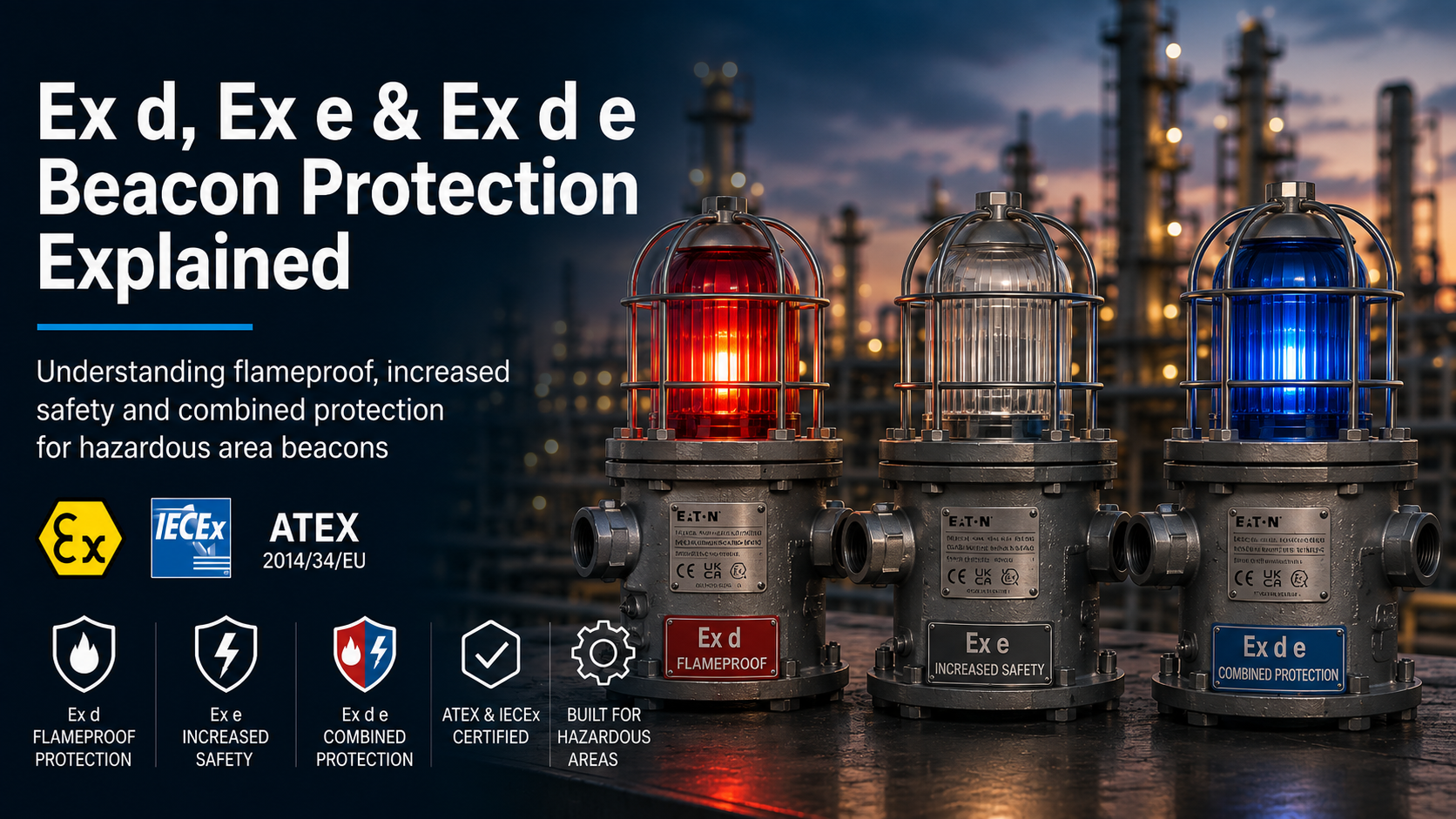
Ex d, Ex e and combined Ex d e markings describe different methods of protecting electrical equipment intended for use in potentially explosive gas atmospheres.
An Ex d beacon uses a flameproof enclosure designed to contain an internal ignition and prevent flame propagation into the surrounding atmosphere. Ex e increased safety uses additional construction measures intended to avoid arcs, sparks and excessive temperatures under the certified operating conditions.
A product marked Ex d e or Ex db eb combines these protection concepts in different parts of the equipment. For example, the optical and electronic components may be housed within a flameproof chamber while the field-wiring terminal compartment uses increased-safety protection.
Thorne & Derrick supplies a comprehensive range of hazardous area visual signalling devices with flameproof, increased-safety and combined protection arrangements.
For a general introduction to visual signalling in potentially explosive atmospheres, read What Is an ATEX Beacon?
Key distinction: Ex d is designed to contain an internal explosion. Ex e is designed to avoid ignition-capable faults through increased constructional safety. A combined Ex d e product applies the appropriate concept to different parts of the equipment.
In This Guide
Ex d vs Ex e vs Ex d e: Quick Comparison
| Protection | Principle | Typical Beacon Application | Important Installation Consideration |
|---|---|---|---|
| Ex d / Ex db | Contains an internal explosion and controls flame propagation through designed flamepaths | Optical chamber, lamp housing or electronics enclosure | Flamepaths, threads, fasteners and certified cable entries must remain compliant |
| Ex e / Ex eb | Uses additional measures to avoid arcs, sparks and excessive temperatures | Terminal compartment and field-wiring connections | Terminal capacity, conductor preparation, clearances and connection security are critical |
| Ex d e / Ex db eb | Applies flameproof and increased-safety concepts to different equipment sections | Flameproof signalling chamber with a separate increased-safety terminal compartment | Both protection concepts and their associated installation requirements must be maintained |
Do not interpret the marking in isolation: Ex d, Ex e or Ex d e does not by itself confirm the permitted zone, gas group, temperature class, ambient range or dust suitability. The complete equipment marking and certificate must be checked.
How Does Ex d Flameproof Beacon Protection Work?
An Ex d flameproof enclosure is designed on the basis that an explosive gas atmosphere may enter the enclosure and could be ignited by an internal component.
The enclosure is constructed to withstand the pressure created by an internal explosion. Joints and openings are engineered as flamepaths that cool escaping gases sufficiently to prevent the explosion from propagating into the external atmosphere under the certified conditions.
Ex d does not mean that an explosion can never occur inside the enclosure. Its protection principle is based on containment and controlled flame transmission.
Typical Flameproof Beacon Components
- Lamp, LED or xenon light chamber
- Electronic power-supply components
- Xenon energy-storage and flash circuitry
- Internal switching or operating-mode electronics
- Glass dome and enclosure joint
Flamepaths
Flamepaths can be formed by threaded joints, cylindrical joints, flanged joints or other certified enclosure interfaces.
Their dimensions, finish and condition form part of the certified design. Flamepaths must not be drilled, filed, painted, damaged or modified outside the manufacturer’s permitted procedures.
Ex d Cable Entries
Where the cable enters directly into a flameproof enclosure, the gland, adaptor or stopping plug must be appropriate for the certified entry arrangement, cable type and installation.
An unsuitable cable gland or unapproved modification can compromise the complete protection concept even when the beacon itself carries the correct marking.
What Does “Flameproof” Not Mean?
Flameproof equipment is sometimes described using the general term “explosion proof”. This can lead to misunderstandings about what the construction provides.
How Does Ex e Increased-Safety Protection Work?
Ex e increased safety uses additional construction measures intended to prevent ignition-capable arcs, sparks and excessive temperatures under the certified operating conditions.
Unlike Ex d, an increased-safety enclosure is not based on containing an internal explosion. Equipment and components are selected so that an ignition source is not expected to develop within the protected section during normal service.
Typical Increased-Safety Measures
- Secure and suitably rated terminals
- Defined creepage and clearance distances
- Enhanced electrical insulation
- Protection against loose conductors and connections
- Control of component and conductor temperatures
- Mechanical protection of field-wiring connections
Increased-Safety Terminal Compartments
On a combined beacon, Ex e is frequently applied to the terminal compartment. This allows the incoming supply cable to be connected without opening the separate flameproof electronics or optical chamber.
The terminals, conductor sizes, stripping lengths and cable-entry equipment must still follow the manufacturer’s instructions and certificate conditions.
Important: Ex e does not make loose strands, incorrect conductor sizes or poorly tightened terminals acceptable. Correct workmanship forms an essential part of maintaining increased-safety protection.
What Does Combined Ex d e Protection Mean?
Combined Ex d e protection means that different sections of the same beacon use different protection concepts.
A typical arrangement includes:
Flameproof Signalling Chamber
The LEDs, lamp, xenon tube, power electronics or energy-storage components are contained within an Ex d or Ex db enclosure.
Increased-Safety Terminal Compartment
The incoming cable and supply conductors terminate within a separate Ex e or Ex eb compartment using increased-safety terminals and entry equipment.
The marking does not mean that every component is simultaneously protected by both concepts. It identifies a certified assembly incorporating more than one method of protection.
Why Combine Ex d and Ex e?
- The ignition-capable electronics can remain inside a flameproof chamber
- Field wiring can be completed in a separate terminal section
- The main flameproof chamber does not normally need to be opened for routine termination
- Different equipment sections can use the protection concept most appropriate to their function
Ex d vs Ex db and Ex e vs Ex eb
Product literature and certificates can use different marking formats depending on the applicable standard edition and approval.
Older or simplified documentation may show:
- Ex d — flameproof enclosure
- Ex e — increased safety
- Ex d e — combined flameproof and increased-safety protection
More detailed markings can include an additional protection-level suffix:
- Ex db — flameproof protection with level “b”
- Ex eb — increased-safety protection with level “b”
- Ex db eb — combined protection using both level “b” concepts
Always use the exact marking shown on the product certificate and equipment label. Do not rewrite or assume a marking based only on a catalogue heading.
How to Read an Ex d e Beacon Marking
The protection concept forms only one part of the complete hazardous area marking.
Ex db eb IIC T6 Gb
Illustrative marking format only. Refer to the actual product certificate and label.
| Marking | General Meaning |
|---|---|
| Ex | Equipment uses a recognised explosion-protection concept |
| db | Flameproof enclosure protection, level “b” |
| eb | Increased-safety protection, level “b” |
| IIC | Gas group shown in this illustrative example |
| T6 | Gas temperature class shown in this illustrative example |
| Gb | Equipment protection level for a gas atmosphere |
The complete marking may also include the equipment group, category, certificate number, permitted ambient range, ingress protection and special conditions of use.
Read the wider guide to ATEX and IECEx certification of hazardous area equipment.
Does Ex d e Marking Cover Combustible Dust?
Ex d and Ex e are protection concepts associated with explosive gas atmospheres. They do not, by themselves, confirm suitability for combustible dust.
A beacon certified for Zones 21 and 22 will normally carry a separate dust marking. This may include protection by enclosure such as Ex tb, together with a dust group, maximum surface temperature and equipment protection level.
| Atmosphere | Example Protection Concepts | Zones Commonly Associated |
|---|---|---|
| Gas, vapour or mist | Ex d, Ex e, Ex d e and other gas protection concepts | Zones 0, 1 and 2, subject to the complete marking |
| Combustible dust | Ex t or Ex tb protection by enclosure and other applicable concepts | Zones 20, 21 and 22, subject to the complete marking |
See the guide to hazardous area zones and explosive atmosphere classification for further information about gas and dust zones.
Examples of Ex d and Combined Ex d e Beacons
These product families demonstrate how different protection arrangements can be applied to visual signalling equipment. Always confirm the current certificate and exact ordered configuration.
MEDC FB11 & FL11
The FB11 filament and FL11 fluorescent steady-beacon range uses flameproof construction. Current marking and temperature classification depend on the selected certified variant.
Eaton FHF dSLB20 LED
The dSLB20 LED combines a flameproof aluminium signalling housing with an increased-safety terminal compartment.
Eaton FHF dSLB20 Xenon
The dSLB20 xenon strobe also uses a flameproof signalling enclosure with a separate increased-safety terminal arrangement.
Installation Requirements for Ex d and Ex e Beacons
Installation must follow the manufacturer’s instructions, certificate conditions, applicable standards and site procedures.
Ex d Installation Checks
- Correct flameproof cable gland or stopping element
- Correct thread type and engagement
- Flamepaths clean, undamaged and unmodified
- All specified enclosure fasteners installed
- Correct tightening torque where stated
- No unauthorised drilling or machining
- Enclosure not opened while unsafe to do so
Ex e Installation Checks
- Correct increased-safety cable gland and blanking elements
- Conductor size within the terminal rating
- Correct conductor stripping length
- No loose or exposed conductor strands
- Terminals tightened correctly
- Creepage and clearance distances maintained
- Unused entries correctly sealed
Installation, inspection and maintenance should be completed by suitably competent personnel familiar with hazardous area equipment and the relevant protection concepts.
Inspection and Maintenance Differences
| Inspection Area | Ex d Focus | Ex e Focus |
|---|---|---|
| Enclosure | Damage, corrosion, cracks and pressure-containing integrity | Damage, ingress, corrosion and environmental protection |
| Joints | Flamepath condition, threads, covers and fasteners | Gaskets, covers and protection of terminal clearances |
| Connections | Certified entry system and internal connection integrity | Terminal security, conductor condition and insulation |
| Modifications | Check for unauthorised machining or flamepath alteration | Check for unapproved terminals, links or wiring changes |
Should You Select Ex d, Ex e or Ex d e?
The protection concept should not be selected independently from the certified beacon design. The manufacturer determines the equipment construction and obtains approval for the complete product.
Product selection should instead confirm:
- Hazardous area zone
- Gas or combustible-dust atmosphere
- Gas or dust group
- Equipment category and protection level
- Temperature class or maximum surface temperature
- Permitted ambient-temperature range
- Required signal technology and operating mode
- Operating voltage and current consumption
- Cable-entry and termination requirements
- Required regional approvals
Read How to Select an ATEX Beacon for the complete product-selection process.
Related Hazardous Area Beacon Guides
Common Ex d and Ex e Beacon Mistakes
Ex d, Ex e and Ex d e Beacon FAQs
Is Ex d the same as explosion proof?
Ex d is the IEC flameproof protection concept. “Explosion proof” is often used as a general term, but the exact approval system, marking and technical requirements should always be confirmed.
Can an explosion occur inside an Ex d beacon?
The protection principle assumes an internal ignition may occur. The enclosure is designed to withstand it and prevent flame propagation into the external atmosphere under the certified conditions.
Is an Ex e enclosure flameproof?
No. Increased safety is based on preventing ignition-capable arcs, sparks and temperatures. It is not designed on the basis of containing an internal explosion.
What is the benefit of an Ex e terminal compartment?
It can allow the field supply cable to be terminated in a separate increased-safety section without opening the main flameproof electronics or optical chamber.
What is the difference between Ex d and Ex db?
Both identify flameproof protection. The additional “b” identifies the protection level within the more detailed marking format. Use the exact terminology shown on the relevant certificate.
Does Ex d e mean the beacon is suitable for Zone 1?
Not from that marking alone. The complete equipment category, protection level, gas group, temperature class, ambient range and certificate must confirm suitability for the installation.
Can an Ex d e beacon be used in a dust zone?
Only when it also carries appropriate combustible-dust certification and marking, such as the applicable Ex t or Ex tb protection details.
Need Help Checking Beacon Protection and Certification?
Send Thorne & Derrick the zone, gas or dust group, temperature requirements, signal type, operating voltage and installation conditions for product selection support.
Compare Hazardous Area Beacon Protection Options
Explore flameproof and combined-protection visual signalling devices with LED, xenon, steady, flashing and rotating configurations.