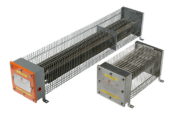
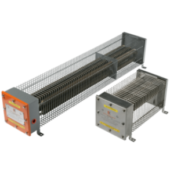
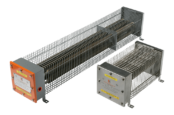
EXHEAT FAW-C-1000 Air Heater 1000 Watts | Hazardous Area Zone 1 & 2

FAW-C-1000 | EXHEAT HEATER

Product Code: FAW-C-1000



EXHEAT FAW-C-1000 is a compact EXHEAT Heater designed for safe, reliable air heating in hazardous areas where installation space is limited. Part of the wider FAW Heater range, this 1000W unit provides lightweight, weatherproof and versatile heating for Zone 1 and Zone 2 gas atmospheres in industrial environments.
Product Overview
The EXHEAT FAW-C-1000 is a compact hazardous area air warmer from the FAW range of EXHEAT Heaters, engineered for use in locations where safe air heating is required but available space is restricted. Designed for Zone 1 and Zone 2 hazardous areas, the unit provides a practical 1000W heat output for small industrial spaces and confined work areas.
As part of the wider FAW Heater family, this model is suited to explosive gas atmospheres covering IIA, IIB and IIC gas groups. The FAW compact design is especially useful in battery rooms, paint and solvent stores, motor enclosures, crane or forklift cabins and aircraft hangars, where maintaining temperature safely can support both personnel comfort and equipment protection.
Suitable for small workspaces, storage areas, crane or forklift cabins, battery rooms, solvent stores, motor enclosures and similar confined areas, the EXHEAT FAW-C-1000 Heater combines robust hazardous area certification with practical mounting and voltage flexibility. For buyers searching for EXHEAT Heaters for compact air warming duties, the FAW-C-1000 is a strong solution for dependable heat in explosive atmospheres.
For specifiers, contractors and maintenance teams looking for a compact EXHEAT Heater, the FAW-C-1000 offers hazardous area certification, IP67 weatherproof protection, floor or wall mounting flexibility and compatibility with single-phase or selected alternative supply arrangements across the broader FAW range. It is a strong option where reliability, compact footprint and hazardous area compliance are all critical.
Need help specifying the right EXHEAT Heater for your hazardous area? Thorne & Derrick are specialist suppliers of hazardous area electrical heaters, providing technical advice, quotations and worldwide delivery for UK and export projects.
Technical Specifications
Key Benefits
✔ Compact EXHEAT Heater design for small or restricted spaces
✔ Suitable for Zone 1 and Zone 2 hazardous area gas atmospheres
✔ Covers IIA, IIB and IIC gas groups within the FAW range
✔ 1000W output suited to localised air warming and frost protection support
✔ Weatherproof IP67 enclosure for demanding industrial environments
✔ T2, T3 and wider FAW range T4 options available depending on model/configuration
✔ Lightweight construction supports easier installation and handling
✔ Floor or wall mounting flexibility
✔ Available across broader FAW range for single-phase, three-phase or DC requirements
✔ Optional flameproof thermostat arrangements can be supplied
✔ Strong choice for buyers comparing compact EXHEAT Heaters

Applications
✔ Battery rooms and battery storage areas
✔ Paint stores and solvent storage areas
✔ Crane cabins and forklift cabins
✔ Motor enclosures and compact plant spaces
✔ Aircraft hangars and aerospace support areas
✔ Small workspaces in hazardous process environments
✔ Confined spaces where safe air warming is required
✔ Localised heating duties in explosive gas atmospheres

Certifications
The FAW range of EXHEAT Heaters is manufactured for hazardous area use and is available with multiple international certification routes. Current FAW range literature references ATEX, IECEx, UKEX, KGS and CSA approvals, with Zone 1 and Zone 2 suitability for gas atmospheres and IP67 weatherproof protection.
ATEX / IECEx
Ex e IIC T2 to T4 Gb
Zone 1 and Zone 2
IP67
CSA
Groups A, B, C, D
T4, T3 or T2
CU TR / EAC / KGS
KGS certification available
Additional approvals depend on model / market
Note: FAW heaters are designed to operate in potentially explosive atmospheres with ambient temperatures up to +40°C for T3 / T4 units and up to +60°C for T2-rated units. The user must ensure these ambient temperature limits are not exceeded.
 EXHEAT FAW Hazardous Area Air Warmers Datasheet
Download
EXHEAT FAW Hazardous Area Air Warmers Datasheet
Download