ATEX marking is the information shown on certified hazardous area equipment to identify where and how it can be used safely in potentially explosive atmospheres. It usually includes the equipment group, category, gas or dust suitability, explosion protection method, gas group, temperature class, equipment protection level and certificate reference.
For engineers, buyers, site managers and safety teams, understanding ATEX equipment markings is essential. A product described as “ATEX certified” is not enough on its own — the marking must match the hazardous area zone, gas or dust group, temperature class and installation conditions for the site.
Quick Answer: What Does ATEX Marking Mean?
ATEX marking shows the certified limits of hazardous area equipment. It tells the user whether the equipment is suitable for gas, vapour, mist or dust atmospheres, which hazardous area zone it can be used in, what explosion protection method it uses, what gas or dust group it is approved for, and what maximum surface temperature or T-class applies.
ATEX Marking: Quick Summary
| ATEX Marking |
A code shown on certified equipment to identify suitability for potentially explosive atmospheres. |
| Used For |
Hazardous area equipment selection, installation, inspection, maintenance and compliance checks. |
| Key Information |
Equipment group, category, gas/dust suitability, protection type, gas group, temperature class, EPL and certificate number. |
| Important Check |
The marking must match the site’s hazardous area classification and the manufacturer’s certificate conditions. |
| Common Risk |
Assuming all ATEX equipment is suitable for all zones, gases, dusts or temperatures. |
What Is ATEX Marking?
ATEX marking is the visible certification code applied to equipment designed for use in potentially explosive atmospheres. It helps users identify whether a product is suitable for specific hazardous area conditions.
ATEX markings are commonly found on equipment such as:
The marking should always be checked alongside the product certificate, manufacturer instructions and the hazardous area classification for the site. Correct certification does not remove the need for correct product selection, installation, inspection and maintenance.
External reference: The European Commission explains that ATEX Directive 2014/34/EU applies to equipment and protective systems intended for use in potentially explosive atmospheres.
ATEX Marking Example Explained
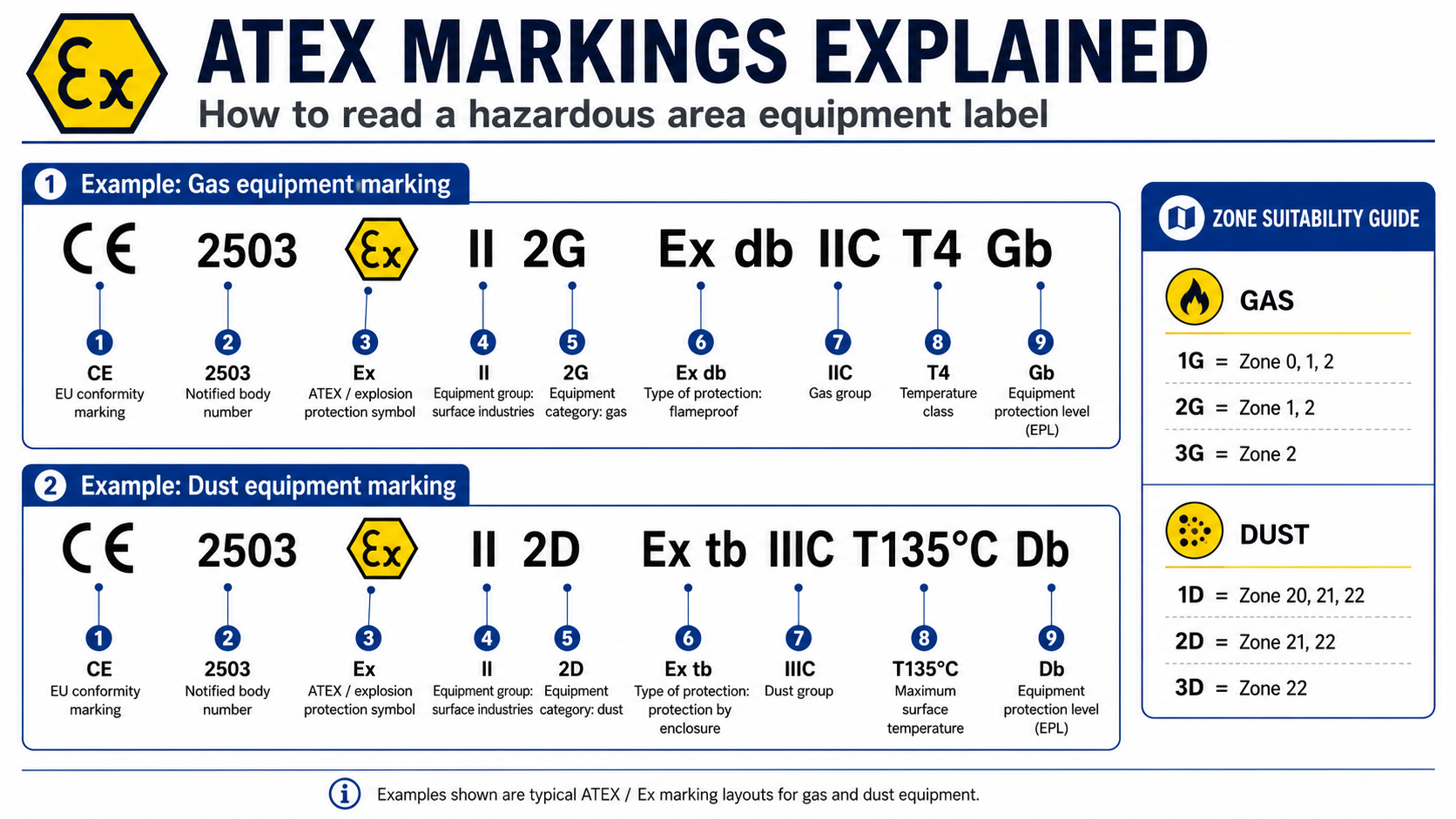
A typical hazardous area equipment marking may look similar to the example below. Exact markings vary depending on the equipment, certification, protection concept, gas or dust atmosphere, temperature class and manufacturer.
Example ATEX / Ex Marking
Example marking:
II 2G Ex db IIC T4 Gb
What Each Part Means
| II |
Equipment Group II — equipment intended for surface industries, not mining. |
| 2G |
Category 2 equipment for gas, vapour or mist atmospheres. Commonly associated with Zone 1 applications, subject to the full marking and certificate. |
| Ex |
Indicates explosion-protected equipment. |
| db |
Flameproof enclosure protection method, designed to contain an internal explosion and prevent flame transmission to the surrounding atmosphere. |
| IIC |
Gas group suitable for the most severe gas group within Group II, including gases such as hydrogen and acetylene when all other conditions are met. |
| T4 |
Temperature class showing the maximum surface temperature does not exceed 135°C under certified conditions. |
| Gb |
Equipment Protection Level for gas atmospheres, indicating a high level of protection suitable for Zone 1 where correctly applied. |
Important: This is only an example. The actual suitability of any ATEX marked product must be confirmed against the full certificate, manufacturer instructions, ambient temperature range, installation method, cable entries, accessories and any special conditions of safe use.
ATEX Equipment Groups Explained
ATEX markings identify the type of environment the equipment is designed for. The first major distinction is the equipment group.
ATEX Equipment Groups
| Group I |
Equipment intended for use in mines susceptible to firedamp. |
| Group II |
Equipment intended for surface industries where gas, vapour or mist explosive atmospheres may occur. |
| Group III |
Equipment intended for surface industries where combustible dust explosive atmospheres may occur. |
Most industrial hazardous area products supplied for oil and gas, chemical, petrochemical, utilities, pharmaceutical, food processing and energy applications are typically associated with Group II gas atmospheres, Group III dust atmospheres, or both.
ATEX Categories & Hazardous Area Zones
ATEX equipment categories help identify the level of protection provided by equipment and the type of hazardous area it may be suitable for. These categories must be considered alongside the site’s hazardous area classification.
ATEX Categories & Typical Zone Relationship
| Category 1 |
Very high level of protection. Typically associated with Zone 0 for gases or Zone 20 for dusts. |
| Category 2 |
High level of protection. Typically associated with Zone 1 for gases or Zone 21 for dusts. |
| Category 3 |
Normal level of protection. Typically associated with Zone 2 for gases or Zone 22 for dusts. |
For gas, vapour and mist atmospheres:
- Zone 0 – explosive atmosphere present continuously, for long periods or frequently.
- Zone 1 – explosive atmosphere likely to occur in normal operation occasionally.
- Zone 2 – explosive atmosphere not likely in normal operation, or only for short periods if it occurs.
For combustible dust atmospheres:
- Zone 20 – explosive dust atmosphere present continuously, for long periods or frequently.
- Zone 21 – explosive dust atmosphere likely to occur occasionally in normal operation.
- Zone 22 – explosive dust atmosphere not likely in normal operation, or only for short periods if it occurs.
Read more in our guide to Hazardous Area Zones Definitions.
External reference: HSE guidance explains that employers must classify areas where hazardous explosive atmospheres may occur into zones.
Gas & Dust Markings: G, D, IIA, IIB, IIC
ATEX markings also identify whether the equipment is certified for gas, dust, or both.
Gas & Dust Marking Codes
| G |
Indicates suitability for gas, vapour or mist explosive atmospheres. |
| D |
Indicates suitability for combustible dust explosive atmospheres. |
| GD |
Indicates that the equipment may have certification for both gas and dust atmospheres, subject to the full marking and certificate scope. |
For gas atmospheres, the marking may include gas groups such as IIA, IIB or IIC.
Gas Groups IIA, IIB & IIC
| IIA |
Gas group associated with less severe explosion characteristics compared with IIB and IIC. Propane is a common reference gas. |
| IIB |
Intermediate gas group. Ethylene is a common reference gas. |
| IIC |
Most severe gas group within Group II. Hydrogen and acetylene are common reference gases. |
A product marked for IIC may often be suitable for IIB and IIA atmospheres where all other marking and installation requirements are also satisfied. The reverse is not normally true: equipment marked only IIA should not be assumed suitable for IIB or IIC gas environments.
Related guide: Minimum Ignition Energy.
Ex Protection Methods Explained
The Ex protection method explains how the equipment prevents ignition of the surrounding explosive atmosphere. This is one of the most important parts of an ATEX or IECEx marking.
Common Ex Protection Methods
| Ex d |
Flameproof enclosure. Designed to contain an internal explosion and prevent flame propagation to the external atmosphere. |
| Ex e |
Increased safety. Designed to prevent arcs, sparks and excessive temperatures during normal operation. |
| Ex i |
Intrinsic safety. Limits electrical energy so sparks or thermal effects cannot ignite the specified atmosphere under defined conditions. |
| Ex m |
Encapsulation. Components capable of ignition are enclosed in a compound to prevent contact with the explosive atmosphere. |
| Ex n |
Non-sparking or restricted breathing concepts for certain Zone 2 applications, depending on the specific protection type and certification. |
| Ex p |
Pressurisation. Maintains a protective gas pressure inside an enclosure to prevent explosive atmosphere entry. |
| Ex t |
Protection by enclosure for combustible dust atmospheres, preventing dust ingress and controlling surface temperature. |
Different protection methods are used for different product types. For example, an ATEX junction box may use increased safety or flameproof protection, while an instrument circuit may use intrinsic safety. Always check the certificate and manufacturer documentation rather than relying on the protection code alone.
Temperature Class Ratings
The temperature class, often shown as T1 to T6, identifies the maximum surface temperature of equipment under certified conditions. This is critical because hot surfaces can become ignition sources.
Temperature Class Ratings
| T1 |
Maximum surface temperature 450°C. |
| T2 |
Maximum surface temperature 300°C. |
| T3 |
Maximum surface temperature 200°C. |
| T4 |
Maximum surface temperature 135°C. |
| T5 |
Maximum surface temperature 100°C. |
| T6 |
Maximum surface temperature 85°C. |
A lower temperature value provides a stricter temperature limit. For example, equipment marked T6 has a lower maximum surface temperature than equipment marked T4. The equipment temperature class must be suitable for the auto-ignition temperature of the gas, vapour, mist or dust present.
Read more in our dedicated guide to Temperature T-Class Ratings.
Equipment Protection Levels
An Equipment Protection Level, often shortened to EPL, indicates the level of ignition protection provided by equipment. EPLs are widely associated with IECEx and IEC standards, but they are also commonly seen in Ex markings used on hazardous area equipment.
Common EPL Markings
| Ga |
Very high protection level for gas atmospheres. Typically associated with Zone 0 applications. |
| Gb |
High protection level for gas atmospheres. Typically associated with Zone 1 applications. |
| Gc |
Enhanced protection level for gas atmospheres. Typically associated with Zone 2 applications. |
| Da |
Very high protection level for combustible dust atmospheres. Typically associated with Zone 20 applications. |
| Db |
High protection level for combustible dust atmospheres. Typically associated with Zone 21 applications. |
| Dc |
Enhanced protection level for combustible dust atmospheres. Typically associated with Zone 22 applications. |
EPLs are useful because they give a direct indication of the equipment protection level. However, they should still be assessed alongside the full marking, certificate scope, gas or dust group, T-class and installation conditions.
Related guide: What is IECEx Certification?
Certificate Numbers & Special Conditions
ATEX and IECEx marked equipment should include a certificate reference or documentation route that allows the product approval to be checked. The certificate must match the exact product range, model, variant and conditions of use.
A certificate check should confirm:
- Manufacturer name – does the certificate match the actual manufacturer?
- Product type – does it cover the exact product being supplied?
- Model or variant – is the specific version covered?
- Protection method – does it match the Ex marking?
- Gas or dust group – is it suitable for the site atmosphere?
- Temperature class – is it suitable for the ignition temperature of the atmosphere?
- Ambient temperature range – does it match site conditions?
- Special conditions of use – are there any restrictions or installation requirements?
If a certificate number ends with an “X”, this indicates there are specific conditions of safe use. These conditions must be reviewed before installation or operation.
Read more: What is the “X” in Ex Certificates?
For IECEx certificates, users can also check the official IECEx Certificate Database.
Common ATEX Marking Mistakes
ATEX markings are often misunderstood, especially when equipment is being purchased quickly, replaced on site, or sourced from unfamiliar suppliers.
Common mistakes include:
- Assuming “ATEX certified” means suitable for every hazardous area – the marking must match the zone, gas or dust group, temperature class and application.
- Ignoring the difference between gas and dust markings – equipment marked for gas is not automatically suitable for dust, and vice versa.
- Confusing Category 2G with Category 2D – gas and dust categories must be checked separately.
- Checking the product label but not the certificate – markings should be verified against the certificate and manufacturer instructions.
- Overlooking T-class – the maximum surface temperature must be suitable for the atmosphere present.
- Ignoring ambient temperature limits – certification may only apply within a defined ambient temperature range.
- Missing special conditions of use – an “X” suffix can indicate important restrictions.
- Using non-certified accessories – cable glands, plugs, stopping plugs and other accessories may affect the integrity of the installation.
For hazardous area applications, product selection should always be based on the site classification, the full certification documentation and competent technical assessment.
Example ATEX Marked Product Ranges
ATEX markings are found across a wide range of hazardous area electrical and mechanical equipment. Thorne & Derrick supply certified products for industrial and process applications where flammable gases, vapours, mists or combustible dusts may be present.
Typical product ranges include:
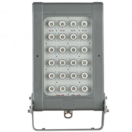
- ATEX Lighting – LED floodlights, linear lighting, bulkhead lighting, high bay lighting, emergency lighting and portable hazardous area lighting.
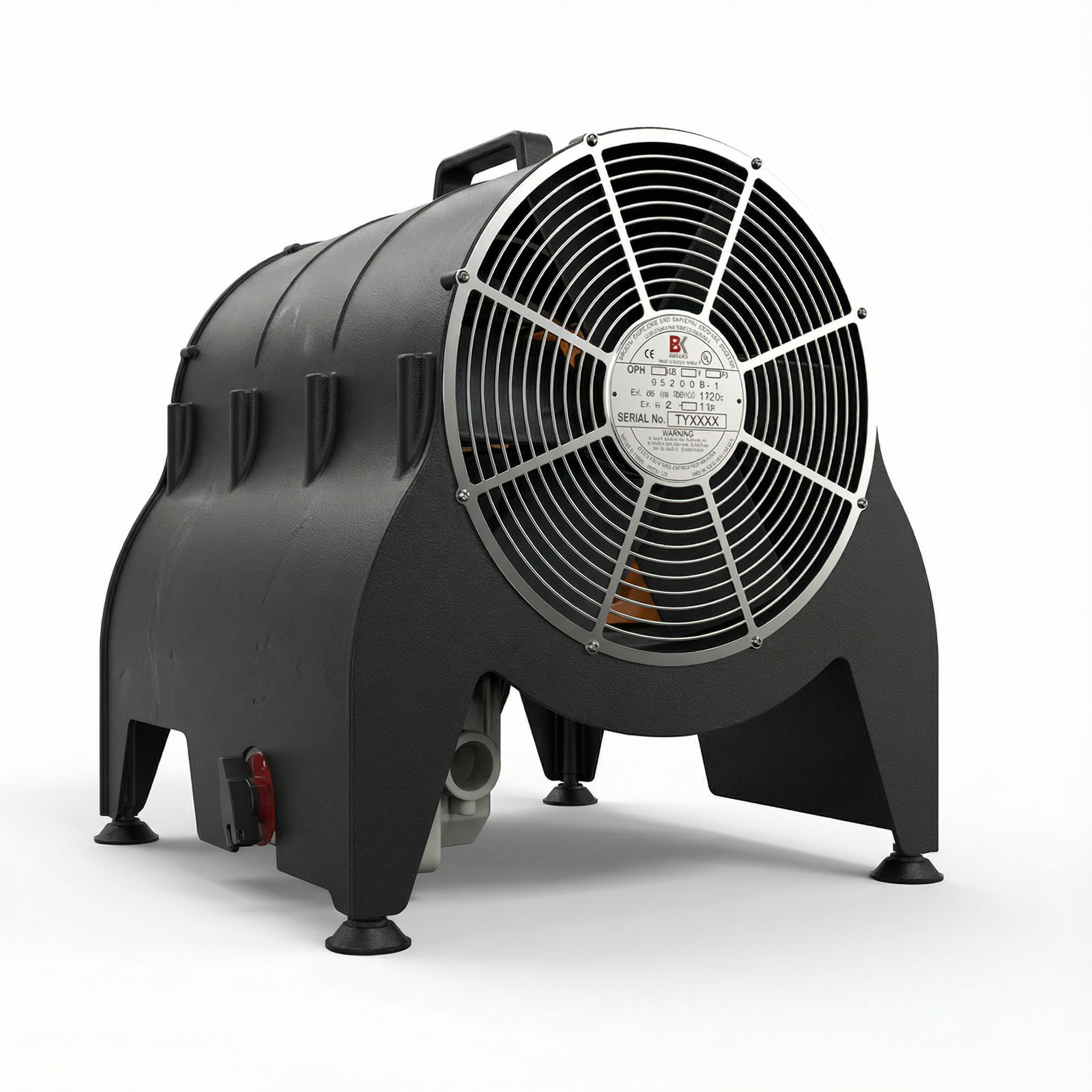
- ATEX & IECEx Heaters – hazardous area fan heaters, space heaters, immersion heaters, enclosure heaters and process heaters.
- Heat Trace Systems – certified trace heating cables, junction boxes, thermostats and controls for hazardous areas.
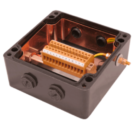
- ATEX Enclosures & Junction Boxes – power, control, instrumentation and heat tracing enclosures.
- ATEX Plugs, Sockets & Connectors – hazardous area electrical connection systems.
- ATEX Isolators – local isolation and control devices for certified hazardous area installations.
- Static Grounding Systems – equipment used to help control electrostatic ignition risks in process environments.
- Process Pressure Measurement – instrumentation used for measurement and control in industrial process applications.
When selecting equipment, the marking should be checked against the full application. For example, an ATEX light fitting suitable for Zone 2 gas atmospheres may not be suitable for Zone 1, Zone 21, combustible dusts, higher ambient temperatures or a different gas group unless the full marking and certificate confirm suitability.
ATEX Marking FAQs
Q: What does ATEX marking mean?
A: ATEX marking identifies how equipment is certified for use in potentially explosive atmospheres. It can show the equipment group, category, gas or dust suitability, protection method, gas group, temperature class, equipment protection level and certificate reference.
Q: What does II 2G mean in ATEX marking?
A: II means the equipment is intended for surface industries rather than mining. 2G means Category 2 equipment for gas, vapour or mist atmospheres. Category 2G equipment is commonly associated with Zone 1 applications, subject to the full marking and certificate conditions.
Q: What is the difference between 2G and 2D?
A: 2G refers to Category 2 equipment for gas, vapour or mist atmospheres. 2D refers to Category 2 equipment for combustible dust atmospheres. A product marked for gas should not automatically be assumed suitable for dust unless the marking and certificate confirm dust suitability.
Q: What does Ex db mean?
A: Ex db is a flameproof protection marking. It indicates that the equipment uses a flameproof enclosure designed to contain an internal explosion and prevent flame transmission to the surrounding explosive atmosphere, within the certified limits of the product.
Q: What does IIC mean in ATEX marking?
A: IIC is the most severe gas group within Group II gas atmospheres. Hydrogen and acetylene are commonly associated with IIC. Equipment marked IIC may often be suitable for IIB and IIA atmospheres when all other conditions are also met, but the certificate must always be checked.
Q: What does T4 mean on ATEX equipment?
A: T4 means the maximum surface temperature of the equipment does not exceed 135°C under certified conditions. The T-class must be suitable for the auto-ignition temperature of the hazardous atmosphere present.
Q: Is ATEX marking the same as IECEx marking?
A: ATEX and IECEx markings are closely related and often use similar Ex coding, but they are not the same certification scheme. ATEX is a European legal framework, while IECEx is an international certification system. Read more in our guide to ATEX vs IECEx.
Q: Can I rely on the ATEX label alone?
A: No. The label is important, but it should be checked against the certificate, manufacturer instructions, hazardous area classification, ambient temperature, gas or dust group, T-class, accessories and any special conditions of safe use.
Conclusion
ATEX marking is essential for selecting and verifying hazardous area equipment. It helps identify whether a product is suitable for gas or dust atmospheres, which zone it may be used in, what explosion protection method is applied, what gas group and temperature class apply, and what equipment protection level is provided.
However, ATEX marking should never be read in isolation. The safest approach is to check the full marking, certificate number, manufacturer documentation, special conditions of use, ambient temperature range and site hazardous area classification before installation.
Thorne & Derrick supply ATEX and IECEx certified equipment for hazardous area lighting, process heating, heat tracing, enclosures, isolators, plugs, connectors, process instrumentation and static control applications, with technical support to help customers select equipment suitable for demanding industrial environments.
ATEX and IECEx certification are both used to demonstrate that equipment is suitable for use in potentially explosive atmospheres, but they are not the same scheme. ATEX is a legal requirement for equipment placed on the EU market, while IECEx is an international certification system designed to provide globally recognised evidence of compliance with explosion protection standards.
For hazardous area industries such as oil and gas, petrochemical, chemical processing, offshore energy, food production, pharmaceutical manufacturing, hydrogen, utilities and mining, understanding the difference between ATEX vs IECEx is essential when specifying electrical, mechanical, heating, lighting, instrumentation and process equipment for hazardous area zones.
Quick Answer: ATEX vs IECEx
ATEX and IECEx both relate to the safe use of equipment in explosive atmospheres, but they serve different purposes. ATEX is a European legal framework for equipment placed on the EU market. IECEx is an international certification system based on IEC standards, used to support global acceptance and verification of explosion-protected equipment.
ATEX vs IECEx: Quick Comparison
| ATEX |
A European legal requirement for equipment and protective systems intended for use in potentially explosive atmospheres within the EU market. |
| IECEx |
An international certification system for equipment, services and personnel associated with explosive atmospheres. |
| Main Difference |
ATEX is market legislation. IECEx is a global certification and conformity assessment system. |
| Best Practice |
For international projects, equipment is often specified with both ATEX and IECEx certification where available. |
| Important Note |
Certification must always be checked against the actual hazardous area zone, gas or dust group, temperature class, equipment protection level and certificate conditions. |
What Is ATEX Certification?
ATEX certification confirms that equipment or protective systems meet the requirements of the ATEX Directive for use in potentially explosive atmospheres. The term ATEX comes from the French phrase ATmosphères EXplosibles, meaning explosive atmospheres.
The ATEX Directive applies to equipment and protective systems that are intended for use where flammable gases, vapours, mists or combustible dusts could create an explosion risk. This includes many types of electrical and non-electrical equipment used in hazardous area zones.
ATEX certification is especially relevant for products such as:
For equipment placed on the EU market, ATEX certification is not simply a technical preference — it is part of the legal route to demonstrating conformity with essential health and safety requirements.
External reference: The European Commission explains that ATEX Directive 2014/34/EU covers equipment and protective systems intended for use in potentially explosive atmospheres.
What Is IECEx Certification?
IECEx certification is an international certification system for equipment, services and personnel associated with explosive atmospheres. IECEx is operated by the International Electrotechnical Commission and is based on internationally recognised IEC standards, including the IEC 60079 series for explosive atmospheres.
Unlike ATEX, IECEx is not a regional legal directive. Instead, it provides a harmonised route for demonstrating that equipment has been independently assessed against international explosion protection standards.
An IECEx Certificate of Conformity provides traceable evidence that a product has been assessed by an approved Ex Certification Body and that the certificate can be checked through the official IECEx system.
Read more in our full guide: What is IECEx Certification?
IECEx is commonly used by international operators, EPCs, engineering contractors, OEMs and end users who need equipment that can support project specifications across multiple regions.
External reference: The official IECEx website describes IECEx as the IEC System for Certification to Standards Relating to Equipment for Use in Explosive Atmospheres.
ATEX vs IECEx: Key Differences
Although ATEX and IECEx are closely related, they are not interchangeable. They often use similar technical standards and markings, but the legal status, certification route, documentation and geographic acceptance are different.
ATEX vs IECEx: Detailed Comparison
| Legal Status |
ATEX is a legal requirement for relevant equipment placed on the EU market. |
IECEx is an international certification system. It is widely recognised, but national or regional requirements may still apply. |
| Geographic Scope |
ATEX applies to the European Union and is also relevant in markets that specify ATEX-approved equipment. |
IECEx is international and supports global acceptance across many countries and projects. |
| Primary Purpose |
Demonstrates conformity with European legislation for potentially explosive atmospheres. |
Provides internationally harmonised certification against IEC explosion protection standards. |
| Certification Bodies |
Uses Notified Bodies under the ATEX conformity assessment system, where third-party assessment is required. |
Uses approved IECEx Certification Bodies, known as ExCBs, and Ex Testing Laboratories, known as ExTLs. |
| Documentation |
Usually includes EU Declaration of Conformity, ATEX certificate where required, instructions and technical documentation. |
Includes IECEx Certificate of Conformity, Ex Test Report and Quality Assessment Report. |
| Marking |
Uses CE marking, Ex marking, equipment group, category, protection method, gas/dust group and temperature class. |
Uses Ex marking based on IEC standards, including protection method, equipment protection level, gas/dust group and temperature class. |
| Best Use |
Essential for EU market access and European hazardous area compliance. |
Highly useful for international projects, global specifications and independent certificate verification. |
In simple terms: ATEX tells you whether equipment follows the required European route for explosive atmosphere safety. IECEx provides an internationally recognised certificate route based on IEC standards.
Does IECEx Replace ATEX?
No — IECEx does not automatically replace ATEX. A product can be IECEx certified and still require ATEX conformity for placement on the EU market.
This is one of the most common misunderstandings in hazardous area specification. IECEx is extremely valuable because it provides independent international certification, but the legal requirements of the destination market must still be followed.
For example:
- For EU projects, ATEX conformity is required for applicable equipment placed on the EU market.
- For international projects, IECEx may be requested because it provides a globally recognised certificate route.
- For UK projects, the applicable UK requirements must also be considered, particularly where equipment is placed on the Great Britain market.
- For multinational operators, dual ATEX and IECEx certification is often preferred to simplify approval across different project regions.
In practice, many high-quality hazardous area products are supplied with both ATEX and IECEx certification because the two schemes are often used together in global industrial projects.
What About UKEX Certification?
For Great Britain, hazardous area equipment must also be considered in relation to the UK regulatory framework for equipment and protective systems intended for use in potentially explosive atmospheres.
After the UK left the EU, the UK introduced its own conformity marking framework for Great Britain. In many project conversations, this is often referred to as UKEX or UKCA Ex, depending on the context.
This means project teams may need to check whether equipment has:
- ATEX for EU market requirements.
- IECEx for international certification and project specifications.
- UKCA / UKEX-related conformity for Great Britain market requirements.
- Correct hazardous area marking for the gas or dust zone where the equipment will be installed.
External reference: UK Government guidance explains the requirements for equipment and protective systems intended for use in potentially explosive atmospheres in Great Britain.
Why Are Products Often ATEX & IECEx Certified?
Many manufacturers choose to obtain both ATEX and IECEx certification because hazardous area projects are often international. A product may be designed in one country, certified by an international test body, purchased by an EPC contractor, installed offshore, and operated by a global end user.
Dual certification can help:
- Support EU and international project requirements with one product range.
- Reduce specification risk by giving buyers more complete certification evidence.
- Simplify procurement for operators with global hazardous area standards.
- Improve documentation traceability by providing formal certificates and marking references.
- Support technical review by engineers, safety teams, inspectors and duty holders.
For high-risk environments, certification should never be treated as a tick-box exercise. The certificate must match the actual equipment, the hazardous area classification, the protection concept, the gas or dust group, the temperature class and any specific conditions of use.
Related guide: ATEX Certification & IECEx Certification of Equipment
What Should You Check on ATEX & IECEx Markings?
When selecting hazardous area equipment, the marking and certificate should be checked carefully. A product being described as “ATEX” or “IECEx” is not enough on its own.
ATEX & IECEx Certification Checks
| Zone Suitability |
Check that the equipment is suitable for the hazardous area zone, such as Zone 0, Zone 1, Zone 2, Zone 20, Zone 21 or Zone 22. |
| Gas or Dust Group |
Confirm compatibility with the gas group or dust environment, such as IIA, IIB, IIC or relevant dust group classification. |
| Temperature Class |
Verify the T-class or maximum surface temperature is suitable for the ignition temperature of the surrounding atmosphere. |
| Protection Method |
Check the protection concept, such as Ex d, Ex e, Ex i, Ex m, Ex n, Ex p or Ex t, and confirm it suits the application. |
| Certificate Number |
Confirm that the certificate number matches the product, model, manufacturer and approval scope. |
| Specific Conditions of Use |
Look for an “X” suffix on the certificate number, which indicates that special conditions of safe use apply. |
| Installation Requirements |
Check manufacturer instructions for installation, maintenance, cable entries, earthing, ambient temperature, accessories and inspection requirements. |
For more detail on certificate suffixes, read our guide: What is the “X” in Ex Certificates?
You should also consider temperature T-class ratings, minimum ignition energy and hazardous area classification when assessing equipment suitability.
Example ATEX & IECEx Product Ranges
ATEX and IECEx certification can apply to a wide range of hazardous area equipment. The correct product will depend on the zone classification, gas or dust group, temperature class, ambient conditions, process risk and installation requirements.
Typical ATEX and IECEx certified product ranges include:
- ATEX Lighting – hazardous area LED floodlights, linear lighting, bulkhead lighting, high bay lighting, emergency lighting and portable lighting for Zone 1, Zone 2, Zone 21 and Zone 22.
- Hazardous Area Heaters – ATEX and IECEx certified fan heaters, space heaters, enclosure heaters, immersion heaters and process heaters.
- Heat Trace Systems – trace heating cables, thermostats, junction boxes and control systems for frost protection and process temperature maintenance.
- ATEX Enclosures & Junction Boxes – hazardous area power, control, instrumentation and heat tracing enclosures.
- ATEX Plugs, Sockets & Connectors – safe electrical connection systems for hazardous area power distribution.
- ATEX Isolators – certified isolation and control devices for local disconnection in hazardous areas.
- Process Instrumentation – hazardous area measurement, detection and control equipment for industrial process applications.
Thorne & Derrick supply hazardous area equipment from leading manufacturers with technical support to help customers select products that match the required certification, hazardous area classification and installation conditions.
Common Mistakes When Comparing ATEX & IECEx
Even experienced buyers can misunderstand the relationship between ATEX and IECEx. The most common mistakes include:
- Assuming IECEx automatically replaces ATEX – IECEx is valuable, but EU market requirements must still be considered.
- Assuming all Ex equipment is suitable for every hazardous area – equipment must match the zone, gas or dust group, temperature class and protection level.
- Checking the certificate but not the model number – the certificate must cover the exact product variant being supplied.
- Ignoring the “X” suffix – an “X” on the certificate number indicates specific conditions of safe use.
- Overlooking ambient temperature limits – equipment may only be certified within a defined temperature range.
- Treating certification as the only safety requirement – correct installation, inspection, maintenance and risk assessment are also essential.
Correct certification is only one part of hazardous area safety. Equipment must also be installed, inspected and maintained correctly by competent personnel in line with the site’s hazardous area classification and safety management procedures.
External reference: The Health and Safety Executive explains that explosive atmospheres can be caused by gases, mists, vapours or combustible dusts, and that controlling ignition sources and using suitable equipment are important risk reduction measures.
ATEX vs IECEx FAQs
Q: What is the main difference between ATEX and IECEx?
A: The main difference is that ATEX is a European legal framework for equipment used in potentially explosive atmospheres, while IECEx is an international certification system based on IEC standards. ATEX is required for applicable equipment placed on the EU market, whereas IECEx supports international acceptance and certificate verification.
Q: Is IECEx accepted in Europe?
A: IECEx is widely recognised and can support technical evidence for explosion protection, but it does not remove the need to meet ATEX requirements for equipment placed on the EU market. Many manufacturers use IECEx test data and certification evidence alongside ATEX conformity processes.
Q: Can equipment be both ATEX and IECEx certified?
A: Yes. Many hazardous area products are supplied with both ATEX and IECEx certification. Dual certification is common for international projects because it helps support both European and global specification requirements.
Q: Does IECEx certification mean a product is safe for any hazardous area?
A: No. IECEx certification only confirms suitability within the limits stated on the certificate and product marking. The equipment must still match the hazardous area zone, gas or dust group, temperature class, equipment protection level, ambient temperature range and specific conditions of use.
Q: Is ATEX only for electrical equipment?
A: No. ATEX can apply to both electrical and non-electrical equipment if the product is intended for use in potentially explosive atmospheres and falls within the scope of the directive. This can include mechanical equipment, protective systems, control devices and safety components.
Q: What does Ex marking mean?
A: Ex marking shows how equipment is certified for use in explosive atmospheres. It may include the equipment group, category or equipment protection level, protection method, gas or dust group, temperature class and certificate references. These markings help confirm whether the equipment is suitable for the intended hazardous area.
Q: Where can I verify an IECEx certificate?
A: IECEx certificates can be checked through the official IECEx certificate database. The certificate number, manufacturer, product type and status should match the equipment being supplied.
Q: Should I specify ATEX, IECEx or both?
A: The correct specification depends on the project location, market requirements, end-user standards and hazardous area classification. For EU projects, ATEX conformity is normally required. For international projects, IECEx may be requested. For global operators, dual ATEX and IECEx certification is often preferred where available.
Conclusion
ATEX and IECEx are closely connected, but they are not the same. ATEX is a European legal requirement for equipment and protective systems used in potentially explosive atmospheres, while IECEx is an international certification system that helps provide globally recognised evidence of explosion protection compliance.
For hazardous area projects, the safest approach is to check the complete certification picture: the legal market requirement, the IECEx or ATEX certificate, the Ex marking, the hazardous area zone, the gas or dust group, the temperature class, the equipment protection level and any specific conditions of use.
Thorne & Derrick can support the specification and supply of ATEX and IECEx certified equipment for hazardous area lighting, heating, heat tracing, power distribution, process instrumentation, plugs, connectors, enclosures and electrical safety applications.
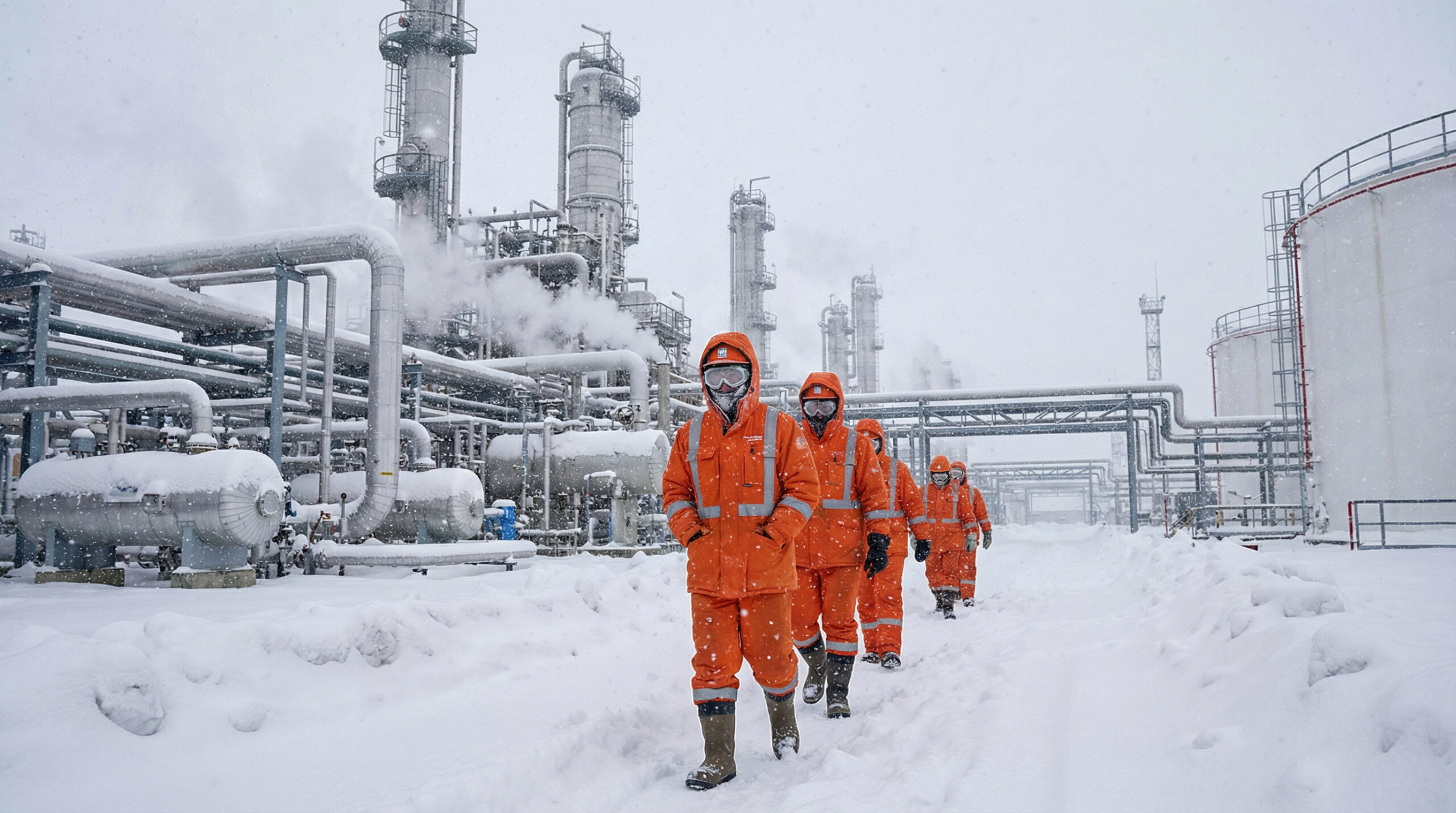
Storm Goretti is already impacting Europe, bringing a combination of freezing temperatures, snow, ice and strong winds across key industrial regions. While transport disruption and power outages dominate headlines, the most serious risks are being felt quietly across hazardous area industrial sites where temperature control is fundamental to safe operation.
For industries such as oil & gas, petrochemical processing, offshore production, terminals, tank farms and chemical manufacturing, Storm Goretti is not simply a weather event. It is a direct threat to flow assurance, safety compliance, asset integrity and production continuity.
This article explores what Storm Goretti means for hazardous area operations, the specific technical issues sites will face, and how ATEX-certified heating and temperature maintenance solutions can prevent forced shutdowns, damage and lost revenue.
What Is Storm Goretti?
Storm Goretti is a powerful winter storm system that developed over the North Atlantic before intensifying as it moved into Western Europe. Meteorological agencies have issued widespread warnings for sub-zero temperatures, heavy snowfall, freezing rain and strong winds, with conditions expected to deteriorate rapidly in some regions.
What makes Storm Goretti particularly disruptive is not just the snowfall or wind, but the speed at which temperatures are dropping. Sudden cold snaps place significant thermal stress on industrial systems that rely on controlled heat input to remain operational.
For hazardous area sites, these conditions create a perfect storm for freezing, solidification, instrumentation failure and emergency shutdowns.
Why Cold Weather Is a Major Industrial Risk
In hazardous environments, temperature is not simply a comfort issue – it is a critical process variable. Many fluids, chemicals and gases behave very differently as temperatures fall:
- Hydrocarbons become more viscous or gel
- Chemicals crystallise or solidify
- Condensation freezes inside lines and instruments
- Elastomers and seals lose flexibility
Without active temperature maintenance, these changes can lead to blocked pipelines, seized valves, damaged pumps and false instrument readings – all of which can trigger safety trips or forced shutdowns.
Impact on Hazardous Area Industries
Oil & Gas – Onshore, Offshore & Terminals
Oil & gas assets are especially exposed during extreme cold. Storm Goretti increases the risk of:
- Pipeline and valve freeze-ups
- Reduced flow rates and pressure instability
- Heat exchanger efficiency loss due to icing
- Instrument air and impulse line freezing
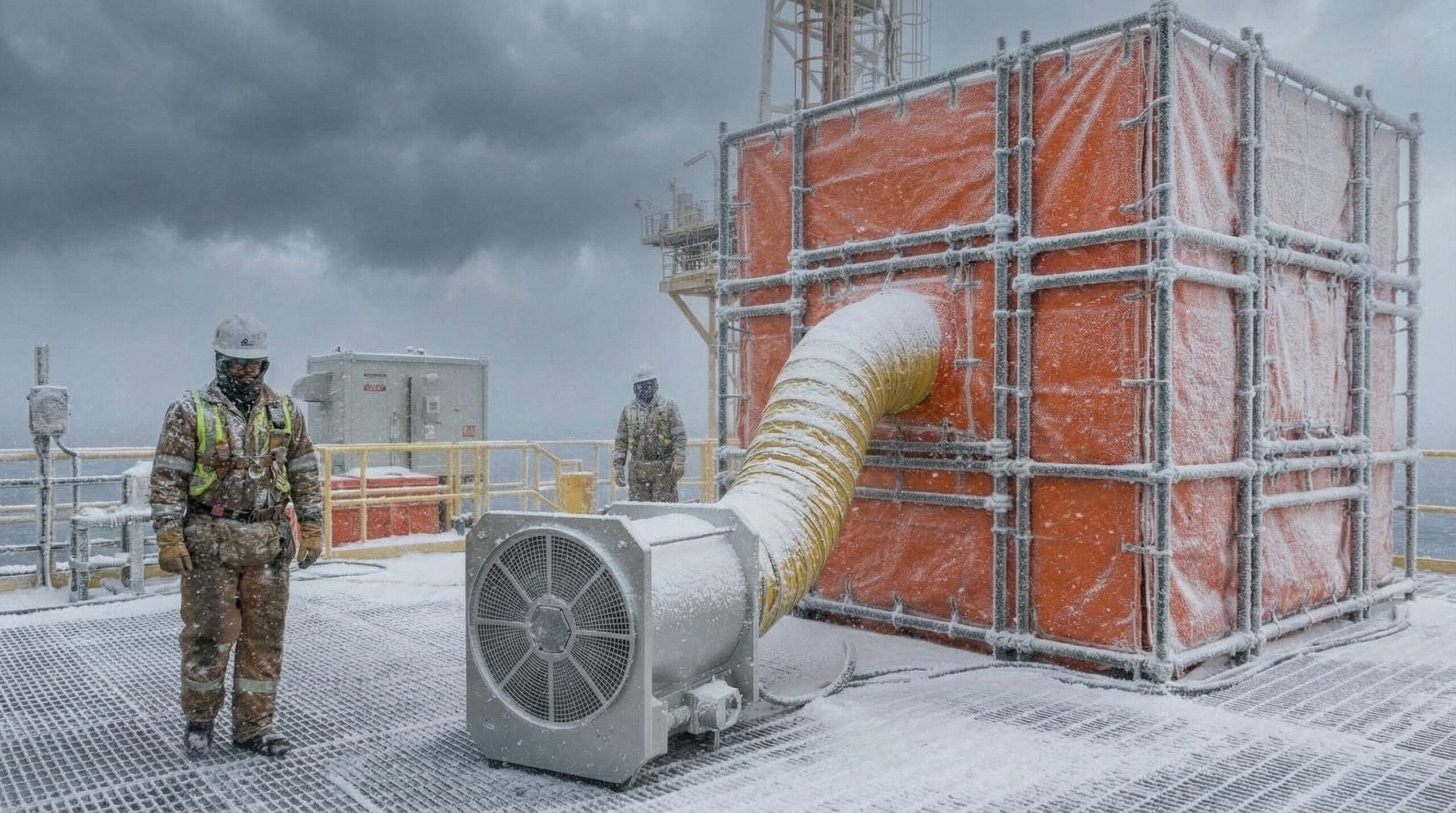
On offshore platforms and remote assets, access restrictions caused by weather make rapid intervention difficult, increasing reliance on permanently installed trace heating and hazardous area heaters.
Petrochemical & Chemical Processing
Many chemical processes operate within tight temperature windows. Cold ingress during storms can cause:
- Feedstock temperature dropping below reaction limits
- Increased viscosity leading to pump overload
- Batch quality issues or scrapped product
- Extended restart times after shutdown
Tank Farms, Drum Storage & Loading Operations
Bulk storage and transfer operations face increased challenges as temperatures fall:
- Drums and IBCs stored outdoors cool rapidly
- Loading arms and hoses freeze between transfers
- Mobile operations become difficult or unsafe
Common Failure Modes During Extreme Cold Events
- Frozen pipework and valves requiring controlled thawing
- Unplanned production shutdowns due to process trips
- ATEX compliance risks if uncertified heaters are introduced in emergencies
- Asset damage caused by thermal shock or ice expansion
- Extended restart timelines once materials solidify
Crucially, many sites only discover these vulnerabilities after temperatures have dropped. By that point, options are limited and downtime is already unavoidable.
Heating & Temperature Control Solutions for Storm Conditions
At Thorne & Derrick, we specialise in engineered heating solutions for hazardous areas, designed to maintain safe operating temperatures during extreme winter weather events such as Storm Goretti.
Typical mitigation strategies include:
- ATEX & IECEx certified air heaters for plant rooms, enclosures and temporary work areas
- Electrical trace heating for pipelines, valves, manifolds and tanks
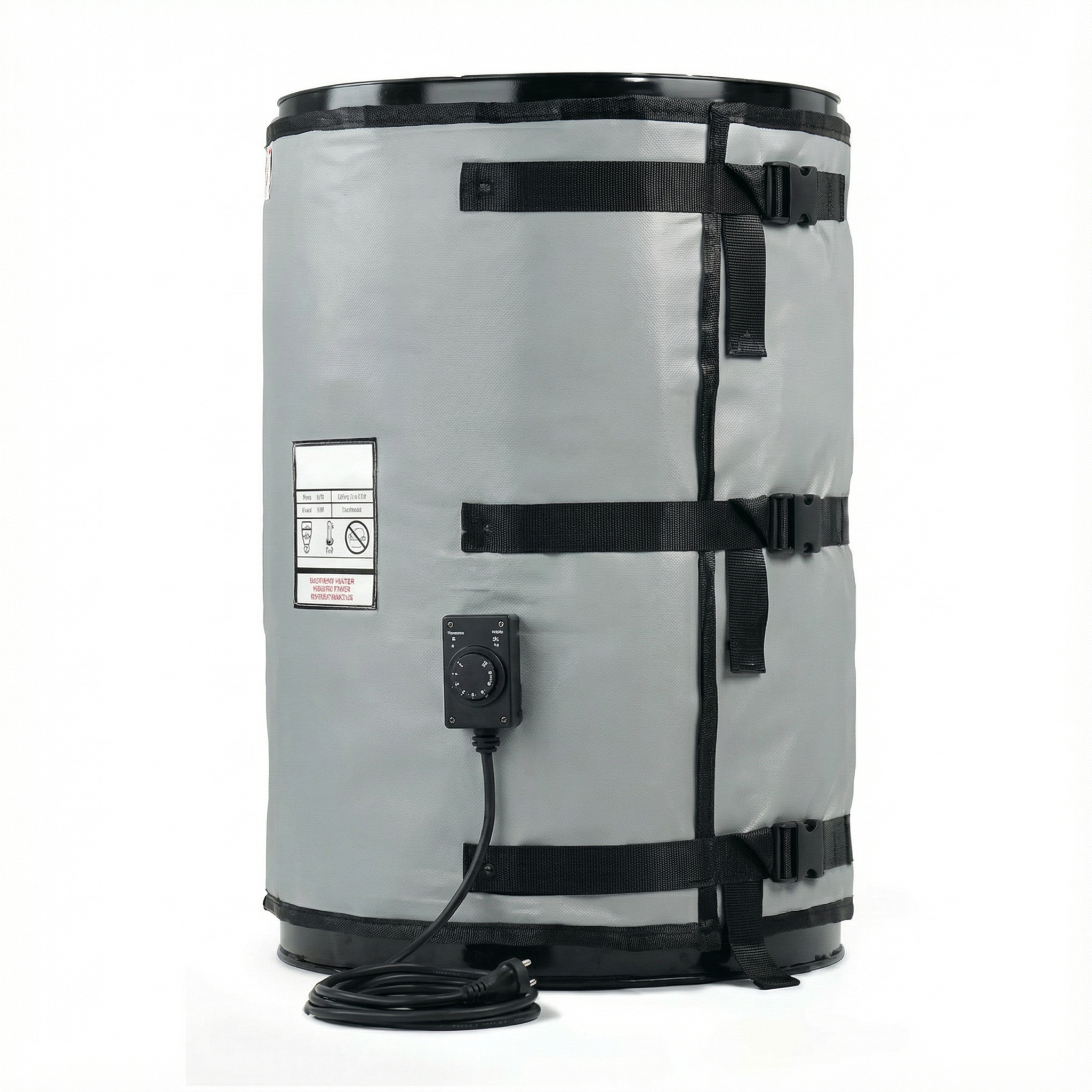
- Drum and IBC heaters to maintain product viscosity and prevent solidification
- Heated hoses for safe, flexible transfer of temperature-sensitive fluids
All equipment is selected to meet the required zone classification, temperature class (T-class), ingress protection and duty cycle.
Product Highlight: Hazardous Area Solutions for Extreme Weather
Thorne & Derrick International, based in the UK, are the leading stockists and suppliers of EXHEAT, Heatfast, Eltherm, Winkler & more – providing technical advice, quotations and fast worldwide delivery for both UK & export projects.
Hazardous Area Heater Safety Checklist
- ATEX / IECEx certification verified
- Correct temperature class (T3 / T4)
- No exposed ignition sources
- Anti-static, corrosion-resistant construction
- Ingress protection suitable for offshore use
- Thermal cut-out and over-temperature protection
Why Industrial-Grade ATEX Heating Matters
| Feature |
Certified ATEX Heater |
Non-Certified Alternative |
| Hazardous Area Approval |
✔ Zone-rated |
✖ Not permitted |
| Temperature Control |
✔ T-Class compliant |
✖ Uncontrolled |
| Continuous Operation |
✔ Designed for duty |
✖ Short-term only |
Urgent Actions: What Sites Should Do Now
Storm Goretti is not a future risk – it is a current one. Sites that delay preparation risk being forced into shutdowns rather than making controlled decisions.
- Audit existing trace heating and space heating systems
- Identify unprotected or marginal assets
- Deploy certified hazardous area heaters before access becomes restricted
Need urgent hazardous area heating support?
Thorne & Derrick supply ATEX-certified heating solutions for storm response, winterisation and critical temperature maintenance.
Contact Sales
Why EXHEAT LFH Matters
The EXHEAT LFH is a purpose-built ATEX/IECEx-certified fan heater engineered for hazardous areas (Zone 1 & Zone 2 gas and Zone 21 & Zone 22 dust). It is commonly specified by engineers, safety managers and procurement teams who require robust performance, full certification and flexible installation options for industrial, offshore and process environments.
Key capabilities that set EXHEAT LFH apart:
EXHEAT LFH: Core Strengths
- Full ATEX & IECEx certification for Zone 1 / Zone 2 (Gas IIB + H₂ options) and Zone 21 / Zone 22 (dust).
- High power options (standard LFH up to 20 kW; higher-power variants & multi-unit configurations available for larger loads).
- Stainless-steel construction for marine and corrosive environments, ideal for offshore applications.
- Mounting & ducting flexibility: floor, wall, ceiling mounted or ducted for targeted heating.
- Wide ambient range: –40 °C to +40 °C, suitable for cold-climate and offshore operations.
Competitor ATEX Heater: Overview
To help buyers compare fairly, we summarise the capabilities of a typical portable ATEX-rated fan heater commonly offered by other suppliers (portable up to 18 kW class). This generic unit is designed for rapid plug-and-play deployment and is widely used for short-term, on-site heating tasks.
Typical characteristics: 18 kW power, 3-phase 400–440 V, high free airflow (2,100–2,500 m³/hr), IP65, portable with lifting handles and optional anti-static ducting. Suitable for temporary heating of small enclosures or short-duration tasks in Zones 1/2.
Side-by-Side Specification Comparison
Specification Comparison: EXHEAT LFH vs Generic Portable ATEX Heater
| Specification |
EXHEAT LFH |
Generic Portable ATEX Heater |
| ATEX / IECEx Certification (Zones) |
Zone 1 / Zone 2 (Gas IIB + H₂ options), Zone 21 / Zone 22 (dust). IECEx & CU-TR options available. |
Zone 1 / Zone 2 (Gas IIB). Typical IECEx variants may be limited; dust options vary by supplier. |
| Power Output (kW) |
Temporary LFH up to 20 kW; scalable options & multi-unit setups allow higher total kW (XLFH variants exist). |
Standard portable unit typically 18 kW (single unit). |
| Airflow (m³/hr) |
~1,950–2,340 m³/hr (model & frequency dependent) — designed for controlled ducting and area heating. |
~2,100–2,560 m³/hr free airflow — optimised for free air or short duct runs. |
| Ambient Temperature Range |
–40 °C to +40 °C (suitable for cold-climate offshore use). |
–40 °C to +40 °C (portable variants advertise similar range). |
| Construction |
Stainless-steel casing, finned stainless tubular elements, PA66 glass-filled impeller — designed for harsh environments. |
Robust steel enclosure with corrosion protection; designed for portability rather than long-term fixed installation. |
| Mounting & Mobility |
Floor/wall/ceiling mounting options, ducting-ready; long flying lead for fixed or semi-permanent install; optional castors for mobility. |
Portable with handles; plug-and-play; intended primarily for temporary site use. |
| Ingress Protection (IP) |
IP65 (suitable for outdoor / washdown and marine environments). |
IP65 on many models; verify for the specific portable unit. |
| Best Use Case |
Permanent or semi-permanent installations, ducted area heating, spray-booths, offshore modules and larger hazardous-area rooms. |
Temporary enclosures, quick site jobs, short-term area heating and spot heating tasks. |
Feature Comparison: EXHEAT LFH vs Generic Portable ATEX Heater
| Feature |
EXHEAT LFH |
Generic Portable ATEX Heater |
| Zone 1 & Zone 2 Certified |
✔️ Yes |
✔️ Yes |
| T-Class Options (T3/T4) |
✔️ Full range |
✔️ / Limited |
| High-Efficiency Motor |
✔️ Yes |
✖️ Standard motor |
| Comprehensive Airflow Control |
✔️ Yes |
✖️ No |
| Stainless Steel Construction |
✔️ Full stainless |
✖️ Partial |
| Low Noise & Vibration |
✔️ Yes |
✖️ No |
| Fixed or Semi-Permanent Installation |
✔️ Designed for permanent & ducted use |
✖️ Primarily temporary |
| Portability |
✔️ Optional castors / mounting options |
✔️ Portable with handles |
| Ingress Protection (IP) |
✔️ IP65 |
✔️ / Check model |
Real-World Benefits: Why EXHEAT LFH Often Outperforms
Specs matter — but so does how a heater performs on site. Below are practical advantages of choosing EXHEAT LFH for industrial deployments.
- Scalable Power: LFH’s higher kW options and modular approach let you heat larger rooms or multiple zones without replacing equipment.
- Durability for Tough Environments: Stainless construction resists corrosion, making LFH better for offshore or long-term installations.
- Ducting & Targeted Heating: LFH is built for efficient ducted airflow, so heat can be delivered exactly where it’s needed — ideal for habitats, spray-booths and process rooms.
- Compliance & Documentation: Full ATEX / IECEx certification and T-class options simplify compliance checks during audits.
- Lower Total Cost of Ownership: Rugged construction and the ability to evolve a semi-permanent site heating plan into a permanent solution reduces replacement & rental costs over time.
Installation, Inspection & Maintenance — Key Practical Tips
Below are practical points and a quick specification checklist to ensure safe, compliant and effective installation of any ATEX heater. Use this before installation and during your maintenance schedules.
Specification Checklist
- Zone Rating: Confirm the zone classification for the exact mounting location (Zone 1 vs Zone 2; Zone 21/22 for dust).
- Gas Group & T-Rating: Match the heater to the gas group and T-class of your environment (IIB, IIB+H₂ options where required).
- kW & Heat Load: Calculate required kW to achieve desired temperature rise (ΔT) for your room volume and losses.
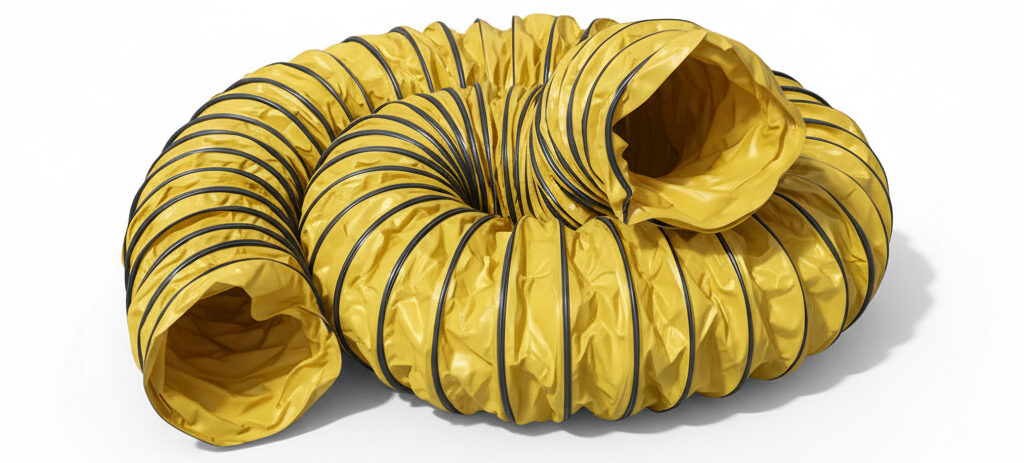
- Ducting: Use appropriately sized anti-static ducting, avoid excessive runs and specify round vs rectangular as required for flow.
- IP & Corrosion Rating: Choose IP65 or higher for outdoor/washdown; choose stainless or marine-grade materials for offshore applications.
- Mounting & Fixings: If permanent/semi-permanent, select wall/ceiling mounting brackets and secure to structural points per manufacturer guidance.
- Electrical Supply & Isolation: Ensure correct three-phase supply, isolator, correct cable sizing and earthing for hazardous areas.
- Inspection & Maintenance: Schedule periodic inspections: element integrity, impeller condition, insulation resistance tests, and certification paperwork.
Conclusion & Next Steps
In short: if you require a robust, scalable, long-term hazardous-area heating solution for large rooms, ducted applications or offshore/process environments — EXHEAT LFH is the superior choice. It delivers higher flexibility (mounting & ducting), industrial durability (stainless construction), strong certification coverage (ATEX / IECEx, Zone 1/2 & dust zones), and options for higher kW capacity when you need it.
A portable 18 kW ATEX heater is a useful tool for short-term or emergency work — but for professional installations where reliability, compliance and lifetime cost matter, LFH is the more future-proof investment.
 IECEx certification is an internationally recognised standard for verifying the safety of electrical and non-electrical equipment used in explosive (Ex) atmospheres. It provides independent proof that products, repair facilities, and even personnel meet globally accepted safety and quality requirements for hazardous locations.
For industries operating in potentially explosive atmospheres — such as oil & gas, chemical processing, energy, mining, and food production — IECEx certification helps ensure that installed equipment will not become an ignition source and cause an explosion.
What Is IECEx Certification?
IECEx stands for the International Electrotechnical Commission System for Certification to Standards Relating to Equipment for Use in Explosive Atmospheres. It is operated by the International Electrotechnical Commission (IEC) — the same global organisation that develops electrical and electronic standards used across over 80 member countries.
IECEx certification demonstrates that equipment has been independently tested and found to comply with the IEC 60079 series of standards. These standards specify how to design, test, and mark electrical and mechanical products for use where flammable gases, vapours, or dusts could ignite.
Unlike regional schemes such as ATEX certification for Hazardous Area Zones (mandatory in the EU), IECEx is an internationally harmonised, voluntary certification system — created to streamline compliance and remove trade barriers between different national approval schemes.
How to Get IECEx Certification
The IECEx certification process involves several stages of technical assessment and quality auditing, all carried out by independent accredited organisations. Here’s how manufacturers typically achieve certification:
- Product Design & Standard Selection – The manufacturer determines which IEC standards apply (typically IEC 60079-0 plus others depending on protection type such as flameproof, increased safety, or intrinsic safety).
- Testing by an Ex Test Laboratory (ExTL) – The product undergoes laboratory testing to verify compliance with relevant IEC standards. This includes environmental, electrical, and mechanical safety testing.
- Technical File Review by an Ex Certification Body (ExCB) – A certified ExCB reviews all test data, drawings, and documentation to confirm that the design meets IECEx requirements.
- Quality Assessment Report (QAR) – The manufacturing facility must demonstrate a consistent production process and quality management system that ensures every unit matches the tested design.
- Issuance of Certificate of Conformity (CoC) – Once approved, the ExCB issues an official IECEx CoC, which is published online in the IECEx database for public verification.
The result is a traceable, transparent, and internationally recognised proof of compliance — valid in all countries participating in the IECEx System.
Is IECEx Accepted Globally?
Yes — IECEx is recognised worldwide, with member countries across Europe, Asia, Africa, Oceania, and the Americas. Although IECEx certification is voluntary, it is accepted in many regions as an equivalent or supporting approval for national compliance schemes.
For example:
- Australia, New Zealand, Singapore, South Africa, and India accept IECEx certificates directly for market entry.
- Europe requires ATEX for legal sale within the EU, but IECEx reports (ExTRs) are commonly used as supporting evidence for ATEX approvals.
- The Middle East and Asia-Pacific increasingly recognise IECEx as the global benchmark for explosion protection assurance.
This global acceptance allows manufacturers to reduce duplication of testing, shorten approval timelines, and demonstrate compliance to a consistent international standard.
What Does IECEx Stand For?
IECEx is an abbreviation of “International Electrotechnical Commission Explosive Atmospheres.” It covers certification schemes for:
- Equipment – electrical and non-electrical apparatus used in explosive atmospheres.
- Service Facilities – workshops conducting repair and overhaul of Ex equipment.
- Personnel Competence – individuals performing design, installation, inspection, and maintenance in hazardous areas.
Each scheme provides its own form of certificate and audit process, all traceable through the official IECEx Certified Equipment database.
ATEX vs IECEx: What’s the Difference?
Although ATEX and IECEx share the same technical foundation (both use IEC 60079 standards), they differ in scope and purpose. ATEX is a legal requirement within the European Union, whereas IECEx is a voluntary international certification system designed to harmonise standards globally.
ATEX vs IECEx: Key Differences
| Legal Status |
ATEX is a mandatory directive in the European Union. IECEx is a voluntary international certification scheme. |
| Geographic Reach |
ATEX applies within the EEA. IECEx is recognised internationally across participating member countries. |
| Certification Bodies |
ATEX uses EU Notified Bodies. IECEx uses globally approved Ex Certification Bodies (ExCBs) under the IECEx System. |
| Testing Approach |
ATEX allows self-declaration for some low-risk equipment. IECEx requires independent testing for all certified products. |
| Certification Output |
ATEX uses the CE marking with Ex coding; IECEx issues a public Certificate of Conformity and associated Test Report (ExTR). |
Read more on ATEX & IECEx | Approval of Electrical Equipment Used in Hazardous Areas & Explosive Atmospheres.
Benefits of IECEx Certification
- International Recognition – Accepted in multiple regions without additional testing or re-certification.
- Safety Assurance – Independent verification ensures equipment safety in explosive atmospheres.
- Transparency – All valid IECEx certificates are published online for anyone to verify.
- Trade Efficiency – Reduces duplication between regional schemes and accelerates global market access.
- Consistency – Aligns testing and quality assurance across products, facilities, and personnel.
What Are Some Example IECEx Certified Product Ranges?
IECEx certification applies to a wide variety of industrial equipment designed for use in explosive or hazardous environments — anywhere electrical energy or surface temperature could ignite a flammable gas, vapour, or dust. Typical IECEx-certified product ranges include:
All of these product ranges must be IECEx-certified because they contain electrical or thermal components capable of becoming ignition sources if not properly designed. Certification ensures the equipment meets strict international standards for safety, construction, and temperature limitation — protecting both personnel and facilities in explosive environments.
IECEx Certification FAQs
Q: Is IECEx certification mandatory?
A: No — IECEx is voluntary. It is not required by law but provides globally recognised proof of safety and quality for hazardous area equipment.
Q: Is IECEx accepted worldwide?
A: Yes — IECEx is recognised by over 30 member countries and accepted across many global markets. Some nations require additional national approvals, but IECEx is the foundation for most explosion-protection standards.
Q: Can a product be both ATEX and IECEx certified?
A: Yes — most manufacturers pursue dual certification. The same test data can support both systems, simplifying compliance for global markets.
Q: Where can I check an IECEx certificate?
A: All valid certificates are listed on the official IECEx Certificate Database, searchable by certificate number or company name.
Conclusion
IECEx certification offers a reliable, internationally accepted pathway to demonstrate the safety and quality of equipment used in explosive atmospheres. It aligns global standards, enhances confidence for operators and end users, and streamlines international trade in explosion-protected equipment. While not legally required in every country, IECEx remains a key indicator of product safety, quality, and compliance in hazardous environments worldwide.