Hazcon Inc.
Explosion Protection
& Hazardous Area Equipment
Hazcon Inc. provides a full suite of consulting services for manufacturers of electrical equipment for hazardous locations and explosive atmospheres. Their primary focus is to help manufacturers prepare for all phases of certification of these products – from product design, approval and installation to certification maintenance.
NEW Explosion Protection Apps
Find out about Explosion Protection Techniques & Equipment Protection Level in just 10 seconds.
These NEW explosion protection apps, brought to you by HAZCON, use excellent experience and knowledge that will help you through the certification approval process.
HAZCON 100 app
Not sure which protection techniques can be implemented for your electrical equipment intended to be installed and used in the zone system in hazardous areas? Try the FREE Hazcon100 App to learn which protection techniques apply in the zone system and to get a report immediately. Hazcon100 helps users navigate all available protection techniques for zone systems per IEC 60079 series in 10 seconds.
HAZCON 200 APP
The clear and correct markings of Ex equipment in the product name-plate and certificate will help the end users to procure and install the Ex equipment in hazardous areas correctly. However, unclear markings can result in missing the target clients of the Ex equipment and may lead to a wrong installation in the field.
If you would like to find out the correct International (IECEx), Europe (ATEX) and North American (for both Zone and Division systems) markings per each hazardous location protection technique, try the user-friendly and FREE Hazcon200 App and get accurate results in 10 seconds. This app provides a report of accurate markings for different types of certification and area classifications.
| Hazcon100 helps you navigate all the Explosion Protection Techniques for each Zone system and flammable substances and Ex equipment for use in hazardous locations. |
|
Hazcon200 helps you navigate the correct IECEx, ATEX and North American markings of Ex Equipment for each Explosion Protection Techniques & Equipment Protection Level (EPL). |
If electrical equipment is not selected or installed properly, it can become an ignition source within hazardous areas and could lead to catastrophic loss. The markings of Ex equipment is a short description of the equipment and its protection technique.
It should be an essential consideration when developing, designing, evaluating, procuring and installing Ex Equipment.
If you need to find out the correct International (IECEx), European (ATEX) and North American (for both Zone and Division Systems) markings per each protection technique, try out the free and user-friendly Hazcon200 app.
Maintaining Hazardous Area
& Explosion Protection
Compliance & Certification
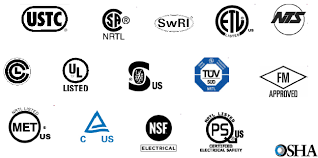
Hazcon can help you navigate the complexities of the equipment design and certification processes (North American and international) through a proactive, step-by-step approach. The key to a successful certification application is being fully prepared before starting certification projects.
Further Reading
Optical Radiation | A Source Of Ignition In Hazardous Areas
Class I Division 1 Products & Hazardous Area Locations
Class I Division 2 Products & Hazardous Area Locations
The Importance Of Grounding Of Intrinsically Safe Devices In Hazardous Areas
Information Courtesy
Behzad Nejad, P. Eng. (Hazcon)
Director & Consulting Engineer at Hazcon Inc.; Hazardous Locations Consulting Services; IECEx, ATEX, CEC & NEC
Specializing in the design, safety and approval of electrical equipment for hazardous locations.
Mr. Nejad has over 15 years of experience as an Electrical Engineer and is a sought after professional in the hzardous area and explosion protection industry. He is fully-qualified at the advanced level of all hazardous locations protection techniques including Intrinsic Safety & Non-incendive, Explosion Proof & Flame proof, Increased Safety, Non-arcing, Purging and Pressurization, Encapsulation, Optical Radiation, and Dust-tight enclosures. Mr. Nejad’s tenure in the industry includes six years at the CSA certification agency, working closely with manufacturers (Emerson, GE, ABB, Siemens, Endress-Houser, VEGA etc.) as a technical and certification engineer for Hazardous locations equipment.
EXPERTS IN EQUIPMENT FOR EXPLOSIVE ATMOSPHERES
leaders in ATEX Innovation To The Hazardous Area Industries
Thorne & Derrick are leaders in the development and distribution of Product Innovations that deliver significant improvements to clients plant, people and operational safety in the explosive atmosphere industries.
Your proactive problem solvers experienced in succession planning for the replacement of obsolete, non-conformant and legacy equipment in hazardous areas.
Your first-choice provider of innovative and competitive solutions to ensure ATEX & IECEx Compliance for Hazardous Area Electrical, HVAC & Process Instrumentation Equipment to UK and international projects.
Control Panels | Plugs | Isolators | Enclosures & Junction Boxes | Lighting | Control Stations | Motor Starters | Heat Trace | Gas Detection | Flame Detection | Process Instrumentation | Process Heating | Ventilation Fans | Security Access Control

Competitive Prices | Extensive Stocks | Technical Support | Express Delivery
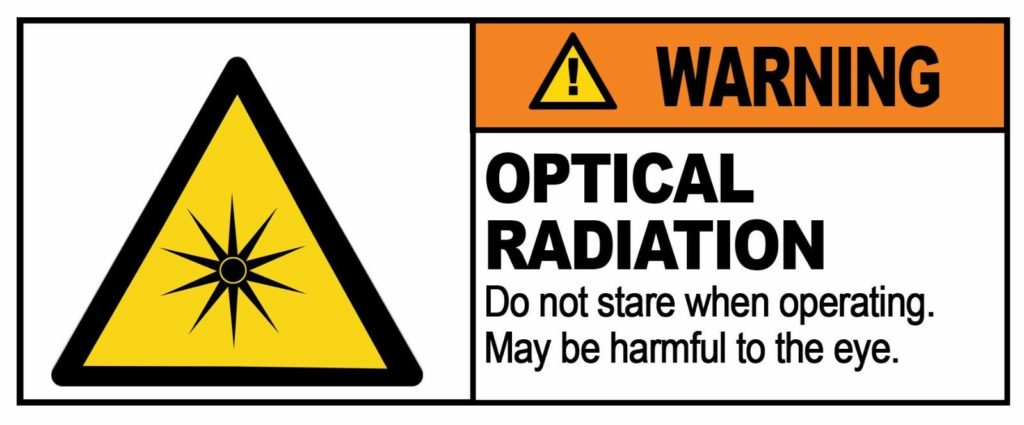
Optical Radiation is a Source of Ignition in Hazardous Areas.
The use of optical radiation in hazardous locations has increased significantly in measurement, control system applications, analysis, lightning technology, signal and power transmission and telecommunications.
Optical radiation, especially when the optical signal is unconfined, can be considered as a source of ignition in gas and dust explosive atmospheres. One of the the main mechanism for ignition by optical radiation is absorption of optical energy by the solid surface of equipment. As a result, optical radiation energy can be converted into thermal energy and cause a rise in temperature that might exceed the minimum Auto Ignition Temperature (AIT) of the surrounding explosive atmosphere, potentially causing ignition.
Standard IEC 60079-28 has introduced three types of protection to prevent ignition by optical radiation:
1) Inherently Safe (Ex op is): Hazardous Area Zones 0/20, 1/21, 2/22
2) Protected Optical Radiation (Ex op pr): Hazardous Area Zones 1/21, 2/22
3) Optical System with Interlock (Ex op sh): Hazardous Area Zones 1/21, 2/22
IEC 60079-28:2015
(Reference: IEC 60079-28:2015 Ed. 2). IEC 60079-28:2015 Standard | Explosive atmospheres – Part 28: Protection of equipment and transmission systems using optical radiation.
IEC 60079-28:2015 is available as IEC 60079-28:2015 RLV which contains the International Standard and its Redline version, showing all changes of the technical content compared to the previous edition.
IEC 60079-28:2015 specifies the requirements, testing and marking of equipment emitting optical radiation intended for use in explosive atmospheres. It also covers equipment located outside the explosive atmosphere or protected by a Type of Protection listed in IEC 60079-0, but which generates optical radiation that is intended to enter an explosive atmosphere. It covers Groups I, II and III, and EPLs Ga, Gb, Gc, Da, Db, Dc, Ma and Mb. This standard does not cover ignition by ultraviolet radiation and by absorption of the radiation in the explosive mixture itself.
Information Courtesy
Author Behzad Nejad, P. Eng. (Hazcon)
Director & Consulting Engineer at Hazcon Inc.; Hazardous Locations Consulting Services; IECEx, ATEX, CEC & NEC
Specializing in the design, safety and approval of electrical equipment for hazardous locations.
Mr. Nejad has over 15 years of experience as an Electrical Engineer and is a sought after professional in the hzardous area and explosion protection industry. He is fully-qualified at the advanced level of all hazardous locations protection techniques including Intrinsic Safety & Non-incendive, Explosion Proof & Flame proof, Increased Safety, Non-arcing, Purging and Pressurization, Encapsulation, Optical Radiation, and Dust-tight enclosures. Mr. Nejad’s tenure in the industry includes six years at the CSA certification agency, working closely with manufacturers (Emerson, GE, ABB, Siemens, Endress-Houser, VEGA etc.) as a technical and certification engineer for Hazardous locations equipment.
The opinions expressed in this article are those of the author.
Hazloc Products with Class 1/Division 2 & ATEX Certifications
EXPERTS IN EQUIPMENT FOR EXPLOSIVE ATMOSPHERES
leaders in ATEX Innovation To The Hazardous Area Industries
Thorne & Derrick are leaders in the development and distribution of Product Innovations that deliver significant improvements to clients plant, people and operational safety in the explosive atmosphere industries.
Your proactive problem solvers experienced in succession planning for the replacement of obsolete, non-conformant and legacy equipment in hazardous areas.
Your first-choice provider of innovative and competitive solutions to ensure ATEX & IECEx Compliance for Hazardous Area Electrical, HVAC & Process Instrumentation Equipment to UK and international projects.
Control Panels | Plugs | Isolators | Enclosures & Junction Boxes | Lighting | Control Stations | Motor Starters | Heat Trace | Gas Detection | Flame Detection | Process Instrumentation | Process Heating | Ventilation Fans | Security Access Control
Competitive Prices | Extensive Stocks | Technical Support | Express Delivery
What is a “Process Seal”?
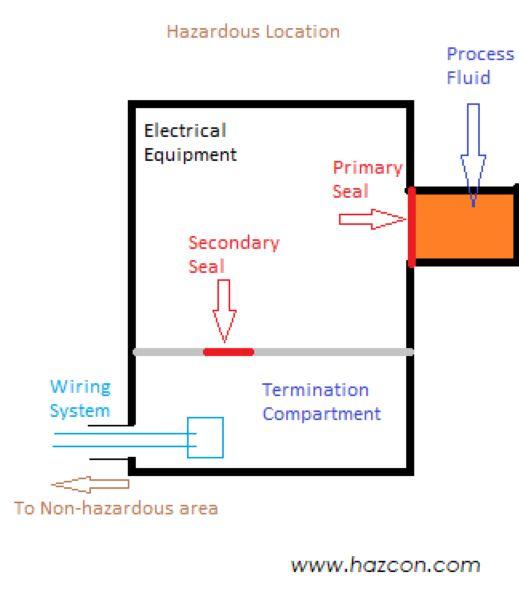
“Process seal” is a seal that is used for process-connected equipment intended for connection to an external system containing process fluids in order to prevent the migration of flammable or combustible process fluids into the wiring system in non-hazardous areas or other classified areas.
There are two main types of Process Seal:
“Primary Seal” & “Secondary Seal”
Primary seal is defined as a process seal that is directly in contact with process fluids during the operation of equipment and secondary seal is the seal that comes into contact with process fluids only in the case of the primary seal failure.
Article 501.17 of NFPA 70 Ed. 2017 (NEC) and Rule 18-070 of Canadian Electrical Code Ed. 2018 (CEC) explain the requirement of process sealing (primary seal and secondary seal) for process-connected equipment and measurement instrument intended for use in hazardous locations in North America.
References: ANSI/ISA 12.27.01, IEC 60079-40:2015, NFPA 70 and CEC.
NFPA 70: Adopted in all 50 states, NFPA 70, National Electrical Code (NEC) is the benchmark for safe electrical design, installation, and inspection to protect people and property from electrical hazards.
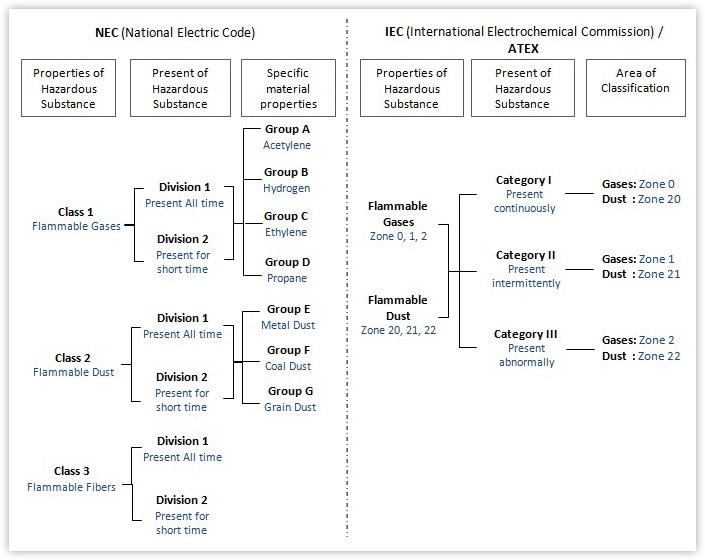
The National Electrical Code (NEC), NFPA 70, defines hazardous (classified) areas as those where fire or explosion hazards may exist due to the presence of flammable gases, vapors, or liquids, combustible dust, or ignitable fibres.
Information Courtesy
Author Behzad Nejad, P. Eng. (Hazcon)
Director & Consulting Engineer at Hazcon Inc.; Hazardous Locations Consulting Services; IECEx, ATEX, CEC & NEC
Specializing in the design, safety and approval of electrical equipment for hazardous locations.
Mr. Nejad has over 15 years of experience as an Electrical Engineer and is a sought after professional in the hzardous area and explosion protection industry. He is fully-qualified at the advanced level of all hazardous locations protection techniques including Intrinsic Safety & Non-incendive, Explosion Proof & Flame proof, Increased Safety, Non-arcing, Purging and Pressurization, Encapsulation, Optical Radiation, and Dust-tight enclosures. Mr. Nejad’s tenure in the industry includes six years at the CSA certification agency, working closely with manufacturers (Emerson, GE, ABB, Siemens, Endress-Houser, VEGA etc.) as a technical and certification engineer for Hazardous locations equipment.
The opinions expressed in this article are those of the author.
Hazloc Products with Class 1/Division 2 & ATEX Certifications
EXPERTS IN EQUIPMENT FOR EXPLOSIVE ATMOSPHERES
leaders in ATEX Innovation To The Hazardous Area Industries
Thorne & Derrick are leaders in the development and distribution of Product Innovations that deliver significant improvements to clients plant, people and operational safety in the explosive atmosphere industries.
Your proactive problem solvers experienced in succession planning for the replacement of obsolete, non-conformant and legacy equipment in hazardous areas.
Your first-choice provider of innovative and competitive solutions to ensure ATEX & IECEx Compliance for Hazardous Area Electrical, HVAC & Process Instrumentation Equipment to UK and international projects.
Control Panels | Plugs | Isolators | Enclosures & Junction Boxes | Lighting | Control Stations | Motor Starters | Heat Trace | Gas Detection | Flame Detection | Process Instrumentation | Process Heating | Ventilation Fans | Security Access Control
Competitive Prices | Extensive Stocks | Technical Support | Express Delivery
Purging & Pressurizing Techniques in hazardous locations.
Purging is a method where a flow of air or inert gas is maintained in an enclosure installed in a classified hazardous area to prevent or reduce the risk of explosive atmosphere occurring.
Pressurizing is a method where the pressure of air or inert gas is maintained at sufficient level inside the enclosure installed in a classified area to prevent the ingress of explosive atmosphere.
There are two main techniques for Purging & Pressurizing:
1) Leakage Compensation
2) Continuous Flow
Using both above techniques will allow an equipment containing electrical components that might be potential ignition sources to be installed in hazardous areas.
Ex-markings for IECEx & ATEX certifications are:
1) Ex pxb (for Hazardous Zone 1)
2) Ex pyb (for Hazardous Zone 1)
3) Ex pzc (For Hazardous Zone 2)
Ex-markings for North American certifications are:
1) Type X (For Hazardous Division 1)
2) Type Y (For Hazardous Division 1)
3) Type Z (For Hazardous Division 2)
References: IEC 60079-2 & NFPA 496
NFPA 496 Standard for Purged and Pressurized Enclosures for Electrical Equipment – this standard provides information on the methods for purging and pressurizing electrical equipment enclosures to prevent ignition of a flammable atmosphere, whether introduced into the enclosure by a surrounding external atmosphere or by an internal source.
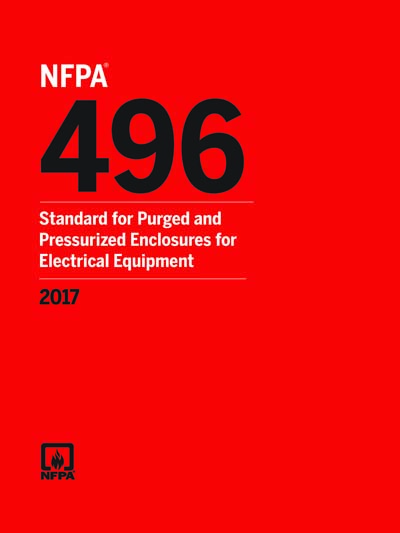
NFPA 496
Information Courtesy
Author Behzad Nejad, P. Eng. (Hazcon)
Director & Consulting Engineer at Hazcon Inc.; Hazardous Locations Consulting Services; IECEx, ATEX, CEC & NEC
Specializing in the design, safety and approval of electrical equipment for hazardous locations.
Mr. Nejad has over 15 years of experience as an Electrical Engineer and is a sought after professional in the hzardous area and explosion protection industry. He is fully-qualified at the advanced level of all hazardous locations protection techniques including Intrinsic Safety & Non-incendive, Explosion Proof & Flame proof, Increased Safety, Non-arcing, Purging and Pressurization, Encapsulation, Optical Radiation, and Dust-tight enclosures. Mr. Nejad’s tenure in the industry includes six years at the CSA certification agency, working closely with manufacturers (Emerson, GE, ABB, Siemens, Endress-Houser, VEGA etc.) as a technical and certification engineer for Hazardous locations equipment.
The opinions expressed in this article are those of the author.
Hazloc Products with Class 1/Division 2 & ATEX Certifications
EXPERTS IN EQUIPMENT FOR EXPLOSIVE ATMOSPHERES
leaders in ATEX Innovation To The Hazardous Area Industries
Thorne & Derrick are leaders in the development and distribution of Product Innovations that deliver significant improvements to clients plant, people and operational safety in the explosive atmosphere industries.
Your proactive problem solvers experienced in succession planning for the replacement of obsolete, non-conformant and legacy equipment in hazardous areas.
Your first-choice provider of innovative and competitive solutions to ensure ATEX & IECEx Compliance for Hazardous Area Electrical, HVAC & Process Instrumentation Equipment to UK and international projects.
Control Panels | Plugs | Isolators | Enclosures & Junction Boxes | Lighting | Control Stations | Motor Starters | Heat Trace | Gas Detection | Flame Detection | Process Instrumentation | Process Heating | Ventilation Fans | Security Access Control
Competitive Prices | Extensive Stocks | Technical Support | Express Delivery
“Class I, Division 1” Electrical Rotating Machines
Electrical machines with “Class I, Division 1” marking are based on “explosion-proof” design. In order to get “C1D1” marking, there are two steps:
1) Ordinary location requirement per standards CSA C22.2 No. 100 for Canada and UL 1004 for the USA. These standards covers general safety aspects (i.e. electrical shock, fire hazard, etc.).
2) Hazardous location requirement per harmonized standard CSA C22.2 No. 145 & UL 674 for Canada and the USA.
This standard uses “Explosion Proof” technique for electric motors and generators or submersible and nonsubmersible sewage pumps for Class I, Division 1, Groups B, C, D.
Notes:
i.) Hazloc electrical machines can NOT be certified for gas group A (Acetylene – IIC). The only solution is using purging technique with a clean air or inert gas when Acetylene is present.
ii.) IECEx certifications or Zone system protection techniques can NOT be used to get “C1D1” marking for electrical machines.
iii.) “C1D1” marking for electrical machines can be obtained by one of NRTLs only.
Information Courtesy
Author Behzad Nejad, P. Eng. (Hazcon)
Director & Consulting Engineer at Hazcon Inc.; Hazardous Locations Consulting Services; IECEx, ATEX, CEC & NEC
Specializing in the design, safety and approval of electrical equipment for hazardous locations.
Mr. Nejad has over 15 years of experience as an Electrical Engineer and is a sought after professional in the hzardous area and explosion protection industry. He is fully-qualified at the advanced level of all hazardous locations protection techniques including Intrinsic Safety & Non-incendive, Explosion Proof & Flame proof, Increased Safety, Non-arcing, Purging and Pressurization, Encapsulation, Optical Radiation, and Dust-tight enclosures. Mr. Nejad’s tenure in the industry includes six years at the CSA certification agency, working closely with manufacturers (Emerson, GE, ABB, Siemens, Endress-Houser, VEGA etc.) as a technical and certification engineer for Hazardous locations equipment.
The opinions expressed in this article are those of the author.
Hazloc Products with Class 1/Division 2 & ATEX Certifications
EXPERTS IN EQUIPMENT FOR EXPLOSIVE ATMOSPHERES
leaders in ATEX Innovation To The Hazardous Area Industries
Thorne & Derrick are leaders in the development and distribution of Product Innovations that deliver significant improvements to clients plant, people and operational safety in the explosive atmosphere industries.
Your proactive problem solvers experienced in succession planning for the replacement of obsolete, non-conformant and legacy equipment in hazardous areas.
Your first-choice provider of innovative and competitive solutions to ensure ATEX & IECEx Compliance for Hazardous Area Electrical, HVAC & Process Instrumentation Equipment to UK and international projects.
Control Panels | Plugs | Isolators | Enclosures & Junction Boxes | Lighting | Control Stations | Motor Starters | Heat Trace | Gas Detection | Flame Detection | Process Instrumentation | Process Heating | Ventilation Fans | Security Access Control
Competitive Prices | Extensive Stocks | Technical Support | Express Delivery