T&D are the UK’s largest stockist of Drum, IBC & Tank Heaters & Jackets. Delivering UK & Worldwide.
T&D’s online library of Drum, IBC & Tank Heating applications is now updated to include the following : heating product to allow it to be transferred to production.
Visit Silicone Heating Products for details of electric surface heating solutions – flexible silicone heaters can be applied to heat the most complex shapes, geometries, curves and pipes.
Medium Temperature Heating (21-50 degrees Celsius)
High Temperature Heating (50 degrees Celsius+) ✓
Other Heat Up
IBC Heating Jackets – T&D supply heating and insulating jackets for plastic or steel metal cage IBC’s for bulk liquid storage.
HEATING JACKET VOLTAGE
110 Volt
230 Volt ✓
Low Voltage
HEATING APPLICATION : DRUM, IBC, TANK OR VESSEL
25 Litres
50 Litres
105 Litres
205 Litres ✓
1000 Litres
Other
VESSEL MATERIAL
Steel ✓
Stainless Steel
Plastic
Cardboard
Other
HEAT UP TEMPERATURE
0-5 degrees Celsius
5-20 degrees Celsius
20-50 degrees Celsius
50-70 degrees Celsius
70+ degrees Celsius ✓
N/A (Frost Protection)
HEAT UP TIME REQUIREMENT
0-4 Hours
4-12 Hours ✓
12-24 Hours
24-48 Hours
N/A
Contact T&D for specification, support and sales of Electrical Heating Equipment for safe, industrial and hazardous area plant and equipment – we provide process temperature heating and pipework frost protection (Winterisation) products for pipework, valves, IBC’s, drums and tanks. Complete range of heating cables and trace heating cables are available for process temperature maintenance.
T&D – Largest UK Stockist of Heat Tracing Cables. UK & International Delivery.
EXPERTS IN EQUIPMENT FOR EXPLOSIVE ATMOSPHERES
T&D are your first-choice provider of innovative and competitive solutions to ensure ATEX & IECEx Compliance for Hazardous Area Electrical, HVAC & Process Instrumentation Equipmentto your UK and international projects.
Woodcock & Wilson are specialist manufacturers of independently certified fans – this includes portable ATEX & IECEx certified ventilation fans and high performance industrial versions for onshore and offshore applications.
In this series of 6 Articles we look to understand more about centrifugal, industrial, axial and 3rd Party Certified ATEX and IECEx fans for hazardous areas and explosive atmospheres
The World’s First ATEX & IECEx Certified Portable Ventilation Fan | Exstream Fans
Experts In Equipment for Explosive Atmospheres with ATEX & IECEx Certification
LEADERS IN ATEX INNOVATION
T&D are your first-choice provider of innovative and competitive solutions to ensure ATEX & IECEx Compliance for Hazardous Area Electrical, HVAC & Process Instrumentation Equipmentto your UK and international projects.
Article Written By Woodcock & Wilson | 6 of 6 Articles
Woodcock & Wilson are specialist manufacturers of independently certified ATEX fans and IECEx industrial fans for the ventilation of hazardous area locations and potentially explosive atmospheres.
Below is Part 6 in a series of 6 Articles by Woodcock & Wilson discussing fans, the laws, common problems, troubleshooting the main performance issues and getting your fan started again if you encounter any issues.
Electrical :-
Motor wired incorrectly. Check fan wiring diagram
Incorrect starter overloads or fuses. Check requirement with supplier
Problems with electrical supply (possible low voltage due to cable length)
Undersize motor. Check with supplier
Fan Mechanical or System :-
Incorrect fan rotation
Mechanical contact within fan (shaft rubbing on seal or impeller rubbing on inlet cone)
Wrongly installed v -belt drive (loose pulleys or mis-aligned pulleys
Impeller inertia too large for the motor stating torque
Attempting to start the fan cold when it is only designed to run in its hot condition (Any dampers in the system can be closed to reduce the fan power absorbed)
Experts In Equipment for Explosive Atmospheres with ATEX & IECEx Certification
LEADERS IN ATEX INNOVATION
T&D are your first-choice provider of innovative and competitive solutions to ensure ATEX & IECEx Compliance for Hazardous Area Electrical, HVAC & Process Instrumentation Equipmentto your UK and international projects.
Article Written By Woodcock & Wilson | 5 of 6 Articles
Woodcock & Wilson are specialist manufacturers of independently certified ATEX fans and IECEx industrial fans for the ventilation of hazardous area locations and potentially explosive atmospheres.
Below is Part 5 in a series of 6 Articles by Woodcock & Wilson discussing fans, the laws, common problems, troubleshooting the main performance issues and getting your fan started again if you encounter any issues.
Fan Mechanical, Balance & Vibration
A) Balance Grades & Categories
B) Possible reasons for excessive vibration during commissioning
C) Possible reasons for vibration experienced after successful commissioning
A) Balance Grades & Categories
Fan balancing and vibration is in accordance with BS848-7 BS ISO 14694. Woodcock & Wilson Ltd have selected “Fan application category: BV-3 for fans ≤ 37KW & BV-4 for fans > 37 kW.
The balance quality grade for these categories are G 6.3 & G 2.5 respectively. The tables below are taken from the above standard. They give vibration limits for tests in manufacturers workshop & recommended vibration limits for fans operating in situ.
Maximum Vibration Levels Limits for Factory Tested Fan
Fan Category Application Category
Rigidly Mounted mm/s
Flexibly Mounted (AV Mounts) mm/s
Peak
r.m.s
Peak
r.m.s
BV-3
3.8
2.8
5.1
3.5
BV-4
2.5
1.8
3.8
2.8
Fan Vibration Limits For Fans Operating In Situ
Condition
Fan Application Category
Rigidly Mounted mm/s
Flexibly Mounted mm/s
Peak
r.m.s
Peak
r.m.s
Start-up
BV-3
6.4
4.5
8.8
6.3
BV-4
4.1
2.8
6.4
4.5
Alarm
BV-3
10.2
7.1
16.5
11.8
BV-4
6.4
4.5
10.2
7.1
Shut-down
BV-3
12.7
9
17.8
12.5
BV-4
10.2
7.1
15.2
11.2
The vibration levels on the table before are guidelines for acceptable operation of fans. The vibration level of newly commissioned fans should be at or below the “start up” level.
Historical data is an important factor when considering vibration severity. A sudden & maintained change in the vibration level may indicate the need for prompt inspection or maintenance.
B) Possible Reasons for Vibration Experienced During Commissioning
Fans test run and balanced in the manufacturers works and delivered as a complete, fully assembled fan.
Mechanical Problems
Damage to fan during transport causing out of balance or misalignment problems
Foreign bodies on impeller causing out of balance
Fan pedestal distorted during installation causing drive chain misalignment
Incorrect selection or fitting of anti-vibration mounts
Loose holding down bolts
Defective foundations
II) System or System Effect Problems:-
The system has greater resistance to flow than anticipated resulting in the fan operating further up the characteristic in a stalled section. Depending on fan type, vibration may be experienced when operating in the stalled area
On fans fitted with inlet vanes or inlet louvers on an inlet box, vibration may be experienced at lower vane angles due to a condition known as inlet cone vortex
Bands or other obstacles fitted to the fan inlets may cause airborne instabilities resulting in vibration (see “V fan systems” in “underperforming” section
Fans not previously run:
All previous possible reasons + the following:-
Impeller out of balance
Faulty or wrongly fitted bearings
Motor out of balance
Shaft misalignment in bearings
Coupling misalignment (on direct coupled fan)
Pulley misalignment or loose belts (on v belt driven fan)
Experts In Equipment for Explosive Atmospheres with ATEX & IECEx Certification
LEADERS IN ATEX INNOVATION
T&D are your first-choice provider of innovative and competitive solutions to ensure ATEX & IECEx Compliance for Hazardous Area Electrical, HVAC & Process Instrumentation Equipmentto your UK and international projects.
Article Written By Woodcock & Wilson | 4 of 6 Articles
Woodcock & Wilson are specialist manufacturers of independently certified ATEX fans and IECEx industrial fans for the ventilation of hazardous area locations and potentially explosive atmospheres.
Below is Part 4 in a series of 6 Articles by Woodcock & Wilson discussing fans, the laws, common problems, troubleshooting the main performance issues and getting your fan started again if you encounter any issues.
Fan Performance Troubleshoot
Reasons For Fans Underperforming
Fan running in the wrong direction
Fan running at the wrong speed
Fan incorrectly manufactured
Fan wrongly selected
Fan system problems
Fan Running in the Wrong Direction
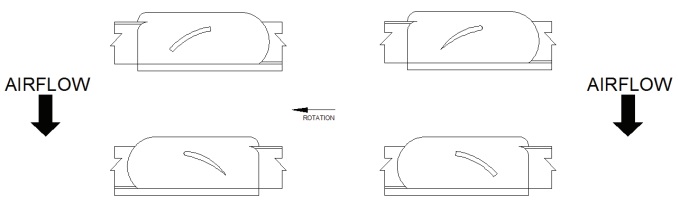
While the fan is running up or coasting to a stop, check that the rotation is correct relative to fan type and discharge orientation. Check that the impeller handling is correct for the selected rotation. Examples for centrifugal and axial fans are shown below.
Types of Centrifugal Fan Impellers
Correction Rotation for Axial Flow Impellers
Fan Running at the Wrong Speed
Check the required running speed with the supplier. (Note: If the fan is v belt drive the final running speed may be different from the original selected speed due to the use of standard pulley diameters
Measure actual fan speed with tachometer or other instrumentation
If the fan is operated via an inverter, the fan may be designed to run at specific speed (motor frequency) other than 50 or 60 Hz. If the fan is v belt drive the motor frequency will probably not be the fan speed
Fan Incorrectly Manufactured
This will be unusual but must be considered as part of a fault diagnosis.
Wrong impeller handing in fan case (see above)
Wrong pulleys fitted, giving wrong speed
V belt drive wrongly tensioned causing slip & resulting in wrong speed
Wrong internal clearance between impeller & inlet cone or wrong tip clearance between blades & fan case on an axial fan
Fan Wrongly Selected
Again this will be usual but must be considered as part of a fault diagnosis.
Check that the fan has been selected in accordance with the specification and requirements.
This may include the following:
Selection pressure not referred to the correct section ie -ve on inlet +ve on discharge or a combination of both
Selection pressure not referred to the correct temperature or altitude
Selected fan not taking account of existing or required inlet & discharge duct sizes
Selected fan oversized relative to available space constraints (this may lead to bad inlet & discharge conditions).
Wrong running speed selected ie 50Hz instead of 60hz & vice versa on direct driven fans
System Problems
Fans will only meet the duty point shown on the performance curve under ‘ideal’ installation conditions
Ideal conditions are seldom obtainable in practice consequently there will always be some ‘SYSTEM EFFECT‘
Factors That Influence System Effect
Elbow or bend too close to fan inlet or outlet
Abrupt duct transition
Pre swirl of the incoming air due to duct design (swirl in same direction as rotation
Dampers not fully open
Damper location
Poorly designed fan drives – large drive pulley – solid rather than spoked
Experts In Equipment for Explosive Atmospheres with ATEX & IECEx Certification
LEADERS IN ATEX INNOVATION
T&D are your first-choice provider of innovative and competitive solutions to ensure ATEX & IECEx Compliance for Hazardous Area Electrical, HVAC & Process Instrumentation Equipmentto your UK and international projects.
Press Release Date: 02.04.2020 uploaded by Chris Dodds (T&D Sales + Marketing Manager) World’s First Fully Certified ATEX Doors Thorne & Derrick International, the Experts in Equipment for Explosive Atmospheres, today announce the signing of a Commercial Distribution Agreement...
Press Release Date: 04.07.2019 uploaded by Chris Dodds (T&D Sales + Marketing Manager) Category: Stockist Distributor Agreement Announcement Thorne & Derrick International announce that they have signed a Preferred Distributor Agreement with Raytec, the world leading manufacturer of LED...