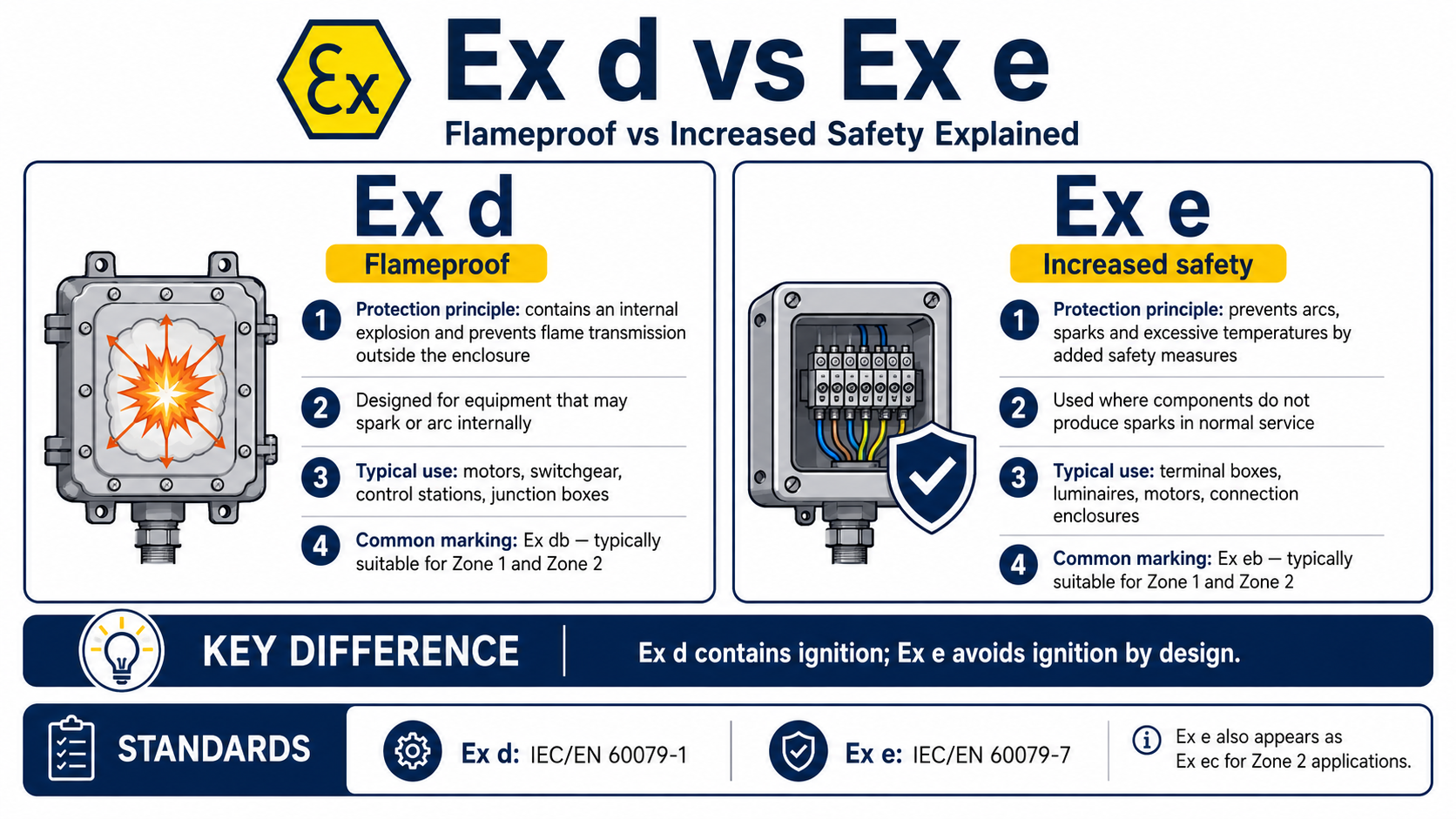
Ex d and Ex e are two common explosion protection methods used for electrical equipment in hazardous areas. Ex d refers to flameproof protection, where an enclosure is designed to contain an internal explosion and prevent flame transmission to the surrounding atmosphere. Ex e refers to increased safety protection, where equipment is designed to prevent arcs, sparks and excessive temperatures during normal operation.
Understanding the difference between Ex d vs Ex e is essential when selecting hazardous area equipment, including ATEX lighting, junction boxes, enclosures, control stations, isolators, plugs, sockets and electrical distribution equipment for Zone 1 and Zone 2 applications.
Quick Answer: Ex d vs Ex e
Ex d is flameproof protection. It allows the possibility of an internal ignition inside a certified enclosure, but the enclosure is designed to contain the explosion and prevent flames from escaping into the surrounding hazardous atmosphere. Ex e is increased safety protection. It is designed to prevent ignition from occurring in the first place by avoiding arcs, sparks and excessive temperatures during normal operation.
Ex d vs Ex e: Quick Summary
| Ex d |
Flameproof protection. The enclosure is designed to withstand an internal explosion and prevent flame transmission to the outside atmosphere. |
| Ex e |
Increased safety protection. Equipment is designed to prevent arcs, sparks and excessive temperatures during normal operation. |
| Main Difference |
Ex d contains and controls an internal explosion. Ex e reduces the likelihood of ignition occurring by design. |
| Typical Products |
Ex d: flameproof enclosures, control stations, luminaires and equipment with potential ignition sources. Ex e: junction boxes, terminals, increased safety enclosures and selected luminaires. |
| Important Check |
The full marking, zone, gas group, T-class, EPL, certificate and installation instructions must always be checked. |
What Is Ex d Flameproof Protection?
Ex d flameproof protection is an explosion protection method where equipment is housed inside an enclosure designed to withstand an internal explosion without rupturing. The enclosure also prevents flames, hot gases or ignition from transmitting to the surrounding explosive atmosphere.
This protection concept is often used where electrical equipment may contain components capable of producing sparks, arcs, hot surfaces or other ignition sources. Instead of relying only on preventing ignition inside the enclosure, Ex d assumes an internal explosion could occur and ensures the enclosure safely contains it.
Ex d equipment may be used for products such as:
- flameproof control stations;
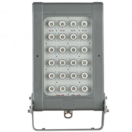
- hazardous area lighting with certified flameproof construction;
- motor starters and switchgear where the certificate permits;
- flameproof enclosures containing electrical components;
- certain plugs, sockets, isolators and control equipment used in hazardous areas.
Ex d equipment must be installed and maintained carefully because the flamepath, cable entries, enclosure integrity, fasteners and accessories are all critical to the certified protection method.
Related guide: ATEX Marking Explained.
What Is Ex e Increased Safety?
Ex e increased safety is an explosion protection method where equipment is designed to reduce the risk of arcs, sparks and excessive temperatures during normal operation. Unlike Ex d, Ex e does not rely on containing an internal explosion inside a heavy flameproof enclosure. Instead, it focuses on preventing ignition-capable conditions from arising.
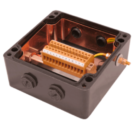
Ex e is commonly used for equipment that does not normally produce arcs or sparks, such as terminals, junction boxes and certain electrical assemblies designed with additional insulation, creepage, clearance, temperature and connection security measures.
Ex e equipment may be used for:
Because Ex e relies on preventing ignition, equipment that normally produces sparks or arcs should not be placed in an Ex e enclosure unless the complete assembly and protection concept have been specifically assessed and certified.
Ex d vs Ex e: Key Differences
The main difference between Ex d and Ex e is the way each protection method controls ignition risk. Ex d contains an internal explosion. Ex e prevents ignition sources from occurring during normal operation.
Ex d vs Ex e Comparison
| Protection Principle |
Ex d: Contains an internal explosion and prevents flame transmission. |
Ex e: Prevents arcs, sparks and excessive temperatures during normal operation. |
| Common Name |
Flameproof. |
Increased safety. |
| Typical Construction |
Robust enclosure with flamepaths and certified cable entries. |
Enhanced insulation, secure terminals, controlled temperatures and careful spacing. |
| Common Applications |
Control stations, luminaires, enclosures and equipment containing potential ignition sources. |
Junction boxes, terminal boxes, connection chambers and selected motors or luminaires. |
| Maintenance Focus |
Flamepath condition, cover bolts, glands, enclosure integrity and correct accessories. |
Terminal tightness, insulation, spacing, temperature rise, component suitability and ingress protection. |
| Selection Risk |
Incorrect glands, damaged flamepaths or missing fasteners can compromise protection. |
Adding uncertified sparking components can invalidate increased safety protection. |
Both protection methods can be suitable in hazardous areas when correctly certified, selected, installed and maintained. The correct choice depends on the equipment type, hazardous area classification, electrical function, gas group, temperature class and certificate conditions.
How Ex d Flameproof Equipment Works
Ex d flameproof equipment is designed so that if an explosive gas atmosphere enters the enclosure and is ignited internally, the enclosure can contain the explosion pressure and prevent the flame from igniting the surrounding atmosphere.
Key design features may include:
- flameproof enclosure strength – designed to withstand internal explosion pressure;
- flamepaths – precision gaps or joints that cool hot gases before they can exit the enclosure;
- certified cable entries – glands, stopping plugs and adaptors must match the protection requirements;
- correct fasteners – cover bolts and fixings must be present, tightened and compatible;
- temperature control – the equipment must not exceed its certified temperature class.
Because flameproof protection depends heavily on mechanical integrity, installation and inspection are critical. Damaged threads, missing bolts, incorrect glands, corrosion or paint on flamepaths can compromise safety.
Ex d Flameproof: Practical Checks
| Flamepath Condition |
Check for damage, corrosion, paint, dirt or mechanical distortion on flameproof joints. |
| Cable Entries |
Use certified cable glands, stopping plugs and adaptors suitable for the Ex d enclosure and cable type. |
| Fasteners |
Ensure correct bolts are fitted and tightened according to the manufacturer’s instructions. |
| Certificate Conditions |
Review any “X” suffix and special conditions of safe use before installation. |
How Ex e Increased Safety Equipment Works
Ex e increased safety equipment works by reducing the risk of ignition during normal operation. It does this through design features that improve electrical security, reduce overheating and prevent arcs or sparks.
Key design features may include:
- increased creepage and clearance distances to reduce electrical tracking and breakdown risk;
- secure terminals and connections to reduce loosening, overheating or arcing;
- controlled surface temperatures to remain within the certified T-class;
- reinforced insulation and improved electrical separation;
- ingress protection to prevent contamination that could affect electrical safety;
- certified components selected for increased safety use.
Ex e equipment is commonly used where the electrical components do not normally create arcs or sparks. It is especially common for terminal boxes and junction boxes used in hazardous area wiring systems.
Ex e Increased Safety: Practical Checks
| Terminal Security |
Check terminals are suitable, correctly tightened and installed according to manufacturer instructions. |
| Component Suitability |
Only use components and accessories permitted by the certificate and enclosure design. |
| Temperature Rise |
Ensure current, loading and ambient temperature remain within certified limits. |
| Ingress Protection |
Maintain seals, gaskets and enclosure integrity to protect the increased safety design. |
Related page: Ex e Increased Safety Equipment.
Ex d & Ex e in ATEX and IECEx Marking
Ex d and Ex e appear as part of a wider ATEX or IECEx marking. The protection method should never be read in isolation. The full marking must also include suitability for the zone, gas group, temperature class and Equipment Protection Level.
Example Ex d Marking
Example marking:
II 2G Ex db IIC T4 Gb
Example Ex e Marking
Example marking:
II 2G Ex eb IIC T4 Gb
What the Marking Parts Mean
| II |
Group II equipment for surface industries with explosive gas atmospheres. |
| 2G |
ATEX Category 2 equipment for gas atmospheres, commonly associated with Zone 1. |
| Ex db |
Flameproof protection with EPL b level protection. |
| Ex eb |
Increased safety protection with EPL b level protection. |
| IIC |
Gas group commonly associated with hydrogen and acetylene-type atmospheres. |
| T4 |
Temperature class with a maximum surface temperature of 135°C under certified conditions. |
| Gb |
Equipment Protection Level for gas atmospheres, commonly associated with Zone 1 applications. |
Read more in our guides:
Ex d, Ex e, Zones & EPLs
Ex d and Ex e equipment can be used in hazardous areas when the equipment is certified for the relevant zone and protection level. The zone tells you how likely an explosive atmosphere is to occur, while the EPL identifies the level of ignition protection.
Gas Zones & Common EPL Relationship
| Zone 0 |
Explosive gas atmosphere present continuously, frequently or for long periods. Commonly associated with EPL Ga. |
| Zone 1 |
Explosive gas atmosphere likely to occur occasionally during normal operation. Commonly associated with EPL Gb. |
| Zone 2 |
Explosive gas atmosphere not likely during normal operation, or only present for a short time. Commonly associated with EPL Gc. |
Ex d and Ex e protection methods are often used for Zone 1 and Zone 2 equipment, depending on the full certification. The protection concept alone does not confirm suitability. Equipment must also have the correct category or EPL, gas group, temperature class and certificate conditions.
Related guide: Zone 1 vs Zone 2 Hazardous Areas.
Gas Groups & T-Class Ratings
Ex d and Ex e markings often include a gas group and temperature class. These are essential for confirming equipment suitability.
Gas Group vs T-Class
| Gas Group |
Identifies compatibility with gases and vapours such as IIA, IIB or IIC. |
| Temperature Class |
Identifies the maximum surface temperature of the equipment, such as T1, T2, T3, T4, T5 or T6. |
| Selection Requirement |
Both must be suitable. A product can have the correct protection method but the wrong gas group or temperature class for the site. |
For example, an Ex d enclosure marked IIC T4 may be suitable for IIC gas atmospheres with a T4 temperature class, subject to the full certificate. However, it must still be suitable for the zone, ambient temperature, cable entries and any special conditions of safe use.
Related guides:
Can Equipment Use Both Ex d and Ex e?
Yes. Some hazardous area equipment uses more than one protection method. A product may use Ex d for one part of the equipment and Ex e for another, depending on the design and certification.
For example:
- an Ex d enclosure may contain sparking components inside a flameproof chamber;
- an Ex e terminal chamber may be used for cable termination where the terminals are designed for increased safety;
- a hazardous area luminaire may use different protection concepts for different parts of the fitting;
- a control station may combine flameproof and increased safety construction depending on the components used.
In these cases, the marking may show multiple protection concepts. The installation and maintenance requirements for each part must be followed.
Combined Protection Concepts
| Why Combined Protection Is Used |
Different parts of equipment may present different ignition risks, so different protection methods may be applied within one certified product. |
| Common Example |
A flameproof chamber for switching components combined with an increased safety terminal chamber for cable connection. |
| Important Check |
Each part of the equipment must be installed and maintained according to the manufacturer’s instructions and certificate conditions. |
How to Choose Between Ex d and Ex e
The correct choice between Ex d and Ex e depends on the equipment function, hazardous area classification and installation requirements. Neither protection method is automatically “better” than the other. They are designed for different types of ignition risk.
A practical selection process should include:
- Confirm the hazardous area zone – for example Zone 1 or Zone 2.
- Identify the gas group – such as IIA, IIB or IIC.
- Confirm the temperature class – such as T4, T5 or T6.
- Identify whether the equipment contains sparking components – Ex d may be appropriate where certified flameproof containment is required.
- Check whether the equipment normally avoids arcs and sparks – Ex e may be suitable for terminals, junction boxes and selected equipment where certified.
- Check the certificate and marking – the exact product variant must be covered.
- Check cable entries and accessories – glands, plugs, adaptors and stopping plugs must maintain the certified protection concept.
- Review installation and maintenance requirements – especially flamepath inspection for Ex d and terminal integrity for Ex e.
For critical applications, equipment selection should be reviewed by competent personnel using the site hazardous area classification, manufacturer data and certification documentation.
Example Ex d and Ex e Product Applications
Ex d and Ex e protection methods are used across a wide range of hazardous area products. The correct product depends on the zone, gas group, T-class, ambient temperature, protection concept and installation conditions.
Typical product ranges include:
- ATEX Lighting – hazardous area LED lighting using certified protection methods suitable for Zone 1, Zone 2, Zone 21 and Zone 22 applications.
- ATEX Enclosures & Junction Boxes – Ex d, Ex e or combined protection enclosures for power, control and instrumentation circuits.
- ATEX Plugs, Sockets & Connectors – hazardous area connection systems for certified electrical installations.
- ATEX Isolators – local isolation and switching equipment for hazardous environments.
- Ex e Increased Safety Equipment – increased safety components and assemblies for hazardous area installations.
- Process Instrumentation – measurement and control equipment where suitable protection methods must be selected for the classified area.
- Heat Trace Systems – hazardous area trace heating circuits, junction boxes, controls and accessories where certification must match the application.
Thorne & Derrick supply ATEX and IECEx certified hazardous area equipment with technical support to help customers select products suitable for demanding industrial and process environments.
Common Ex d and Ex e Mistakes
Mistakes with Ex d and Ex e equipment can compromise hazardous area safety. Common errors include:
- Assuming Ex d and Ex e are interchangeable – they use different protection principles and have different installation requirements.
- Using Ex e enclosures for uncertified sparking components – increased safety equipment should not contain components that normally spark unless the complete assembly is certified for that use.
- Damaging Ex d flamepaths – corrosion, paint, dirt or mechanical damage can compromise flameproof protection.
- Using incorrect cable glands or stopping plugs – accessories must maintain the certified protection method.
- Ignoring gas group – Ex d or Ex e equipment still needs the correct IIA, IIB or IIC suitability.
- Ignoring T-class – the surface temperature must be suitable for the hazardous atmosphere.
- Not checking the certificate number – the certificate must cover the exact product, model and configuration.
- Overlooking special conditions of use – an “X” suffix may indicate important restrictions.
Correct Ex equipment selection should always be supported by the site hazardous area classification, product certificate, manufacturer instructions and competent installation practices.
External reference: HSE explains that equipment used in zoned hazardous areas should be selected to meet the relevant equipment regulations.
Ex d vs Ex e FAQs
Q: What is the difference between Ex d and Ex e?
A: Ex d is flameproof protection, where an enclosure is designed to contain an internal explosion and prevent flame transmission to the surrounding atmosphere. Ex e is increased safety protection, where equipment is designed to prevent arcs, sparks and excessive temperatures during normal operation.
Q: What does Ex d mean?
A: Ex d means flameproof protection. It is used for equipment with an enclosure designed to withstand an internal explosion and prevent flames or hot gases from igniting the external hazardous atmosphere.
Q: What does Ex e mean?
A: Ex e means increased safety protection. It is used for equipment designed to prevent arcs, sparks and excessive temperatures during normal operation by using enhanced insulation, secure terminals, controlled temperatures and suitable construction.
Q: Is Ex d better than Ex e?
A: Not necessarily. Ex d and Ex e are different protection methods for different applications. Ex d is suitable where flameproof containment is required, while Ex e is suitable for equipment designed to avoid arcs, sparks and excessive temperatures. The correct choice depends on the equipment function and hazardous area classification.
Q: Can Ex e equipment be used in Zone 1?
A: Ex e equipment may be suitable for Zone 1 if the full marking, certificate, EPL, gas group, temperature class and conditions of use confirm suitability. The protection concept alone is not enough to confirm zone suitability.
Q: Can Ex d equipment be used in Zone 2?
A: Ex d equipment may be suitable for Zone 2 if the full certification confirms suitability for the zone, gas group, temperature class, ambient temperature and installation conditions. Equipment should always be selected based on the complete marking and certificate.
Q: Can equipment be both Ex d and Ex e?
A: Yes. Some equipment uses combined protection concepts. For example, a product may have a flameproof chamber for sparking components and an increased safety terminal chamber for cable connections. The marking and certificate should explain the protection methods used.
Q: Is Ex d the same as explosion-proof?
A: Ex d is commonly referred to as flameproof protection. In some markets, similar concepts are described as explosion-proof, but terminology and certification requirements vary by region. For ATEX and IECEx equipment, the exact Ex marking and certificate should be checked.
Conclusion
Ex d and Ex e are both important explosion protection methods for hazardous area electrical equipment, but they work in different ways. Ex d flameproof protection contains an internal explosion and prevents flame transmission to the surrounding atmosphere. Ex e increased safety protection prevents ignition by reducing the risk of arcs, sparks and excessive temperatures during normal operation.
The correct protection method depends on the hazardous area zone, equipment function, gas group, T-class, EPL, certificate conditions and installation requirements. Ex d and Ex e should never be selected by name alone. The full ATEX or IECEx marking, certificate and manufacturer instructions must always be reviewed.
Thorne & Derrick supply ATEX and IECEx certified hazardous area equipment, including lighting, enclosures, junction boxes, plugs, sockets, isolators, process instrumentation, heat tracing and control equipment for demanding industrial environments.
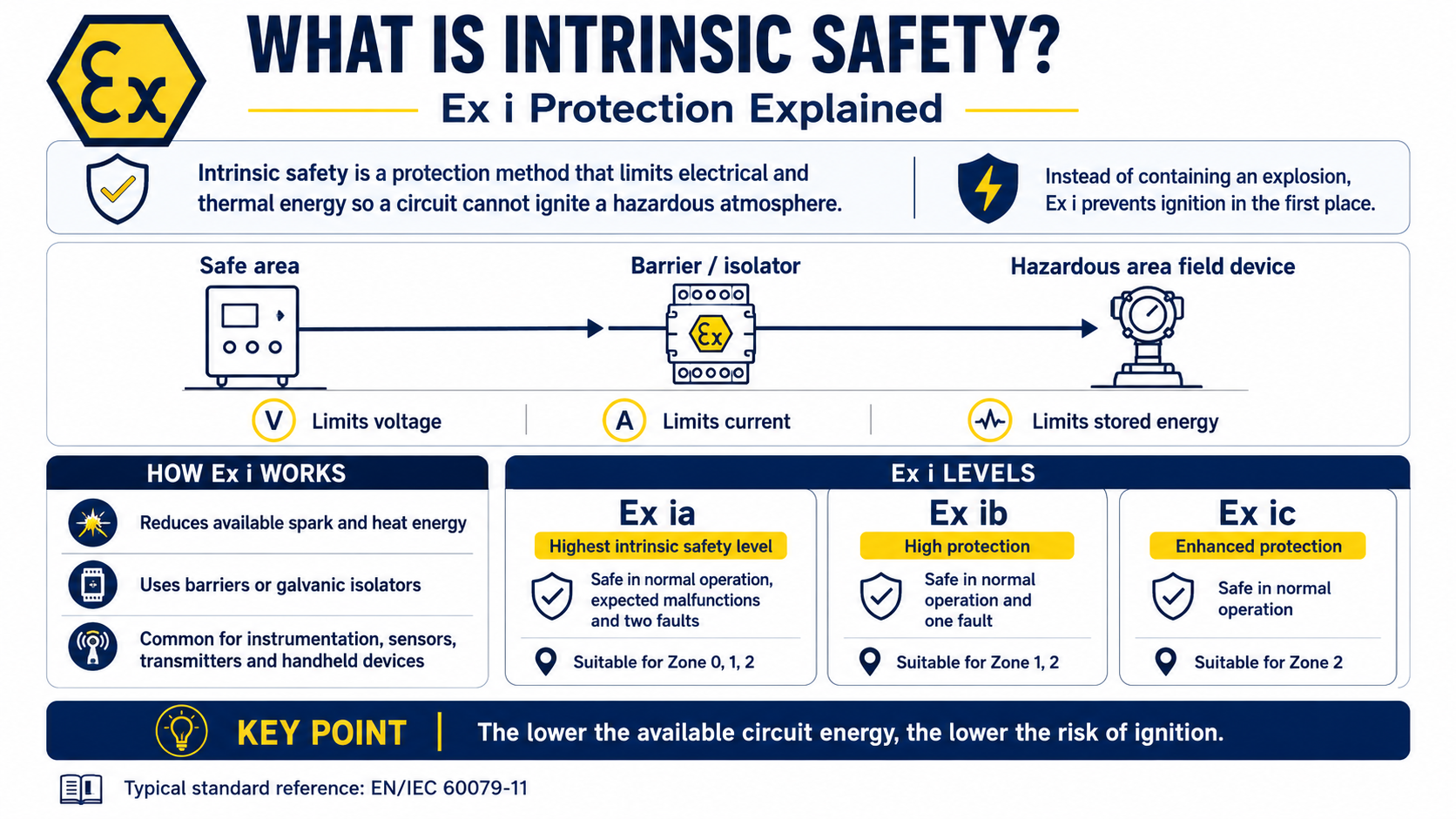
Intrinsic safety is an explosion protection technique used in hazardous areas to prevent electrical equipment and circuits from releasing enough energy to ignite a flammable gas, vapour, mist or dust atmosphere. In Ex markings, intrinsic safety is shown as Ex i, with common protection levels including Ex ia, Ex ib and Ex ic.
In simple terms, intrinsically safe equipment is designed so that sparks, arcs or heat produced by the electrical circuit cannot ignite the specified explosive atmosphere under the certified conditions. This makes intrinsic safety especially important for process instrumentation, sensors, transmitters, communication devices, control circuits and other low-power hazardous area equipment.
Quick Answer: What Is Intrinsic Safety?
Intrinsic safety is a method of explosion protection that limits the electrical and thermal energy in a circuit so it cannot ignite a specified explosive atmosphere. It is commonly used for low-power equipment such as transmitters, sensors, switches, communication devices and instrumentation circuits installed in hazardous area zones.
Intrinsic Safety: Quick Summary
| Protection Method |
Intrinsic safety, shown as Ex i in hazardous area markings. |
| Main Principle |
Limits electrical energy and heat so the circuit cannot ignite the specified explosive atmosphere. |
| Common Levels |
Ex ia, Ex ib and Ex ic, depending on the level of protection required. |
| Typical Equipment |
Transmitters, sensors, switches, handheld devices, communication equipment and instrumentation loops. |
| Important Check |
The full circuit, certificate, gas group, T-class, EPL, cable parameters and associated apparatus must be suitable. |
What Is Intrinsic Safety?
Intrinsic safety is a type of explosion protection used for electrical equipment and circuits in potentially explosive atmospheres. Instead of containing an explosion inside an enclosure, intrinsic safety prevents ignition by ensuring that the electrical energy available in the circuit is too low to cause ignition.
This is achieved by controlling:
- voltage – limiting the electrical potential in the circuit;
- current – restricting the available current under normal and fault conditions;
- power – keeping the available energy below ignition-capable levels;
- capacitance and inductance – controlling stored energy in cables and connected devices;
- surface temperature – ensuring equipment does not exceed the permitted temperature class.
Intrinsic safety is most commonly used for low-energy control and measurement circuits rather than high-power equipment. It is widely used across oil and gas, petrochemical, chemical processing, pharmaceutical, food and beverage, water treatment, utilities, energy and other industries where explosive atmospheres may occur.
External reference: HSE explains that electricity can create hot surfaces or sparks capable of igniting explosive atmospheres, which is why suitable protection methods are required in hazardous areas.
How Does Intrinsic Safety Work?
Intrinsic safety works by designing the circuit so it cannot release enough energy to ignite the hazardous atmosphere, even under defined fault conditions. This means the complete circuit must be assessed, not just the field device.
An intrinsically safe loop may include:
- field equipment installed in the hazardous area, such as a transmitter, sensor or switch;
- associated apparatus installed in the safe area or suitably protected area, such as a safety barrier or galvanic isolator;
- interconnecting cable with controlled capacitance and inductance values;
- earthing and bonding arrangements where required by the system design;
- documentation proving that the circuit remains intrinsically safe.
The key point is that intrinsic safety is a system concept. A device may be marked as intrinsically safe, but the complete installation must still be checked to confirm the loop remains within certified limits.
How Intrinsic Safety Prevents Ignition
| Energy Limitation |
Voltage, current and power are restricted so sparks cannot ignite the specified atmosphere. |
| Thermal Control |
The equipment must not reach a surface temperature capable of igniting the atmosphere. |
| Fault Assessment |
The circuit is assessed under defined normal and fault conditions according to the certification basis. |
| Loop Verification |
The complete loop must be checked, including field device, barrier or isolator, cable and connected apparatus. |
What Does Ex i Mean?
Ex i is the marking used for equipment or circuits protected by intrinsic safety. The letter “i” identifies intrinsic safety as the protection method.
You may see markings such as:
- Ex ia – very high level of intrinsic safety protection;
- Ex ib – high level of intrinsic safety protection;
- Ex ic – enhanced level of intrinsic safety protection.
These markings appear as part of a wider Ex marking that may also include the gas group, temperature class and Equipment Protection Level.
Example:
Example Intrinsic Safety Marking
Example marking:
Ex ia IIC T4 Ga
This example indicates intrinsic safety protection, IIC gas group suitability, T4 temperature class and Ga Equipment Protection Level, subject to the full certificate and conditions of use.
Read more: ATEX Marking Explained.
Ex ia, Ex ib & Ex ic Explained
Intrinsic safety is divided into different levels depending on the level of protection required. The three common levels are Ex ia, Ex ib and Ex ic.
Ex ia, Ex ib & Ex ic Comparison
| Ex ia |
Very high level of intrinsic safety protection. Commonly associated with Ga for gas atmospheres and use in Zone 0, subject to full certification. |
| Ex ib |
High level of intrinsic safety protection. Commonly associated with Gb for gas atmospheres and use in Zone 1, subject to full certification. |
| Ex ic |
Enhanced level of intrinsic safety protection. Commonly associated with Gc for gas atmospheres and use in Zone 2, subject to full certification. |
A product or circuit marked Ex ia may provide a higher level of protection than Ex ib or Ex ic, but the complete marking must still be checked. It is not enough to look at “ia”, “ib” or “ic” alone.
Other essential checks include:
- gas group – such as IIA, IIB or IIC;
- temperature class – such as T1 to T6;
- EPL – such as Ga, Gb or Gc;
- certificate number – including any “X” suffix conditions;
- entity parameters – such as voltage, current, capacitance and inductance limits;
- installation requirements – including cable and associated apparatus compatibility.
Intrinsic Safety, Zones & EPLs
Intrinsic safety levels are commonly linked to hazardous area zones and Equipment Protection Levels. The zone identifies how likely the explosive atmosphere is to occur, while the EPL identifies the level of ignition protection provided by the equipment.
Intrinsic Safety, Zones & EPL Relationship
| Zone 0 |
Explosive gas atmosphere present continuously, frequently or for long periods. Commonly associated with Ex ia and EPL Ga. |
| Zone 1 |
Explosive gas atmosphere likely to occur occasionally during normal operation. Commonly associated with Ex ib or higher, and EPL Gb. |
| Zone 2 |
Explosive gas atmosphere not likely during normal operation, or only present for a short time. Commonly associated with Ex ic or higher, and EPL Gc. |
This relationship is useful, but it must not replace a full assessment. Equipment suitability depends on the complete marking, the certificate, the gas group, T-class, ambient temperature, circuit design and installation conditions.
Related guides:
Intrinsically Safe Apparatus & Associated Apparatus
Intrinsic safety often involves more than one device. A complete intrinsically safe system may include intrinsically safe apparatus in the hazardous area and associated apparatus that limits the energy entering the hazardous area circuit.
Intrinsic Safety Apparatus Types
| Intrinsically Safe Apparatus |
Equipment installed in the hazardous area with circuits designed to be intrinsically safe under the certified conditions. |
| Associated Apparatus |
Equipment that may include both intrinsically safe and non-intrinsically safe circuits, designed so the non-IS side cannot adversely affect the IS circuit. |
| Simple Apparatus |
Simple components with well-defined electrical parameters may be used in intrinsically safe circuits where permitted by the relevant standard and installation design. |
Examples of intrinsically safe field equipment may include pressure transmitters, temperature transmitters, level sensors, proximity switches, handheld devices and certain communication equipment.
Examples of associated apparatus may include safety barriers, galvanic isolators and interface modules that limit the energy supplied to the hazardous area circuit.
Barriers, Galvanic Isolators & IS Loops
Many intrinsically safe systems use a safety barrier or galvanic isolator between the safe area and the hazardous area. These devices help limit the energy that can pass into the intrinsically safe circuit.
Barriers vs Galvanic Isolators
| Zener Safety Barrier |
Limits voltage and current entering the hazardous area circuit and normally requires a high-integrity earth connection as part of the safety system. |
| Galvanic Isolator |
Provides energy limitation with electrical isolation between circuits, often simplifying earthing requirements depending on the system design. |
| IS Loop |
The complete intrinsically safe circuit, including field device, associated apparatus, cable parameters and connected equipment. |
Intrinsic safety loop design must consider entity parameters such as maximum voltage, current, power, capacitance and inductance. The cable itself can store energy, so cable length and cable characteristics may affect whether the loop remains within safe limits.
For critical installations, loop calculations and documentation should be completed by competent personnel.
Intrinsic Safety vs Explosion-Proof Protection
Intrinsic safety is often confused with explosion-proof or flameproof protection. They are not the same.
Intrinsic safety prevents ignition by limiting energy. Explosion-proof or flameproof protection, commonly marked Ex d, is designed to contain an internal explosion and prevent flame transmission to the external atmosphere.
Intrinsic Safety vs Flameproof / Explosion-Proof
| Intrinsic Safety |
Prevents ignition by limiting circuit energy and surface temperature. Commonly used for low-power instrumentation and control circuits. |
| Flameproof / Explosion-Proof |
Contains an internal explosion and prevents flame transmission to the surrounding atmosphere. Commonly used for higher energy equipment and robust enclosures. |
| Key Difference |
Intrinsic safety limits ignition energy. Flameproof protection manages the consequences of ignition inside a certified enclosure. |
The correct protection method depends on the equipment type, power level, hazardous area zone, gas group, temperature class, maintenance requirements and installation conditions.
Intrinsic Safety in ATEX & IECEx Marking
Intrinsic safety may appear in both ATEX and IECEx markings. The marking should be read carefully to confirm the protection method, gas group, temperature class and Equipment Protection Level.
Example Intrinsically Safe Ex Marking
Example marking:
II 1G Ex ia IIC T4 Ga
What Each Part Means
| II |
Group II equipment for surface industries with explosive gas atmospheres. |
| 1G |
ATEX Category 1 equipment for gas atmospheres, commonly associated with Zone 0 applications. |
| Ex ia |
Intrinsic safety protection with very high level of protection. |
| IIC |
Gas group commonly associated with hydrogen and acetylene-type atmospheres. |
| T4 |
Temperature class with a maximum surface temperature of 135°C under certified conditions. |
| Ga |
Equipment Protection Level for gas atmospheres, commonly associated with Zone 0 applications. |
This example should not be used as a universal marking. Actual markings vary depending on the equipment type, standard, certificate and manufacturer. Always check the product certificate, datasheet and instructions.
Related guides:
Where Is Intrinsic Safety Used?
Intrinsic safety is especially useful for low-power equipment and signal circuits where energy limitation is practical. It is widely used in measurement, control, communication and monitoring applications.
Typical applications include:
- Process pressure measurement using transmitters, pressure sensors and instrumentation loops.
- Process instrumentation for temperature, level, flow, pressure and control applications.
- Gas detection systems and monitoring circuits used in hazardous process environments.
- Intrinsically safe switches and sensors used for machine, process and safety monitoring.
- Hazardous area mobile devices used for inspections, maintenance, communication and digital workflows.
- Control and signalling circuits connected to field devices in Zone 0, Zone 1 or Zone 2 applications.
- Static grounding and monitoring systems used to help control electrostatic ignition risks.
Intrinsic safety is generally not used for high-power loads such as large motors, high-output lighting circuits or power heating equipment. Those applications usually require other protection methods and certified equipment designs.
Common Intrinsic Safety Mistakes
Intrinsic safety is effective when designed and installed correctly, but it is easy to misunderstand. Common mistakes include:
- Assuming one intrinsically safe device makes the whole system safe – the complete loop must be assessed.
- Ignoring associated apparatus – barriers or galvanic isolators must be compatible with the field device and circuit.
- Forgetting cable parameters – cable capacitance and inductance can affect stored energy in the loop.
- Confusing Ex ia, Ex ib and Ex ic – each level has different protection implications and zone suitability.
- Checking the Ex i marking but ignoring gas group – the circuit must be suitable for IIA, IIB or IIC as required.
- Ignoring temperature class – equipment must not exceed the permitted surface temperature for the atmosphere.
- Using non-approved replacement components – substitution can invalidate the certified loop design.
- Not reviewing certificate conditions – an “X” suffix may indicate special conditions of safe use.
For intrinsically safe systems, documentation, verification and competent installation are just as important as the equipment marking.
External reference: HSE states that areas classified into zones must be protected from sources of ignition and that equipment used in zoned areas should be selected to meet the relevant regulations.
Intrinsic Safety FAQs
Q: What is intrinsic safety?
A: Intrinsic safety is an explosion protection technique that limits electrical and thermal energy in a circuit so it cannot ignite a specified explosive atmosphere. It is commonly used for low-power hazardous area instrumentation, sensors, communication devices and control circuits.
Q: What does Ex i mean?
A: Ex i means the equipment or circuit uses intrinsic safety as its explosion protection method. The “i” identifies intrinsic safety in the Ex marking.
Q: What is the difference between Ex ia, Ex ib and Ex ic?
A: Ex ia provides a very high level of intrinsic safety protection and is commonly associated with Zone 0 gas applications. Ex ib provides a high level of protection and is commonly associated with Zone 1. Ex ic provides an enhanced level of protection and is commonly associated with Zone 2. Full certification must always be checked.
Q: Is intrinsically safe the same as ATEX?
A: No. ATEX is a European legal framework for equipment used in potentially explosive atmospheres. Intrinsic safety is one specific explosion protection method that may be used within ATEX or IECEx certified equipment. Read more in our guide to ATEX vs IECEx.
Q: Is intrinsically safe the same as explosion-proof?
A: No. Intrinsic safety prevents ignition by limiting energy in the circuit. Explosion-proof or flameproof protection contains an internal explosion inside a certified enclosure and prevents flame transmission to the surrounding atmosphere.
Q: Can intrinsically safe equipment be used in Zone 1?
A: Intrinsically safe equipment may be suitable for Zone 1 if it has the correct Ex marking, protection level, gas group, T-class, EPL and certificate conditions. Ex ib or higher is commonly associated with Zone 1 gas applications, but the full certification must be checked.
Q: Do intrinsically safe circuits need barriers?
A: Many intrinsically safe circuits use a safety barrier or galvanic isolator to limit the energy entering the hazardous area circuit. The correct device depends on the field equipment, circuit parameters, installation design and certification requirements.
Q: Is intrinsic safety suitable for high-power equipment?
A: Intrinsic safety is generally used for low-power circuits such as instrumentation, sensors and communication devices. High-power equipment usually requires other explosion protection methods such as flameproof, increased safety, pressurisation or protection by enclosure, depending on the application.
Conclusion
Intrinsic safety is one of the most important explosion protection methods for hazardous area instrumentation, sensors, communication devices and low-power control circuits. By limiting voltage, current, power, stored energy and surface temperature, intrinsically safe circuits are designed so they cannot ignite the specified explosive atmosphere under certified conditions.
However, intrinsic safety must always be treated as a complete system. The field device, associated apparatus, cable, entity parameters, gas group, T-class, EPL, certificate and installation conditions must all be checked carefully.
Thorne & Derrick supply ATEX and IECEx certified hazardous area equipment for process instrumentation, mobile devices, static grounding, isolators, lighting, heating, trace heating, enclosures and electrical control applications, with technical support to help customers select equipment suitable for demanding industrial environments.
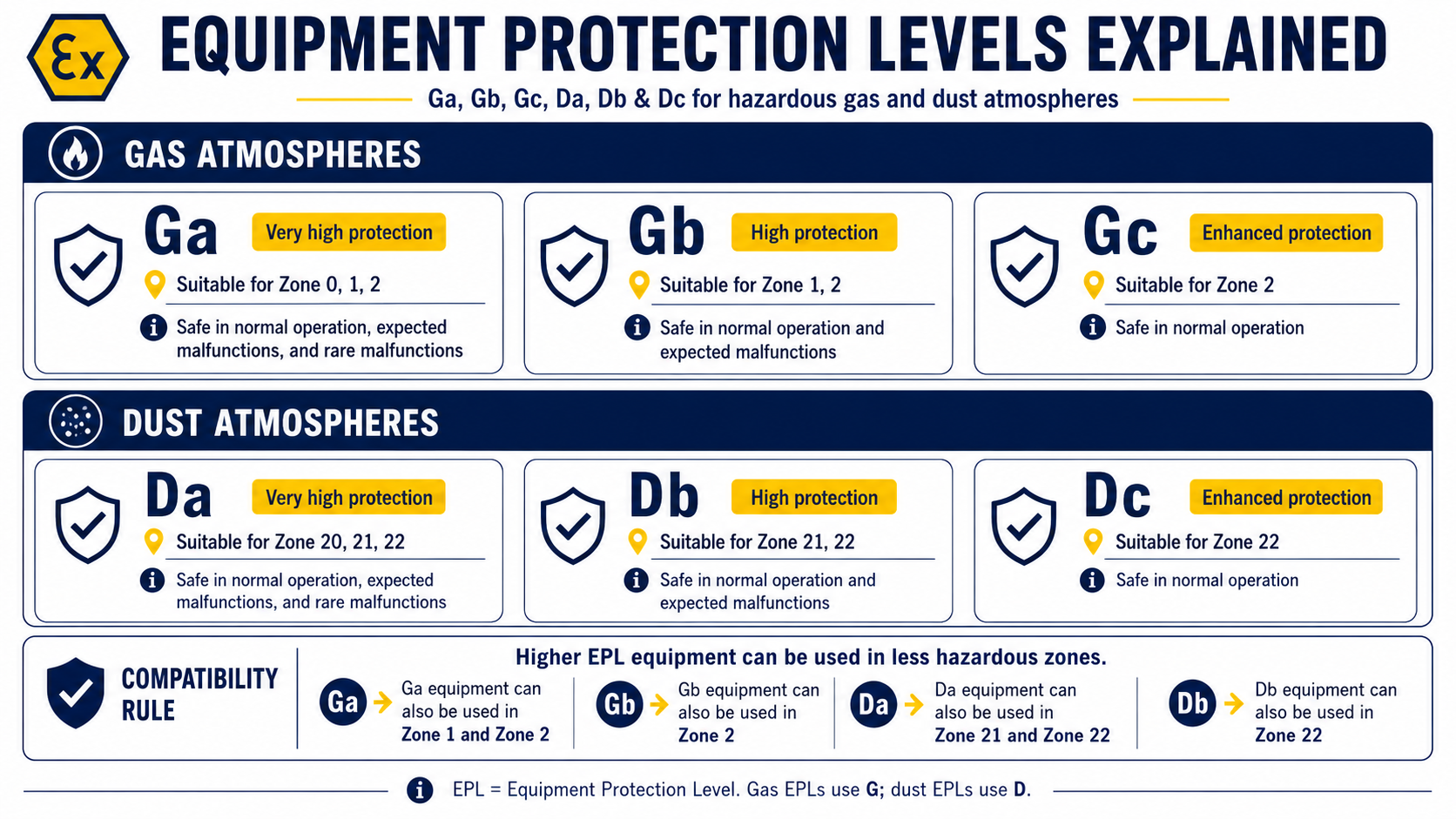
Equipment Protection Levels, often shortened to EPLs, are used in hazardous area equipment markings to show the level of ignition protection provided by equipment used in explosive atmospheres. Common EPL markings include Ga, Gb, Gc, Da, Db and Dc.
In simple terms, EPLs help show whether equipment is suitable for hazardous areas such as Zone 1 or Zone 2, or combustible dust areas such as Zone 21 or Zone 22. They are commonly found in ATEX and Ex markings alongside the protection method, gas group, temperature class and certificate reference.
Quick Answer: What Are Equipment Protection Levels?
Equipment Protection Levels identify the level of protection hazardous area equipment provides against becoming an ignition source. For gas atmospheres, the common EPLs are Ga, Gb and Gc. For combustible dust atmospheres, the common EPLs are Da, Db and Dc.
Equipment Protection Levels: Quick Summary
| Ga |
Very high level of protection for gas atmospheres. Typically associated with Zone 0. |
| Gb |
High level of protection for gas atmospheres. Typically associated with Zone 1. |
| Gc |
Enhanced level of protection for gas atmospheres. Typically associated with Zone 2. |
| Da |
Very high level of protection for combustible dust atmospheres. Typically associated with Zone 20. |
| Db |
High level of protection for combustible dust atmospheres. Typically associated with Zone 21. |
| Dc |
Enhanced level of protection for combustible dust atmospheres. Typically associated with Zone 22. |
What Is an Equipment Protection Level?
An Equipment Protection Level is a marking used to indicate the level of protection provided by equipment against ignition risk in an explosive atmosphere. EPLs are commonly associated with the IECEx system and IEC standards, but they are also widely seen in Ex markings on equipment used in ATEX hazardous areas.
The EPL does not describe the type of gas or dust. It does not describe the temperature class. It does not replace the full certificate. Instead, it gives a high-level indication of the equipment’s ignition protection level.
EPLs are used alongside other critical marking details, including:
- equipment group – such as Group II for surface gas atmospheres or Group III for dust atmospheres;
- protection method – such as Ex d, Ex e, Ex i, Ex p, Ex m or Ex t;
- gas group – such as IIA, IIB or IIC;
- temperature class – such as T1 to T6;
- certificate number – used to verify the exact product approval;
- special conditions of safe use – often indicated by an “X” suffix on the certificate.
For product selection, the EPL should always be checked with the full ATEX or IECEx marking, certificate, manufacturer instructions and hazardous area classification.
Gas EPLs: Ga, Gb & Gc Explained
For explosive gas, vapour or mist atmospheres, the most common Equipment Protection Levels are Ga, Gb and Gc.
Gas Equipment Protection Levels
| Ga |
Very high level of protection for gas atmospheres. Typically associated with areas where explosive atmosphere is present continuously, frequently or for long periods. |
| Gb |
High level of protection for gas atmospheres. Typically associated with areas where explosive atmosphere is likely to occur occasionally during normal operation. |
| Gc |
Enhanced level of protection for gas atmospheres. Typically associated with areas where explosive atmosphere is not likely during normal operation, or only present for a short time. |
A product marked Gb is commonly associated with Zone 1 gas applications, while Gc is commonly associated with Zone 2 gas applications. However, suitability should never be confirmed by EPL alone. The gas group, T-class, protection method and certificate conditions must also be checked.
Dust EPLs: Da, Db & Dc Explained
For combustible dust atmospheres, the common Equipment Protection Levels are Da, Db and Dc.
Dust Equipment Protection Levels
| Da |
Very high level of protection for combustible dust atmospheres. Typically associated with Zone 20. |
| Db |
High level of protection for combustible dust atmospheres. Typically associated with Zone 21. |
| Dc |
Enhanced level of protection for combustible dust atmospheres. Typically associated with Zone 22. |
Dust EPLs are not interchangeable with gas EPLs. Equipment marked for gas atmospheres should not automatically be assumed suitable for combustible dust atmospheres. The marking must specifically confirm dust suitability, including the correct dust group, maximum surface temperature and enclosure protection.
Related product range: Dust Protected Enclosures for Zone 21 & Zone 22.
EPLs & Hazardous Area Zones
EPLs are closely related to hazardous area zones. The zone describes the likelihood and duration of the explosive atmosphere. The EPL identifies the level of ignition protection provided by the equipment.
Hazardous Area Zones & Common EPL Relationship
| Zone 0 |
Gas, vapour or mist atmosphere present continuously, frequently or for long periods. Commonly associated with EPL Ga. |
| Zone 1 |
Gas, vapour or mist atmosphere likely to occur occasionally during normal operation. Commonly associated with EPL Gb. |
| Zone 2 |
Gas, vapour or mist atmosphere not likely in normal operation, or only present for a short time. Commonly associated with EPL Gc. |
| Zone 20 |
Combustible dust atmosphere present continuously, frequently or for long periods. Commonly associated with EPL Da. |
| Zone 21 |
Combustible dust atmosphere likely to occur occasionally during normal operation. Commonly associated with EPL Db. |
| Zone 22 |
Combustible dust atmosphere not likely in normal operation, or only present for a short time. Commonly associated with EPL Dc. |
Read more in our full guide to Hazardous Area Zones Definitions.
ATEX Categories vs IECEx EPLs
ATEX equipment categories and IECEx Equipment Protection Levels are closely related, but they come from different certification frameworks. ATEX categories are commonly used in the European ATEX system, while EPLs are strongly associated with IECEx and IEC-based Ex markings.
ATEX Categories & EPL Comparison
| Zone 0 |
ATEX Category 1G |
EPL Ga |
| Zone 1 |
ATEX Category 2G |
EPL Gb |
| Zone 2 |
ATEX Category 3G |
EPL Gc |
| Zone 20 |
ATEX Category 1D |
EPL Da |
| Zone 21 |
ATEX Category 2D |
EPL Db |
| Zone 22 |
ATEX Category 3D |
EPL Dc |
This relationship is useful, but it should not be used as the only basis for product selection. The full certificate, marking, gas or dust group, T-class, ambient temperature, accessories and special conditions must also be reviewed.
Related guide: ATEX vs IECEx: What’s the Difference?
EPLs in Ex Marking
The Equipment Protection Level is often shown at the end of an Ex marking. It helps identify the level of protection for the gas or dust atmosphere.
Example Ex Marking with EPL
Example marking:
II 2G Ex db IIC T4 Gb
What Each Part Means
| II |
Group II equipment for surface industries with explosive gas atmospheres. |
| 2G |
ATEX Category 2 equipment for gas atmospheres, commonly associated with Zone 1. |
| Ex db |
Flameproof protection method. |
| IIC |
Gas group suitable for IIC atmospheres, commonly including hydrogen and acetylene-type hazards. |
| T4 |
Temperature class with a maximum surface temperature of 135°C under certified conditions. |
| Gb |
Equipment Protection Level for gas atmospheres, commonly associated with Zone 1 applications. |
In this example, Gb is the Equipment Protection Level. It helps confirm the product’s protection level for a gas atmosphere, but the full marking must still be assessed.
Read more: ATEX Marking Explained.
EPLs, Gas Groups & T-Class Ratings
An EPL is only one part of Ex equipment selection. The equipment must also match the gas group and temperature class required by the hazardous area.
EPL vs Gas Group vs Temperature Class
| EPL |
Shows the level of ignition protection, such as Ga, Gb, Gc, Da, Db or Dc. |
| Gas Group |
Shows suitability for the gas or vapour explosion characteristics, such as IIA, IIB or IIC. |
| Temperature Class |
Shows the maximum surface temperature of the equipment, such as T1, T2, T3, T4, T5 or T6. |
For example, an item marked Ex db IIC T4 Gb may have:
- Gb EPL for a Zone 1-type gas application;
- IIC gas group suitability;
- T4 temperature class, meaning a maximum surface temperature of 135°C under certified conditions.
All three parts must be correct. A product can have the correct EPL but the wrong gas group or temperature class for the site.
Related guides:
How EPLs Affect Equipment Selection
Equipment Protection Levels help guide product selection, but they should never be used in isolation. The correct product must match the full hazardous area classification and the full certification documentation.
A practical selection process should include:
- Confirm the hazardous area zone – for example Zone 1, Zone 2, Zone 21 or Zone 22.
- Identify whether the atmosphere is gas or dust – gas EPLs and dust EPLs are different.
- Check the required EPL – for example Gb for many Zone 1 gas applications or Gc for many Zone 2 gas applications.
- Check the Ex protection method – such as Ex d, Ex e, Ex i, Ex p, Ex m, Ex n or Ex t.
- Check the gas or dust group – such as IIA, IIB, IIC, IIIA, IIIB or IIIC.
- Check the temperature class or maximum surface temperature – to prevent hot-surface ignition risk.
- Check the certificate number – the certificate must match the exact product and model.
- Review special conditions of safe use – especially where an “X” suffix appears on the certificate.
- Check installation accessories – cable glands, plugs, stopping plugs, adaptors and entries must preserve the protection method.
This is especially important when replacing equipment, modifying plant, changing suppliers or specifying products for international projects where ATEX, IECEx and UKCA/UKEX requirements may need to be considered.
Example EPL Product Applications
Equipment Protection Levels appear across many hazardous area product types. The correct EPL depends on the zone classification, gas or dust atmosphere, protection concept, certificate and site conditions.
Typical product ranges include:
Thorne & Derrick supply ATEX and IECEx certified equipment for hazardous area applications where the correct EPL, zone suitability, gas group, T-class and certificate documentation must be checked carefully.
Common EPL Mistakes
Equipment Protection Levels are useful, but they are often misunderstood. Common mistakes include:
- Assuming EPL alone confirms suitability – the full marking and certificate must be checked.
- Confusing gas EPLs and dust EPLs – Ga, Gb and Gc apply to gas atmospheres, while Da, Db and Dc apply to dust atmospheres.
- Using Zone 2-only equipment in Zone 1 – Gc equipment should not be assumed suitable for Zone 1 unless the full certification confirms suitability.
- Ignoring gas group – Gb equipment still needs the correct IIA, IIB or IIC gas group suitability.
- Ignoring T-class – equipment must not exceed the maximum surface temperature permitted for the hazardous atmosphere.
- Not checking the certificate number – the certificate must cover the exact product, variant and conditions of use.
- Forgetting ambient temperature limits – certification may only apply within a defined ambient range.
- Overlooking installation accessories – cable glands, stopping plugs, adaptors and entries must be suitable for the certified installation.
For hazardous area applications, equipment should always be selected by competent personnel using the site classification, certification documents and manufacturer instructions.
Equipment Protection Level FAQs
Q: What does EPL mean in hazardous areas?
A: EPL stands for Equipment Protection Level. It indicates the level of ignition protection provided by equipment used in explosive atmospheres. Common EPLs include Ga, Gb and Gc for gas atmospheres, and Da, Db and Dc for dust atmospheres.
Q: What is the difference between Ga, Gb and Gc?
A: Ga is a very high level of protection for gas atmospheres, commonly associated with Zone 0. Gb is a high level of protection, commonly associated with Zone 1. Gc is an enhanced level of protection, commonly associated with Zone 2.
Q: What is the difference between Da, Db and Dc?
A: Da is a very high level of protection for combustible dust atmospheres, commonly associated with Zone 20. Db is a high level of protection, commonly associated with Zone 21. Dc is an enhanced level of protection, commonly associated with Zone 22.
Q: Is EPL the same as ATEX category?
A: No. EPL and ATEX category are closely related, but they are not the same term. ATEX categories are used in the ATEX framework, while EPLs are strongly associated with IEC and IECEx Ex markings. For example, Category 2G is commonly associated with EPL Gb for Zone 1 gas applications.
Q: What EPL is required for Zone 1?
A: Zone 1 gas applications are commonly associated with EPL Gb. However, equipment selection must also consider gas group, T-class, protection method, ambient temperature, certificate conditions and installation requirements.
Q: What EPL is required for Zone 2?
A: Zone 2 gas applications are commonly associated with EPL Gc. The equipment must still be suitable for the gas group, temperature class, protection method, ambient conditions and certificate scope.
Q: Can Gc equipment be used in Zone 1?
A: Equipment marked only Gc should not be assumed suitable for Zone 1. Zone 1 commonly requires a higher protection level, such as Gb, depending on the application and full certification requirements.
Q: Is EPL enough to confirm equipment suitability?
A: No. EPL is only one part of equipment selection. The full ATEX or IECEx marking, certificate number, zone, gas or dust group, T-class, ambient temperature range, accessories and special conditions of safe use must also be checked.
Conclusion
Equipment Protection Levels are an important part of hazardous area equipment marking. They help identify the level of ignition protection provided by equipment used in explosive atmospheres. For gas atmospheres, the common EPLs are Ga, Gb and Gc. For combustible dust atmospheres, the common EPLs are Da, Db and Dc.
However, EPL should never be checked in isolation. The correct equipment selection must also consider the hazardous area zone, ATEX category, protection method, gas or dust group, temperature class, certificate number, ambient temperature range and special conditions of safe use.
Thorne & Derrick supply ATEX and IECEx certified equipment for hazardous area lighting, heating, trace heating, enclosures, plugs, sockets, isolators, process instrumentation and static control applications, with technical support to help customers select equipment suitable for demanding industrial environments.
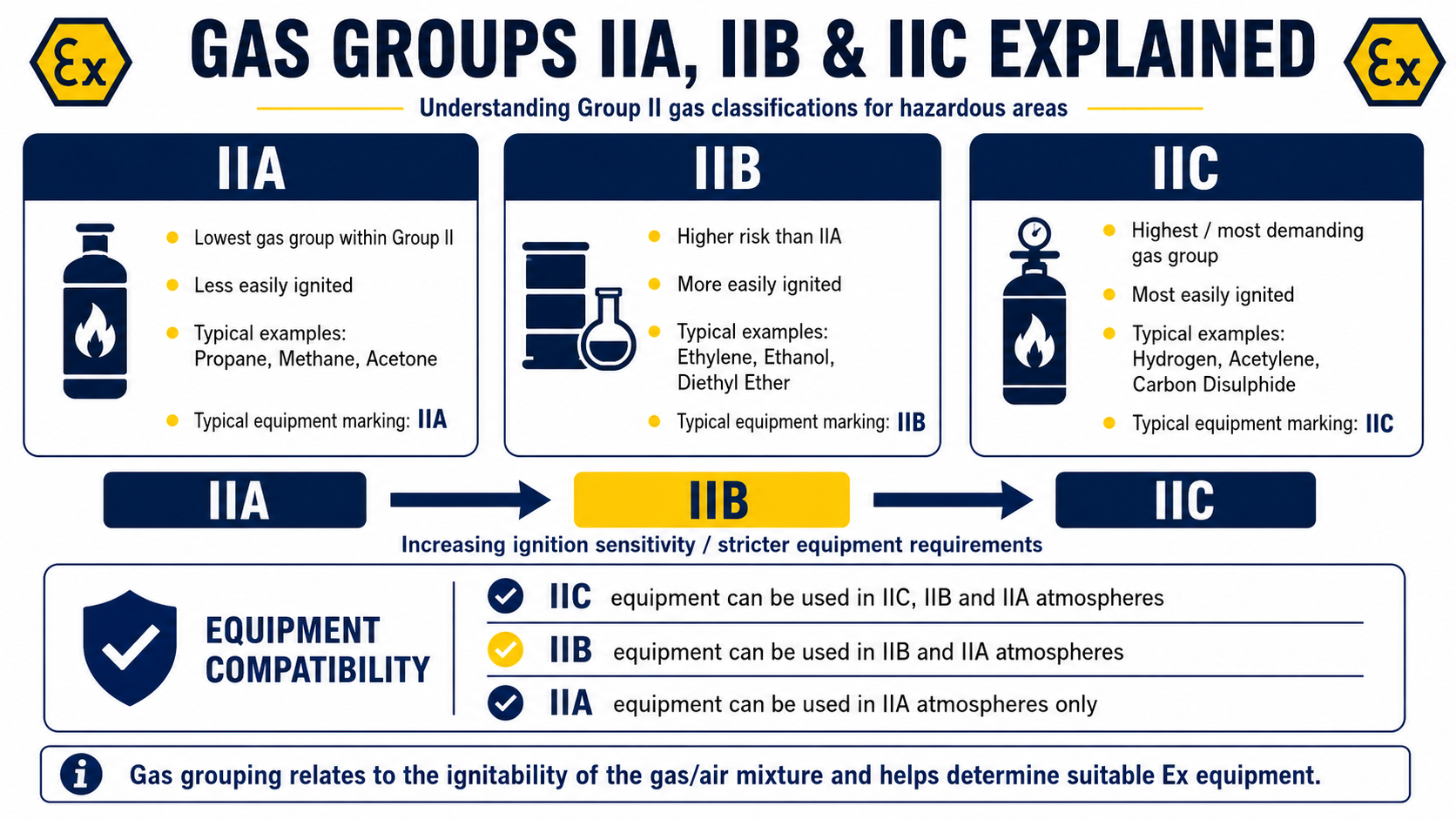 Gas groups IIA, IIB and IIC are hazardous area classifications used to group flammable gases and vapours according to their explosion characteristics. They help engineers, buyers and safety teams confirm whether hazardous area equipment is suitable for the explosive atmosphere present on site.
In simple terms, IIA, IIB and IIC show how easily a gas or vapour may ignite and how demanding the equipment protection needs to be. IIC is generally the most severe gas group, commonly associated with gases such as hydrogen and acetylene, while IIA is commonly associated with propane-type atmospheres.
Quick Answer: Gas Groups IIA, IIB & IIC
Gas groups IIA, IIB and IIC classify flammable gases and vapours by their explosion characteristics. They are used in hazardous area equipment markings to show whether equipment is suitable for the gas atmosphere present. IIA is commonly associated with propane-type gases, IIB with ethylene-type gases, and IIC with the most severe gas group, commonly including hydrogen and acetylene.
Gas Groups IIA, IIB & IIC: Quick Summary
| IIA |
Commonly associated with propane-type atmospheres. Generally the least severe of the Group II gas subgroups. |
| IIB |
Commonly associated with ethylene-type atmospheres. More demanding than IIA. |
| IIC |
Commonly associated with hydrogen and acetylene. Generally the most severe Group II gas subgroup. |
| Why It Matters |
Equipment must be certified for the correct gas group. IIA-rated equipment should not be assumed suitable for IIB or IIC atmospheres. |
| Key Check |
Always check the full ATEX or IECEx marking, certificate, temperature class, zone suitability and conditions of use. |
What Are Hazardous Area Gas Groups?
Hazardous area gas groups classify gases and vapours according to how easily they can ignite and how demanding the explosion protection requirements are. They are used to help match certified equipment to the explosive atmosphere present in a classified area.
For surface industries, gas atmospheres fall under Group II. Group II is then divided into:
- IIA – commonly associated with propane or gases and vapours of similar characteristics.
- IIB – commonly associated with ethylene or gases and vapours of similar characteristics.
- IIC – commonly associated with hydrogen, acetylene or gases and vapours of similar characteristics.
These gas groups appear in ATEX markings and IECEx certification to show what atmosphere the equipment has been assessed for.
They are especially important for equipment such as:
Gas group selection should always be based on the actual substances present on site and the hazardous area classification, not assumptions based on the industry or product type.
IIA, IIB & IIC Explained
The three Group II gas subgroups are used to classify explosive gas atmospheres in surface industries. The higher the gas group severity, the more demanding the explosion protection requirements usually become.
Gas Group Comparison
| Gas Group IIA |
Commonly associated with propane-type atmospheres. Generally the least severe Group II gas subgroup. |
| Gas Group IIB |
Commonly associated with ethylene-type atmospheres. More severe than IIA and requires equipment certified for IIB or IIC where applicable. |
| Gas Group IIC |
Commonly associated with hydrogen and acetylene. Generally the most severe Group II gas subgroup and requires equipment certified accordingly. |
A useful rule of thumb is that equipment certified for IIC may often cover IIB and IIA atmospheres, provided all other certification requirements are met. Equipment certified only for IIA should not be assumed suitable for IIB or IIC areas.
This does not mean gas group is the only factor. The product must also match:
- the hazardous area zone;
- the equipment category or EPL;
- the temperature class or maximum surface temperature;
- the ambient temperature range;
- the installation method;
- the certificate conditions.
Why Gas Groups Matter for ATEX Equipment
Gas groups matter because equipment that is safe for one flammable atmosphere may not be safe for another. Different gases and vapours have different ignition characteristics, flame transmission behaviour and explosion properties.
If equipment is not certified for the gas group present, it may not provide the required level of protection. This can create serious ignition risk in hazardous areas.
For example:
- An IIA product should not be assumed suitable for an IIB or IIC gas atmosphere.
- An IIB product should not be assumed suitable for IIC gases such as hydrogen or acetylene.
- An IIC product may often be suitable for IIA and IIB atmospheres if the full certificate, zone rating, T-class and conditions of use are also suitable.
This is especially important when selecting equipment for applications involving hydrogen, acetylene, ethylene, solvents, fuels, petrochemical vapours and other flammable substances.
Practical Impact of Gas Groups
| Equipment Marking |
The gas group appears in the Ex marking, such as Ex db IIC T4 Gb. |
| Certificate Scope |
The certificate must confirm the gas group suitability for the exact product and model. |
| Installation Design |
Gas group affects equipment selection, cable entries, enclosures, accessories and inspection requirements. |
| Safety Risk |
Using equipment with an insufficient gas group rating may compromise explosion protection. |
Gas Groups in ATEX & Ex Marking
Gas groups are usually shown as part of the product’s ATEX, IECEx or Ex marking. A typical marking may include the equipment group, category, protection method, gas group, temperature class and EPL.
Example Ex Marking with Gas Group
Example marking:
II 2G Ex db IIC T4 Gb
What the Gas Group Part Means
| II |
Group II equipment for surface industries with explosive gas atmospheres, excluding mines susceptible to firedamp. |
| 2G |
Category 2 gas equipment, commonly associated with Zone 1 gas applications. |
| Ex db |
Flameproof protection method. |
| IIC |
Gas group suitable for IIC atmospheres, commonly including hydrogen and acetylene-type hazards. |
| T4 |
Temperature class with a maximum surface temperature of 135°C under certified conditions. |
| Gb |
Equipment Protection Level commonly associated with Zone 1 gas applications. |
For a full breakdown of equipment markings, read our guide: ATEX Marking Explained.
Gas Groups & Minimum Ignition Energy
Gas groups are closely linked to ignition sensitivity. One important concept is Minimum Ignition Energy, often shortened to MIE. MIE is the minimum spark energy required to ignite a flammable atmosphere under defined test conditions.
In general:
- IIA gases are usually less easily ignited than IIB and IIC gases.
- IIB gases are more demanding than IIA gases.
- IIC gases are generally the most easily ignited and require the most demanding equipment compatibility.
This is why IIC atmospheres require particular care. Hydrogen and acetylene are commonly associated with IIC because they have demanding ignition and explosion characteristics.
Read more in our technical guide to Minimum Ignition Energy.
Gas Group Severity & Ignition Sensitivity
| IIA |
Generally less severe than IIB and IIC. Commonly associated with gases such as propane. |
| IIB |
Intermediate severity. Commonly associated with gases such as ethylene. |
| IIC |
Most severe Group II gas subgroup. Commonly associated with hydrogen and acetylene. |
MIE should not be used alone to select equipment. The final selection must consider the full hazardous area classification, Ex marking, gas group, temperature class, EPL, certificate and installation conditions.
Gas Groups vs Temperature Class Ratings
Gas group and temperature class are different parts of hazardous area equipment selection.
Gas group tells you about the type of gas or vapour explosion characteristics. Temperature class tells you the maximum surface temperature the equipment can reach under certified conditions.
Gas Group vs T-Class
| Gas Group |
Identifies compatibility with gases and vapours such as propane, ethylene, hydrogen or acetylene. |
| Temperature Class |
Identifies the maximum surface temperature of the equipment, such as T1, T2, T3, T4, T5 or T6. |
| Selection Requirement |
Both must be correct. Equipment could have the right gas group but the wrong T-class, or the right T-class but the wrong gas group. |
For example, equipment marked IIC T4 may have a suitable gas group for hydrogen or acetylene-type atmospheres, but the T4 temperature class must still be suitable for the auto-ignition temperature of the specific gas or vapour present.
Read more in our guide to Temperature T-Class Ratings.
Gas Groups vs Hazardous Area Zones
Gas groups and hazardous area zones are also different. The zone tells you how likely an explosive atmosphere is to occur. The gas group tells you about the type of gas or vapour hazard.
Gas Group vs Hazardous Area Zone
| Hazardous Area Zone |
Describes the likelihood and duration of the explosive atmosphere, such as Zone 0, Zone 1 or Zone 2. |
| Gas Group |
Describes the explosion characteristics of the gas or vapour, such as IIA, IIB or IIC. |
| Equipment Selection |
Both must be correct. A product must be suitable for the zone and the gas group. |
For example, an area may be classified as Zone 1 IIC T4. This means the equipment must be suitable for Zone 1, the IIC gas group and the required temperature class.
Read more: Zone 1 vs Zone 2 Hazardous Areas.
Gas Groups vs Dust Groups
Gas groups IIA, IIB and IIC apply to flammable gas, vapour and mist atmospheres. Combustible dust atmospheres use different groupings and zone classifications.
For dust atmospheres, Group III may be subdivided into:
- IIIA – combustible flyings.
- IIIB – non-conductive dust.
- IIIC – conductive dust.
Dust zones are normally identified as Zone 20, Zone 21 and Zone 22, rather than Zone 0, Zone 1 and Zone 2.
Gas Groups & Dust Groups
| Gas Atmospheres |
Use Group II gas subgroups: IIA, IIB and IIC. |
| Dust Atmospheres |
Use Group III dust subgroups: IIIA, IIIB and IIIC. |
| Important Check |
Equipment marked for gas should not automatically be assumed suitable for dust, and equipment marked for dust should not automatically be assumed suitable for gas. |
Related product range: Dust Protected Enclosures for Zone 21 & Zone 22.
How Gas Groups Affect Equipment Selection
When selecting hazardous area equipment, gas group compatibility must be checked against the actual site hazard. This is especially important when replacing existing equipment, changing suppliers, upgrading lighting or adding new electrical systems to a classified area.
A practical equipment selection process should include:
- Confirm the hazardous area classification – identify the zone, gas group, temperature class and environmental conditions.
- Identify the flammable substances present – confirm whether the atmosphere is IIA, IIB, IIC or a dust group.
- Check the Ex marking – confirm the gas group is clearly shown and suitable.
- Check the certificate – make sure the certificate covers the exact product model and gas group.
- Check the temperature class – ensure the T-class is suitable for the ignition temperature of the atmosphere.
- Check the ambient temperature range – certification may only apply within defined ambient limits.
- Check accessories – cable glands, plugs, stopping plugs, adaptors and entries must maintain the certified protection method.
- Check installation requirements – manufacturer instructions and any special conditions of safe use must be followed.
For applications involving hydrogen, acetylene, solvents, fuels, petrochemical vapours or mixed gas environments, gas group confirmation is particularly important.
Example ATEX Product Ranges
Gas group suitability appears across a wide range of hazardous area equipment. The correct product depends on the zone, gas group, T-class, protection method and site conditions.
Typical product ranges include:
Thorne & Derrick support the supply of hazardous area equipment for demanding industrial applications where gas group, T-class, zone suitability and certificate compliance must be carefully reviewed.
Common Gas Group Mistakes
Gas group mistakes can lead to incorrect equipment selection and serious safety risks. The most common errors include:
- Assuming all ATEX equipment is suitable for all gases – the gas group must match the atmosphere present.
- Using IIA equipment in IIB or IIC areas – IIA equipment should not be assumed suitable for more severe gas groups.
- Assuming IIB equipment is suitable for hydrogen – hydrogen is commonly associated with IIC, so the certificate must be checked carefully.
- Checking the gas group but ignoring T-class – both must be correct for the hazardous substance.
- Confusing gas groups with dust groups – IIA, IIB and IIC are for gas atmospheres, while IIIA, IIIB and IIIC relate to dust atmospheres.
- Checking the product label but not the certificate – the certificate must match the exact product model and conditions of use.
- Ignoring ambient temperature limits – the product may only be certified within a specific temperature range.
- Forgetting accessories – cable glands, plugs, stopping plugs and adaptors can affect the certified installation.
For hazardous area applications, equipment should always be selected by competent personnel using the site classification, manufacturer documentation and certification records.
Gas Groups IIA, IIB & IIC FAQs
Q: What are gas groups IIA, IIB and IIC?
A: Gas groups IIA, IIB and IIC classify flammable gases and vapours according to their explosion characteristics. They are used in ATEX and IECEx equipment markings to show whether equipment is suitable for the gas atmosphere present in a hazardous area.
Q: Which gas group is most severe?
A: IIC is generally the most severe Group II gas subgroup. It is commonly associated with hydrogen and acetylene, which have demanding ignition and explosion characteristics.
Q: What gases are associated with IIA, IIB and IIC?
A: IIA is commonly associated with propane-type atmospheres, IIB with ethylene-type atmospheres, and IIC with hydrogen or acetylene-type atmospheres. The actual classification should always be confirmed against the site hazardous area assessment and relevant standards.
Q: Can IIC equipment be used in IIB or IIA areas?
A: IIC equipment may often be suitable for IIB and IIA atmospheres if all other certification requirements are also suitable, including zone rating, T-class, EPL, ambient temperature and certificate conditions. The certificate and manufacturer instructions should always be checked.
Q: Can IIA equipment be used in IIC areas?
A: No. Equipment marked only for IIA should not be assumed suitable for IIC atmospheres. IIC is a more severe gas group and requires equipment certified for that group.
Q: Is hydrogen IIC?
A: Hydrogen is commonly associated with gas group IIC. Equipment used in hydrogen atmospheres should be checked carefully for IIC suitability, correct T-class, zone rating, EPL and certificate conditions.
Q: Are gas groups the same as hazardous area zones?
A: No. Hazardous area zones describe how likely an explosive atmosphere is to occur. Gas groups describe the explosion characteristics of the gas or vapour. Equipment must be suitable for both the zone and the gas group.
Q: Are gas groups the same as temperature classes?
A: No. Gas group identifies the type of gas or vapour hazard, while temperature class identifies the maximum surface temperature of the equipment. Both must be suitable for the hazardous atmosphere.
Conclusion
Gas groups IIA, IIB and IIC are essential for selecting safe and suitable hazardous area equipment. They identify the explosion characteristics of flammable gases and vapours and help confirm whether ATEX or IECEx certified equipment is compatible with the site atmosphere.
IIA is commonly associated with propane-type atmospheres, IIB with ethylene-type atmospheres, and IIC with the most severe Group II gas subgroup, commonly including hydrogen and acetylene. However, gas group is only one part of equipment selection. The hazardous area zone, temperature class, EPL, certificate, ambient temperature, accessories and special conditions of use must also be checked.
Thorne & Derrick supply ATEX and IECEx certified equipment for hazardous area lighting, heating, heat trace, enclosures, plugs, connectors, isolators, process instrumentation and static control applications, with technical support to help customers select equipment suitable for demanding industrial environments.
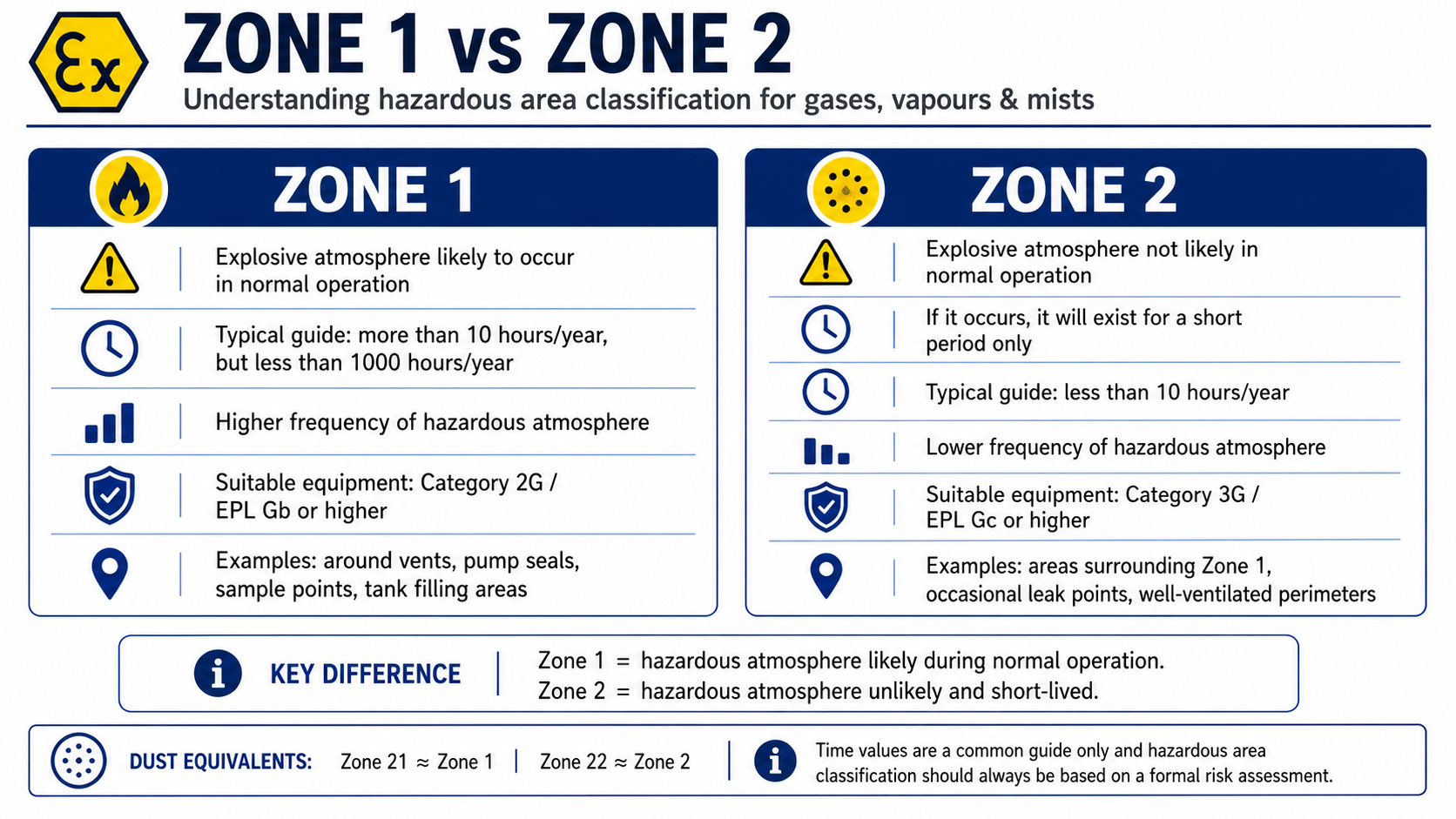
Zone 1 and Zone 2 hazardous areas are classified locations where flammable gases, vapours or mists may create an explosive atmosphere. The main difference is how likely the explosive atmosphere is to occur during normal operation. Zone 1 is higher risk because an explosive atmosphere is likely to occur occasionally, while Zone 2 is lower risk because an explosive atmosphere is not likely during normal operation and, if it occurs, should only exist for a short time.
Understanding the difference between Zone 1 vs Zone 2 is essential when selecting hazardous area equipment, including ATEX lighting, heaters, enclosures, plugs, sockets, isolators, gas detection, heat trace and static grounding systems.
Quick Answer: Zone 1 vs Zone 2
Zone 1 is a hazardous area where an explosive gas, vapour or mist atmosphere is likely to occur occasionally during normal operation. Zone 2 is a hazardous area where an explosive atmosphere is not likely to occur during normal operation, and if it does occur, it is expected to exist only for a short time.
Zone 1 vs Zone 2: Quick Comparison
| Zone 1 |
Explosive atmosphere is likely to occur occasionally during normal operation. |
| Zone 2 |
Explosive atmosphere is not likely during normal operation, and if it occurs, it should only exist for a short time. |
| Relative Risk |
Zone 1 generally represents a higher likelihood of explosive atmosphere than Zone 2. |
| Equipment Selection |
Zone 1 typically requires equipment with a higher protection level than Zone 2 equipment. |
| Important Check |
The equipment marking, certificate, gas group, temperature class, EPL and installation conditions must match the classified area. |
What Is a Zone 1 Hazardous Area?
A Zone 1 hazardous area is a location where an explosive atmosphere consisting of flammable gas, vapour or mist is likely to occur occasionally during normal operation. This does not mean that an explosive atmosphere is always present, but it means the risk is credible enough during normal site activity to require carefully selected certified equipment.
Zone 1 areas may be found near process equipment, vents, filling points, pumps, valves, sampling points, tanker loading areas, chemical handling areas, fuel transfer systems and other locations where flammable substances may be released during normal operation.
Typical examples may include:
- Areas around pump seals where flammable vapours may be released occasionally.
- Filling or transfer points where vapour release is possible during routine operation.
- Process plant areas where gases or vapours may be present during normal production or maintenance cycles.
- Chemical and petrochemical processing areas where flammable materials are handled regularly.
- Offshore and marine environments where gas or vapour release risks must be controlled.
Because Zone 1 carries a higher likelihood of explosive atmosphere than Zone 2, equipment used in Zone 1 must be selected with particular care. Products should be checked for the correct ATEX marking, certificate scope, gas group, temperature class and any special conditions of safe use.
What Is a Zone 2 Hazardous Area?
A Zone 2 hazardous area is a location where an explosive gas, vapour or mist atmosphere is not likely to occur in normal operation. If it does occur, it is expected to exist only for a short time.
Zone 2 areas are still hazardous areas. They require suitable ignition control, certified equipment and correct installation practices, but the likelihood and expected duration of explosive atmosphere is lower than Zone 1.
Typical Zone 2 examples may include:
- Areas surrounding Zone 1 locations where vapours could spread under abnormal or short-duration conditions.
- Well-ventilated process areas where flammable release is not expected during normal operation.
- Storage and handling areas where flammable substances are present but releases are normally controlled.
- Outdoor process plant where ventilation may reduce the persistence of explosive atmospheres.
- Secondary release areas where failure or abnormal operation could create a temporary hazard.
Although Zone 2 is lower risk than Zone 1, it still requires certified equipment. A standard industrial product should not be used in Zone 2 unless it is specifically certified and marked as suitable for that hazardous area.
Zone 1 vs Zone 2: Key Differences
The difference between Zone 1 and Zone 2 is based on the likelihood and expected duration of the explosive atmosphere. This is important because it directly affects the required level of equipment protection.
Zone 1 vs Zone 2: Detailed Comparison
| Likelihood of Hazard |
Zone 1: Explosive atmosphere likely to occur occasionally during normal operation. |
Zone 2: Explosive atmosphere not likely during normal operation, and if present, only for a short time. |
| Relative Risk Level |
Higher likelihood of explosive atmosphere. |
Lower likelihood of explosive atmosphere. |
| Typical ATEX Category |
Category 2G equipment is commonly associated with Zone 1 gas applications. |
Category 3G equipment is commonly associated with Zone 2 gas applications. |
| Typical EPL |
Gb for gas atmospheres. |
Gc for gas atmospheres. |
| Equipment Requirement |
Requires equipment suitable for higher likelihood explosive atmosphere conditions. |
Requires certified equipment suitable for lower likelihood, short-duration explosive atmosphere conditions. |
| Selection Risk |
Using Zone 2-only equipment in Zone 1 can create a serious safety risk. |
Using incorrectly marked or uncertified equipment remains unsafe, even in Zone 2. |
A product that is suitable for Zone 1 may also be suitable for Zone 2 in many cases, provided the full marking, certificate and installation conditions are appropriate. However, the reverse is not normally true: equipment certified only for Zone 2 should not be assumed suitable for Zone 1.
Zone Classification & Equipment Selection
Hazardous area classification is the process of identifying where explosive atmospheres may occur and classifying those areas into zones. The classification should consider the type of flammable substance, release source, ventilation, operating conditions, duration of release and likelihood of explosive atmosphere formation.
Equipment selection should then be based on the classified zone and the full hazardous area conditions, including:
- Zone classification – Zone 0, Zone 1, Zone 2, Zone 20, Zone 21 or Zone 22.
- Gas, vapour, mist or dust risk – the product must be suitable for the specific atmosphere.
- Gas group or dust group – for example IIA, IIB or IIC for gas atmospheres.
- Temperature class – the maximum equipment surface temperature must be suitable for the hazardous substance.
- Equipment Protection Level – the EPL must match the required level of protection.
- Ambient temperature range – certification may only apply within defined temperature limits.
- Special conditions of safe use – shown by an “X” suffix on some certificates.
Read more in our full guide to Hazardous Area Zones Definitions.
External reference: HSE guidance explains that areas where hazardous explosive atmospheres may occur must be classified into zones.
ATEX Categories for Zone 1 & Zone 2
ATEX equipment categories help identify the level of protection provided by equipment. For gas atmospheres, the common relationship between categories and zones is shown below.
ATEX Categories & Gas Zone Relationship
| Zone 0 |
Category 1G equipment is typically required for gas atmospheres present continuously, frequently or for long periods. |
| Zone 1 |
Category 2G equipment is commonly associated with gas atmospheres likely to occur occasionally during normal operation. |
| Zone 2 |
Category 3G equipment is commonly associated with gas atmospheres not likely during normal operation, or only present for a short time. |
For combustible dust atmospheres, the equivalent zone structure uses Zone 20, Zone 21 and Zone 22, with equipment categories commonly identified as 1D, 2D and 3D.
Related guide: ATEX Marking Explained.
Equipment Protection Levels
An Equipment Protection Level, or EPL, identifies the level of ignition protection provided by equipment. EPL markings are commonly used in Ex markings and help show whether equipment is suitable for different hazardous area zones.
Common EPLs for Gas & Dust Zones
| Ga |
Very high protection level for gas atmospheres, typically associated with Zone 0. |
| Gb |
High protection level for gas atmospheres, typically associated with Zone 1. |
| Gc |
Enhanced protection level for gas atmospheres, typically associated with Zone 2. |
| Da |
Very high protection level for combustible dust atmospheres, typically associated with Zone 20. |
| Db |
High protection level for combustible dust atmospheres, typically associated with Zone 21. |
| Dc |
Enhanced protection level for combustible dust atmospheres, typically associated with Zone 22. |
EPL should not be checked in isolation. It must be reviewed alongside the full Ex marking, certificate number, gas or dust group, temperature class, ambient temperature and installation requirements.
Gas, Vapour, Mist & Dust Zones
Zone 1 and Zone 2 normally refer to gas, vapour or mist hazardous areas. For combustible dust atmospheres, the equivalent classifications are Zone 21 and Zone 22.
Gas & Dust Zone Comparison
| Gas Zone 0 |
Explosive gas, vapour or mist atmosphere present continuously, frequently or for long periods. |
| Gas Zone 1 |
Explosive gas, vapour or mist atmosphere likely to occur occasionally during normal operation. |
| Gas Zone 2 |
Explosive gas, vapour or mist atmosphere not likely during normal operation, or only present for a short time. |
| Dust Zone 20 |
Combustible dust cloud present continuously, frequently or for long periods. |
| Dust Zone 21 |
Combustible dust cloud likely to occur occasionally during normal operation. |
| Dust Zone 22 |
Combustible dust cloud not likely during normal operation, or only present for a short time. |
A product marked for gas atmospheres should not automatically be assumed suitable for dust atmospheres. The marking must specifically confirm dust suitability, and the equipment must be assessed against the dust classification, maximum surface temperature and installation environment.
Related guide: Dust Protected Enclosures for Zone 21 & Zone 22.
Zone 1 Equipment Examples
Zone 1 hazardous area equipment is used where explosive atmospheres are likely to occur occasionally during normal operation. These environments normally require equipment with a high level of protection and the correct ATEX or IECEx certification for the application.
Examples of Zone 1 equipment include:
When selecting Zone 1 equipment, the marking may include references such as II 2G and Gb, depending on the certification route and equipment type. Always check the product certificate and datasheet.
Zone 2 Equipment Examples
Zone 2 hazardous area equipment is used where explosive atmospheres are not expected during normal operation, and if they do occur, they should only exist for a short period. Zone 2 is lower likelihood than Zone 1, but it is still a classified hazardous area.
Examples of Zone 2 equipment include:
Zone 2-only equipment should not be installed in Zone 1 unless the certificate and marking clearly confirm suitability for Zone 1. The correct selection must be based on the full site classification and product certification.
Common Zone 1 & Zone 2 Mistakes
Misunderstanding hazardous area zones can lead to unsafe equipment selection, poor compliance and unnecessary project risk.
Common mistakes include:
- Assuming Zone 2 equipment can be used in Zone 1 – Zone 1 requires a higher level of protection because explosive atmospheres are more likely.
- Selecting equipment based only on the word “ATEX” – the full marking, certificate and conditions of use must be checked.
- Ignoring gas group – equipment suitable for IIA should not automatically be used in IIB or IIC atmospheres.
- Overlooking temperature class – the equipment surface temperature must be suitable for the ignition temperature of the hazardous atmosphere.
- Confusing gas zones and dust zones – Zone 1 and Zone 2 relate to gas, vapour and mist; Zone 21 and Zone 22 relate to combustible dust.
- Ignoring accessories – cable glands, plugs, stopping plugs, adapters and other accessories must maintain the integrity of the certified installation.
- Missing special conditions of use – certificates with an “X” suffix require specific conditions to be followed.
- Relying on old assumptions – hazardous area classification should be reviewed if processes, substances, ventilation or plant layout change.
For critical applications, equipment selection should be supported by competent hazardous area assessment, correct documentation and manufacturer guidance.
Zone 1 vs Zone 2 FAQs
Q: What is the difference between Zone 1 and Zone 2?
A: Zone 1 is a hazardous area where an explosive gas, vapour or mist atmosphere is likely to occur occasionally during normal operation. Zone 2 is a hazardous area where an explosive atmosphere is not likely during normal operation, and if it occurs, it should only exist for a short time.
Q: Is Zone 1 more hazardous than Zone 2?
A: Yes. Zone 1 generally represents a higher likelihood of explosive atmosphere than Zone 2. This is why Zone 1 equipment normally requires a higher level of protection than equipment intended only for Zone 2.
Q: Can Zone 1 equipment be used in Zone 2?
A: Zone 1 equipment may often be suitable for Zone 2 if the full marking, certificate, gas group, temperature class, ambient rating and installation conditions are suitable. However, equipment should never be selected on zone alone; the full certification must be checked.
Q: Can Zone 2 equipment be used in Zone 1?
A: No, not unless the equipment is also certified and marked as suitable for Zone 1. Equipment certified only for Zone 2 should not be used in Zone 1 because Zone 1 has a higher likelihood of explosive atmosphere.
Q: What ATEX category is required for Zone 1?
A: Category 2G equipment is commonly associated with Zone 1 gas atmospheres. The final selection must also consider the gas group, T-class, equipment protection level, ambient temperature and certificate conditions.
Q: What ATEX category is required for Zone 2?
A: Category 3G equipment is commonly associated with Zone 2 gas atmospheres. However, the product must still be suitable for the gas group, temperature class, ambient conditions and application.
Q: Are Zone 1 and Zone 2 only for gas?
A: Zone 1 and Zone 2 usually refer to gas, vapour or mist explosive atmospheres. For combustible dust atmospheres, the equivalent classifications are Zone 21 and Zone 22.
Q: Is ATEX certification enough to confirm suitability?
A: No. The product must be ATEX or IECEx certified for the correct zone, gas or dust group, temperature class, EPL, ambient temperature and installation conditions. The certificate and manufacturer instructions should always be checked.
Conclusion
Zone 1 and Zone 2 hazardous areas are both classified locations where explosive atmospheres may occur, but the likelihood and duration of the hazard are different. Zone 1 is higher risk because an explosive atmosphere is likely to occur occasionally during normal operation. Zone 2 is lower risk because an explosive atmosphere is not expected in normal operation and, if it occurs, should only exist for a short time.
When selecting equipment for Zone 1 or Zone 2, the safest approach is to check the complete certification picture: ATEX marking, IECEx certification where applicable, equipment category, EPL, gas group, temperature class, ambient temperature, accessories, installation instructions and any special conditions of safe use.
Thorne & Derrick supply ATEX and IECEx certified equipment for Zone 1 and Zone 2 hazardous areas, including lighting, heaters, heat trace systems, enclosures, isolators, plugs, sockets, gas detection, process instrumentation and static grounding systems.