When sourcing lighting to install in hazardous areas, cost, performance and reputation of the manufacturer, are important criteria to consider. But how much thought do end-users give to ease of maintenance? For many, the answer to this question is probably, ‘not enough’.
This White-Paper is intended to help end users gain a better understanding of what makes a hazardous area luminaire easy to maintain, and how it can help to reduce costs.
The design of a luminaire, and how easy it is to maintain, can vary significantly between different manufacturers and different luminaires. In part, this is down to how the units are certified; certification can restrict the level of maintenance that can be carried out on-site. However, ease of maintenance is also down to the manufacturer and how much importance it’s given during the design process. It’s easy for a manufacturer to overlook ease of maintenance, especially as the person specifying the lighting is not always responsible for maintaining it.
Choosing an LED luminaire will of course help to reduce the amount of maintenance required, but as with any electrical product, there is always some risk of failure. In hazardous area applications, where the environment can be particularly harsh and challenging, this risk is often amplified. So, while LED undoubtedly helps to reduce the level and frequency of maintenance, no hazardous area luminaire should really be thought of as being completely ‘maintenance free’.
Before we look more closely at what actually makes a luminaire easy to maintain, we’ll first consider what maintenance is required for any luminaire installed in a hazardous area.
What Maintenance is Required?
Routine Inspection
Luminaires that are certified for use in hazardous areas possess special features which render them suitable for use in these environments. Routine inspections are therefore required over the lifetime of the luminaire to ensure these special features are preserved.
The level and complexity of these inspections are covered under hazardous area guidelines (BS EN60079- 17), but speaking generally, will usually be visual and are unlikely to require the unit to be opened up. As a result, the design of a luminaire, and how easy it is to maintain, is unlikely to have any significant impact on the complexity and duration of these routine inspections. Crucially though, these inspections are designed to highlight the need for any additional, unplanned maintenance. It is these requirements that make a luminaire’s ease of maintenance so important.
Unplanned Maintenance
Unplanned maintenance can be categorised as any maintenance procedure which is required outside of routine inspection. Unplanned maintenance is likely to be more complex, and there is a higher chance that the unit will need to be opened up for a problem to be rectified or repaired.
A luminaire’s ease of maintenance will determine two things;
Who can carry out the repair; the end-user or the manufacturer?
Whether the unit can be repaired at all, or if it must be replaced?
The answer to these two questions will have a significant effect on the length of time which the end-user will be left without light, and on the cost (both the direct cost of the repair, but also the associated costs of downtime).
➡ Pro-Tip – Any unplanned maintenance requirements could increase the lifetime cost of the luminaire if it is not easy to maintain.
Identifying Ease of Maintenance
Traditional Luminaires
Luminaires in this category are non-LED and use traditional technology (such as fluorescent tubes or sodium lamps). Of course, this category is very broad with a wide variety of different types of luminaire.
However, they are similar in that they all have a shorter lifetime (so lamps will have to be replaced numerous times over the lifetime of the luminaire). While the process of maintaining the luminaire may be a slow or difficult process, maintenance can generally be carried out on-site.
Sealed for Life LED Luminaires
We know that choosing an LED luminaire means maintenance is required less often, but we’ve also highlighted that when installed in a hazardous area application, it should not be considered as being ‘maintenance free’.
Despite this, many LED luminaires are factory sealed. Because the seal is critical to the luminaire’s hazardous area certification, it cannot be opened up for maintenance or repair.
Tampering with the seal, or forcing the unit open, would mean the luminaire no longer complies with its Ex rating and could present a risk of explosion. Sealed for life units must therefore
be returned to the manufacturer for any maintenance procedures to be carried out.
Modular LED Luminaires
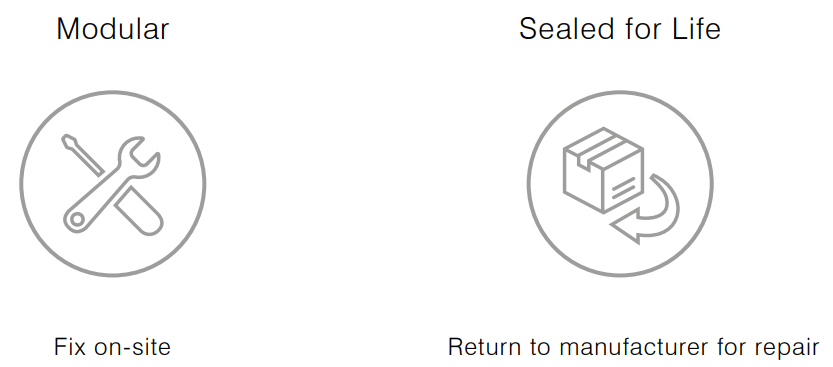
Modular luminaires are designed with maintenance in mind; the unit is not factory sealed and can be opened up on-site. Maintenance can therefore be carried out by the end-user.
Spare parts are interchangeable and can be removed independently, while the ability to mount key components remotely can also make access for maintenance much easier.
The key feature of a modular luminaire is that maintenance can be done on-site and there is no need to return the unit back to the manufacturer.
➡ Pro-Tip – A modular luminaire allows maintenance to be carried out on-site, whereas a sealed for life unit must be returned to the manufacturer to resolve any issues.
Why is Modular Easier to Maintain?
Now we know how different types of luminaire can be grouped, we need to understand what’s different about a modular luminaire which makes it easier to maintain.
A modular luminaire should be designed to ensure parts can be removed and replaced without causing damage to the luminaire.
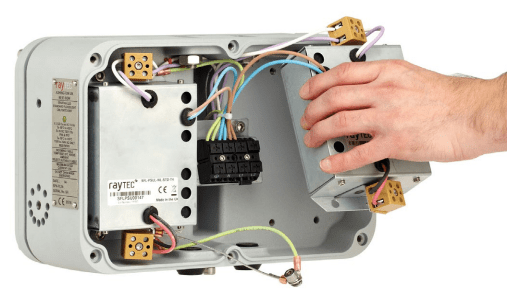
This means parts such as PSUs, emergency batteries, light engines etc. can all be removed independently. The luminaire is not factory sealed, which means an end-user can access internal components and carry out maintenance without having to remove the luminaire first. Meanwhile, spare parts can also be kept on-site to service the installation.
These features help to speed up the process of maintenance and reduce downtime.
Figure 1: A modular luminaire allows parts to be removed independently
At this point, you may be asking, ‘How is all this possible within a hazardous area environment?’. Primarily, it’s down to the unit’s protection method and how it’s been certified. A true modular unit will be ‘Ex e’ certified (increased safety), which in short, means the unit has been designed and certified to prevent an explosion (rather than contain it). Not all Ex e luminaires are modular but certifying using this protection method does allow the manufacturer more flexibility in being able to design it for easy maintenance.
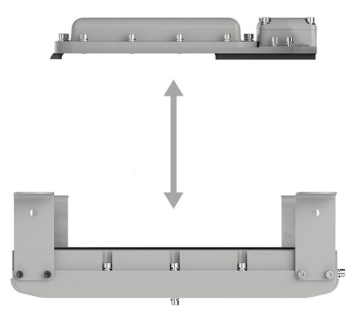
A modular unit should also make access for maintenance easier. In the same way that parts can be removed independently, the control gear can be mounted remotely, away from the luminaire’s main body. This makes access for maintenance much easier (we cover this in more detail in section 6.0).
Figure 2: Modular luminaire’s also allow PSU’s to be removed and mounted remotely for easy access
➡ Pro-Tip – Because a modular luminaires parts are interchangeable, a small stock of spare parts can be kept on-site to service the installation.
Modular vs Sealed for Life
If you are reading this White-Paper, and have an interest in reducing maintenance costs, you probably already understand the benefits of selecting a luminaire using LED technology. For the remainder of this White-Paper we will therefore be focusing on the differences between sealed for life and modular luminaires.
We know that a modular luminaire is easier to maintain, but we also need to understand why ease of maintenance is so important. To recap, the biggest and most significant difference between the two is that modular luminaires can be maintained on-site, whereas a sealed for life luminaire must be returned to the manufacturer.
Downtime
A component failure could result in either a partial or total loss of light from the luminaire. A loss of light may mean an increased risk to workers onsite, or operations may even have to cease. This
could have huge cost implications, which means the speed of resolution is critical.
Sealed for LifeLuminaire
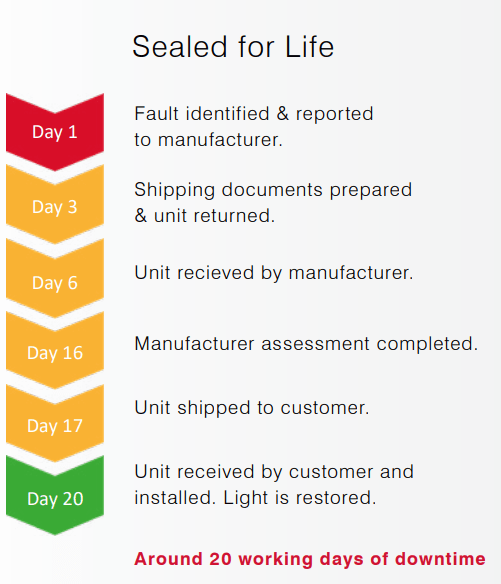
If a failure does cause a loss of light output, it’s unlikely that an end-user will be able to do anything to rectify the problem. The luminaire must therefore be returned to the manufacturer which will have a significant impact on the length of downtime. Let’s take a look at a typical downtime period for a sealed for life luminaire.
Figure 4: Typical downtime of a Sealed for Life luminaire
Transporting a unit between an end-user and manufacturer can be a slow process. Ex lighting is installed across the world, but a customer will often be expected to return it to a single location for repair. The exact duration will depend on the end user’s proximity to the manufacturer, but it could add a number of days to the overall downtime period.
Another factor that contributes towards the duration of downtime is the time it takes for a manufacturer to complete a fault assessment. The assessment will identify the cause of the failure and establish whether it can be covered under warranty (this is usually required before any further action can be taken to resolve the issue). Of course, the length of time this takes to complete will vary between manufacturers. While the best case may be that the assessment is completed within a few days of the unit being received, in reality, it could take significantly longer.
For offshore applications (and other applications where access is difficult and transport is restricted) the duration of downtime could increase significantly. Offshore applications rely on the use of helicopters to get goods to and from shore; these flights are often limited in frequency, and also unreliable due to the harsh conditions of an offshore environment. This could lead to long delays which will increase overall downtime. The longer the downtime, the higher the cost to the end-user.
Modular Luminaire
With the ability to access the internal components (without risk of invalidating the certification), modular ex lighting can be serviced on-site. This allows light to be restored much quicker in the
event of a failure.
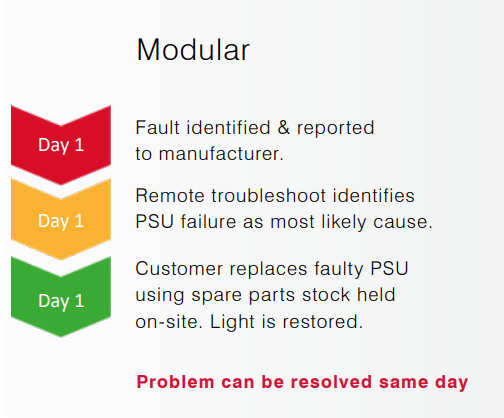
Without the need to return the unit to the manufacturer, transit times are no longer an issue. With the ability to keep spare parts on-site to service the installation, combined with a design which lends itself to easy maintenance, any issues with a modular luminaire can be rectified almost as quickly as they’re identified.
Figure 5: Typical downtime of a Modular luminaire.
On-site maintenance also facilitates remote troubleshooting. For a sealed for life unit (with no way of carrying out a repair), a remote troubleshoot would be a pointless exercise. For a modular unit though, it allows a faulty component to be identified quickly, and then replaced from spare part stock kept on-site.
However, understanding the exact cause of failure may still be important. If the failure has been caused by something on-site, the assessment will provide important information to the end-user and help them rectify the problem.
Because faulty components can be removed independently, they can be returned to the manufacturer without having to ship the entire luminaire back. As well as reducing shipping costs, time also becomes less critical. The luminaire’s output can be restored first using the spare parts, and the faulty components can be returned for assessment afterwards.
How Fast Can You Change a Power Supply on Spartan Linear?
Watch the video below as we demonstrate how quick the process is to change a PSU/driver on a SPARTAN Zone 1 Linear
Environmental Impact
Knowing that a sealed for life luminaire must be returned to the manufacturer for maintenance, let’s now consider the environmental impact; an increasing global concern.
Sealed for Life Luminaire
Once the luminaire eventually reaches the manufacturer, even they may be unable to actually repair it. Carrying out the fault assessment is often impossible without damaging the luminaire to the extent that it cannot be resealed. The process of returning the luminaire is more likely to be for fault identification purposes (and whether the fault is covered under warranty). Regardless of the cause of the fault, the most likely solution will be for it to be replaced by a brand-new unit. The existing housing will be scrapped, and if it contains high levels of polycarbonate or GRP (glass reinforced plastic), this could be particularly damaging to the environment.
We identified earlier that Ex lighting is installed across the world, so the logistics of shipping the luminaire back to the manufacturer could significantly add to the luminaire’s environmental footprint (the extent of this will depend on the location of where the unit is installed, and of the manufacturer). The best case is that the manufacturer has a local repair centre (to reduce shipping distance), but with many manufacturers, the luminaire will have to be returned to a single global location.
Modular Luminaire
The environmental cost of a modular luminaire is a fraction of that of a sealed luminaire. Because the parts are interchangeable, a single component failure will not render the whole luminaire useless. Basic troubleshooting should allow a faulty component to be identified remotely, and the ability to replace parts while the luminaire is in-situ, means in theory, there is never a requirement to return the entire fitting to the manufacturer.
To identify the exact cause of failure, and for warranty purposes, a faulty component could still be returned to the manufacturer for inspection. However, the ease and environmental impact of doing this will be much smaller when compared to returning the entire unit.
Cost
Reducing downtime and the impact on the environment will ultimately translate into significant cost reductions too.
Modular Luminaire
The ability to repair the luminaire on-site removes any costs associated with returning the luminaire back to the manufacturer. Furthermore, even if the repair is not covered under warranty, the cost of repair will be significantly cheaper than having to replace the entire luminaire.
Sealed for Life Luminaire
Transporting goods to and from site can be challenging and expensive. The responsibility of returning the faulty unit to the manufacturer will almost always lie with the customer, rather than the manufacturer. Even if the fault is covered by the luminaires warranty, the customer may still be expected to cover the cost of the luminaire being shipped back.
Furthermore, if a fault occurs which is not covered under warranty, i.e. over-voltage of a PSU, the customer may have to pay the cost of a new unit as the entire luminaire is likely to be replaced rather than repaired (even though only one, relatively inexpensive component has caused the failure).
Figure 6: Summary of Modular vs. Sealed for Life
Sealed for Life Luminaire
Modular Luminaire
Increased downtime; no on-site maintenance possible
Reduced downtime; allows field-based repair
Increased environmental impact; more scrappage, more shipping
Increased lifetime cost; no cost-effective method of repair
Reduced lifetime cost; spare parts can be kept for servicing
Increasing Ease of Access
A luminaire that is easy to maintain is only likely to benefit an end-user if they are able to easily access the unit in the first place. The nature of some hazardous area applications means that doing so may be dangerous or require specialist equipment. Thankfully, the design of a luminaire can also help to make access easier.
As well as being easy to maintain, a truly modular solution should also allow key components to be mounted remotely (with a wired connection to the luminaire head, via a cable) and provide an end-user with greater flexibility in the way that they mount the luminaire. If PSUs can be mounted at ground level, access for maintenance becomes far easier. As well as reducing the cost of maintenance, this will also help to increase speed and minimise downtime.
At Raytec, this is something we’ve experienced when working with clients installing luminaires in grain storage warehouses, which will usually have High Bay luminaires mounted to (or suspended from) the warehouse ceiling. With non-modular lighting installed, gaining access to the luminaire may require the grain to be removed before maintenance is carried out; a slow and costly process. Plus, even if the luminaire can be accessed without needing to remove the grain, carrying out maintenance with the grain still below is risky; it could lead to it becoming contaminated if anything falls while maintenance is being carried out. In contrast, being able to mount the PSUs remotely means maintenance can be carried out at ground level (so there is no risk of contamination), and the grain does not have to be removed. Ultimately this means maintenance can be done quicker, and at a lower cost.
Make Maintenance Easier with a Remote PSU
Watch the video below to see how SPARTAN’s High Power Flood and Bay luminaires removable PSU can benefit installation and maintenance.
Warranties and Returns
We have mentioned warranties a few times during this White-Paper, and a good warranty is certainly an important thing to look for when selecting a luminaire for a new lighting installation. A good warranty can help to reduce costs and provide peace of mind. However, even with the best warranty, associated downtime costs are unavoidable if the unit cannot be maintained on-site and must be returned to the manufacturer. There may also be hidden costs to a warranty that you might not have considered. We consider some of these here;
What’s Actually Covered?
Some warranties may only cover mechanical problems (such as corrosion to the luminaires housing). But what about electrical components, such as the luminaires PSU, where failures are more
common? If they are not covered by the warranty, the manufacturer will not be obligated to rectify the problem should something go wrong. Furthermore, the labour cost to repair the fault could come as an extra charge to the end-user.
Return Shipping
If the unit has to be returned to the manufacturer for repair, it will generally be the responsibility of the end-user to cover the cost of doing so. In some instances, the customer may also be expected to cover the cost of getting the unit back to site after the repair has been carried out; even if the repair has been covered under warranty. This will depend on the manufacturer’s terms, so it’s always best to check if you’re unsure.
Is a Repair Possible?
We highlighted earlier that even the manufacturer may be unable to repair a sealed for life luminaire. This issue is amplified for issues not covered under warranty. It means the end-user is more likely to have to pay for an entire replacement, rather than just covering the cost of repair. The expense of this is likely to be significantly larger than the end user would have anticipated.
Discretion
Warranty terms vary between different manufacturers. Some warranties may include a reference to manufacturer ‘discretion’, which gives the manufacturer more authority and flexibility in deciding how warranty claims are resolved. As an example, the manufacturer may have the discretion to resolve a problem by repairing the luminaire, replacing it with an equivalent, or to issue a credit instead; regardless of the customer’s preference.
Raytec Emergency Hazardous Area Lighting
💡 Did you Know? Thorne & Derrick using latest software provide a FREE LIGHTING DESIGN SERVICE for the specification and supply of ATEX & IECEx Certified light fittings to provide safe and reliable lighting in explosive atmospheres and hazardous area locations.
Industry leading manufacturers of Lighting Products for hazardous areas | Raytec
SPARTAN is a full range of Ex LED luminaires and lighting approved for all ATEX and IEC Ex Zone 1 and Zone 2 hazardous area environments, including UL /CSA C1D2 installations. The hazardous area lighting products are designed for the most extreme environments – Flood, Linear, Bulkhead, Bay and Crane luminaires with emergency and industrial lighting versions are also available from Thorne & Derrick International.
Specialists to the Process & Hazardous Area Industries
EXPERTS IN EQUIPMENT FOR EXPLOSIVE ATMOSPHERES
leaders in ATEX Innovation To The Hazardous Area Industries
Thorne & Derrick are leaders in the development and distribution of Product Innovations that deliver significant improvements to clients plant, people and operational safety in the explosive atmosphere industries.
Your proactive problem solvers experienced in succession planning for the replacement of obsolete, non-conformant and legacy equipment in hazardous areas.
Your first-choice provider of innovative and competitive solutions to ensure ATEX & IECEx Compliance for Hazardous Area Electrical, HVAC & Process Instrumentation Equipmentto UK and international projects.
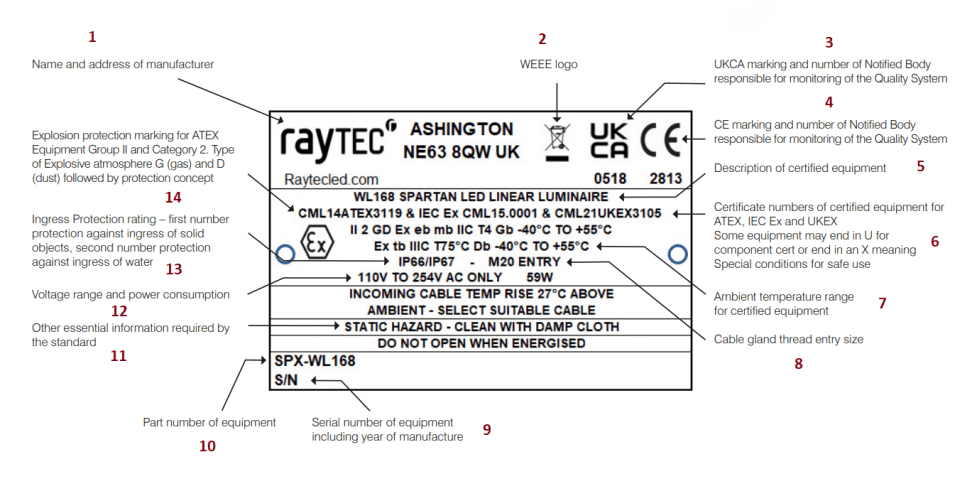
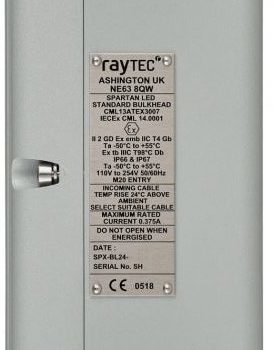
Namplates for hazardous area lighting provide valuable information about the ex luminaire. It allows you to identify the manufacturer, the areas in which it’s safe to be used, as well as information about the luminaire’s specification, such as input voltage, ingress protection rating and much more.
For installers and end-users, this information is critical to ensuring the luminaire is installed correctly and safety on-site is maintained.
For a manufacturer, such as Raytec, developing products specifically for hazardous locations, nameplates are a necessity to showcase the latest and appropriate certification standards. It is important that manufacturers keep their nameplates up to date with the correct information.
If not, unclear markings can lead to incorrect equipment being purchased and installed on-site. This can be detrimental to the safety of the individuals located there.
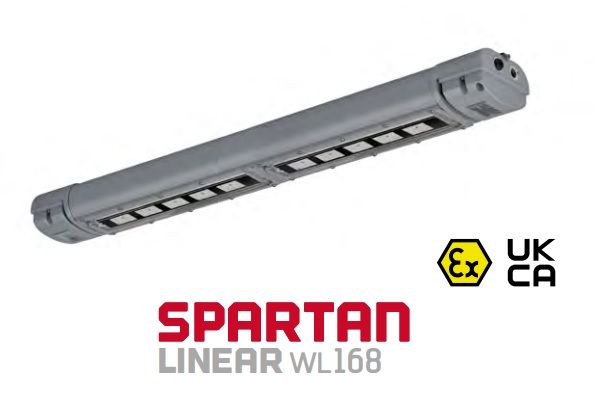
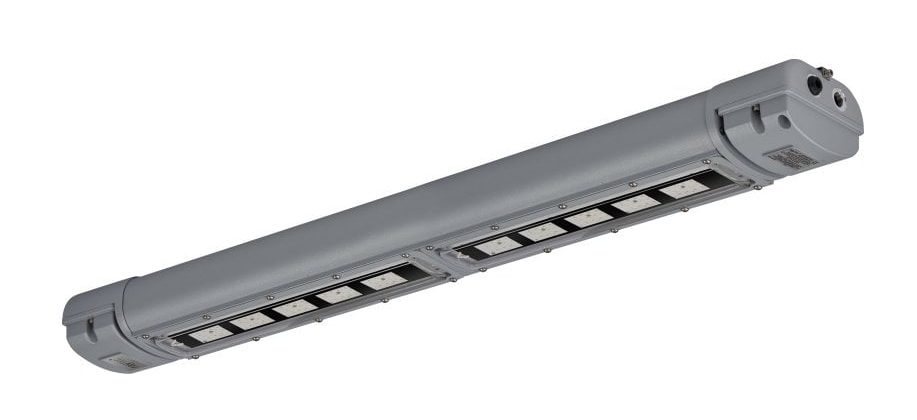
To understand the different information a nameplate tells us, we’ll look at an example of the nameplate that would be fitted to Raytec’s SPARTAN WL168 Linear luminaire. The look and layout of a nameplate will vary between the manufacturer, however, this is a typical example of the markings you should expect to see from on a luminaire that has been certified for use in a hazardous area.
1– The name and address of the manufacturer, as well as the web address of the manufacturers’ website.
2 – WEEE logo – this symbol indicates that the product should not be discarded as unsorted waste but must be sent to separate collection facilities for recovery and recycling. The WEEE marking must appear on any electrical and electronic equipment placed on the EU market.
3, 4 & 14– Certification symbols – showing that this product is certified to ATEX, IEC EX and UKCA standards. Raytec use a tri-rated nameplate on luminaires which means there will be three certificate numbers included on a product label – ATEX, IEC EX and UKCA. Showcasing each of these certification markings on each Raytec nameplate means the same luminaire can be used worldwide.
5 – Description of certified equipment.
6 – Certificate numbers of certified equipment for ATEX, IEC Ex and UKEX (all certificates should be accessible via the manufacturers website). Look out here an ‘X’ at the end of the certificate. If this is it means the products have a condition for safe use which the end-user must follow.
7– Luminaire operating temperature – showing the minimum and maximum temperature.
8– Cable gland thread entry size.
9 – Serial number of the equipment.
10 – Equipment part number.
11 – Other essential information required by the standard, such as cleaning procedure.
12– Voltage range and consumption.
13 – Ingress protection rating.
Raytec Spartan Linear SPX-WL168 Zone 1 Hazardous Area 6,130 Lumens
Ex Lighting Nameplate Material
The nameplate is arguably the most critical component of a hazardous area product. It is important the information and markings on the nameplate remain legible for the lifetime of the product. The manufacturer should therefore give careful consideration to the materials from which the nameplate is designed. Let’s touch on this briefly.
Whilst all manufacturers must keep their nameplates up to date, many produce them using materials that are unable to withstand the harsh environments to which they are exposed. Most commonly, nameplates found on Ex lighting consist of a printed, self-adhesive, polyester label.
While these self-adhesive nameplates are adequate for many indoor applications, Ex environments are often harsh and demanding, with exposure to extremes in temperatures, humidity, and corrosive atmospheres.
These conditions could lead to the information on a label being weathered or erased, to the point where it cannot be read. Or worse, it could even cause the label itself to detach from the product, leaving the luminaire unmarked and untraceable.
A more robust method is to use metal nameplates where the information is engraved, ensuring it remains legible throughout the Ex lighting’s lifetime. At Raytec, we utilise this method, where all our SPARTAN Ex lighting are fitted with a laser-engraved, stainless steel certification nameplate which is riveted to the luminaire so it cannot become detached. This allows our nameplates to withstand the harshest of environments.
Raytec Emergency Hazardous Area Lighting
💡 Did you Know? Thorne & Derrick using latest software provide a FREE LIGHTING DESIGN SERVICE for the specification and supply of ATEX & IECEx Certified light fittings to provide safe and reliable lighting in explosive atmospheres and hazardous area locations.
Industry leading manufacturers of Lighting Products for hazardous areas | Raytec
SPARTAN is a full range of Ex LED luminaires and lighting approved for all ATEX and IEC Ex Zone 1 and Zone 2 hazardous area environments, including UL /CSA C1D2 installations. The hazardous area lighting products are designed for the most extreme environments – Flood, Linear, Bulkhead, Bay and Crane luminaires with emergency and industrial lighting versions are also available from Thorne & Derrick International.
Specialists to the Process & Hazardous Area Industries
EXPERTS IN EQUIPMENT FOR EXPLOSIVE ATMOSPHERES
leaders in ATEX Innovation To The Hazardous Area Industries
Thorne & Derrick are leaders in the development and distribution of Product Innovations that deliver significant improvements to clients plant, people and operational safety in the explosive atmosphere industries.
Your proactive problem solvers experienced in succession planning for the replacement of obsolete, non-conformant and legacy equipment in hazardous areas.
Your first-choice provider of innovative and competitive solutions to ensure ATEX & IECEx Compliance for Hazardous Area Electrical, HVAC & Process Instrumentation Equipmentto UK and international projects.
Wednesday 20 October 2021 9am-4pm The Grand Marquee, Wynyard Hall TS22 5SH
Thorne & Derrick are pleased to announce that once again we will be exhibiting at the Nepic Meet The Members Conference & Exhibition. Now in its 11th year, and attracting more than 600 delegates, NEPIC’s annual Meet the Members conference & exhibition is a stand out event for the region!
Packed with investment project updates and networking, Meet the Members is attended by investors, manufacturers and suppliers from across North East England’s chemical-processing sector.
Thorne & Derrick will be showcasing a range of different products and equipment suitable for the chemical-processing industry at the exhibition including:
Through Meet the Members Conference Nepic outline the investment projects that lie ahead for the region, and the potential opportunities they present for your business, plus you’ll hear from inspirational speakers and businesses showcasing growth success stories.
Meet the Members Expo provides networking in an abundance. You’ll browse the 100 exhibition stands, mingle with industry colleagues and engage in peer-to-peer learning via one-2-one mentoring appointments.
Day delegate passes start from just £59, or you can promote your business further by booking a stand from £400. To find out more and secure your tickets today – https://www.eventstop.co.uk/event/4239/mtm2021#/
NEPIC is a not-for-profit organisation that supports the needs and interests of the chemical-processing sector in the North East of England. Essentially, we exist to ensure industry in this region thrives – and that we have investments, innovations and a network that will create jobs and opportunities long into the future.
By working closely with member companies, we forge meaningful business relationships that allow us to identify opportunities, facilitate connections, promote collaboration and enable growth. We also actively work beyond our traditional stakeholder base with universities, research institutes and public bodies to leverage additional value for the sector.
EXHEAT Fan Heaters | Distributed from Stock | International Delivery | Competitive Prices | Contact Us Today
by Terry McDonald | Product Specialist | Electrical Heating & Explosive Atmospheres
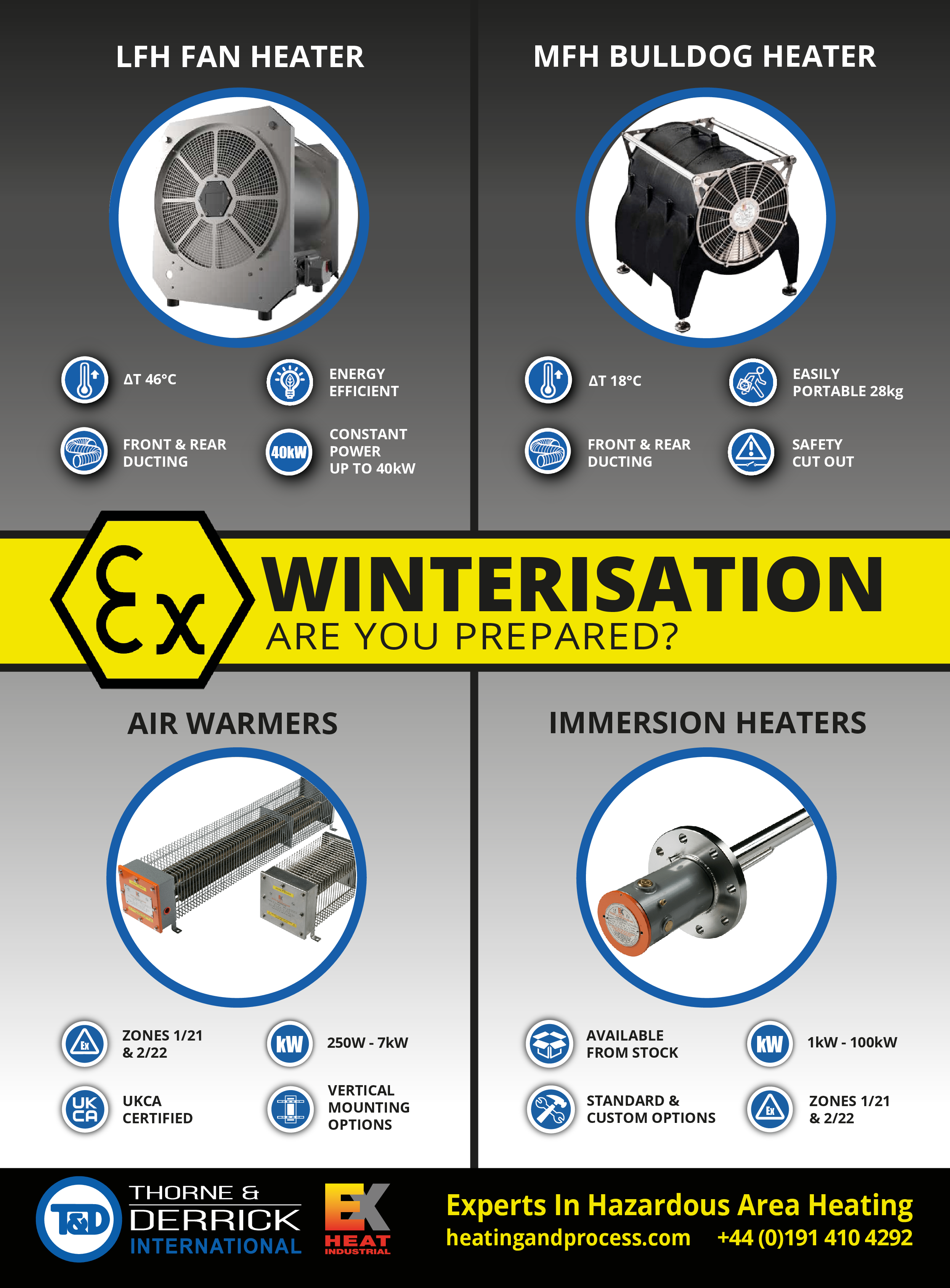
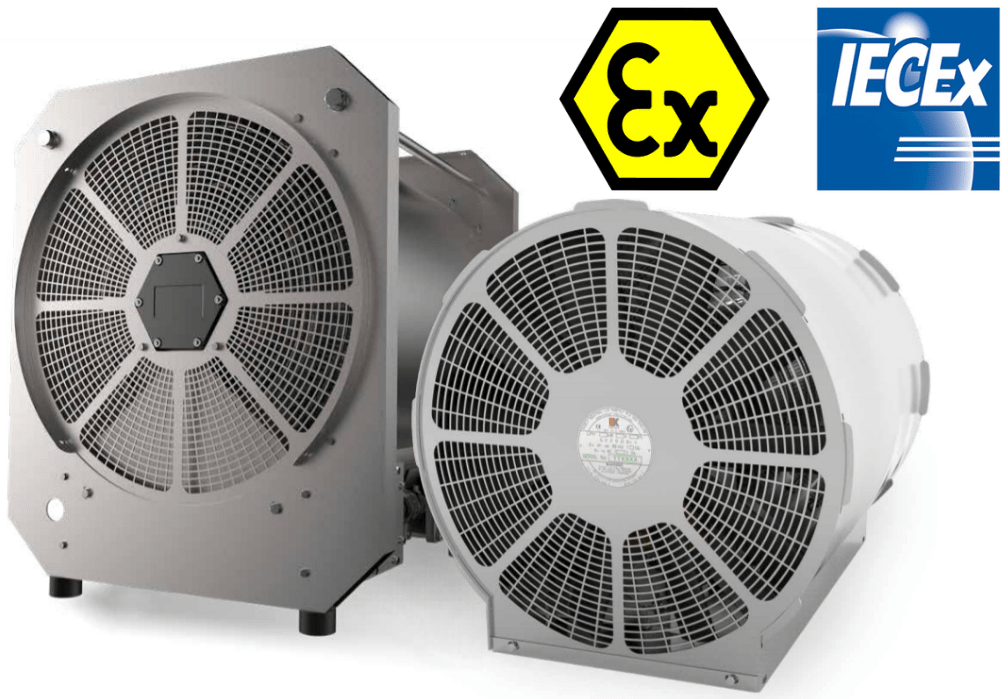
The EXHEAT LFH Heater, Distributed Exclusively by Thorne & Derrick, combines superior heating efficiencywith simple user functionality to provide the next-generation solution for heating hazardous areas where the atmosphere is classified as Zone 1/2 (IIB FlammableGas) or Zone 21/22 (IIIC CombustibleDust).
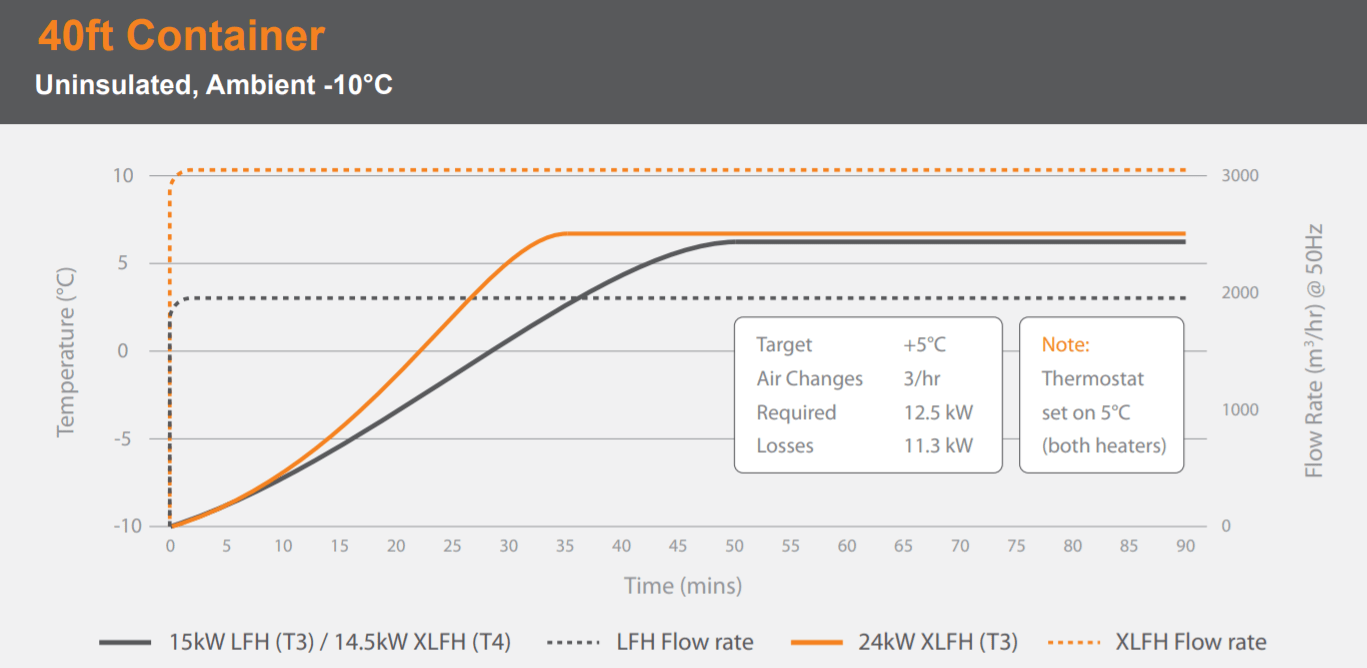
Dual certified according to ATEX & IECEX, the LFH withstands extreme onshore and offshore conditions (-40°C… +40°C) offering robust, reliable and powerful fixed or temporaryheating (up to 40kW output – 3600m³/hour air flow) with T3 and T4 temperature classes.
The corrosion and chemical resistant marine grade stainless steel casing provides durabilityand ductability of the heater permits localised and directed heat flow – LFH electrical fan heaters provide comfort, space and accelerated process heating in the explosive atmosphere industries.
With multiple mounting options for floors, walls and ceilings the versatile heater is supplied ready to ‘plug and play’, with the option of fitting a plug, or hard wiring to an isolator unit.
➡ Should you require a product demonstration (in-person or virtual) or further information please contact us – for further details refer to the IOM Manual or Brochure.
Ex Stock Availability, Contact us for Quotation
Temporary Heating Solution for Explosive Atmospheres
The EXHEAT LFH can also be manufactured and supplied as a temporary heating solution with options for anti-static castors, lifting handles, built in isolator and controls if required. This version can also be ducted front and rear to provide a versatile heating option for hazardous area locations.
lfh Fan Heaters
Applications
High Performance Space Heaters | the patented heating element provides market-leading energy efficiency compared to conventional competitor fan heaters that utilise heat exchangers. Ask about Air ΔT (°C/°F) for the fixed and temporary version of the fan heaters.
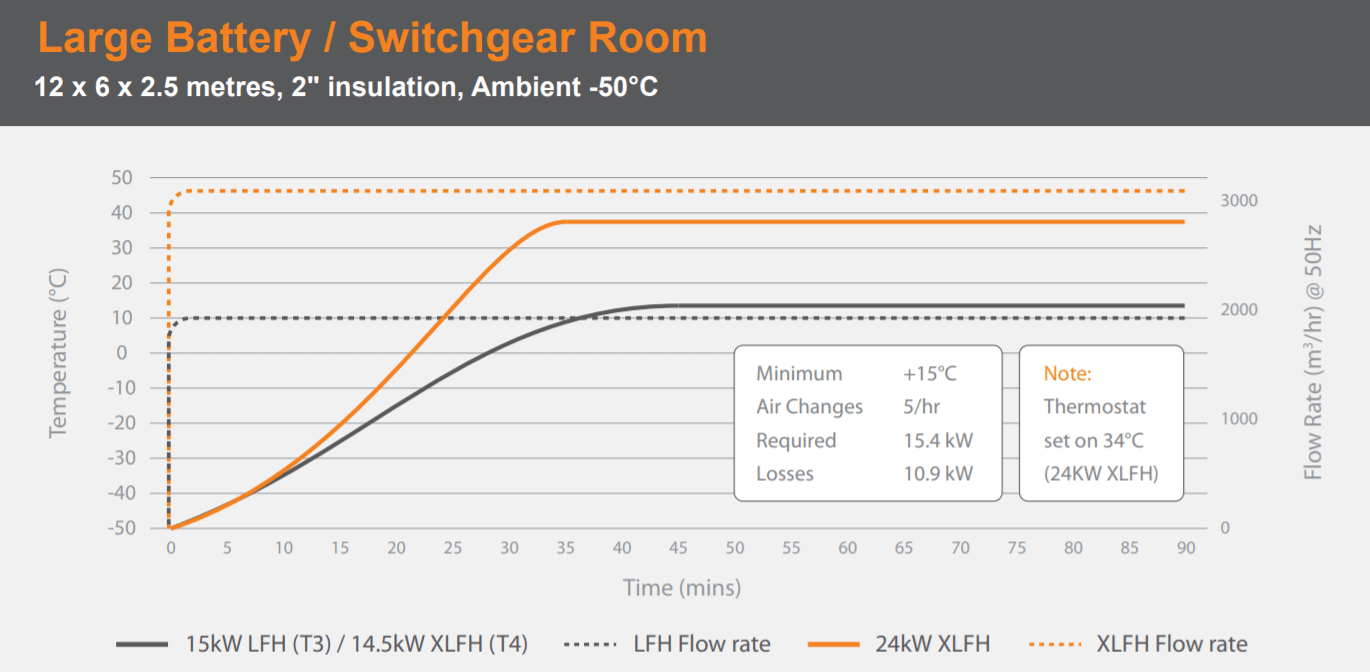
Heating High Voltage Substations & Hard-to-reach Locations | with optional long flying lead to direct heat to the target spot, the heaters provide reliable air warming for battery room sections of MV HV substations. Safe to use in locations where lead-acid type batteries release potentially explosive hydrogen gas when charging.
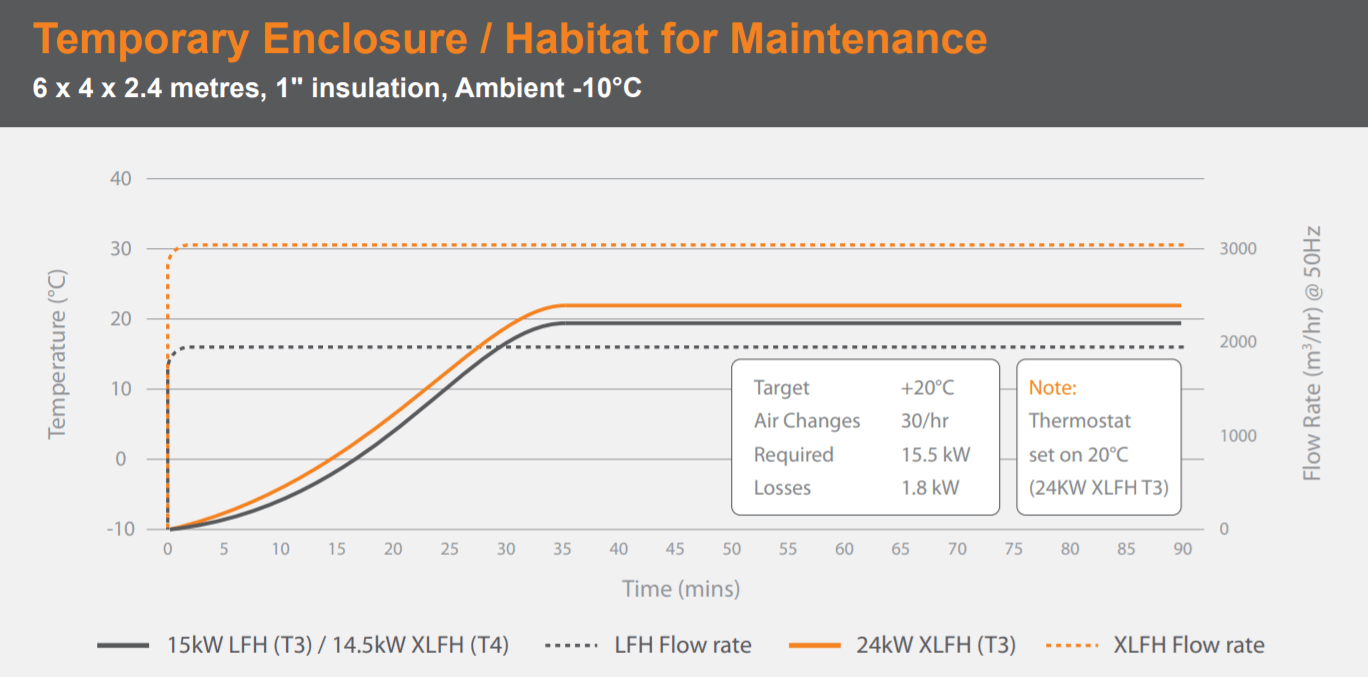
Supreme Air Flow |market-leading air flow capability ensures safe pressurising and heating of habitats for onsite onshore or offshore repair works.
Aircraft Servicing Hangars
Frost Protection & Winterisation
Oil & Petroleum Refineries
Marine & Shipping
Comfort & Space Heating
Skids & Offshore Containers
Paint Rooms
Spray Booths
Curing | Drying Paints & Resins
Oil & Gas Drilling Platforms
Pipe Wrapping & Composite Repairs
Utilities, Substations & Battery Rooms
Certified
ATEX
II 2 G D Ex h
Ex db eb IIB T3…T4 Gb
Ex tb IIIC T200°C…T135°C Db
IECEx
Ex db eb h IIB T3…T4 Gb
Ex tb IIIC T200°C…T135°C Db
CU TR (EAC)
1Ex db e IIB T4…T3 Gb X
Ex tb IIIC T135°C…T200°C Db X
In 2016, 2 new standards were issued to replace the now withdrawn BS EN 13463 range of standards that are to protect non-electrical equipment for use in potentially explosive atmospheres. Adding to the EN IEC 80079 range of standards, BS EN ISO 80079-36:2016 and BS EN ISO 80079-37:2016 were published.
Products protected by constructional safety, control of an ignition source and liquid immersion have their ATEX markings suffixed by the letters ‘c’, ‘b’ and ‘k’ respectively.
The new standards have compressed these three concepts into a single explosion protection concept and allow the new Ex h marking to be used. By including a fan in the design, the ATEX requirements in BS EN 14986:2017 were triggered, which calls on the requirement for constructional safety markings.
The LFH fan heater ranges are marked with the Ex h markings, and have undergone additional testing over and above the standard electrical and mechanical requirements of the BS EN IEC 60079 range of standards in order to confirm compliance.
Specification
Materials
Casing: Stainless Steel
Impeller: PA66
Element: Finned Stainless Steel Tubular Elements
Ex e Enclosure: Stainless Steel
Ex d Enclosure: Anodised Extruded Aluminium
LFH | Temporary & Powerful – the compact space-saving design delivers powerful warm air flows up to 40kW.
Whether distilling whisky or refining oil we can help put heat back into your process. Whatever the weather, wherever the Zone | Winterisation
Tank Heating BY ELTHERM
Frost Protection For Industrial & Hazardous Areas Available From Stock At T&D
Electrical trace heating for tank containers provides a safe, sophisticated and reliable alternative to heating with glycol or steam. Whether for storage or transport, whether water tank, oil tank or tank container for chemicals, highly viscous or natural substances: an electrical trace or tank heating system ensures that substances of all kinds.
Sensitive chemicals such as MDI and petrochemical industrial substances to oil, grease, resin and paint to bitumen, adhesives and even foodstuffs can be stored, preserved or transported at the right temperature without heat loss.
If you want to claim the highest quality, you have to be able to guarantee that even complex liquids reach their destination undamaged and remain intact there. The best thing to do is to heat up the tank before it is filled.
Design and temperature regulation of a tank heater
Regardless of application, the tank heaters that a made from robust stainless steel with IP68 certification protect the tank’s contents against dust, foreign material, as well as dripping, spraying, jetting and salt water. Inside, a limited temperature controller ensures effective heat distribution and ideal heating levels. Redundant routing of the heating cables ensures safe and loss-free transport without cold zones even if one heating cable per heating circuit is damaged.
Technical Advantages
Electrical controllers with a hysteresis of + / – 1 °C
Repair of PTFE-insulated heat cables always and everywhere
Monitoring and storage of temperature data at any time
Tank container heating for hazardous areas with ATEX approval
Low weight for minimal loss of vehicle payload and low additional fuel consumption
Movable cables with very tight bending radius
Operational capability of the entire fleet
Exact temperature maintenance during loading and unloading
Control and design
differences depending on the type of tank
Temperature-sensitive chemicals are being used more and more frequently in the automotive industry, in mechanical engineering and in plant engineering. Therefore it is even more important to transport these chemicals safely.
This is predominantly done using tank containers, SWAP containers, road tanks and IBCs(intermediate bulk containers). Highly sensitive chemicals in particular are subject to stringent requirements for safe transport, which necessitate differences in design and control depending on the type of tank.
Electrical Heating for MDI Tank Containers
The transport of MDI (methylene diphenyl diisocyanate) requires a temperature of 43 °C, which may deviate by a maximum of + / – 1 K in the product. For worldwide transports, the voltage supply range must also be between 380 and 440 V, which makes additional protection against voltage peaks crucial with regards to the control system – especially when the supply is provided by the on-board network of a container ship or a ferry.
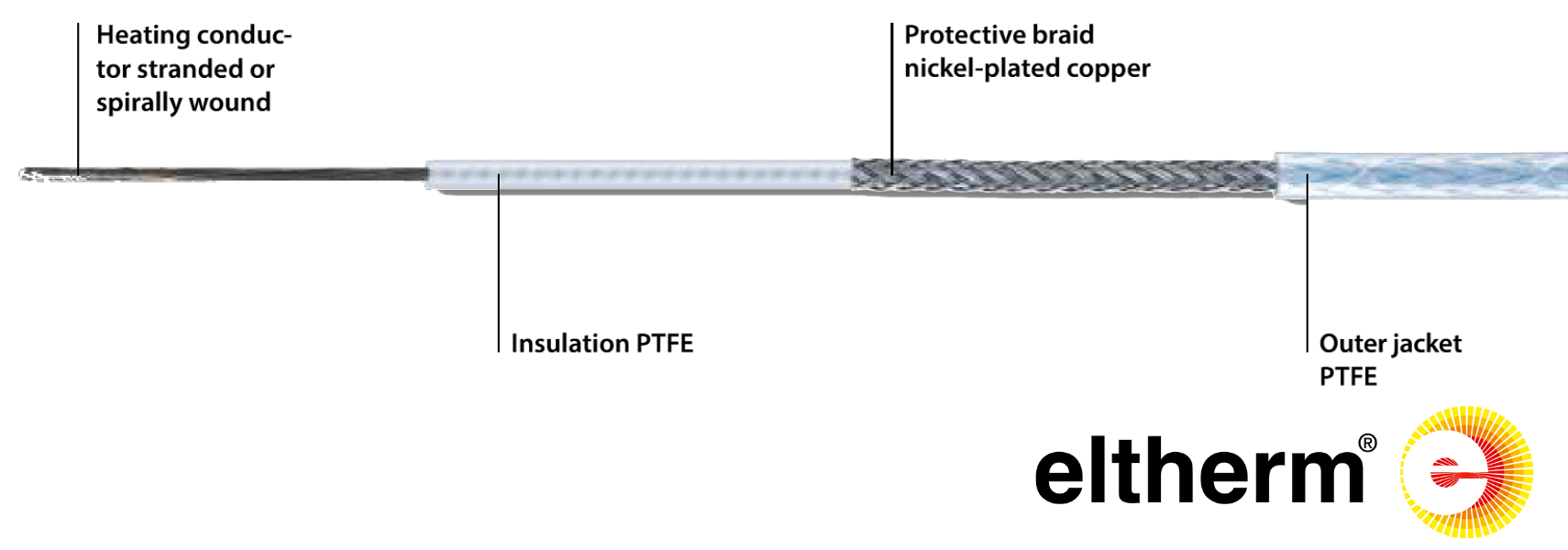
To meet all these requirements, eltherm offers a suitable of electrical heating solution in the form of a fluoropolymer-insulated ELKM-AG-L heating cable. In addition to the choice of heating cable, the method of laying the cable and its fastening is also important.
Uniform heating of the entire container surface
Recording of the product and heating cable temperature for each heating circuit
Vibration-resistant components in stainless steel housing
Separate heating options for dome boxes and riser pipes
Eltherm ELKM-AG-L Heater Cable – Resistance Heating Process Temperature Maintenance
Electrical heating of high temperature tank containers
For the transport of highly viscous materials from the chemical and petrochemical industry, suitable transport containers are required that can be used globally. Electrically heated 20′ Iso tank containers, SWAP containers and road tankers are ideally suited for this purpose. Special demands are made on the electrical heating system. High heating capacities with the lowest possible heat losses, brief heating of the empty tanks before filling, and resistance of the heating system to filling temperatures of up to 260 °C are all required.
Since these tank containers are generally operated without generators, an appropriate power reserve must be installed to be able to heat up the entire tank contents over several hours if necessary.
Technical Advantages
Power ratings up to 18 kW
Supply voltages between 380V & 440V
Maintain temperatures up to 210 °C
Specially manufactured tank container heating cables
Uniform heating of the tank surface
Multilayer insulation for efficient energy management
Continued use of the heater without cold zones even in case of damage
Operating hours counter for documentation of energy
Electrical heating of chocolate containers
After mixing the raw materials necessary for the production of chocolate, they are conched. After conching (heating up to 90 °C with constant stirring), the chocolate is still unsuitable for actual consumption. Due to the increasing globalisation of the leading confectionery manufacturers, it is becoming more and more necessary to transport basic products such as fats, oils and cocoa butter as well as finished products, such as chocolate mass, between the individual production sites for further processing without any loss of quality.
For large quantities of chocolate, transport in liquid form is most economical way to move the product. To ensure that the chocolate does not lose its flavour properties or harden en route, the containers must be heated. Worldwide standardised means of transport such as 20′ iso tank containers, SWAP containers, road tankers as well as IBCs are used.
Technical Advantages
Uniform heating by a fluoropolymer-insulated heating cable
Compensation of heat losses
Uninterruptible power supply
Complete documentation of temperatures
Installation of the tank heating
Besides engineering, design and calculation, installation is part of eltherm’s superior range of services. In order to mount the respective tank heaters on the tank surface, a large opening is required for insertion, depending on the heating conductor.
In order to ensure uniform heating of the entire stainless steel tank, up to two-thirds of the tank surface is covered with the heater and taped with self-adhesive aluminium tape or high-temperature aluminium foil. The standard length of the supply line is 16 m. Other lengths are available on request. The capacity and maintain temperature depend on the tank specification as well as on the medium being transported.
Thorne & Derrick specialise in providing specialist heating for industrial and hazardous areas including Eltherm’s heat tracing cablesand heated hoses.
Press Release Date: 02.04.2020 uploaded by Chris Dodds (T&D Sales + Marketing Manager) World’s First Fully Certified ATEX Doors Thorne & Derrick International, the Experts in Equipment for Explosive Atmospheres, today announce the signing of a Commercial Distribution Agreement...
Press Release Date: 04.07.2019 uploaded by Chris Dodds (T&D Sales + Marketing Manager) Category: Stockist Distributor Agreement Announcement Thorne & Derrick International announce that they have signed a Preferred Distributor Agreement with Raytec, the world leading manufacturer of LED...













 An Introduction to Maintaining an Ex Luminaire








 II 2 G D Ex h