uploaded by Chris Dodds - Thorne & Derrick Sales & Marketing Manager
Hazardous Area Motor Starter
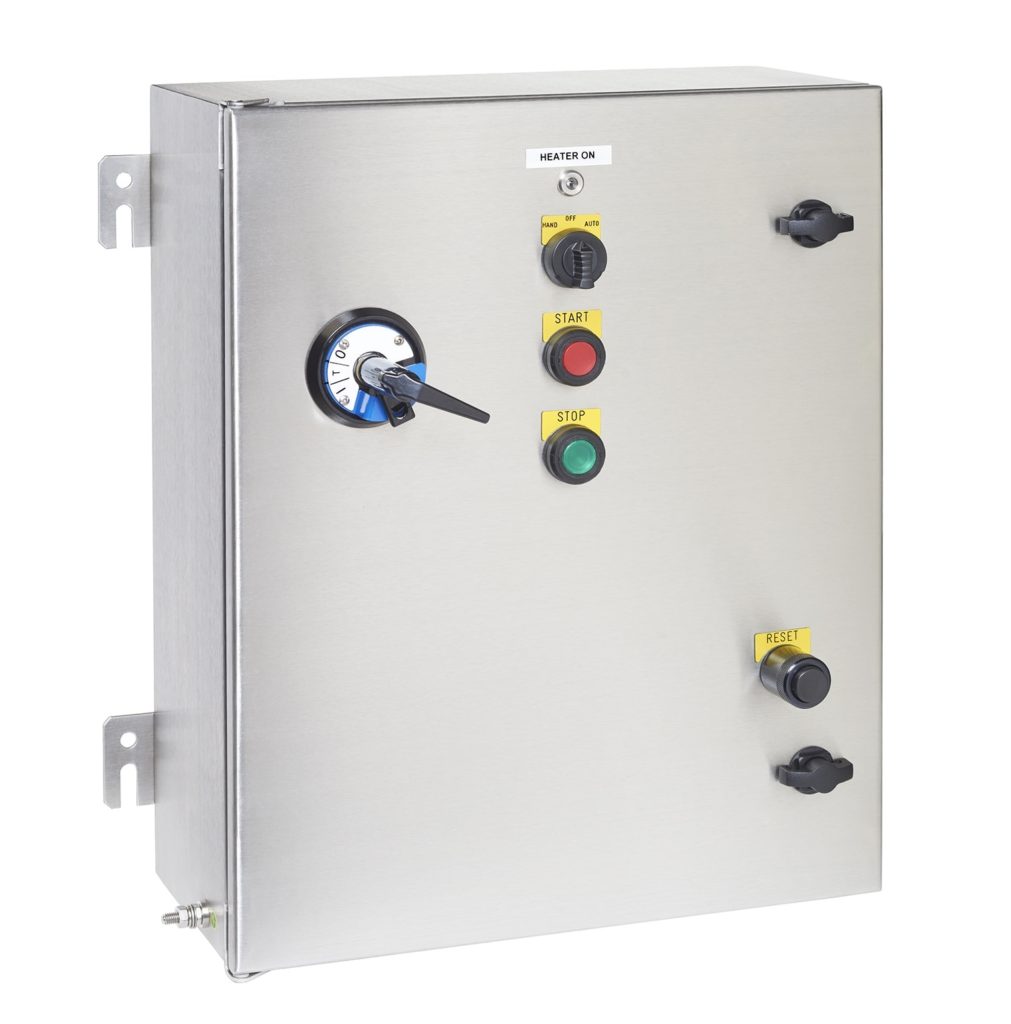
Appleton PlexPower Motor Starter
Class I, Division 2 or Class I, Zone 1 Hazardous Areas
Appleton PlexPower is designed for hazardous areas, wet or corrosive locations such as oil refineries and chemical plants, the Appleton PlexPower hazardous area motor starter provides electrical apparatus protection combined with the convenience and savings of off-the-shelf components.
Appleton PlexPower motor starter is a cost-effective, easy-to-install and simple-to-operate alternative to traditional cast and bolted motor starters in the form of its new Appleton PlexPower solution for hazardous area applications.
Appleton PlexPower motor starters deliver savings up to 73% compared to the total cost of ownership of traditional cast and bolted motor starters – they are fabricated from lightweight 316L stainless steel instead of heavy-cast aluminum, PlexPower motor starters require fewer engineers and less labour hours to install. Also, there is no need for conduit seals or cable glands like with traditional cast and bolted motor starters.
Another advantage is the hazardous area certified motor starters are not limited only to switch rack mounting. For example, by locating the PlexPower closer to motors and equipment, electricians can shorten cable runs to achieve lower overall labour and materials costs. Modular design construction using cost effective off-the-shelf breakers, contractors and motor starters also ensures faster commissioning by making replacements readily available from multiple suppliers.
Hazardous Area Motor Starter – Appleton PlexPower
Appleton PlexPower
Hazardous Area Motor Starter
Features & Benefits
Full voltage, combination and non-combination, single and multiple motor starter
These motor starters provide disconnecting means, circuit protection, and motor running protection
Ideal for use in areas where hazardous materials are handled or stored such as petroleum plants, chemical plants, refineries, wastewater treatment plants, paper and pulp industries, and other process facilities
Ideal for placement in wet, corrosive environments or where flammable gases or vapors are likely to be present
No external conduit or cable seals required thus making installations faster, easier, and less costly
Feature a ground-breaking design that uses individual breaker, contactor and motor starter housings to minimize the downtime and costs associated with maintenance in hazardous locations
Accommodate non-proprietary off-the-shelf breakers, contactors and motor starters, making replacements readily available from multiple sources
The lighter weight contactor and motor starter enclosure with quarter turn latches, can be quickly opened in the field for easier servicing
Gland plate at the bottom of enclosure can be easily field punched for cable or conduit entries. Additional gland plates available for sides and top can be ordered with the panelboard
Standard configuration includes external actuation and a solid door
For multiple contactor or motor starter panels, each contactor or motor starter can be individually padlocked in either the “On” or “Off” position
Ground and/or neutral bars, external/internal ground lug and drain/breather provided as standard
“The Appleton PlexPower delivers on Emerson’s enduring commitment to the electrical professional with a patented design that saves time and money, while giving electricians working in hazardous locations much needed peace of mind,” said Tim Graff, Vice President of Engineering for Emerson Automation Solutions. “Because it is easier to install, operate, upgrade and maintain, it is the perfect alternative to traditional cast motor starters.”
Motor Starters
Appleton PlexPower motor starters offer fast installation by increasing mounting flexibility with a slimmer footprint and flexible, modular design. They can be configured in single or multiple motor starter designs to reduce space requirements in crowded control rooms while meeting exact specifications. In addition, the starters can be mounted standalone at various locations throughout a facility, giving additional convenience while saving valuable space and cabling costs.
Accessibility to enclosures is one of the biggest challenges for end users installing, operating, and maintaining hazardous area motor starters. To access internal components in traditional cast and bolted enclosures, up to 70 bolts must be loosened and then tightened again, leading to extended production downtime and potentially greater risk to arc flash accidents. Plus, improperly torqued or missing bolts can be dangerous and cause accidents or safety risks.
To combat this time-consuming and potentially dangerous situation, the PlexPower is designed for easier accessibility to be quickly opened with a few quarter-turn latches rather than multiple bolts. Only standard tools are needed to open and close the enclosure, which means production lines can be up and running in less time and greater profitability.
The Appleton PlexPower Motor Starter modular design improves worker safety by limiting workers’ exposure to high levels of incident energy when installed close to the application. Component level protection means every component has its own module with its own flame path. The result is fewer workplace accidents, a diminished risk of damaging the flame path, and greater flexibility and convenience for the end-user.
Appleton PlexPower Motor Starters are available with up to a NEMA 1 size starter and have NEC and CEC Certification for Class I, Division 2 or Class I, Zone 1 and Type 4X hazardous area applications.
Hazardous area Specifications
NEC and CEC Certifications and Compliances – Ex de IIB+H2 T6; Class I, Zone 1, AEx de IIB+H2 T6; Class I, Division 2, Groups B, C, D; Class II, Division 2, Groups F, G; Class III; Type 4X; IP66
Standard Materials and Finishes – 316L stainless steel enclosure with stainless steel hardware and hard drawn, tin plated, copper bus bar
Options – Class I, Division 2, Zone 2 equivalency only, gland plate, thermostatically controlled heater, inverted feed, lockable wing knobs, name/legend plate, and terminal blocks are available.
Junction Boxes | Zone 1 & Zone 2 Hazardous Area Junction Boxes EX ATEX Certified
Control Stations | Zone 1 & Zone 2 Hazardous Area Control Stations EX ATEX Certified
ELECTRICAL & PROCESS INSTRUMENTATION EQUIPMENT
FOR EXPLOSIVE ATMOSPHERES
Thorne & Derrick International, based in the UK, are Specialist Distributors of Hazardous Area & Explosion Proof Equipment with IECEx & ATEX Certifications to the onshore and offshore oil, gas, petrochemicals and process industries.
uploaded by Chris Dodds - Thorne & Derrick Sales Marketing Manager
Hazardous Area LED Lighting
Explosion Proof Lighting – Appleton Contender
Class I, Division 2 and Class I, Zone 2, Class II, Division 1 and 2, Zone 21 and 22, and Class III
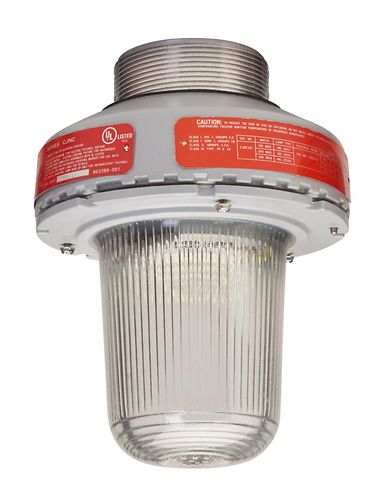
Appleton Contender LED, an extra low-profile enclosed and gasketed LED explosion proof lighting that brings energy and maintenance savings of up to 65 percent to challenging low clearance areas, such as walkways, catwalks, stairwells and tunnels in explosive atmospheres.
Designed specifically for hazardous area retrofit lighting applications, this cost-effective light fitting mounts directly to the hood of a competitor’s High-Intensity Discharge (HID) hazardous area lighting without an adapter, saving time and labour costs.
“Until recently, HID has been the primary light source for hazardous area locations. LED is now the go-to choice for retrofitting the installed base of tens of thousands of HID luminaries,” said Michael McCormack, Director of Product Marketing, Emerson Automation Solutions. “To meet this growing market demand, the Appleton Contender LED was designed to directly retrofit to one of our competitor’s most popular HID models. Additionally, it is certified with Appleton Mercmaster LED Low Profile globes and many of its accessories including the visor, angled reflector, globe guards and safety cable.”
💡 Did you Know? Thorne & Derrick using latest software provide a FREE LIGHTING DESIGN SERVICE for the specification and supply of ATEX & IECEx Certified light fittings to provide safe and reliable lighting in explosive atmospheres and hazardous area locations.
LED Lighting Fittings
Oil and gas facilities, chemical processors and other hazardous area place critical demands on luminaries, especially when it comes to extreme temperature ranges and long service lives. The Appleton Contender LED provides rated illumination through its full ambient operating temperature range of -40° F to +149° F to make sure facilities are safely lit in arctic cold or when the going gets hot. In addition, it features a rated L70 lifetime of 100,000+ hours — the equivalent of more than 11 years — adding value while minimising maintenance requirements.
To withstand particularly harsh areas the light fitting construction includes:
a proprietary epoxy powder coat finish for unmatched corrosion resistance
a rugged IP68 watertight hub to ensure water in the conduit is kept out of the luminaire, heavy industrial-grade gaskets
high vibration and shock resistance
plus a robust 6KV surge suppression circuit to protect against damaging transients
Appleton Contender
LED Hazardous Area Lighting
Features & Benefits
Enclosed and gasketed fixtures suitable for use in a wide range of industrial, chemical processing and other areas where flammable gases, vapors and combustible dusts and fibers are present including simultaneous exposure
Ideal for use in areas of low clearance, low ceiling heights or where fixture weights must be minimized
Typical industries include pulp and paper mills, processing plants, chemical plants, petrochemical facilities, oil refineries, drilling rigs, foundries, waste treatment, mining and steel mills
Typical explosion proof lighting applications include walkways/catwalks, stairwells, grain elevators, tunnels, pipe racks, offshore rigs, vessel lighting, cooling towers and processing areas
Compact light weight low profile design is suited for low mounting heights (less than 12 lbs)
Customize to the application requirements with four different field replaceable globe options: clear and diffused polycarbonate, clear glass, or prismatic glass refractor
Three Correlated Color Temperatures (CCTs) for a wide variety of applications: Cool (5000K), Neutral (4000K) and Warm (3000K)
Three light output levels for retrofit of HID fixtures up to 175 W
Standard 6 kV surge protection
Luminaire comes pre-wired with three conductors, approximately 12″ long, of 14 AWG TEW wire from the IP68 watertight NPT hub at the top of the luminaire lid.
With three lumen output options and four interchangeable and field replaceable globes options – clear and diffused polycarbonate, clear glass or prismatic glass refractor – this luminaire light fitting delivers the lighting equivalent of 70W to 175W HID luminaires to provide a fully customized solution.
To ensure safe operation in hazardous areas where flammable gases or vapors may be present, the Appleton Contender LED is engineered to meet or exceed industry standards to assure workers in places such as offshore rigs, petrochemical and chemical processing plants, water treatment plants, and grain elevators can work productively and comfortably.
The hazardous area LED light fitting is NEC/CEC certified for hazardous locations rated Class I, Division 2 and Class I, Zone 2, Class II, Division 1 and 2, Zone 21 and 22, and Class III, as well as NEMA Type 3R, 4 and 4X wet locations and is IP 66/67 and ABS certified.
Light Fitting Specifications
NEC/CEC Certifications and Compliances – Class I, Division 2, Groups A, B, C, D; Class I, Zone 2, Group IIC; Class II, Division 1, Groups E, F, G; Zone 21, 22, Group IIIC; Class II, Division 2, Groups F, G; Class III; Type 3R, 4, 4X; IP66/67; Simultaneous Exposure; Suitable for Wet Locations; M
Lumens to Watts – 3300 lumens is 70-100 W HID, 4400 lumens is 100-150 W HID, 5500 lumens 150-175 W HID
Ambient Temperature – BU: -40 °C to +65 °C (-40 °F to +149 °F); BH: -40 °C up to +65 °C (-40 °F up to +149 °F)
Standard Materials – Cast copperfree (4/10 of 1% max.) aluminum luminaire body with stainless steel hardware. Polycarbonate or glass globe with stainless steel wire guard. Heat-resistant prismatic glass refractor with die cast aluminum guard. Fiberglass reinforced white poly
Standard Finishes – Luminaire body and glass refractor guard have gray epoxy powder coat finish, electrostatically applied for complete uniform protection
Options – Glass globe and glass refractor guard available separately
Junction Boxes | Zone 1 & Zone 2 Hazardous Area Junction Boxes EX ATEX Certified
Control Stations | Zone 1 & Zone 2 Hazardous Area Control Stations EX ATEX Certified
ELECTRICAL & PROCESS INSTRUMENTATION EQUIPMENT
FOR EXPLOSIVE ATMOSPHERES
Thorne & Derrick International, based in the UK, are Specialist Distributors of Hazardous Area & Explosion Proof Equipment with IECEx & ATEX Certifications to the onshore and offshore oil, gas, petrochemicals and process industries.
uploaded by Chris Dodds - Thorne & Derrick Sales & Marketing Manager
Explosion proof Lighting
Appleton A-51 Lighting Fixture | LED Version
The field-proven Appleton A-51 hazardous area lighting fixture is now available in an LED version, a move that will save end-users as much as 80 percent on energy costs compared to the incandescent model, while simplifying retrofit applications for lighting installations in explosive atmospheres.
Appleton A-51 LED explosion proof light fitting is designed to provide the benefits of LED lighting in low mounting height applications previously served by incandescent luminaires.
Easy to install in new and retrofit applications, the light fitting fits in the same mounting hoods as traditional incandescent Appleton A-51 luminaires with no rewiring. Models are available for Group A, B, C and D areas (AAL) as well as strictly Group C and D areas (AL).
First introduced in 1951, the Appleton A-51 incandescent factory-seal luminaire has long been a standard for industrial and hazardous area lighting, providing safe illumination to workers in petrochemical processing, wastewater treatment centers, chemical plants and other areas classified as “hazardous” by the National Electrical Code where ignitable vapors, dust, moisture and corrosive environments may be present.
Because it uses the same mounting as the original A-51, the LED light fitting version transforms the traditional retrofit lighting process from an expensive, time-consuming task to simply removing the legacy incandescent fixture unit and replacing it with the new LED fixture unit. Appleton’s standardized threads fit all A-51 LED light fittings and fixtures and mounting hoods. In the rare event the A-51 LED requires maintenance, its “wireless” design allows the fixture unit to be threaded off the mounting hood for fast servicing or immediate exchange with a stand-by replacement.
“The new A-51 LED model brings the potential benefits of burning less energy, producing less heat, and requiring less maintenance to the thousands of A-51 incandescent fixtures currently in service,” said Christy Buttner, lighting product manager for Emerson Automation Solutions. “Best of all, there is no compromise in hazardous area lighting quality since the LED pattern and spread of light is very similar to the older incandescent version of the A-51.”
Appleton A-51 Lighting Fixture
Features & Benefits
Ideal for use in chemical and petrochemical plants, and in other heavy process areas where ignitable vapors, dust, moisture and corrosive atmospheres are present
Suitable for use in wet locations
Porcelain reflectors for multiple applications requiring light to be directed
Choice of pendant, ceiling, 25° stanchion, long bracket and 15° short bracket mountings
Fixtures are factory-sealed; no external sealing fittings required
Fixture units have standardized threads to fit all A-51™ mounting hoods. “”Wireless”” fixture unit easily threads off mounting hood for convenient servicing or for immediate exchange with “”stand-by”” unit
Globes in Appleton A-51 lighting fixtures are explosion proof and heat- and impact-resistant glass. Prismatic configuration on globe interior provides light control while allowing smooth exterior surface for cleaning. Fixture guards to protect globe are easily mounted to globe ring with 3 screws
Single sided and Three-Way Exit signs available
Light outputs up to 3,200 lumens
Ambient Temperature: -25 ºC to +55 ºC (-13 ºF to +131 ºF)
6 kV Surge Protection
Led Lighting for Hazardous Areas
Leveraging years of experience in designing and manufacturing LED fixtures for some of the harshest environments, Emerson is offering the new luminaries or light fittings in an output range of 1,600 to 3,200 lumens to replace incandescent lighting fixtures up to 300 watts. The light fittings deliver crisp, bright light with excellent colour rendering for optimal visibility. The LED lamp’s long lifespan of 50,000+ hours maximizes its value while lowering the cost of ownership, improving work environment safety and delivering shorter paybacks to the hazardous area industries.
To guard against corrosion and chemical abrasion the Appleton A-51 LED’s fixture unit, mounting hoods and guards are manufactured from copper-free, die-cast aluminum, and feature Appleton’s exclusive epoxy powder coat finish to assure long-term corrosion resistance. In addition, end-users can specify either porcelain reflectors for standard applications or fiberglass reinforced polyester reflectors for exceptionally severe corrosive atmospheres.
New Appleton A-51 LED luminaries are suitable for wet locations, and are compliant with NEC/CEC certifications for Class I, Division 1, Groups A, B, C, D; Class II, Division, Groups F, G; Class III, and Class I, Division 1, Groups C, D; Class II, Division 1, Groups E, F, G; Class III hazardous applications.
Lighting Specifications
NEC/CEC Certifications and Compliances for Group A and B – Class I, Division 1, Groups A, B, C, D; Class II, Division, Groups F, G; Class III
NEC/CEC Certifications and Compliances for Group C and D – Class I, Division 1, Groups C, D; Class II, Division 1, Groups E, F, G; Class III
Lumens to Watts – Up to 1700 lumens is 100 – 150 W incandescent, 3000 lumens and more for 200 – 300 W incandescent
Standard Materials & Finishes – Fixtures, guards and mounting hoods are copperfree (4/10 of 1% max.) aluminum with two-coat epoxy-clad finish. Ceiling and bracket mounting hoods are malleable iron with aluminum adapters
Surge Protection – 6 kV
Standard Materials and Finishes – Fixtures, guards and mounting hoods are copperfree (4/10 of 1% max.) aluminum with two-coat epoxy-clad finish. Ceiling and bracket mounting hoods are malleable iron with aluminum adapters
Junction Boxes | Zone 1 & Zone 2 Hazardous Area Junction Boxes EX ATEX Certified
Control Stations | Zone 1 & Zone 2 Hazardous Area Control Stations EX ATEX Certified
ELECTRICAL & PROCESS INSTRUMENTATION EQUIPMENT
FOR EXPLOSIVE ATMOSPHERES
Thorne & Derrick International, based in the UK, are Specialist Distributors of Hazardous Area & Explosion Proof Equipment with IECEx & ATEX Certifications to the onshore and offshore oil, gas, petrochemicals and process industries.
uploaded by Chris Dodds - Thorne & Derrick Sales Marketing Manager
Explosion Proof Lighting
Appleton Code Master Light Fittings
Appleton Code Master simplifies upgrading from legacy HID lighting to the more energy efficient LED (Light Emitting Diode) as the LED lighting for hazardous areas has familiar lighting patterns of traditional incandescent and HID (High Intensity Discharge) fixtures.
The new explosion proof lightingfitting is compatible with the legacy Appleton Code Master and therefore is easy to retrofit to the current lighting installation in less than five minutes.
💡 Did you Know? Thorne & Derrick using latest software provide a FREE LIGHTING DESIGN SERVICE for the specification and supply of ATEX & IECEx Certified light fittings to provide safe and reliable lighting in explosive atmospheres and hazardous area locations.
LED Lighting for Hazardous Areas
Up To 85% Savings
In addition, the light fitting delivers crisp white light for superior colour rendering and a safer working environment, while allowing facility managers to take full advantage of impressive LED cost savings of up to 85% in petrochemical and chemical processing plants, refineries, waste treatment centers and other hazardous zone locations – delivering 60,000 hours of labour-saving, virtually maintenance-free lighting operation adding value by lowering maintenance costs and requiring fewer stand-by units be kept in stock.
Its service life is four times as long as an HID so it eliminates the high cost of frequent lamp or ballast replacement for lighting systems in explosive atmospheres.
Appleton Code Master Light Fittings Hazardous Area Lighting Download
Code Master by Appleton
“The Code Master Jr. HID from Appleton has been a hazardous area industry standard for decades,” said Christy Buttner, lighting product manager for Emerson Automation Solutions. “The new Appleton Code Master Jr. LED light fitting provides the same durability and reliability as the original along with money-saving energy efficiency. Retrofitting an HID lighting fixture only calls for removing the older fixture and threading in the new LED version, a process that takes mere minutes to complete.”
The new and improved Appleton Code Master is an ideal hazardous area lighting solution for high energy cost areas due to faster and more cost effective installation. The only wiring required is attaching two wires to the connection block of the mounting hood. Acme double-lead threads speed installation and fixture removal from the mounting hood with only half as many turns required compared to single-lead threads.
Safe Lighting for Hazardous Area Zones
Appleton Code Master Jr. LED explosion proof lighting is designed to provide operation in the presence of ignitable gases, vapors or dusts, such as in wastewater treatment plants, petrochemical plants and oil refineries.
Meeting the National Electrical Manufacturers Association (NEMA) 3R and 4X performance criteria for enclosures, the new LED lighting fixtures are equally suitable for coastal locations and other wet environments that would damage standard lighting fixtures.
To fight corrosion caused by saltwater or chemicals, the lighting fittings and fixtures have a triple coat finish electrostatically applied for uniform protection.
The Appleton Code Master Jr. LED is available in models producing either 1600 or 3000 nominal lumens, which is the equivalent of 100W incandescent (50W HID) or 300W incandescent (70-100W HID), and in 5150 lumens (100-150 HID).
Junction Boxes | Zone 1 & Zone 2 Hazardous Area Junction Boxes EX ATEX Certified
Control Stations | Zone 1 & Zone 2 Hazardous Area Control Stations EX ATEX Certified
ELECTRICAL & PROCESS INSTRUMENTATION EQUIPMENT
FOR EXPLOSIVE ATMOSPHERES
Thorne & Derrick International, based in the UK, are Specialist Distributors of Hazardous Area & Explosion Proof Equipment with IECEx & ATEX Certifications to the onshore and offshore oil, gas, petrochemicals and process industries.
SIL3 or Safety Integrity Level (SIL) is based on the value of risk reduction associated with a Safety Instrumented Function (SIF) protecting against a specific hazardous event, or how the risk has to be reduced to reach an acceptable level.
The determination of a SIL is based on quantitative and qualitative factors such as:
development process
safety life cycle management
Read the following article about SIL 3 to learn more about Safety Integrity Levels, the need for SIL 3, its determination and implementation costs.
The implementation of Safety Instrumented Systems (SIS) is a common way to address hazards.
The eventual need for such instrumented protection must always be determined. If needed, the appropriate Safety Integrity Level (SIL) must be identified in order to achieve the required level of safety.
This process is crucial for achieving safety.
As we will see, SIL 3 is the appropriate level in rare and quite dangerous situations.
Safety Integrity Levels SIL3
The Safety Integrity Level (SIL) is based on the value of risk reduction associated with a Safety Instrumented Function (SIF) protecting against a specific hazardous event, or how the risk has to be reduced to reach an acceptable level.
Therefore it is a relative level of risk-reduction provided by a safety function, and, in other words, provides a measurement of the performance of a Safety Instrumented Function (SIF).
In IEC 61508 Standard, safety is defined as “freedom from unacceptable risk of harm”, while risk is the combination of the probability of occurrence of harm and the severity of that harm (R=FxC, where F is the Frequency of accidents and C is their Consequences, evaluated as a cost; therefore R is defined as cost per time unit).
Not all of the functional safety standards provide the same requirements for given SIL’s. IEC 61508 defines four SIL’s, with SIL 4 the most dependable and SIL 1 the least.
SIL is a measure of reliability and risk reduction used in several international standards;
ANSI/ISA S84 (Functional safety of safety instrumented systems for the process industry sector)
IEC 61508 (Functional safety of electrical/electronic/programmable electronic safety related systems)
EC 61511 (Safety instrumented systems for the process industry sector)
IEC 61513 (nuclear industry)
IEC 62061 (safety of machinery)
EN 50128 (railway applications – software for railway control and protection)
EN 50129 (railway applications – safety related electronic systems for signalling)
EN 50402 (fixed gas-detection systems)
ISO 26262 (automotive industry)
MISRA, various (guidelines for safety analysis, modelling, and programming in automotive applications)
Defence Standard 00-56 Issue 2 – accident consequence
The determination of a SIL is based on quantitative and qualitative factors such as development process and safety life cycle management. For example, the safety lifecycle includes a hazard and risk assessment phase, in which all significant hazardous events have to be identified and then subjected to an assessment to determine the level of risk reduction required from a safety instrumented function (SIF) to achieve a target level of risk.
The SIL expresses the required risk reduction or performance for the SIF. This assessment, called SIL determination, defines the required performance or “target SIL” for the SIF, and a target Average Probability of Failure on Demand (PFD), representing the maximum value allowed in the range of a target SIL.
The SIL determination methods commonly used are: Safety Layer Matrix (SLM); Risk Graphs (RG); Layer of Protection Analysis (LOPA); Fault Tree Analysis (FTA); and Event Tree Analysis (ETA), and they are normally used in combination, with LOPA being the most commonly used by large industrial facilities, SLM the simplest, FTA and ETA the most flexible and therefore suitable to complex cases.
SLM and RG are used for initial screening assessments. Because of its flexibility and orientation to details, FTA is especially suitable for the reassessment needed when a SIL 2, SIL 3 or SIL 4 level is determined.
Generally speaking, the assignment of a SIL is made as follows: the risk associated with a specific hazard is calculated without the risk reduction effect of the SIF. Then, the risk determined is compared to a risk target considered acceptable. The risk reduction of the SIF must address the difference between the unmitigated risk and the tolerable risk, with the SIL target corresponding in a correlation relationship to the required risk reduction, where the greater the reduction required, the higher the required SIL.
The International Electrotechnical Commission’s (IEC) standard IEC 61508 groups the requirements into the two categories of hardware safety integrity and systematic safety integrity. According to the standard the requirements for both categories must be met for a device to achieve a certain SIL. For hardware safety integrity, the requirements are statistical, with specific targets to reach, as the maximum probability of dangerous failure and the minimum safe failure fraction. In IEC EN 61508, the requirements for PFD (probability of failure on demand) and RRF (risk reduction factor) for different SIL’s for low demand operations are:
SIL
PFD
PFD (power)
RRF
SIL 1
0.1-0.01
10-1 – 10-2
10-100
SIL 2
0.01-0.001
10-2 – 10-3
100-1000
SIL 3
0.001-0.001
10-3 – 10-4
1000-10.000
SIL 4
0.0001-0.00001
10-4 – 10-5
10.000-100.00
and for high demand of operation or continuous operation (Probability of failure per hour)
SIL
PFH
PFH (power)
RRF
SIL 1
0.00001 – 0.000001
10-5 – 10-6
100.000 – 1.000.000
SIL 2
0.000001 – 0.0000001
10-6 – 10-7
1.000.000 – 10.000.000
SIL 3
0.0000001 – 0.00000001
10-8 – 10-9
10.000.000 – 100.000.000
SIL 4
0.00000001 – 0.000000001
10-9 – 10-10
100.000.000 – 1.000.000.000
The Need For SIL 3
Need for a SIL 3 Safety Functionis rare at process plants.
At process plants, most SIF won’t require higher than SIL 1. For safety functions requiring above SIL 2, several questions have to be addressed, regarding the use of the correct formula for reliability calculation, the consideration of common cause failure, the use of the right method to select appropriate values for common cause factors, the inclusion of the contributions from human error in the calculation of PFD, the inclusion of all relevant factors in the assessment, the evaluation of the appropriateness of the methodology used (if suitable or not; RG, LOPA and SLM aren’t appropriate for SIL 3, which requires a review of the assessment with a fault tree.
In fact, the reassessment can lead to reassigning a SIL 3 requirement for the SIF to a target PFD in the range of a lower SIL, with a consequent reduction in both capital and operating costs).
SIL 3
When SIL 3 is necessary, the combination of hardware configuration and human interactions with the safety function must be accurately examined, with the determination of the demand frequency requiring particular attention and a systematic approach (through the use a demand tree), covering normal operation, abnormal operation, start-up, shutdown and demands initiated from outside the plant (loss of services, power, etc.), since these factors added together are very significant.
SIL 3 Determination
SIL 3 determination requires care.
Any prospective SIL 3 SIF demands reassessment. Three aspects of SIL determination deserve special mention for SIL 3: team competencies, alarms and personnel exposure.
With regards to team competencies, effective SIL determination requires input from many professionals, managed for example through meetings with a leader and representatives of all the relevant disciplines, chosen according to professional skills and personal attitudes, since they have to work well together. Such meetings can work well for initial screening purposes and may provide sufficient detail to justify SIL 1 safety functions, but for the higher SIL’s, requiring more details, appointing an independent professional to carry out the assessment could be more appropriate.
With regards to alarms, SIL determinations must consider potential risk reduction from operator response to alarms, which could be influenced by his availability at the time the alarm enters in function, by the eventually insufficient time to respond and by the number of alarms in function at the same time. It may be difficult for the operator to decide what to do, and every effort must be put in place to guarantee that he has all the proper directions to make the right decision and initiate the correct actions.
With regards to personnel exposure, and the potential consequences on the workers of a failure, there’s the need to consider the proportion of time that the person at risk may be in the area of the plant where an injury could occur, taking in consideration that, even if for a high hazard zone the proportion of the working day spent there is quite small (for example less than 10%), the person could be asked to go to the hazard area to investigate just when the incident occurs. In that case, the proportion changes drastically, because it would be in practice 100% of the time the hazardous event occurs.
Achieving SIL 3
Achieving and maintaining in the long term (that is to say, for the entire duration of the function) SIL 3 performance is a very hard task. As a consequence, when the need for a SIL 3 SIF is determined, the people involved in the Risk Reduction projects find themselves in the complex situation of demonstrating that SIL 3 performance is achieved by the combination of hardware and human interactions, such condition being very likely to be put in discussion at a further examination by company stakeholders or external regulatory authorities.
For example, one of the major implications of SIL 3 is that it requires a high degree of duplication, a condition that is related with what is described in international standards as “hardware fault tolerance.”, a requirement for continuous functioning (even if one or more faults occur) determining the need of more than one sensor and more than one means of output to guarantee that the function will continue to work in case of failures occurring between periodic tests. In addition, achieving the necessary PFDavg for SIL 3 (that is to say, in the range 0.001 to 0.0001) implies that the SIF’s unavailability to respond successfully over a 1 year (8760h) period can be maximum 8.76 hours or less, a value that must include the time when the organization is unaware that the function isn’t working.
Furthermore, SIL 3 is achieved only when the following four conditions are satisfied in the calculation of the PFD: 1)the failure rates used are those properly applicable to the situation, as direct field-failure ones; 2) an appropriate assessment of dependency is performed in order to guarantee that calculations are not grossly optimistic; 3) the unavailability of the function during testing is accounted for; and, especially, 4) the human interactions with the safety function are taken in consideration, because humans are involved in the maintenance, calibration and testing of SIF and the probability of mistakes by them (for example the same having little effect on a SIL 1 PFD) may make SIL 3 unachievable.
As a consequence, differently from a SIL 1 function, accurate design of the human tasks and assessment of the probability of human error (and its inclusion in the PFDavg calculation) are needed for a SIL 3 function. Such activities require specialist skills.
SIL 3 Costs
Compared to a SIL 1 function, SIL 3 features additional operating costs.
Those, for example incurred in proof testing duration and frequency, which is more frequent and longer than for a SIL 1 function because of the higher number of elements to test, of the greater complexity of the systems and the higher frequency of tests (SIL 3 proof test interval could be at least once a year but will depend on the proof test coverage achievable during the proof test of that SIF).
Conclusions
The Main Concepts with SIL 3 are the following:
SIL 3 is a Safety Integrity Level that is appropriate for very specific and rare situations, in which a high level of risk-reductionperformance by a SIF is required.
The actual need for SIL 3 must be determined through an accurate and thorough SIL determination, and through a reassessment, also in consideration of the additional costs associated with achieving and maintaining a SIL 3 level.
Achieving SIL 3 has severalimplications, among which designing the safety performance of the combination of hardware and human interactions, and therefore requires the involvement of specialists from various disciplines in the risk reduction project.
In conclusion, SIL 3 is at the same time a target and a challenge and approaching it entails the use of the best skills and know-how owned by individuals and organizations. When the need for a SIL 3 Safety Integrity Level is determined, technology and human behaviors must be fit to the challenging goal.
Achieving safety, as “freedom from unacceptable risk of harm”, must be a fundamental objective in every productive activity and SIL 3 is a new frontier in Risk Reduction.
Thorne & Derrick are Specialist Distributors of Hazardous Area & Explosion Proof Equipment with IECEx & ATEX Certifications to the onshore and offshore oil, gas, petrochemicals and process industries.
Press Release Date: 02.04.2020 uploaded by Chris Dodds (T&D Sales + Marketing Manager) World’s First Fully Certified ATEX Doors Thorne & Derrick International, the Experts in Equipment for Explosive Atmospheres, today announce the signing of a Commercial Distribution Agreement...
Press Release Date: 04.07.2019 uploaded by Chris Dodds (T&D Sales + Marketing Manager) Category: Stockist Distributor Agreement Announcement Thorne & Derrick International announce that they have signed a Preferred Distributor Agreement with Raytec, the world leading manufacturer of LED...