T&D, a leading UK distributor for process heaters including a broad range of immersion heaters, present a Guest Article by Ilan Toledano (Vice President from Wattco) on the use of immersion heaters in the oil and gas industries.
The oil and gas sector in the United States produces petroleum from more than 500,000 wells, overtaking Russia and Saudi Arabia as the largest petroleum producing operation in the world. An additional 4,000 oil and gas platforms as well as 144 refineries operate in the US.
A total of 16,000 domestic facilities produce oil and gas and are involved in the extraction and refinement operations. Shipments produced from such facilities carry a value of more than $150 billion and supply 65% of the nation’s energy [1].
Numerous steps in the oil extraction and refinement process require the heating of vats of liquids to extremely high temperatures.
Traditionally, external boilers heat the vessels despite the inherent heat loss associated with this method. Industrial immersion heaters offer a more efficient means for heating; heat is directly infused to the fluid in which it is immersed, and virtually no heat is lost in the process.
These heaters are so efficient that they require about one third to one half of the wattage typically needed to heat a vat of liquid using traditional industrial heating methods. In the energy industry, such efficiency is critical.
Not only are immersion heaters more efficient than traditional fuel-fired heaters, they reduce the footprint of the heated vessel. By design, immersion heaters are submerged within the fluid they are intended to heat and, therefore, take up no space outside the unit.
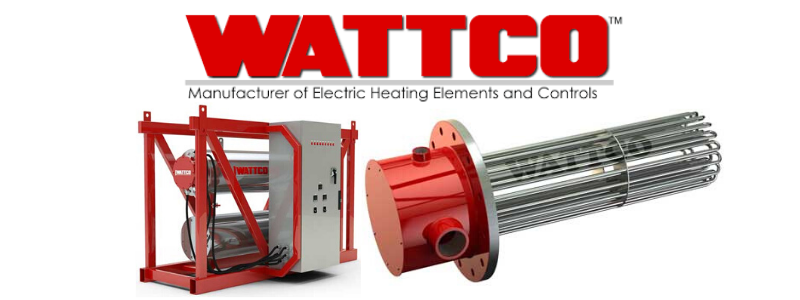
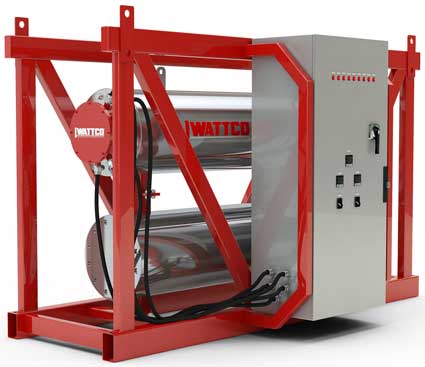
A control box is accessible externally, allowing engineers the ability to input a desired set temperature and obtain real-time readouts of the current temperature within the unit. In addition to conserving space, immersion heaters reduce risk by eliminating combustible heat sources from the proximity of the process fluid.
Based on the application at hand, a variety of immersion heaters and heater compositions may be appropriate. Flanged heaters and circulation heaters, for instance, each have their own benefits, and each heater may be customised in a number of ways.
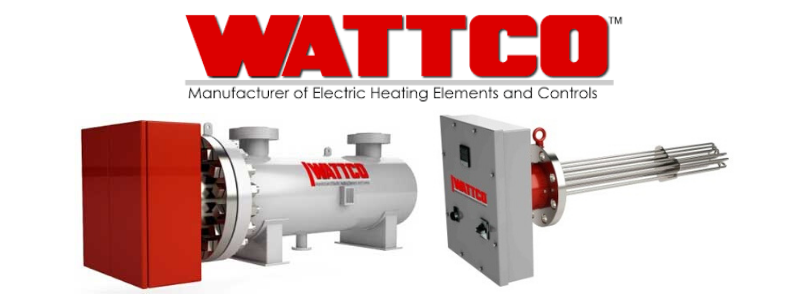
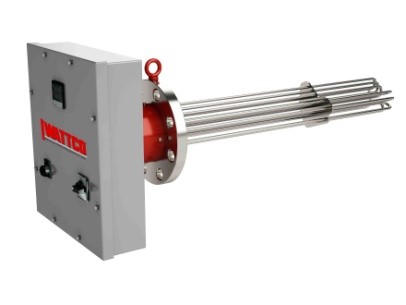
Flanged immersion heaters are the simplest of all, consisting of a tubular heating element attached to a metal flange.
They are the easiest among all immersion heaters to install, maintain, and replace. In instances where fluids must be kept in motion, an electric circulation heater is likely more appropriate.
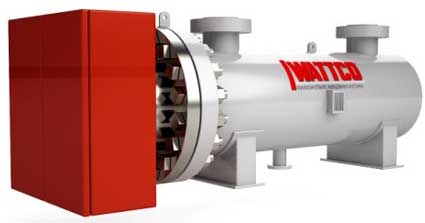
Circulation heaters consist of the simple and efficient flanged heaters mounted within a steel vessel. Fluid is pumped through the inlet valve of the heater where it is heated by the flanged unit, then sent through the exit valve to its final destination.
As with flanged heaters, circulation heaters are highly customisable depending on the nature of the liquid.
After determining the appropriate type of heater, the composition of the heater may be customised for any application. The heating element can be constructed from stainless steel tubules or from more exotic metals if the fluids being heated are corrosive.
Further, the fluid’s pH, viscosity, target temperature, and flow rate are all properties to consider when designing an immersion heater. Wattco offers a number of off-the-shelf units designed for common industrial jobs, and Wattco engineers possess the experience and expertise to collaborate on a design for even the most unique applications.
[1] United States Environmental Protection Agency. October 19, 2014.
Wattco is a manufacturing company developing electric heating products for use around the world since 1969. With uncompromised dedication to customers, Wattco offer solutions and not just products. Wattco development in oil and gas industries, renewable energy, HVAC systems and government projects help customers get alternative solutions for their projects to get off the ground in the most cost efficient way.
Circulation heaters, flanged heaters and industrial immersion heaters are an important heating product of many industries. Wattco heaters are used to prevent freezing and act as a catalyst in many chemical reactions in both the petrochemical industry as well as processing industries. Wattco manufactures electric heating elements for a wide range of applications
ELECTRICAL & PROCESS INSTRUMENTATION EQUIPMENT
FOR EXPLOSIVE ATMOSPHERES
Thorne & Derrick are Specialist Distributors of Hazardous Area & Explosion Proof Equipment with IECEx & ATEX Certifications to the onshore and offshore oil, gas, petrochemicals and process industries.
T&D, a leading UK distributor for process heaters including a broad range of immersion heaters, present a Guest Article by Ilan Toledano (Vice President from Wattco) on the use of immersion heaters in the oil and gas industries.
Immersion heaters are utilised in various applications within the industrial manufacturing and industrial processing fields. These heaters are used in a wide range of industries; this includes petroleum, chemical, process heating, oil and gas, and even food industries, with the main purpose of helping keep liquids at the correct temperature.
In the process industry, this is important for several reasons. First, one crucial aspect of any process industry is to keep the flow of production continuous; industrial immersion heaters ensure that substances are not detrimentally altered along the production line due to variances in temperature.
Second, many process industries involve large quantities of the given substance, and electric immersion heaters are able to maintain the correct temperature for vast amounts of substances. Finally, electric immersion heaters are a relatively cheap and efficient method of maintaining these substances, meaning that manufacturers have less up-front and long-term costs by using immersion heaters.
One interesting development for electric immersion heaters has been the sharp increase in hydraulic fracturing.
In order to both reduce localised emissions and increase production time (both of which are crucial to process industries) the industry trend has been toward using heat generated from electric sources. This has been just one of the boons for electric immersion heaters in relation to the oil and gas sector.
Forms of Electric Immersion Heaters
Even in industrial settings, electric immersion heaters take on many forms. Immersion heaters can be mounted on a pressure vessel through flanged, circulated, or over the side applications.
Over the side heaters are perhaps the most basic application, because it requires no special installation and is easily removed for servicing. These are used primarily in tanks, where the heating element is fully immersed in the liquid either on the side or at the bottom of the tank. As the name implies, installing this form of electric immersion heater is as easy as securing it over the side of the tank and fixing the control panel to the exterior.
Flanged heaters are most commonly used in pressure vessels, since it consists of bent tubes that are welded directly into the container.
These flanged immersion heaters are best for pressure vessels because the heat is divided evenly in order to avoid corrosion. Flanged immersion heaters, like over the side heaters, are usually implemented along with accessible controls on the outside of the vessel or tank.
Finally, circulation heaters are relatively compact systems for heating both fluids and gases. Also known as in-line heaters, they are usually utilised for purified gases, de-ionised water and in a semiconductor, because it requires constant movement and is able to heat substances almost immediately.
One major application of this method is also when the substance requires direct heat from a circuit external to the main vessel or tank.
Technical Specifications
The technical specifications of industrial immersion heaters range quite a bit as well, depending on both the type of immersion heater and the specific manufacturer.
Threaded connections, usually consisting of a 2.25-inch pipe, are rated up to 24 kW and over the side heaters are rated up to 36 kW. In contrast, flanged immersion heaters (most commonly used in steam boilers) and circulation immersion heaters (which are essentially built in to the container) are rated up to 2,000 kW.
Wattco is a manufacturing company developing electric heating products for use around the world since 1969. With uncompromised dedication to customers, Wattco offer solutions and not just products. Wattco development in oil and gas industries, renewable energy, HVAC systems and government projects help customers get alternative solutions for their projects to get off the ground in the most cost efficient way.
Circulation heaters, flanged heaters and industrial immersion heaters are an important heating product of many industries. Wattco heaters are used to prevent freezing and act as a catalyst in many chemical reactions in both the petrochemical industry as well as processing industries. Wattco manufactures electric heating elements for a wide range of applications
ELECTRICAL & PROCESS INSTRUMENTATION EQUIPMENT
FOR EXPLOSIVE ATMOSPHERES
Thorne & Derrick are Specialist Distributors of Hazardous Area & Explosion Proof Equipment with IECEx & ATEX Certifications to the onshore and offshore oil, gas, petrochemicals and process industries.
T&D are the UK’s largest stockist of Drum, IBC & Tank Heaters & Jackets. Delivering UK & Worldwide.
T&D’s online library of Drum, IBC & Tank Heating applications is now updated to include the following : resin curing for a sailing boat to speed up the manufacturing process.
Visit Silicone Heaters for details of electric surface heating solutions – flexible silicone heaters can be applied to heat the most complex shapes, geometries, curves and pipes.
Resins can be produced in a variety of ways such as liquid resins & additives, radiation cured and powder coating resins and additives and cross linkers for use on wood, metal, plastic, and other surfaces.
RESIN HEATING APPLICATION
T&D, The Hazardous Area Heating Specialists
Frost Protection
Reduce Viscosity ✓
Temperature Maintenance
Low Temperature Heating (0-20 degrees Celsius)
Medium Temperature Heating (21-50 degrees Celsius)
High Temperature Heating (50 degrees Celsius+)
Other
♦See also Resin Heating solutions for hazardous area locations.
IBC Heating Jackets – T&D supply heating and insulating jackets for plastic or steel metal cage IBC’s for bulk liquid storage.
HEATING JACKET VOLTAGE
110 Volt
230 Volt ✓
Low Voltage
HEATING APPLICATION : DRUM, IBC, TANK OR VESSEL
25 Litres
50 Litres
105 Litres
205 Litres
1000 Litres ✓
Other
VESSEL MATERIAL
Steel
Stainless Steel
Plastic
Cardboard
Other ✓ – N/A
HEAT UP TEMPERATURE
0-5 degrees Celsius
5-20 degrees Celsius
20-50 degrees Celsius ✓
50-70 degrees Celsius
70+ degrees Celsius
N/A (Frost Protection)
HEAT UP TIME REQUIREMENT
0-4 Hours
4-12 Hours
12-24 Hours
24-48 Hours ✓
N/A (Frost Protection)
Contact T&D for specification, support and sales of Electrical Heating Equipment for safe, industrial and hazardous area plant and equipment – we provide process temperature heating and frost protection trace heating cables for pipework, valves, IBC’s, drums and tanks.
T&D – Largest UK Stockist of Heat Tracing Cables. UK & International Delivery.
Invitation – network, engage, promote
Thorne & Derrick are inviting you to join LinkedIn’s fastest growing Discussion Group :Process & Hazardous Area Industries : Heat Tracing, Gas Detection, Fluid Control & Flow Measurement. News, projects, videos, promotions, whitepapers, jobs, webinars and Process & Instrumentation for Hazardous Areas.
Over 10,000 Members
T&D are the UK’s largest stockist of Drum, IBC & Tank Heaters & Jackets. Delivering UK & Worldwide.
T&D’s online library of Drum Heating applications is now updated to include the following : marine fuel oil heating stored in bespoke IBC’s in a hazardous area location for the chemical industry.
Visit Silicone Heaters for details of electric surface heating solutions – flexible silicone heaters can be applied to heat the most complex shapes, geometries, curves and pipes.
MFO (Medium Fuel Oil) is a blend of MGO (Marine Gas Oil) and HFO (Heavy Fuel Oil) with less gas oil than IFO (Intermediate Fuel Oil) according to marine fuel standard ISO 8217.
marine fuel oil HEATING APPLICATION
Frost Protection
Reduce Viscosity
Temperature Maintenance ✓
Low Temperature Heating (0-20 degrees Celsius)
Medium Temperature Heating (21-50 degrees Celsius)
High Temperature Heating (50 degrees Celsius+)
Other
IBC Heating Jackets – T&D supply heating and insulating jackets for plastic or steel metal cage IBC’s for bulk liquid storage.
T&D – Largest UK Stockist of Heat Tracing Cables. UK & International Delivery.
INVITATION – NETWORK, ENGAGE, PROMOTE
Thorne & Derrick are inviting you to join LinkedIn’s fastest growing Discussion Group :Process & Hazardous Area Industries : Heat Tracing, Gas Detection, Fluid Control & Flow Measurement. News, projects, videos, promotions, whitepapers, jobs, webinars, press plus much more.
T&D’s online library of Drum & IBC Heating applications is now updated to include the following : chemical heating using bespoke heating jackets for containers in a hazardous area location.
Visit Silicone Heaters for details of electric surface heating solutions – flexible silicone heaters can be applied to heat the most complex shapes, geometries, curves and pipes.
Medium Temperature Heating (21-50 degrees Celsius)
High Temperature Heating (50 degrees Celsius+)
Other
Notes : the chemical requiring temperature maintenance had a flash point of 39-43ºC. The bespoke heating jacket was made to ensure that the chemical would not be heated to this point.
IBC Heating Jackets – T&D supply heating and insulating jackets for plastic or steel metal cage IBC’s for bulk liquid storage.
Bespoke Heating Jackets for chemical drums & ibcs
110 Volt
230 Volt ✓
Low Voltage
HEATING APPLICATION : DRUM, IBC, TANK OR VESSEL
25 Litres
50 Litres
105 Litres
205 Litres
1000 Litres
Other ✓ – 4310 x 900mm container
VESSEL MATERIAL
Steel
Stainless Steel
Plastic ✓
Cardboard
Other
HEAT UP TEMPERATURE
0-5 degrees Celsius
5-20 degrees Celsius
20-50 degrees Celsius ✓
50-70 degrees Celsius
70+ degrees Celsius
N/A (Frost Protection)
HEAT UP TIME REQUIREMENT
0-4 Hours
4-12 Hours
12-24 Hours ✓
24-48 Hours
N/A (Frost Protection)
Contact T&D for specification, support and sales of Electrical Heating Equipment for safe, industrial and hazardous area plant and equipment – we provide process temperature heating and frost protection (Winterisation) products for pipework, valves, IBC’s, drums and tanks, including hazardous area immersion heaters.
T&D – Largest UK Stockist of Heat Tracing Cables – UK & International Delivery
Invitation – network, engage, promote
Thorne & Derrick are inviting you to join LinkedIn’s fastest growing Discussion Group :Process & Hazardous Area Industries : Heat Tracing, Gas Detection, Fluid Control & Flow Measurement. News, projects, videos, promotions, whitepapers, jobs, webinars, press plus much more.
Press Release Date: 02.04.2020 uploaded by Chris Dodds (T&D Sales + Marketing Manager) World’s First Fully Certified ATEX Doors Thorne & Derrick International, the Experts in Equipment for Explosive Atmospheres, today announce the signing of a Commercial Distribution Agreement...
Press Release Date: 04.07.2019 uploaded by Chris Dodds (T&D Sales + Marketing Manager) Category: Stockist Distributor Agreement Announcement Thorne & Derrick International announce that they have signed a Preferred Distributor Agreement with Raytec, the world leading manufacturer of LED...















 Not only are immersion heaters more efficient than traditional fuel-fired heaters, they reduce the footprint of the heated vessel. By design, immersion heaters are submerged within the fluid they are intended to heat and, therefore, take up no space outside the unit.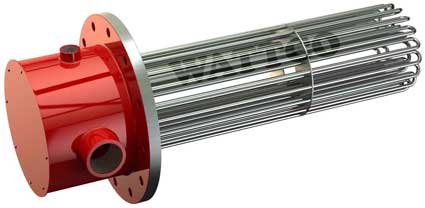


 In the process industry, this is important for several reasons. First, one crucial aspect of any process industry is to keep the flow of production continuous; industrial immersion heaters ensure that substances are not detrimentally altered along the production line due to variances in temperature.
 Even in industrial settings, electric immersion heaters take on many forms. Immersion heaters can be mounted on a pressure vessel through flanged, circulated, or over the side applications.