Intrinsic safety is one of the safest ways to ensure that an electrical device installed in a hazardous location cannot result in a fire or an explosion. Intrinsic safety is a system concept.
Intrinsic safety might seem confusing and involves complex calculations and detailed assessments. But it is not that difficult if we understand the principles behind it. It’s important to understand what intrinsic safety is, the safety of each component in the system, and how an intrinsically safe system is achieved.
In the below intrinsic safety animation, Hazcon Inc. has simplified the concept by focusing on:
The basic principles of an intrinsically safe system;
The three components of an intrinsic safety system;
How the components connect and work together to become an intrinsically safe system (Entity Concept)
To demonstrate why it is critical that electrical equipment to be protected in a hazardous area lets look at an electrical installation in such an area without any protection. An electrical sensor is placed in a hazardous location power is fed to it from a safe area outside the hazardous location.
If a fault happens within the safe area a voltage of 250V or higher can enter the hazardous area. Furthermore if a fault happens within an electrical sensor located inside the hazardous area a high value short circuit current can flow into the hazardous location from the power supply.
In both of these fault conditions, excess temperature, arcs and sparks can ignite the explosive atmosphere present. Intrinsic safety is a highly affective protection technique bases on the principle of limiting the thermal and electric energy within the equipment and its interconnecting wiring.
Intrinsic Safety Systems
Intrinsic Safety Systems contain 3 main components:
Intrinsically Safe Field Device
Safety Barrier (Energy Limiting Device) max amount of voltage, current & power transmitted to the field device at safe levels
Intrinsically Safe Field Wiring
It is vital that the safety of each component is considered.
Director & Consulting Engineer at Hazcon Inc.; Hazardous Locations Consulting Services; IECEx, ATEX, CEC & NEC
Specializing in the design, safety and approval of electrical equipment for hazardous locations.
Mr. Nejad has over 15 years of experience as an Electrical Engineer and is a sought after professional in the hzardous area and explosion protection industry. He is fully-qualified at the advanced level of all hazardous locations protection techniques including Intrinsic Safety & Non-incendive, Explosion Proof & Flame proof, Increased Safety, Non-arcing, Purging and Pressurization, Encapsulation, Optical Radiation, and Dust-tight enclosures. Mr. Nejad’s tenure in the industry includes six years at the CSA certification agency, working closely with manufacturers (Emerson, GE, ABB, Siemens, Endress-Houser, VEGA etc.) as a technical and certification engineer for Hazardous locations equipment.
EXPERTS IN EQUIPMENT FOR EXPLOSIVE ATMOSPHERES
leaders in ATEX Innovation To The Hazardous Area Industries
Thorne & Derrick are leaders in the development and distribution of Product Innovations that deliver significant improvements to clients plant, people and operational safety in the explosive atmosphere industries.
Your proactive problem solvers experienced in succession planning for the replacement of obsolete, non-conformant and legacy equipment in hazardous areas.
Your first-choice provider of innovative and competitive solutions to ensure ATEX & IECEx Compliance for Hazardous Area Electrical, HVAC & Process Instrumentation Equipmentto UK and international projects.
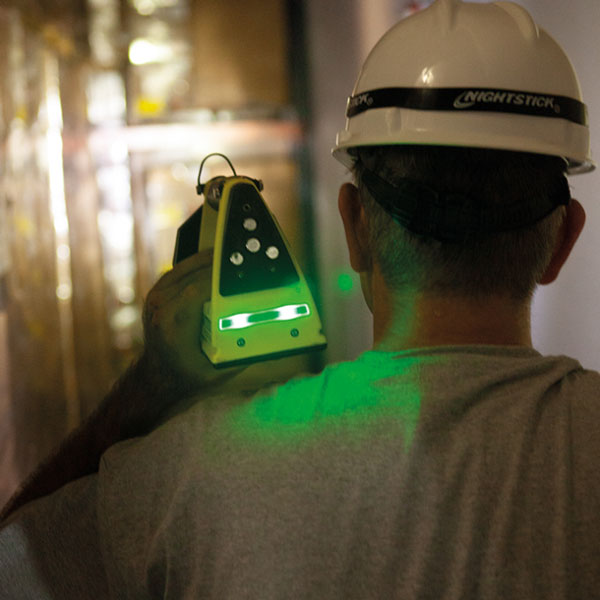
Nightstick: a global brand of professional lighting products including flashlights, headlamps and Intrinsically Safe lighting solutions
Explosive Atmosperes & Hazardous Areas
Portable LED Lighting Meeting or Exceeding Industry Standards
Special thanks to Derek Box at Nightstick for the kind permission to republish
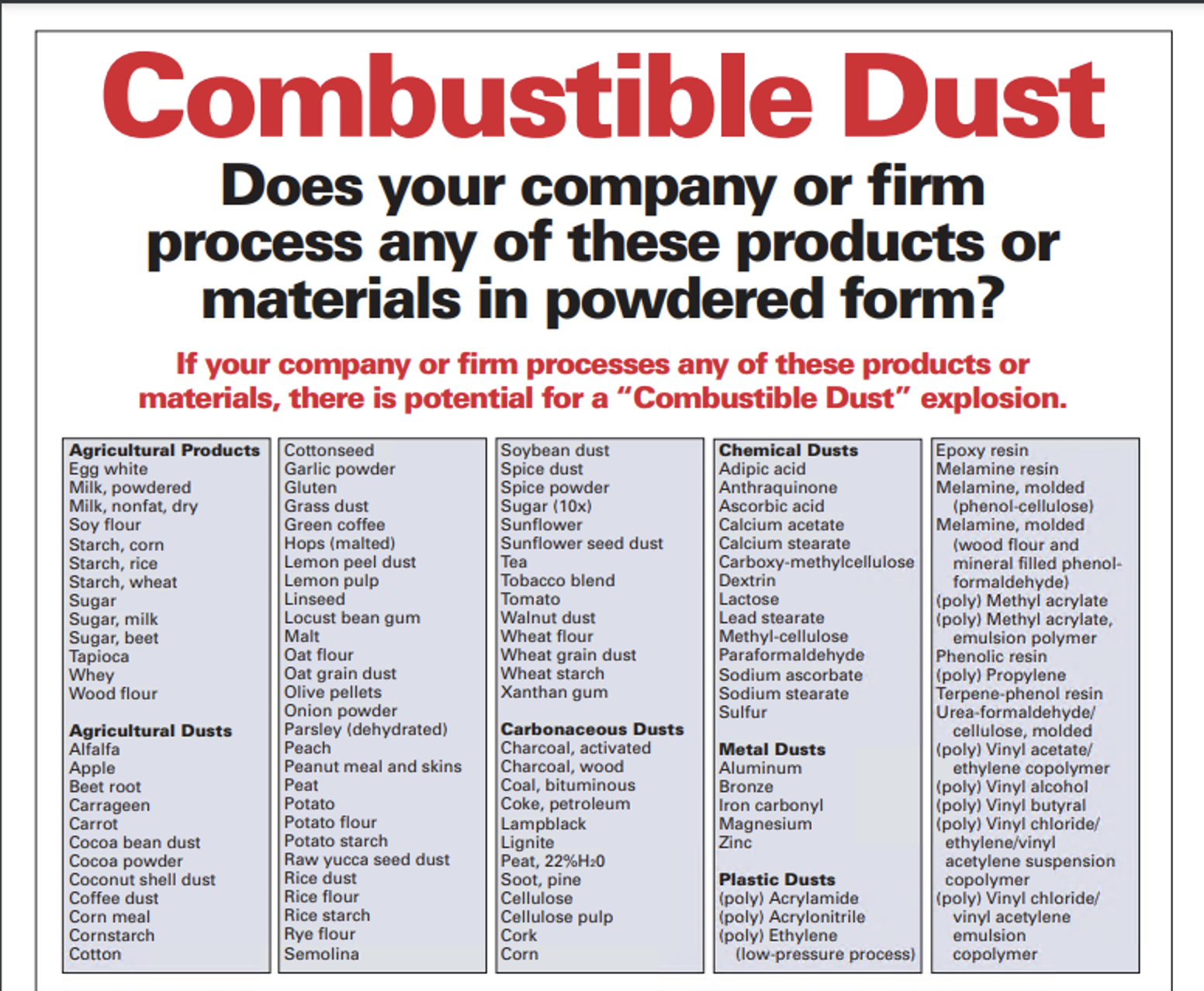
The dangers of explosive environments are obvious in the petroleum and chemical processing industries, but many other industries can create explosive atmospheres that are not as obvious but still represent a serious danger.
Examples illustrating this are facilities that process grains, sugar, metal powders, and wood products. In 2018 grain handling facilities in Nebraska and eastern France were destroyed or seriously damaged by grain dust explosions. In 2008 an explosion wrecked a sugar refinery in Georgia, killing 14 people and injuring another 40. Five workers were fatally injured in an iron dust fire in Tennessee in 2011.
It is essential to understand the conditions that can create explosive environments and the proper equipment required to enter them safely.
The equipment you are using must meet or exceed the standards for the most explosive environment you could face under known or unknown situations. In the United States, intrinsically safe products are tested to the UL 913 5th or 8th edition standards with the UL 913 8th edition being harmonized to the EN/IEC 60079 -01/-11 standard for European Union ATEX certifications and the remaining countries IECEx certifications.
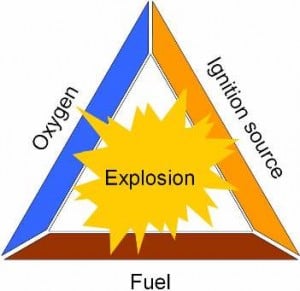
For an explosion to occur, five components must be in place: oxygen, confined space, ignition source, dispersion, and a fuel source. These elements make up the explosion pentagon. The three elements needed for a fire — fuel source, oxygen, and an ignition source — can create a flash fire within a confined space, resulting in the ingredients for an explosion.
Eliminating one of these five elements will prevent an explosion, but eliminating these hazards is not a simple process. Oxygen in confined spaces typically cannot be eliminated. Therefore, managing fuel sources and the use of properly rated equipment to prevent ignition is essential.
As an example, using the ATEX classification system, a Zone 2 environment could quickly become a Zone 1 or even a Zone 0 environment, and your equipment must be rated appropriately as you may not be aware that the environment has changed until it is too late. If you are unsure, analyse the work environment, determine the worst-case scenario, and equip your workers based on that.
The quality of your equipment is vital in explosive environments. You must ensure it is manufactured by a reputable company with documented experience in creating intrinsically safe (IS) products.
The ideal situation would be to purchase all of your IS products from a single manufacturer rather than mixing and matching products from several companies. A single source manufacturer ensures consistent quality and safety across the entire product line. Because of the knowledge, time, and expense required to engineer and produce IS products, a very limited number of companies can achieve this.
About Nightstick
Nightstick is a global brand of professional portable LED lighting products that meet or exceed industry standards. Our products are UL 913 certified for Class I DIV 1 (all gas atmosphere groups) and Class II DIV 1 (all dust atmosphere groups), many with a Zone 0 IIC equivalency rating for use in hazardous environments.
Most additionally carry a Zone 0 IIC ATEX and IECEx certification with T3 & T4 temperature rating, making Nightstick a truly globally intrinsically safe lighting company. From penlights to area scene lights, Nightstick leads with over 50 safety rated LED lighting products.
leaders in ATEX Innovation To The Hazardous Area Industries
Thorne & Derrick are leaders in the development and distribution of Product Innovations that deliver significant improvements to clients plant, people and operational safety in the explosive atmosphere industries.
Your proactive problem solvers experienced in succession planning for the replacement of obsolete, non-conformant and legacy equipment in hazardous areas.
Your first-choice provider of innovative and competitive solutions to ensure ATEX & IECEx Compliance for Hazardous Area Electrical, HVAC & Process Instrumentation Equipmentto UK and international projects.
Follow our Showcase Page on LinkedIn to receive hazardous area product innovations, industry news, whitepapers, videos, technical tips and training webinars for professionals involved in the explosive atmosphere industries.
Thorne & Derrick International, based in the UK, are Preferred Distributors and Stockists for the Raytec SPARTAN range of ATEX lighting using LED technology for the illumination of hazardous area locations and potentially explosive atmospheres.
With the UK officially leaving the EU, the UKCA mark has been introduced for any hazardous area products being sold into the UK.
In Raytec’s latest webinar, they discuss what the changes mean and how they could affect you if you’re using hazardous area products in the UK, or if you’re purchasing them from a UK manufacturer.
Raytec will also be taking you through what their plans are for their hazardous area lighting range in response to the latest certification criteria, and the changes you can expect to see on SPARTAN LED luminaires in the coming weeks – this Webinar will answer all your questions about UKCA Lighting.
Register here
When:Tuesday 16th March 9.00am GMT (London)
Sign-up:9:00 GMT (London), 10.00 CET (Berlin), 13:00 GST (Dubai), 14:30 IST (Mumbai), 18:00 JST (Tokyo), 20:00 AEDT (Sydney)
See how Raytec have been working closely with UK notified body, Eurofins CML to ensure certificates are constantly updated to the latest edition of the standards for all hazardous area lighting in their range in the following Blog.
💡 Did you Know? Thorne & Derrick using latest software provide a FREE LIGHTING DESIGN SERVICE for the specification and supply of ATEX & IECEx Certified light fittings to provide safe and reliable lighting in explosive atmospheres and hazardous area locations.
SPARTAN is a full range of Ex LED luminaires and lighting approved for all ATEX and IEC Ex Zone 1 and Zone 2 hazardous area environments, including UL /CSA C1D2 installations. The hazardous area lighting products are designed for the most extreme environments – Flood, Linear, Bulkhead, Bay and Crane luminaires with emergency and industrial lighting versions are also available from Thorne & Derrick International.
leaders in ATEX Innovation To The Hazardous Area Industries
Thorne & Derrick are leaders in the development and distribution of Product Innovations that deliver significant improvements to clients plant, people and operational safety in the explosive atmosphere industries.
Your proactive problem solvers experienced in succession planning for the replacement of obsolete, non-conformant and legacy equipment in hazardous areas.
Your first-choice provider of innovative and competitive solutions to ensure ATEX & IECEx Compliance for Hazardous Area Electrical, HVAC & Process Instrumentation Equipmentto UK and international projects.
Follow our Showcase Page on LinkedIn to receive hazardous area product innovations, industry news, whitepapers, videos, technical tips and training webinars for professionals involved in the explosive atmosphere industries.
Global Dust Safety Conference 2021 – REGISTER HERE
Global Dust Safety Conference 2021
Dust Safety Academy
Dr. Chris Cloney, PEng is proud to announce the 2nd annual Global Dust Safety Conference which will take place digitally between March 1st- 3rd 2021 after the success of last years which saw 225 people registered from 25 countries and across 12 different time zones.
➡ Register today and watch replays until March 31st 2021 if time zone differences are challenging.
When registering for this conference you’re not only securing your seat for world-class combustible dust safety training, education seminars and research presentations you are protecting yourself and everybody around you.
💡 Did you know? There has been 726Fires, 270 Explosions, 446 Injuries and 51 Fatalities recorded in our global database since 2016.
The goal for the 2021 Dust Safety Conference is to get your questions answered about combustible dust. We do this by bringing together the community of stakeholders involved in combustible dust. This includes equipment manufacturers, OEMs, safety system designers, safety system implementers and integrators, regulators, insurance companies and researchers.
Why Attend This Event?
Here’s What Makes #DSC2021 Different From Your Average Conference…
Learn from 40+ global experts on combustible dust safety
Understand upcoming regulation changes in your industry
Get newest developments in prevention, protection and cleaning systems
Watch and rewatch presentation replays for the entire month after the event
Have questions about
Dust Hazard Analysis?
Safety culture and training?
Purchasing the correct equipment?
Dust collector maintenance?
Legal liability?
Get them answered at the event!
No travel, lodging or extra costs required
No travel – attend right from your computer or mobile device
Standard membership in the Dust Safety Academy complete with access to community forums and exhibition area
Can’t Make it Live? No Problem!
Replays available until March 31, 2021, with Registration
Meet your host, Dr. Chris Cloney, PEng.
Managing Director and Lead Research for Dust Safety Science.
Chris will be bringing together industry experts and researchers to cover combustible dust education from global and regional perspectives.
The purpose of holding the 2021 Global Dust Safety Conference is threefold:
To make change in industries handling combustible dust
To generate awareness of dust fire and explosion hazards
To work towards achieving a zero-fatality year by 2038
Chris will be joined by over 40 speakers from around the world delivering live presentations including:
Reliable 24/7 Dust Detection in Industrial Environments
John Korpi
Sintrol
Dust Collector Replacement – Overcoming Murphy’s Law
Diane Cave
Element6
Practical considerations when planning and implementing dust explosion protection
Timothy Heneks
Dustcon Solutions
Inherently Safer Design Protocol for Process Hazard Analysis
Kayleigh Rayner Brown
Dalhousie University
Difference Between Prescriptive and Performance-Based DHAs
John Wincek
DEKRA
NFPA 69 – Chapter 12-Material Chokes-Rotary Airlocks
Pablo Balan
Boss Products
New 2021 SIL Rating Requirements per NFPA 69
Burke Desautels
IEP Technologies
PPE and Combustible Dust – the often overlooked piece of protection
Derek Sang
Bulwark Protection
A: Anyone can attend the event with the purchase of a general admission ticket. Premium Dust Safety Academy members get access to the conference with their annual subscription.
Q: What if I can’t view the conference live?
A: Replays of the conference presentations will be available for one month after the event for general admission. Premium Dust Safety Academy members have unlimited access to the conference replays from 2020 and 2021.
Q: Are the tickets refundable?
A: No, the tickets are non-refundable. However, they can be reassigned to another individual before February 15, 2021. We will try our best to help you find someone to take the ticket before this date.
Q: How long are the presentations?
A: Live technical presentations are 40 minutes in length (30-minute presentation and 10 minutes of Q&A). Live research sessions are 20-minutes followed by a 5-minute question period. Keynotes are 40 minutes followed by a 15-minute question period. On-demand sessions will vary in length.
EXPERTS IN EQUIPMENT FOR EXPLOSIVE ATMOSPHERES
Zone 1/2 Gas & Zone 21/22 Dust
Thorne & Derrick are leaders in the development and distribution of Product Innovations that deliver significant improvements to clients plant, people and operational safety in the explosive atmosphere industries.
Your proactive problem solvers experienced in succession planning for the replacement of obsolete, non-conformant and legacy equipment in hazardous areas.
Your first-choice provider of innovative and competitive solutions to ensure ATEX & IECEx Compliance for Hazardous Area Electrical, Heating, Lighting & Process Instrumentation Equipmentto UK and international projects.
When electrical equipment is used in, around, or near an atmosphere that has flammable gases or vapours, flammable liquids, combustible dusts, ignitable fibres or flyings, there is always a possibility or risk that a fire or explosion might occur.
Those areas where the possibility or risk of fire or explosion might occur due to an explosive atmosphere and/or mixture is often called a hazardous (or classified) location/area. Currently there are two systems used to classify these hazardous areas; the Class/Division system and the Zone system.
The Class/Division system is used predominately in the United States and Canada, whereas the rest of the world generally uses the Zone system. However, the United States and Canada are trending more towards the Zone System.
Class/Division System for Hazardous Area Locations
Hazardous locations per the Class/Division system are classified according to the Class, Division, and Group.
Class—The Class defines the general nature (or properties) of the hazardous material in the surrounding atmosphere which may or may not be in sufficient quantities.
a. Class I—Locations in which flammable gases or vapours may or may not be in sufficient quantities to produce explosive or ignitable mixtures.
b. Class II—Locations in which combustible dusts (either in suspension, intermittently, or periodically) may or may not be in sufficient quantities to produce explosive or ignitable mixtures.
c. Class III—Locations in which ignitable fibres may or may not be in sufficient quantities to produce explosive or ignitable mixtures.
Division—The Division defines the probability of the hazardous material being able to produce an explosive or ignitable mixture based upon its presence.
a. Division 1 indicates that the hazardous material has a high probability of producing an explosive or ignitable mixture due to it being present continuously, intermittently, or periodically or from the equipment itself under normal operating conditions.
b. Division 2 indicates that the hazardous material has a low probability of producing an explosive or ignitable mixture and is present only during abnormal conditions for a short period of time.
Group—The Group defines the type of hazardous material in the surrounding atmosphere. Groups A, B, C, and D are for gases (Class I only) while groups E, F, and G are for dusts and flyings (Class II or III).
a. Group A—Atmospheres containing acetylene.
b. Group B—Atmospheres containing a flammable gas, flammable liquid-produced vapor, or combustible liquid-produced vapor whose MESG is less than 0.45 mm or MIC ratio is less than 0.40. Typical gases include hydrogen, butadiene, ethylene oxide, propylene oxide, and acrolein.
c. Group C—Atmospheres containing a flammable gas, flammable liquid-produced vapor, or combustible liquid-produced vapor whose MESG is greater than 0.45 mm but less than or equal to 0.75 mm or MIC ratio is greater than 0.40 but less than or equal to 0.80. Typical gases include ethyl either, ethylene, acetaldehyde, and cyclopropane.
d. Group D—Atmospheres containing a flammable gas, flammable liquid-produced vapor, or combustible liquid-produced vapor whose MESG is greater than 0.75 mm or MIC ration is greater than 0.80. Typical gases include acetone, ammonia, benzene, butane, ethanol, gasoline, methane, natural gas, naphtha, and propane.
e. Group E—Atmospheres containing combustible metal dusts such as aluminium, magnesium, and their commercial alloys.
f. Group F—Atmospheres containing combustible carbonaceous dusts with 8% or more trapped volatiles such as carbon black, coal, or coke dust.
g. Group G—Atmospheres containing combustible dusts not included in Group E or Group F. Typical dusts include flour, starch, grain, wood, plastic, and chemicals.
Hazardous Area Zone System
Hazardous locations per the Zone system are classified according to its Zone which can be gas or dust. For gas atmospheres electrical equipment is further divided into Groups and Subgroups.
Zone—The Zone defines the probability of the hazardous material, gas or dust, being present in sufficient quantities to produce explosive or ignitable mixtures.
Gas
a. Zone 0—Ignitable concentrations of flammable gases or vapours which are present continuously or for long periods of time.
b. Zone 1—Ignitable concentrations of flammable gases or vapours which are likely to occur under normal operating conditions.
c. Zone 2—Ignitable concentrations of flammable gases or vapours which are not likely to occur under normal operating conditions and do so only for a short period of time.
Dust
a. Zone 20—An area where combustible dusts or ignitable fibres and flyings are present continuously or for long periods of time.
b. Zone 21—An area where combustible dusts or ignitable fibres and flyings are likely to occur under normal operating conditions.
c. Zone 22—An area where combustible dusts or ignitable fibres and flyings are not likely to occur under normal operating conditions and do so only for a short period of time.
Group—Electrical equipment is divided into three groups.
Group I—Equipment intended for use in mines susceptible to firedamp (flammable mixture of gases naturally occurring in a mine).
Group II—Equipment intended for use in places with an explosive gas atmosphere other than mines susceptible to firedamp. Group II equipment is subdivided into three subgroups.
– Group IIA—Atmospheres containing propane, or gases and vapours of equivalent hazard.
– Group IIB—Atmospheres containing ethylene, or gases and vapours of equivalent hazard.
– Group IIC—Atmospheres containing acetylene or hydrogen, or gases and vapours of equivalent hazard.
Group III—Equipment intended for use in places with an explosive dust atmosphere. Group III equipment is subdivided into three subgroups.
– Group IIIA—Atmospheres containing combustible flyings.
– Group IIIB—Atmospheres containing non-conductive dust.
– Group IIIC—Atmospheres containing conductive dust.
Protection Techniques and Methods
Various protection techniques and methods have been developed and employed, thus reducing or minimising the potential risks of explosion or fire from electrical equipment located in hazardous locations. Not all methods are listed.
Class/Division System for Hazardous Area Locations
Explosion-proof—A type of protection that utilises an enclosure that is capable of withstanding an explosive gas or vapor within it and or preventing the ignition of an explosive gas or vapor that may surround it and that operates at such an external temperature that a surrounding explosive gas or vapor will not be ignited thereby.
Intrinsically Safe—A type of protection in which the electrical equipment under normal or abnormal conditions is incapable of releasing sufficient electrical or thermal energy to cause ignition of a specific hazardous atmospheric mixture in its most easily ignitable concentration.
Dust Ignition-proof—A type of protection that excludes ignitable amounts of dust or amounts that might affect performance or rating and that, when installed and protected in accordance with the original design intent, will not allow arcs, sparks or heat otherwise generated or liberated inside the enclosure to cause ignition of exterior accumulations or atmospheric suspensions of a specified dust.
Non-incendive—A type of protection in which the equipment is incapable, under normal conditions, of causing ignition of a specified flammable gas or vapor-in-air mixture due to arcing or thermal effect.
Hazardous Area Zone System
The below concepts are high-level protection concepts. There are also sub-levels of protection that may or not be applicable to each type. Also, some equipment may combine multiple types of protection such as hazardous area lighting:
Flame-proof—A type of protection in which an enclosure can withstand the pressure developed during an internal explosion of an explosive mixture and that prevents the transmission of the explosion to the explosive atmosphere surrounding the enclosure and that operates at such an external temperature that a surrounding explosive gas or vapor will not be ignited there. This type of protection is referred to as “Ex d”.
Intrinsically Safe—A type of protection in which the electrical equipment under normal or abnormal conditions is incapable of releasing sufficient electrical or thermal energy to cause ignition of a specific hazardous atmospheric mixture in its most easily ignitable concentrations. This type of protection is referred to as “Ex i”.
Increased Safety—A type of protection in which various measures are applied to reduce the probability of excessive temperatures and the occurrence of arcs or sparks in the interior and on the external parts of electrical apparatus that do not produce them in normal service. Increased safety may be used with flame-proof type of protection. This type of protection is referred to as “Ex e”.
Type n—A type of protection applied to electrical equipment such that in normal operation it is not capable of igniting a surrounding explosive atmosphere. This type of protection is referred to as “Ex n”.
Type t—A type of protection in which the electrical equipment is equipped with an enclosure providing dust ingress protection and a means to limit surface temperatures. This type of protection is referred to as “Ex t”.
Type h—Refers to one of three different types of protection: (1) where constructional measures are applied to protect against the possibility of ignition from hot surfaces, sparks and compression generated by moving parts; (2) ignition protection where mechanical or electrical devices are used in conjunction with nonelectrical equipment to manually or automatically reduce the likelihood of a potential ignition source from becoming an effective ignition source; or (3) protection where potential ignition sources are made ineffective or separated from the explosive atmosphere by either totally immersing them in a protective liquid, or by partially immersing and continuously coating their active surfaces with a protective liquid in such a way that an explosive atmosphere which may be above the liquid, or outside the equipment enclosure, cannot be ignited. Non-electrical equipment often apply “Ex h” protection methods.
Equipment Protection Level (EPL) Markings
The EPL marking indicates the level of protection that is given to equipment based on the likelihood of its becoming a source of ignition and distinguishing the difference between explosive gas atmospheres, explosive dust atmospheres, and the explosive atmospheres in mines susceptible to firedamp.
Temperature Code (T Code)
A mixture of hazardous gases and air may be ignited by coming into contact with a hot surface. The conditions under which a hot surface will ignite a gas depends on surface area, temperature, and the concentration of the gas. The same can be said about combustible dusts. The T code or T class rating of a product denotes the maximum surface temperature that a given product will not exceed under a specified ambient temperature. For example, a product with a T code of T3 means that its maximum surface temperature will not exceed 200°C provided it is operated in a ambient temperature defined by the manufacturer.
Nomenclature
Class/Division System
Approved equipment is marked according to which Class (I, II, or III), Division (1 or 2), Group (A, B, C, D, E, F, or G), and temperature code (T1 through T6) that it is rated for. For intrinsically safe equipment the words “Intrinsically Safe” or “IS” will precede the actual approval marking to indicate it as being intrinsically safe. Examples are listed below:
Class I Division 1 Group B,C,D T5
CL I Div 2 GP ABCD T5
IS CL I,II,III Div 1 GP ABCDEFG
CL II,III Div 1,2 GP EFG T4
Zone System for Hazardous Area Locations
Approved equipment is marked according to the protection concept for which it has been designed (Ex i, Ex d, Ex n, and etc.), the group (I, IIA, IIB, IIC, IIIA, IIIB, or IIIC), and temperature code (T1 through T6) that it is rated for. For the United States it will be preceded by which Class and Zone it is approved for. Examples are listed below:
Ex ia IIC T5
Ex d IIB+H2 T6
Ex nA IIC T6
Class I Zone 2 AEx nC IIC T5
Additional Terminology
Although the following terminology is not permitted for markings it is commonly used to describe the various types of approvals or when speaking of them.
XP—Flameproof approval for Class I Division 1
EXP—Flameproof approval for Class I Division 1
NI—Non-incendive approval for Class I Division 2
DIP—Dust Ignition Proof approval for Class II Division 1
S—“Suitable For” for Class II Division 2
IS—Intrinsically Safe
Approval Agencies
Generally speaking, most countries require that products intended for installation in a hazardous location be approved by a recognized authority or approval agency (governmental or independent) which that country has established by various laws, regulations, or codes. See table 1 for an overview of approvals and approval agencies.
North American Approvals
Of the 15 national testing laboratories (NRTL’s) in the United States, only a few are qualified to approve products for use in hazardous locations. Two such agencies are; Factory Mutual (FM) and Underwriters Laboratories (UL). In Canada, products are approved by the Canadian Standards Association (CSA).
European Approvals
Each country belonging to the European Union has established one or more “Notified Bodies” for product approval. Notified Bodies not only approve products for use within their own country, commonly called national certifications/approvals, but also for any other country within the union, known as CENELEC certifications/approvals. CENELEC is the acronym for European Committee for Electrotechnical Standardization. A product which has been CENELEC certified or approved by any of the Notified Bodies is automatically accepted for use within all of the participating union countries. In July 2003 a European Directive, called the ATEX Directive, which pertains to equipment for explosive atmospheres, was adopted. All equipment intended for use in explosive atmospheres must comply with the ATEX Directive in order to be sold into the European Union.
International Approvals for Hazardous Area Locations & Explosive Atmospheres
Countries participating in the IECEx Scheme (International Electrotechnical Commission on explosion protected equipment, known as “Ex”) can issue either an international certification or a national certification of explosion protected equipment. Each country within the IECEx scheme establishes an ExCB (Ex Certification Body) which can approve products. ExCB’s can issue the national certification for their country based upon the IECEx standards (including any national deviations) and the international certification. Currently, Australia is the only country accepting international certifications for use in their country.
Table 1. Approval Agencies
Approvals¹
Approval Agencies Used²
Approvals Accepted
FM
FM—Factory Mutual
North America
CML
CML—Certification Management Limited
Japan
CSA
CSA—Canadian Standards Association
North America
ATEX
Baseefa—British Approvals Service for Electrical Equipment in Flammable Atmospheres
KEMA—NV tot Keuring van Elektrotechnische Materialen
LCIE—Laboratorie Central des Industries Electriques
European Union
IECEx
CSA—Canadian Standards Association
Baseefa—British Approvals Service for Electrical Equipment in Flammable Atmospheres
International
SAA
SAA—Standards Association of Australia
Australia
NEPSI
NEPSI—National Supervision and Inspection Centre for Explosion Protection and Safety of Instrumentation
China
TIIS
TIIS—Technology Institution of Industrial Safety
Japan
INMETRO
INMETRO—National Institute of Metrology, Quality and Technology
Brazil
CUTR
FGUP Certification Centre: SC VSI VNIIFTRI
Certification Body: OS VSI VNIFFTRI
Russia, Belarus, Kazakhstan & America
¹ Fisher™ products may carry additional approvals. Contact T&D for additional approval information.
² Fisher product approvals may be certified by other agencies. Contact T&D for additional information.
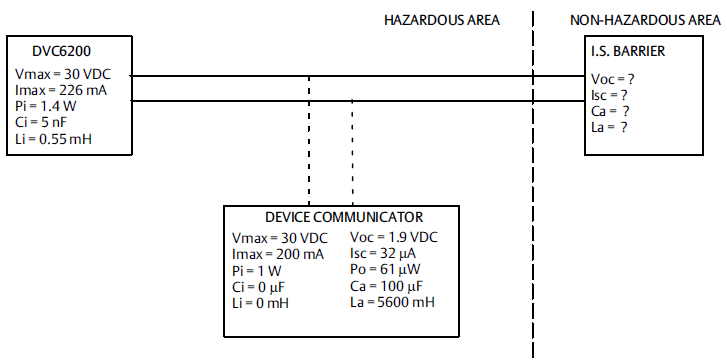
Figure 1. Typical I.S Installation
Guidelines for Selecting Intrinsic Safety Barriers Using Entity Ratings
Selecting an intrinsic safety barrier with the required entity ratings depends upon the combined effects of the instrument, its cabling, and any instrument accessories such as the AMS Trex™ Device Communicator. Determine the barrier entity ratings using the following guidelines:
Voc ≤ Vmax
Isc ≤ Imax
Ca ≥ Ci + Ccable
La ≥ Li + Lcable
where:
Voc = Barrier open circuit voltage
Vmax = Instrument Vmax
Isc = Barrier short circuit current
Imax = Instrument Imax
Ca = Barrier acceptable connected capacitance
Ci = Instrument total unprotected internal capacitance
Ccable = Signal cable total capacitance
La = Barrier acceptable connected inductance
Li = Instrument total unprotected internal inductance
Lcable = Signal cable total inductance
The values Voc, Ioc, Ca, and La are specified by the barrier manufacturer for any given barrier. The values of Ccable and Lcable for the signal cable must be determined for the specific cable used.
Example barrier entity ratings calculation
A system is comprised of a FIELDVUE™ DVC6200 digital valve controller (FM approved), a Device Communicator (FM approved), and 1000 feet of cable with 60 pF/ft capacitance and 0.2 μH/ft inductance. Calculate the barrier entity ratings.
Figure 1 shows a typical I.S. installation.
Calculate Ccable and Lcable
Ccable = 60 pF/ft x 1000 ft
= 60 nF
Lcable = 0.2 μH/ft x 1000 ft
= 0.2 mH
Determine Ca and La for the barrier
Ca ≥ Ci (DVC6200) + Ci (TREX) + Ccable
≥ 5 nF + 0 nF + 60 nF
Ca ≥ 65 nF
La ≥ Li (DVC6200) + Li (TREX) + Lcable
≥ 0.55 mH + 0 mH + 0.2 mH
La ≥ 0.75 mH
Determine Voc and Isc of the barrier. Note that in this example the output of the Trex (Voc (TREX) and Isc (TREX)) must also be considered because it can also add energy to the loop besides just the barrier itself. Voc of the barrier plus any additional voltage that could be added to the loop from each device must be subtracted from Vmax for each device. Isc of the barrier plus any additional current that could be added to the loop from each device must not exceed Imax for each device.
Voc of the barrier must meet all of the following conditional requirements.
Isc of the barrier must meet all of the following conditional requirements.
Isc ≤ Imax (DVC6200) + Isc (TREX) → 226 mA + 0.032 mA → 226.032 mA
Isc ≤ Imax (DVC6200) → 226 mA
Isc ≤ Imax (DVC6200) → 200 mA
Isc ≤ 200 mA
The contents of this publication are presented for informational purposes only, and while every effort has been made to ensure their accuracy, they are not to be construed as warranties or guarantees, express or implied, regarding the products or services described herein or their use or applicability. All sales are governed by our terms and conditions, which are available upon request. We reserve the right to modify or improve the designs or specifications of such products at any time without notice. Emerson.
EXPERTS IN EQUIPMENT FOR EXPLOSIVE ATMOSPHERES
Zone 1/2 Gas & Zone 21/22 Dust
Thorne & Derrick are leaders in the development and distribution of Product Innovations that deliver significant improvements to clients plant, people and operational safety in the explosive atmosphere industries.
Your proactive problem solvers experienced in succession planning for the replacement of obsolete, non-conformant and legacy equipment in hazardous areas.
Your first-choice provider of innovative and competitive solutions to ensure ATEX & IECEx Compliance for Hazardous Area Electrical, Heating, Lighting & Process Instrumentation Equipmentto UK and international projects.
Press Release Date: 02.04.2020 uploaded by Chris Dodds (T&D Sales + Marketing Manager) World’s First Fully Certified ATEX Doors Thorne & Derrick International, the Experts in Equipment for Explosive Atmospheres, today announce the signing of a Commercial Distribution Agreement...
Press Release Date: 04.07.2019 uploaded by Chris Dodds (T&D Sales + Marketing Manager) Category: Stockist Distributor Agreement Announcement Thorne & Derrick International announce that they have signed a Preferred Distributor Agreement with Raytec, the world leading manufacturer of LED...