T&D, a leading UK distributor for industrial and hazardous area Gas Detection Equipment, present a Guest Article by Debra Hall, Sales & Marketing Director of Control Instruments Corporation.
Control Instruments Corporation’s mission is to engineer and manufacture high quality solutions to gas detection problems. From simple to complex cases, Control Instruments Corporation ensure safety is a top priority.
In today’s guest post, Debra explains the top 4 reasons to heat industrial and hazardous area process gases.
Heating Industrial & Hazardous Area Process Gases
Industrial processes operate at various temperatures, using a wide variety of different gases, solvents and background constituents (i.e. tars, resins, salts, plasticisers, water vapor, etc). It is important to keep these process gases heated. Would you like to know why?
Read on to learn the top four reasons …
What are Process Gases?
Process gases consist of hazardous gases and solvents that are used in industrial processes. Industrial processes are those operations, which are typically enclosed, heated spaces that require an active sample drawing system.
These have an intentional release of process gases at all times. In fact these processes are often optimized for speed and performance by safely releasing more process gases, not less; as they often operate near legal limits for combustible gas concentrations.
These process gases are seen in production plants (chemical, automotive, painting, printing, pharmaceuticals) as well as used as non-traditional fuels for energy savings and sustainability, such as SYNGAS to turbine engines.
Some examples include,
Industrial dryers for printing, coating, or laminating that may be designed to operate at solvent concentrations above 25% LFL.
Or the measurement of process gases going into Amine Treaters for pollution control, where there are not only combustibles, but also toxic sulfides.
This means the precise concentration of process gases must be measured with a level of accuracy for safety, health and energy savings. Since the environment of the process gas stream can be a challenge, it is essential to keep them heated to a temperature above their dew point. The process stream must hence be heated from the sample pickup point all the way to the gas sensing analyzer.
Here are the Top 4 Reasons to Heat Hazardous Area Process Gases
1 – Avoid Condensation
The most common sampling problem is condensation (vapor returning to liquid during sampling). Condensation creates two problems: sample drop-out and clogging. When sample drops out due to condensation, the reading taken by the sensor is lower than actual. And clogging increases downtime and maintenance costs.
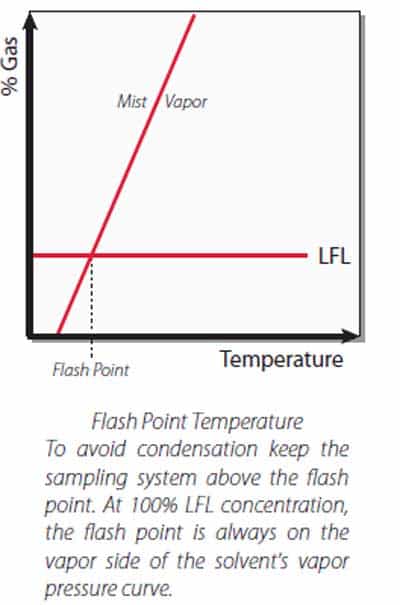
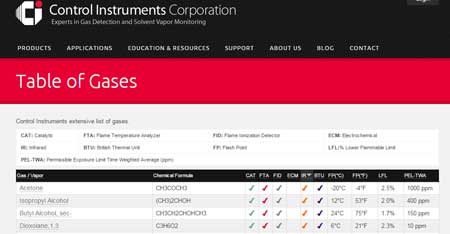
The temperature needed to avoid condensation can be found by looking up the Flash Point temperature for each compound in the sample (see table of common gases). The flash point is that temperature at which a solvent produces sufficient vapor to propagate a flame. Generally, the sample must be kept at or above the flash point temperature to remain in the vapor state during sampling.
Pictured : % Gas v Temperature : A Flash Point Temperature Graph
An essential guide for process and plant engineers concerned with gas detection and solvent vapour monitoring (including hydrocarbons and both flammable and toxic gases).
Data includes : CAT: Catalytic FTA: Flame Temperature Analyzer FID: Flame Ionization Detector ECM: ElectrochemicalFP: Flash Point LFL: % Lower Flammable Limit PEL-TWA: Permissible Exposure Limit Time Weighted Average (ppm)
2 – Ensure Accurate Readings
Keeping all sample-wetted parts of the sampling system and analyzer at the appropriate temperature will ensure that combustible vapors are properly measured with confidence.
Flammability changes as a function of temperature. Small changes in temperature can have a large effect on the flammability readings. Near the Flash Point of the combustibles, the vapor pressure tends to double for every 10°C rise in temperature. Small changes in temperature can have a large effect. There could also be sample drop out if the process sample is cooled. Alcohols are water soluble and will blend with any water condensation, giving false low LFL readings.
Calorific Value Measurements taken on partially dried samples have large errors on their heating values. At atmospheric pressure, saturated water vapor can constitute up to 20% of the mixture’s volume at 60ºC (140ºF), but only 2% at 20ºC (68ºF). If a sample saturated with water vapor is taken at 60ºC and is allowed to cool to 20ºC prior to measurement, 18% of the sample volume turns to liquid, creating false readings than in the true 60ºC mixture
3 – Minimize Unnecessary Maintenance & Downtime
Tars, resins and other sample components can become a maintenance nightmare to the process and/or analyzers if it is allowed to cool. Tars will clog sample ports making them useless. This leads to costly downtime. Resins can cool to an almost glass-like substance. In this case, analyzers may not be able to be cleaned, they must be replaced.
4 – Enjoy Longer Corrosion-Resistance Life
High moisture and humidity can promote corrosion, leading to shorter life of the gas measuring system. Keeping all parts of the sampling system and analyzer properly heated to at least 250ºF (120ºC) prevents condensation of water vapor, which is the main component in causing corrosion.
It is however, very important to consider not only water vapor but also all constituents of the sample, including solvents, poisons, salts, resins, and other high-molecular-weight compounds present in the sample, this can be as high as 250ºC.
Summary
When designing a gas measurement process, it is important to take these four (4) points into consideration, because in no way should the high temperatures of the application impede your process’ operation. Look for a heated analyzer system that:
Has a corrosion-resistant, heated sample delivery train – The heat eliminates condensation and withstands corrosive elements, leaving you with an accurate representation of your process.
What temperature is right for you? Feel free to contact Control Instruments Corporation to assist you in solving the common challenges associated with higher temperature process gas monitoring applications.
Should you require any assistance achieving accurate levels of heat to industrial or hazardous area process liquids or gases, please contact T&D to discuss our heated hoses, drum heaters orheat tracing systems.
Thorne & Derrick are inviting you to join LinkedIn’s fastest growing Discussion Group – Process & Hazardous Area Industries : Heat Tracing, Gas Detection, Fluid Control & Flow Measurement. News, projects, videos, promotions, whitepapers, jobs, webinars, press plus much more.
ABOUT US
Thorne & Derrick International are your single-source supplier of Electrical, Mechanical, Process & Instrumentation Equipment. T&D provide an outstanding service to UK and international customers – we are highly customer responsive and absolutely committed to providing a world-class service.
T&D supply utilities, power, renewable energy, construction, rail, manufacturing, food/beverage, mining, oil, gas and petrochemical industries – distributing 100,000+ products from 100+ manufacturers from multi-million pound stocks. Since 1985 we have established a solid reputation based on service, integrity and trust.
IBC & Drum Heaters: T&D International are the UK’s largest stockist and supplier of Insulated Heating Jackets for Drums & Containers.
By Chris Dodds : estimated reading time 3 minutes
Drum Heaters To Melt Waxes & Resins
Drum heating jackets can be used to consistently heat the drum container and raise the temperature, allowing for easy management of contents with uniform surface heating of drums containing waxes. Wax is solid at ambient temperature and requires heating to the melting point to convert to a liquid state.
T&D provide standard and bespoke heating solutions to drums, containers and storage vessels for an extensive range of waxes:
Natural Waxes
Vegetable Waxes – carnauba, candelilla, soy
Animal Waxes – beeswax, lanolin, tallow
Mineral Waxes – fossil/earth (cereson, montan) or petroleum (paraffin, microcrystalline)
Contact T&D To Discuss Your Wax Drum & Container Heating Applications
Some substances are highly viscous or solid at ambient temperatures making them difficult to decant and have very high melting points. Wax in particular can require high temperatures before becoming manageable – for instance, paraffin wax has a typical melting point between about 46°C and 68°C (115 and 154°F).
T&D are able to provide drum heating jackets and equipment to suit a range of drum container sizes including high temperature heated jackets and base drum heaters to melt solidified substances and reduce viscosity.
A range of high temperature drum heating jackets are available for 25, 50, 105 and 200 litre steel drum containers. Alternatively, custom drum heaters can be provided to fit other container sizes.
To further increase the temperature of 200 litre drums to higher temperatures in a reduced time period a base drum heater can be used.
Drum Heater Jackets Supplied To Keep The Air Fresh
T&D have provided 25L drum heater jackets to many industries and applications including cleaning and hygiene chemical manufacturers.
T&D were approached to provide a solution when problems occurred when trying to empty the contents of a 25L drum container which had arrived from overseas.
The drum containers held a chemical which at low temperatures was difficult to remove and as a result was slowing down the production process.
T&D provided a solution with the HISD/A drum heater jacket for 25L containers, this allowed the client to heat up the container to reduce the viscosity of the chemical allowing the contents to easily be removed and avoid production delays.
HISD/A drum heater jackets can be fitted with either a 0-40ºC or 0-90ºC adjustable thermostat, a 4 metre power cable and adjustable quick release buckles to secure the jacket to the drum container.
ATEX & IECEX Certified IBC Heating Jacket
Heat up IBC & Totes in Hazardous Areas
Visit Hazardous Area IBC Heaters for container heating solutions in potentially explosive atmospheres, including Zone 1 and Zone 2 hazardous locations.
Thorne & Derrick are inviting you to join LinkedIn’s fastest growing Discussion Group – Process & Hazardous Area Industries : Heat Tracing, Gas Detection, Fluid Control & Flow Measurement. News, projects, videos, promotions, whitepapers, jobs, webinars, press plus much more.
ABOUT US
Thorne & Derrick International are your single-source supplier of Electrical, Mechanical, Process & Instrumentation Equipment. T&D provide an outstanding service to UK and international customers – we are highly customer responsive and absolutely committed to providing a world-class service.
T&D supply utilities, power, renewable energy, construction, rail, manufacturing, food/beverage, mining, oil, gas and petrochemical industries – distributing 100,000+ products from 100+ manufacturers from multi-million pound stocks. Since 1985 we have established a solid reputation based on service, integrity and trust.
T&D, based in the UK, service the global oil, gas and petrochemical industries with heat tracing and electrical process heating equipment.
T&D are the UK Approved Distributor for Hazloc Heaters for heating hazardous areas and in this article we focus on the significant cost-efficiencies that can be achieved by using portable electric heaters to secure faster drying times for offshore painting by increasing the ambient temperature.
Hazloc’s AEU1 Explosion Proof Air Heater is the most extensively specified hazardous area electrical air heating product to provide reliable and safe heating on offshore vessels including drill ships, jack-up vessels, semi-submersible vessels, offshore barges and floating platforms.
Offshore Painting, Coating & Shotblasting
Speeding Up Curing Times
The drying and curing time of paint coatings is affected by ambient temperature and relative humidity (RH). RH prevents paint curing effectively to offshore/marine substrates and structures such as carbon steel.
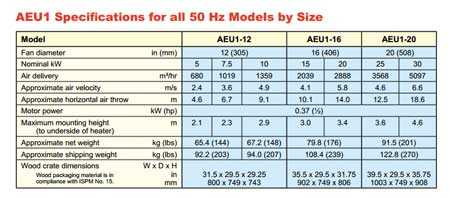
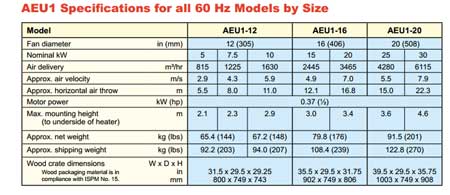
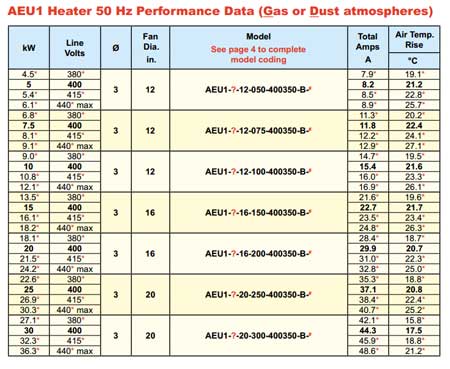
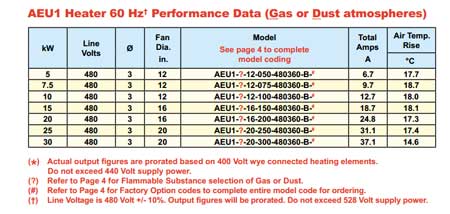
Hazloc’s AEU1 air heaters, available in both 50 Hz and 60 Hz models, are used to provide reliable and consistent ambient heating in hazardous areas Zone 1 and Zone 2 – ideal for warming enclosed workspaces which are “sheeted-off” for offshore shot blasting and industrial painting of tanks, pipework and structures.
The following table establishes the correlation between paint curing time and substrate/ambient temperatures.
Paint Drying & Curing Time
Substrate Temperature
5°C
10°C
23°C
40°C
Surface (Touch) Dry
1 hour
45 minutes
30 minutes
15 minutes
Walk-On-Dry
10 hours
9 hours
7 hours
4 hours
Dry To Over Coat (Minimum)
5 hours
4 hours
2 hours
1.5 hours
Drying and curing times are determined under controlled temperatures and relative humidity below 85%.
Tabled data based upon JOTUN Pioneer Topcoat technical data sheet.
Offshore Shotblasting & Painting
Designing-out risk through careful specification of electrical heating that eliminates or minimises danger is a key consideration for offshore multi-disciplined contractors.
All thought and effort is geared towards preventing sparks in explosive atmospheres.
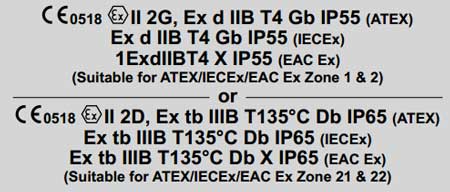
Hazloc Explosion Proof AEU1 air heater is ATEX Certified and designed to provide primary or supplementary heating for comfort or freeze protection in hazardous area (Gas or Dust) atmospheres.
Zone 1 Paint Shop Containers
This paint shop and storage container manufactured by Trans Construction AS is typically used for storing and mixing paint. The hazardous area paintshop container is insulated to A60 and fully equipped with a mixer bench, storage lockers and ventilation supply.
Hazardous Area Light, Heat & Power For Onshore Paint Spray Booths
Whether paint spraying is done in onshore booths or offshore workshops it is impossible to avoid flammable atmospheres during the spraying of flammable liquids, therefore the control of ignition sources in hazardous areas is essential. Hazardous area classification, according to European Directives such as ATEX, identify such workplace locations into Zones dependent upon the concentration and duration of flammable gas, vapour or liquid.
Electrical equipment including heaters, lighting and power distribution equipment such as plugs and socketsMUST be hazardous area certificated for location inside the spray area.
For onshore applications we can provide hazardous areafixed, portable or temporary heating, lighting and power distribution for paint spray booths, spray rooms, store rooms, drying and curing ovens.
We service both spray booth manufacturers and clients planning to retrospectively upgrade.
The EXHEAT Bulldog – safe electrical heating for hazardous area paint spray booths. ATEX certified portable heaters for dry filter extraction chambers.
Typically, onshore Paint Booths & Rooms are galvanised mild steel plenum chambers used for the application of wet spray paints such as solvent based or water based paints, lacquers and stains. The chamber works by extracting the paint overspray in to the atmosphere through an efflux cowl, via an exhaust fan and suitable filter media – paint spray booths provide separation from sources of ignition, prevent fire spread and overspray.
Conclusion
Hazardous Area Air Heaters
Significant drying time reductions can be achieved using electric heaters to improve local heating and increase the surrounding ambient temperatures – electrical heaters can be used to improve labour productivity, paint surface coverage rates and faster job completions based on an accelerated curing time of paint coatings.
Slow paint curing and drying can be overcome in protected workshop environments with potentially explosive atmospheres using appropriately certified hazardous area electrical heaters. The heater MUST only be used in atmospheres that are compliant with the hazardous area atmosphere certification – talk to us about your specific requirements.
Clearly, where multiple paint coats are required the drying time savings also multiply – contact us to discuss the benefits explosion-proof electrical air heaters provide for hazardous area heating applications.
Contact T&D, The “EX” Experts – trust us to make hazardous areas safe.
T&D supply the Offshore & Marine industries with an extensive range of Hazardous Area & Explosion Proof Equipment.
The design and dual ATEX & IECEx Hazardous Area Certification makes the Hazloc AEU1 explosion proof air heater suitable for providing air to heating oil and gas drilling rigs, petrochemical facilities, refineries, chemical storage and handling, paint storage areas, sewage treatment plants and whiskey distilleries.
EXPERTS IN WINTERISATION SOLUTIONS FOR INDUSTRIAL & HAZARDOUS AREA ENVIRONMENTS
Thorne & Derrick hold the largest UK stocks of frost protection & winterisation equipment to help keep your plant and personnel operational during the winter months.
Thorne & Derrick understand that prolonged periods of low ambient temperatures can bring operations to a standstill costing thousands of pounds in lost downtime.
Experts in heating solutions for use in industrial & explosive atmospheres, Thorne & Derrick have the knowledge & expertise to help clients prevent unnecessary down time this winter.
We can provide overnight delivery of Trace Heating Cables at the most competitive prices to guarantee frost protection of your pipelines and mechanical services.| Ask About Our Heat Trace Design Service.
💡 Contact us today and our skilled and friendly team can provide technical support as well as reliable, fit for purpose and compliant solutions to suit your exact requirements.
➡See our Winterisation blog TOP PICKS, including our most read articles about Trace Heating and the requirement for electrical heating products and systems to combat and mitigate Winter weather effects.
Directives such as ATEX and IECEx provide internationally recognised standards for the installation and use of electrical equipment in potentially explosive hazardous areas.
This article specifically focuses on Electrical Heating Equipment and has been written for all people who have an interest in understanding best working practices for installing and maintaining electrical heaters in potentially explosive atmospheres.
The European Directive 94/9/EC is in place to ensure manufacturers of process and hazardous area heaters, such as EXHEAT, meet stringent guidelines and only when these guidelines are satisfied can a product be certified for use in explosive atmospheres.
However, it is just as important that the end user knows and understands their responsibility for the safe installation, use and maintenance of such equipment.
EXHEAT Heaters Typical Hazardous Area Heating Applications.
In the UK, DSEAR (Dangerous Substances and Explosive Atmospheres Regulations) are provided by the HSE for employers with the aim “to protect people from fire and explosion risks related to dangerous substances and potentially explosive atmospheres. DSEAR places duties on employers to protect people from risks to their safety from fires, explosions and similar events in the workplace.”
From the resultant investigation two main issues were raised. First, although the heater was certified for use in hazardous area, it was not suitable for the corrosive atmosphere it was being used in. Secondly, the duty holder did not have a comprehensive list of all such heaters in use and could not therefore carry out a routine planned inspection and maintenance program.
Pictured below are some common types of EXHEAT electrical heaters used for space heating and process heating in hazardous area locations and explosive atmospheres.
All such heaters should be installed, used and maintained strictly in accordance with manufacturers recommendations and under any conditions stipulated under its Ex certification.
Electrical Heating In Hazardous Areas With EXHEAT
EXHEAT FAW Air Warmers – commonly used for space heating in paint stores or small plant areas storing flammable materials.
EXHEAT FLR Radiators – a flameproof radiator used for space heating in explosive areas such as laboratories, firework factories and ammunition stores.
EXHEAT Immersion Heaters– used for frost protection or pre-heating of oils, water and process liquids.
EXHEAT HEF Enclosure Heaters – anti-condensation and space heater for small enclosures such as control & instrumentation cabinets.
EXHEAT In Line Heaters – for frost protection and pre-heating applications including fuel oil heating to ensure pumping viscosity.
In order to appreciate the risks of electrical heating in hazardous areas, let’s first take a brief look at some of the fundamentals for understanding hazardous areas. If you’re an expert in this area you may wish to skip the next couple of paragraphs.
What Is A Hazardous Area?
Fire Triangle
To be specific a hazardous area is defined as “an area in which the atmosphere contains, or may contain in sufficient quantities, flammable or explosive gases, dusts or vapours.”
In such an atmosphere a fire or explosion is possible when three basic conditions are met.
This is often referred to as the “hazardous area” or “combustion” triangle.
Hazardous areas are assessed and defined by:
The types of hazard (gas, vapour, dust or fibre)
The likelihood that the hazard will be present in flammable concentrations (zoning)
Temperature Classification (Auto Ignition temperature)
There are many articles which go into great depth about hazardous areas, gas groups and zoning but I’ll skip past most of that and concentrate on Temperature Classification as this is particularly relevant to electrical heating equipment.
Temperature Classification (Auto Ignition Temperature)
To create an explosion you need fuel, oxygen and an ignition source. The ignition source is often thought of as a spark or flame. Obviously when using electrical equipment there is the risk of incendive arcs or sparks.
What also needs to be considered is the surface temperature of the equipment being used. All electrical equipment will give off some heat but the whole purpose of electrical heating equipment is to heat up and get HOT.
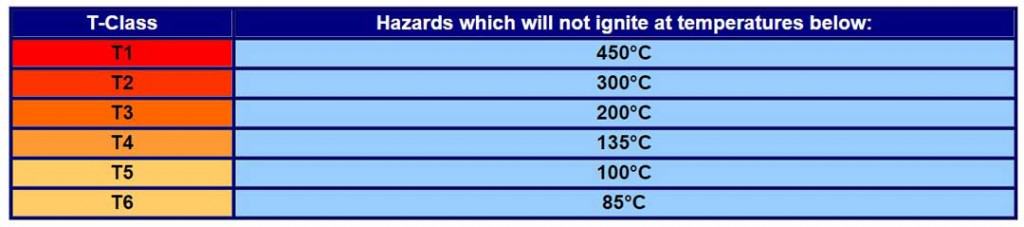
Hazardous Area Temperature (T) Classes
The T rating of an area refers to the temperature at which the flammable substance will auto ignite. See table above. For example, Acetylene has an auto ignition temperature of 300ºC and therefore the T classification for an area where Acetylene may pose a flammable risk would be T3 (Not T2, I’ll explain why in a moment).
This means electrical heating in hazardous areas should not be installed in that area unless it has a T classification of T3 or less.
T4, T5 & T6 would all be acceptable but T2 and T1 would not.
For example If you were to install a 30KW fan heater in such an area and the fan heater was rated T2, there is the potential for the fan heater surface temperature to reach 300ºC. Combine that with a flammable mixture of Acetylene and…. BANG.
Video – Acetylene Tanks Explode In Dallas Texas
Question
Could a T4 rated air heater be used in an area where Ethyle Nitrate is a flammable risk (the auto ignition temperature of Ethyle Nitrate is 90ºC)?
If you know the answer, you understand T-ratings, if you don’t, give T&D a call and we can assist.
Just because an electrical heater is rated T3, the user also needs to consider ambient temperature conditions. As with all hazardous area certified equipment, heaters are certified under certain conditions.
For example, an EXHEAT FWDT-T3 is rated at T3 but the equipment is only permitted for use in ambient conditions of 60ºC<Tamb<+40ºC (see certificate example). If the electrical heater is used in ambient conditions above the limit, there is a risk that the surface temperature will exceed 200ºC (T3).
Another risk is that any safety components (for example over temperature cut-out) may fail to operate if exposed to temperatures above or below the safe working range.
EXHEAT FWDT-T3 ATEX Certificate – Sample
EXHEAT FWD-T Flameproof Air Warmers – certified hazardous areas where the potentially explosive atmosphere is classified as a Zone 1 or 2 (IIA, IIB, IIC) gas group, or a Zone 21 or 22 (IIIA, IIIB, IIIC) dust group. If in about, call T&D.
Installation & Maintenance Of Ex Electric Heaters
Useful Information
Electrical heating in hazardous areas should only be used for its intended purpose and as per manufacturer’s instructions. Sometimes, EX certified products have conditions stipulated for their safe use. An X on the certificate number references this.
It is the duty holders’ responsibility to ensure these special conditions are taken into consideration. For example, an immersion heater may require to be fully immersed at all times during operation. In order for a duty holder to guarantee this, they would need to consider installation of low level monitoring in the tank to ensure the heater remained switched off if it was not fully immersed.
Installation Of Electric Heaters In Hazardous Areas
Inspection of heaters should be carried out on receipt of goods to ensure no damage has occurred during transit.
Before installation, insulation resistance tests should be carried out on the heating elements and the IR reading should be above acceptable value as stipulated by the manufacturer. This value will be clearly stated in the O&M literature.
Insulation Readings
💡 TIP – low insulation readings (IR) are often due to moisture in the enclosure terminal or in the heating elements. Silica gel packs can be used to draw out any moisture and the IR test should be repeated after 24hrs.
Electrical heating in hazardous areas should only be installed in the orientation intended. For example, horizontal immersion heaters should not be installed vertically. We have seen examples of clients mounting heaters, such as the FWDT, vertically as space did not permit horizontal mounting.
Space heaters should never be covered and airflow should not be restricted as it could prevent natural convection. Ambient temperatures should never exceed the safe working temperatures stipulated by the manufacturer.
Maintenance of Electric Heaters
Ensure the risk of flammable atmosphere is removed before any maintenance work is carried out. Electrical heating equipment where elements are exposed (space heaters) should be regularly checked for accumulation of dust which should always be removed.
Equipment should always be fully isolated before any work commences.
Only Manufacturers parts should be used for any repairs. Use of non-approved parts would invalidate any EX hazardous area certification.
Inspections should be routinely carried out 3 monthly, 6 monthly and annually. Manufacturers O&M manual will provide the necessary checks which should be carried out at each inspection.
For detailed guidelines on inspection and maintenance of electrical apparatus in explosive atmospheres, please refer to IEC/EN 60079-17.
IEC 60079-17:2013 applies to users and covers factors directly related to the inspection and maintenance of electrical installations within hazardous areas only, where the hazard may be caused by flammable gases, vapours, mists, dusts, fibres or flyings.
How Can We Help?
For equipment sales and specification guidance about electrical heating in hazardous areas please contact T&D.
T&D are Process & Hazardous Area Heating experts with over 30 years’ experience serving petrochemical, oil and gas, utilities, food and beverage and pharmaceuticals.
Working in partnership with EXHEAT, we are able to offer a full range of electrical heating equipment which is certified for use in explosive atmospheres – this includes immersion heaters, air/space heaters, fan heaters, line heaters, water heaters, oil heaters and drum heaters.
Together we take our design responsibility seriously and help to provide our clients with the necessary information to ensure electrical heating in hazardous areas is safe, reliable and conforming to the required classifications.
Invitation – network, engage, promote
Thorne & Derrick are inviting you to join LinkedIn’s fastest growing Discussion Group – Process & Hazardous Area Industries : Heat Tracing, Gas Detection, Fluid Control & Flow Measurement. News, projects, videos, promotions, whitepapers, jobs, webinars, press plus much more.
ABOUT US
Thorne & Derrick International are your single-source supplier of Electrical, Mechanical, Process & Instrumentation Equipment. T&D provide an outstanding service to UK and international customers – we are highly customer responsive and absolutely committed to providing a world-class service.
T&D supply utilities, power, renewable energy, construction, rail, manufacturing, food/beverage, mining, oil, gas and petrochemical industries – distributing 100,000+ products from 100+ manufacturers from multi-million pound stocks. Since 1985 we have established a solid reputation based on service, integrity and trust.
Press Release Date: 02.04.2020 uploaded by Chris Dodds (T&D Sales + Marketing Manager) World’s First Fully Certified ATEX Doors Thorne & Derrick International, the Experts in Equipment for Explosive Atmospheres, today announce the signing of a Commercial Distribution Agreement...
Press Release Date: 04.07.2019 uploaded by Chris Dodds (T&D Sales + Marketing Manager) Category: Stockist Distributor Agreement Announcement Thorne & Derrick International announce that they have signed a Preferred Distributor Agreement with Raytec, the world leading manufacturer of LED...