ATEX Explosion Hazards Limited has spent nearly 50 years improving the health & safety of workers at work, in explosive atmospheres, in various industries.
In their recent white paper, ATEX Explosion Hazards Limited explore the language of explosion safety. From the earliest recorded dust explosion in Mr Giacomelli’s bakery in the Piedmont area of Italy in 1785, through explosions in UK flour mills a century later, to the language used in legislation of the present day.
Every industry has its own language, terms and acronyms. Below is a Glossary of the common terms in use in the Explosion industry today and how they are employed in current directives. As well as a short overview of the main directives and legislative instruments that govern our industry as well as the testing and statistics that are used and how to interpret them.
Italy 1785
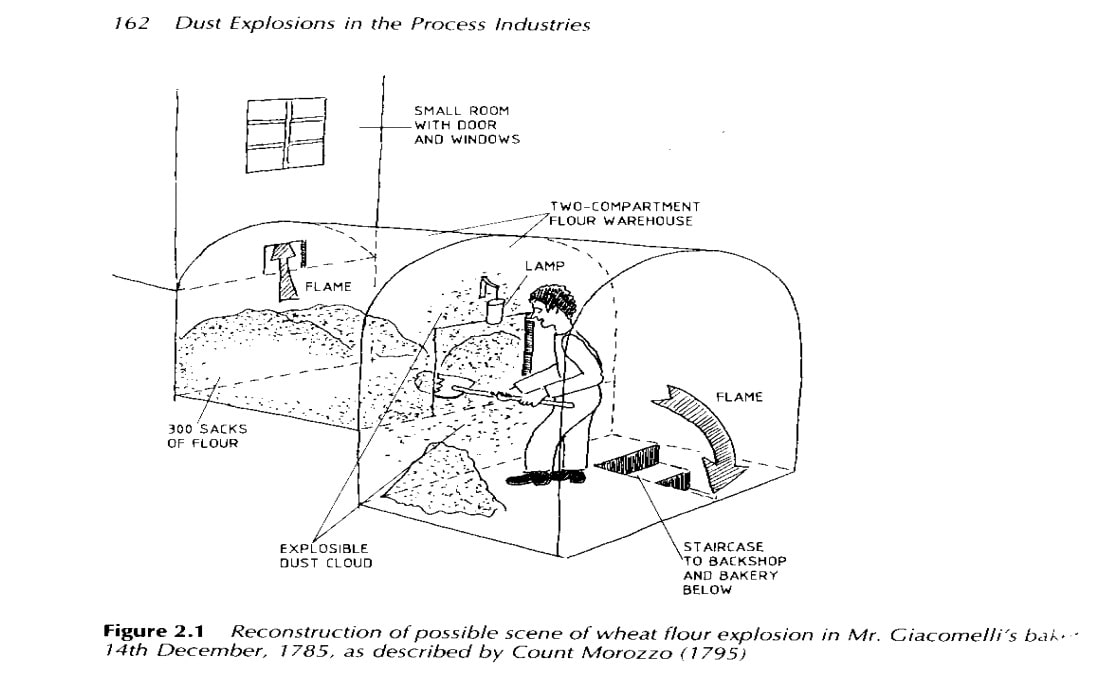
The earliest recorded Dust Explosion happened in Mr Giacomelli’s bakery in the Piedmont area in Italy on 14th December, 1785. A boy shovelling flour by naked candlelight from one level of a warehouse to another had his face and arms scorched in the blast, which blew out windows and released flames into the street.
Another boy, seeing the flames coming towards him, jumped off a scaffold and broke his leg. The accident was reported to be due to the dryness of the corn, as there had not been any rain for the last 5 to 6 months in the Piedmont area!
Figure 2.1 Dust Explosion in the Process Industries
UK Explosions in Flour Mills, 1888
A century later in the United Kingdom, a mill owner called Reynolds issued the following instructions to his staff; Within recent years, several disastrous explosions have occurred in flour mills, resulting in loss of life and destruction of much valuable property.
As all flour mills are liable to such explosions at any moment, it is desirable that the workmen should understand the chief causes of danger and how they may be best avoided. Explosions may be caused when any dust is mixed with air and a naked light brought into contact with the mixture. Flour sharps, stive wheat dust, smut-dust or sweepings will all explode either singly or when mixed.
It is therefore necessary of all who work in the mill that the following precautions shall be most carefully observed.
1. Never stir or mix up loose dust while gas is lit.
2. Never examine a machine with naked light.
3. NEVER ENTER ANY SIVE OR DUST ROOM WITH NAKED LIGHT
4. Never strike matches or smoke about the premises.
5. Where is necessary to sweep or dust at night, do it as quietly as possible
to avoid agitating the dust.
6. Always use closed lamps within the mill
7. Report a leakage of gas directly you find it.
We trust all our workmen will see the necessity for extreme care and the use of lights of all kinds. Should any man exhibit carelessness in this respect after this warning, we shall be obliged to dismiss him.
J Reynolds & Co.
October 1888
Irish Factories Act, 1955
“In the case of a process giving rise to dust of such a character and to such an extent as to be liable to explode on ignition, then, unless the plant is so constructed as to withstand the pressure likely to be produced by any such explosion, all practical steps shall be taken to restrict the spread of the effects of such an explosion by the provision, in connection with the plant, of chokes, baffles, and vents, or other effective appliances”.
EU July 2006
Organisations in the EU must follow the directives, to protect employees from explosion risk in areas with an explosive atmosphere.
This ATEX directive consists of two EU Directives:
1. ATEX 153 or (ATEX 137) Directive 99/92/EC – The responsibility of the User:
This Directive aims at establishing and harmonising minimum requirements for improving the safety and health of workers potentially at risk from explosive atmospheres.
2. 114 Directive 2014/34/EU – Harmonised requirements for the Manufacturer to sell to the User: The Directive of the European Parliament and the Council of Ministers on 26 February
2014 relating to Free trade of goods and the harmonisation of the laws of the Member States relating to equipment and protective systems intended for use in potentially explosive atmospheres.
UK Version
The UK version of the EU directives is known as the Dangerous Substances and Explosive Atmospheres Regulations (DSEAR). DSEAR requires employers to assess the risks of fires and explosions that may be caused by dangerous substances in the workplace & complements the requirement to manage risks under the Management of Health and Safety at Work Regulations.
DSEAR relates to assessments to how people may be affected by dangerous substances and explosive atmospheres. ATEX relates to assessments associated with the equipment that will be used in areas that may be affected by dangerous substances and explosive atmospheres.
CE is Conformity European but UKCA stands for UK Conformity Assessment. As of 1 January 2021, UKCA marking was to replace CE marking.
● NFPA 61: Standard for the Prevention of Fires and Dust Explosions in Agricultural and Food Processing Facilities
● NFPA 68: Standard on Explosion Protection by Deflagration Venting
● NFPA 69: Standard on Explosion Prevention Systems
● NFPA 85: Boiler and Combustion Systems Hazards Code
● NFPA 484: Standard for Combustible Metals
● NFPA 652: Standard on the Fundamentals of Combustible Dust
● NFPA 654: Standard for the Prevention of Fire and Dust Explosions from the Manufacturing, Processing, and Handling of Combustible Particulate Solids
● NFPA 655: Standard for Prevention of Sulfur Fires and Explosions
● NFPA 664: Standard for the Prevention of Fires and Explosions in Wood Processing and Woodworking Facilities
Glossary of Terms:
BZ Number: A product train of width 2 cm and length 4 cm is deposited on a ceramic plate and a glowing platinum wire inserted in an attempt to ignite the dust. After successful
ignition, the severity of the subsequent burning is observed.
Test Result
Class
Reference
No ignition
No spreading of fire
1
Table salt
Brief ignition, rapid extinction
2
Tartaric acid
Localised combustion or glowing with practically no spreading
3
D + Lactose
Glowing withou sparks (smoldering) or slow decomposition without flames
Fire spreads
4
H – acid, tabaco
Burning fireworks or slow quiet burning flames
5
Sulphur
Very rapid combustion with flame propagation or rapid decomposition without flame
6
Black powder
Dust Hazard Analysis (DHA): Understand your hazardous materials, systematically evaluate processes risks, and manage by either administrative or engineering controls.
Explosion Proof: Explosion-proof or flame-proof equipment is sealed and rugged, such that it will not ignite a hazardous atmosphere, despite any sparks or explosion within.
Control Systems and Hazard and Operability (CHAZOP): Study more than HAZOP (qv.), control systems and individual failures of the processes.
Computational Fluid Dynamics (CFD): Software that simulates the dispersion of hazardous materials, fire and explosion.
Failure Mode & Effects Analysis (FMEA): Anticipate, identify and detect potential points of failure of design and consequence.
Fault Tree Analysis (FTA): FTA is a top-down, deductive failure analysis in which an undesired state of a system is analysed using Boolean logic, to combine a series of lower-level events.
Gap Analysis gives organisations an overview of the progress they have made in implementing each of the Standard’s controls.
Hazard Identification (HAZID): Risk analysis for early detection of hazards performed at the earliest stage of project development.
HAZLOC: In electrical and safety engineering, hazardous locations (HazLoc) are places where fire or explosion hazards may exist.
HAZOP: verify and test control and operations in your facility are robust and inherently safe, “as far as reasonably practicable.”
Intrinsic Safety: Intrinsic safety designs equipment to operate using minimal energy, insufficient to cause ignition.
Layers of Protection Analysis (LOPA): A method used to evaluate high-consequence scenarios determining if the combination of probability, of occurrence and severity of consequences, meets a company’s risk tolerance.
Occupational Safety and Health Administration (OSHA): A federal agency of the United States that regulates workplace safety and health.
Process Hazard Analysis (PHA): Potentially hazardous materials, to identify and evaluate dangers, control and mitigate by implementing safety measures.
Process Safety Management (PSM): interrelated approaches to managing hazards associated with the process industries and is intended to reduce the frequency and severity of incidents resulting from releases of chemicals and other energy sources.
Risk Assessment (RA): Risk assessments give organisations an indication of the threats facing them, how likely it is that each of those threats will occur and how severe the damage.
Statistics:
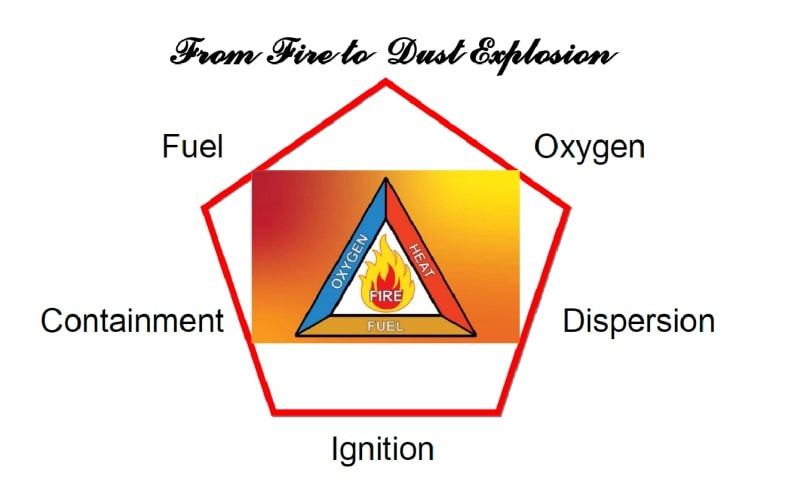
Going back to our basic science class, we have the Fire triangle but we need to add containment and dispersion for a dust explosion.
When presenting these articles we usually present Statistics:
2017
2018
2019
2020
Fires
169
213
250
165
Explosions
68
68
74
60
Injuries
163
78
118
88
Fatalities
13
23
8
10
So there are more fires than explosions. In the EU we assume about 2 explosions per day in industry, but not all incidents are reported. What are we most interested in, when considering process safety:
Life Safety, Plant Safety and Mitigation
Material Properties:
How do you know that a material is dangerous unless you test it?
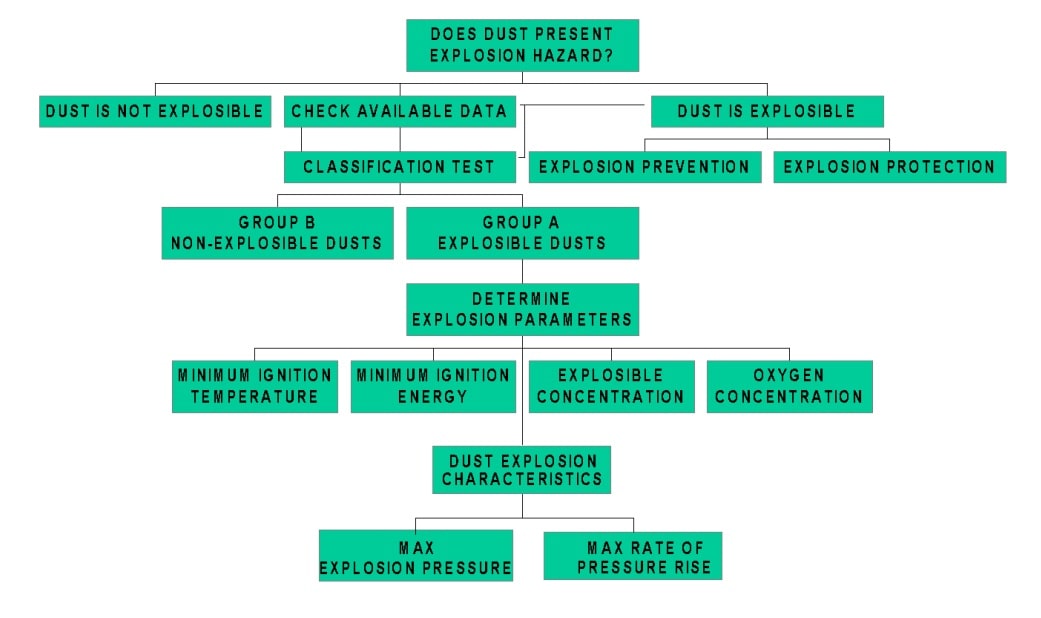
Group A/B (Vertical Tube) Test: Essentially, the dust under test is dispersed in air at ambient temperatures, past a source of ignition and observations of fame propagation made by the
operative.
● Group A is a dust, which is able to ignite and propagate flame
● Group B is a dust, which does not propagate flame
Further testing is required for Group B samples if handled at elevated temperatures >110 degree C.
So what terms do we use to define appropriate sample: particles size (less than 500 micron, potentially explosive, fines less than 100 micron or test sample 63 micron), distribution
usually greater than 30 to 60 g/m3 (you cannot see the hand on the end of your arm), shape (fibre or granular).
Explosion violence falls at higher moisture contents: 0-5% has little effect, 5-10% decreases sensitivity and >25% particles unlikely to stay in suspension.
Where to collect your sample: Horizontal surfaces, girders, floor or inside plant i.e. inside ductwork or inside dust collectors/filters.
Material Safety Data Sheet:
Does the supplier offer an appropriate MSDS? These data sheets are frequently short on specifics:
Minimum Ignition Temperature MIT (cloud)of a dust suspension is the lowest temperature at which it will ignite spontaneously and propagate same. This MIT value is particularly
relevant to problems involving relatively large heated areas of plant e.g. surfaces of dryers, mills, electrical equipment, etc.
Minimum Ignition Temperature: MIT (LIT) 5mm Layer: The test determines the minimum temperature of a prescribed hot surface, which will result in the decomposition and/or
ignition of a layer of powder of specified thickness. The test is particularly relevant to industrial equipment with hot surfaces, on which dust deposits may form. Thicker layers will invalidate the T rating of equipment and may cause ignition.
Dust Minimum Ignition Energy (MIE) Dust Cloud of a dust suspension is the lowest energy at which ignition and flame propagation away from the spark kernel occurs – the value being particularly relevant to identifying potential electrostatic ignition hazards.
Two circuits are employed – capacitive (for electrostatic ignition) and inductive (for friction spark ignition).
In general, three ranges are defined as significant:
Walking across the carpet and touching a metal doorknob can be up to 4 mJ.
A dust is more ignitable at an elevated temperature, i.e. the Minimum Ignition Energy (MIE) is lower.
Concentration Lower Explosion Level (LEL for gases and vapours)or Minimum Explosible Concentration (MEC for powders) is typically of the order 45g/m3 and 30-60 g/m3 respectively. The Upper Explosion Level (UEL) not as clearly defined for powders, but usually is >1000g/m3.
LOC: maximum oxygen concentration in a mixture of a flammable substance and air and an inert gas, in which an explosion will not occur, determined under specified test conditions.
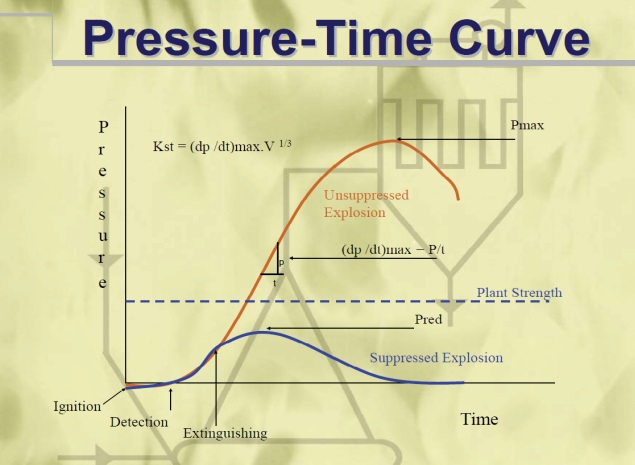
Explosion Characteristics: Kst in bar m/s & Pmax in barg: Although the methods above are relevant for prevention of flame and explosions, to confirm the quantitative assessment of a design for explosion protection, you will need to conduct an actual controlled dust explosion in either the 20 litre or 1m3 test apparatus.
Material
P/max
Kst bar m/s
Methane
8.4
58
Hydrogen
8.2
503
Sugar
8.0
80
Coal
7.7
85
Starch
9.4
150
Cellulose
10.0
160
Milk Powder
8.2
147
Dextrin
8.7
200
Aluminium
11.5
555
As shown, dust explosion pressures can reach the same as gases/vapours and some metal dusts can be as dangerous as Hydrogen.
The speed of the flame may be constant but the surface grows exponentially emitting more heat faster in a confined space, this creates pressure which may eventually break the confinement. To design a protection system these terms are essential. Remember the bigger the vessel, the longer it takes to get to its Pmax, unless the plant strength fails first!
Equipment & Hazardous Area Classification
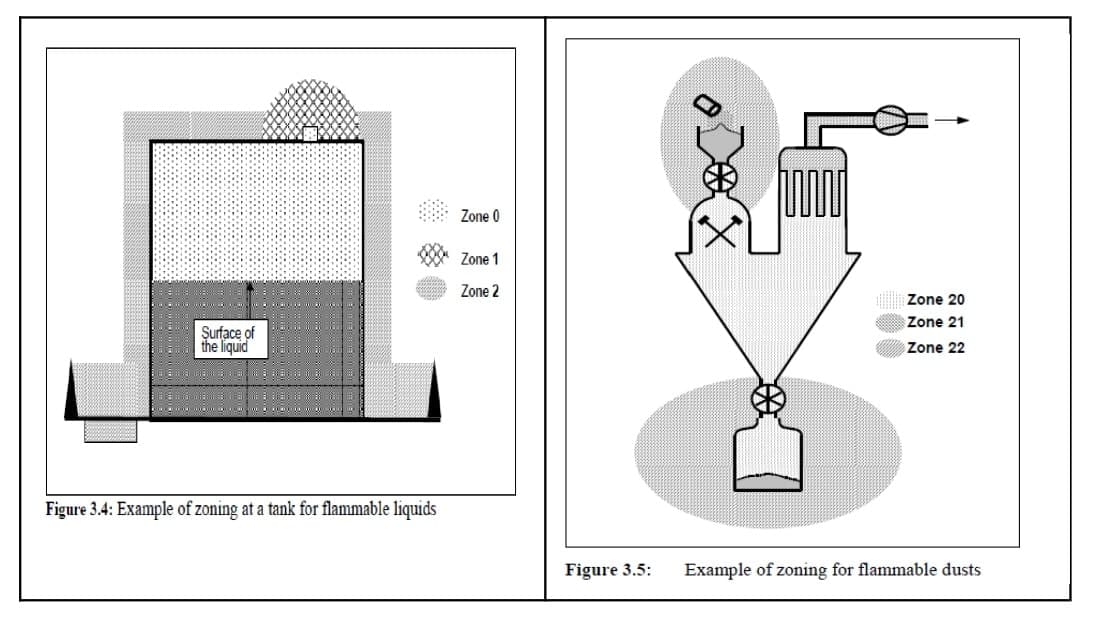
A place in which an explosive atmosphere in the form of a cloud of combustible dust in air is not likely to occur in normal operation (perform their intended function within their design
parameters) but, if it does occur, will persist for a short period only – e.g. outlets from cyclones, clean-side of dust filters, etc.
Historically, the following probability values have been used for guidance (with gases/vapours) and these are commonly applied to solids handling also.
1. Continuous Source (> 1000 hrs. yr-1) yields a Zone 0 / 20 with Equipment Cat 1G/D
2. Primary Source (10 – 1000 hrs. yr-1) yields a Zone 1 / 21 with Equipment Cat 2G/D
3. Secondary Source (<10 hrs. yr-1) yields a Zone 2 / 22 with Equipment Cat 3G/D
You must install the appropriate equipment to the designated Zone
Marking of Equipment – Directive 94/9/EC (Annex II, 1.0.5)
Name/address manufacturer
CE marking + if appropriate notified body number
designation of series or type
Serial number, year of construction
Ex symbol + EEx
Category (M1 / M2 / 1 / 2 / 3) for equipment-group II, ‘G’ (gas) and/or ‘D’ (dust)
Explosion / Ignition protection symbol + (if appropriate) Gas group
Temperature Class or Temperature
Example: EEx 2 G d IIA T4
Certification ensures that the equipment or protective system is fit for its intended purpose and that adequate information is supplied with it, to ensure that it can be used safely.
Explosion Protection Document (EPD):
The EPD must be drawn up prior to the commencement of work and be revised when the workplace, work equipment or organization of the work undergoes significant changes, extensions or conversions.
The employer may combine existing risk assessments, documents or other equivalent reports and incorporate them into the explosion protection document.
The ATEX Directive allows the Explosion Protection Document to be either a separate document or part of a combined safety report and as a whole must cover both technical and
organisational or procedural aspects of explosion prevention and protection. Thus for the majority of process plant, it is recommended that these two aspects be separated and dealt with in different documents.
More than 2000 incidents of gas, mist and dust/air atmospheres occur annually in Europe, causing injuries, loss in production, plant damage and even death. This is not acceptable
and the introduction of the ATEX & DSEAR regulations should be welcomed.
There are many organisations suddenly offering products and services, which can help you through this, but make sure they are reputable, with a history in explosion prevention and
protection.
The ATEX exercise should be programmed and carried out by the employers, with their workers, to make industry a safer and more profitable experience. To do this it helps if you understand the language of explosion safety today.
Declan Barry, MD of ATEX Explosion Hazards Ltd, entered the Explosion business in 1987. His primary objective is to make industry safer by installing appropriate explosion protection solutions with full back up services. He believes strongly that people cause explosions not equipment, yet there is an over-emphasis in industry on area classification, testing and equipment selection, when he believes that the lack of continuous education and training is the primary cause of dust explosions.
EXPERTS IN EQUIPMENT FOR EXPLOSIVE ATMOSPHERES
LEADERS IN ATEX INNOVATION TO THE HAZARDOUS AREA INDUSTRIES
Thorne & Derrick are leaders in the development and distribution of Product Innovations that deliver significant improvements to clients plant, people and operational safety in the explosive atmosphere industries.
Your proactive problem solvers experienced in succession planning for the replacement of obsolete, non-conformant and legacy equipment in hazardous areas.
Your first-choice provider of innovative and competitive solutions to ensure ATEX & IECEx Compliance for Hazardous Area Electrical, HVAC & Process Instrumentation Equipment to UK and international projects.
On the back of delivering his conference paper ‘Fake Products & Certificates’at HazardEx 2023 Live! in Harrogate and receiving positive feedback, Terry plans to take his talk on the road in the North East of England and as well as hosting a webinar on the topic in June.
Terry will be speaking about the problems posed by fake products and certificates, including incorrectly certified products, that enter the market. He will look at just how big the problem is and highlight some solutions to the issue.
Do you work on a Tier 1 or Tier 2 COMAH site in the North East of England? If so are you interested in Terry visiting your premises to deliver his speech to your team please reach out on the following 0191 410 4292
Who Should Attend?
Any person involved in the design, purchase, installation, maintenance, inspection, testing and commissioning of equipment designed for use in explosive atmospheres.
Why Attend?
Improve your knowledge and understanding. Increase awareness and create change to improve safety & compliance. A piece of fake equipment could cause the spark that kills you or your colleagues.
Thorne & Derrick over the years have listened closely to their customers and extensively researched the market to bring their clients fully compliant and correctly certified hazardous area solutions for the safe use in explosive atmospheres.
⚠️ WATCH THIS SPACE ⚠️ – Keep an eye on our social media for the date and time of the ‘Fake Products & Certificates’ webinar planned for June this year. Propose : Sign-up to free trial with GoTo Webinar, commit to date and push (EDM Personal Social Partners)
Seperate Push with
Abstract
Safety and compliance should always come first but unfortunately there are companies that make cost and profit their priority.
There are many examples of fake goods and incorrectly certified products being sold into the explosive atmosphere industry. How big is this problem? How can we all take our share of the responsibility to prevent this? The discussion will highlight some recent examples of fake/non-compliant products and how training and competency levels must improve throughout the supply chain to combat this problem.
About The Author:
Terry McDonald is Sales Manager at Thorne & Derrick and joined the company in 2005 as a graduate technical sales engineer. He has headed their Hazardous Area sales division since 2014. Terry has many years of experience working with Tier 1 and 2 COMAH sites in the UK, as well as clients around the world. He is a passionate supporter of innovation, sharing best practice & knowledge with the aim of improving safety & compliance within the industry. T&D recently won the HazardEx 2023 Delegates’ Award.
To find out more information please read the HazardEx Conference Paper.
Dust Safety Science Podcast
Terry posted a message on LinkedIn about fake ATEX products ahead of his presentation at the HazardEx Conference. He was invited on the Dust Safety Science podcast to discuss the matter.
Chris Cloney and his team had been hearing more about fake systems and fake certificates of systems from Dust Safety Professionals member companies, as well as end-users around the world, so they reached out to Terry to discuss further.
VISION is our monthly round-up of industry news, projects, videos, technical tips, training information, webinars and career opportunities from Thorne & Derrick. Take a moment to Follow Us on LinkedIn to receive future VISION.
PROJECTS & NEWS
Wind Tunnel Heating & Lighting
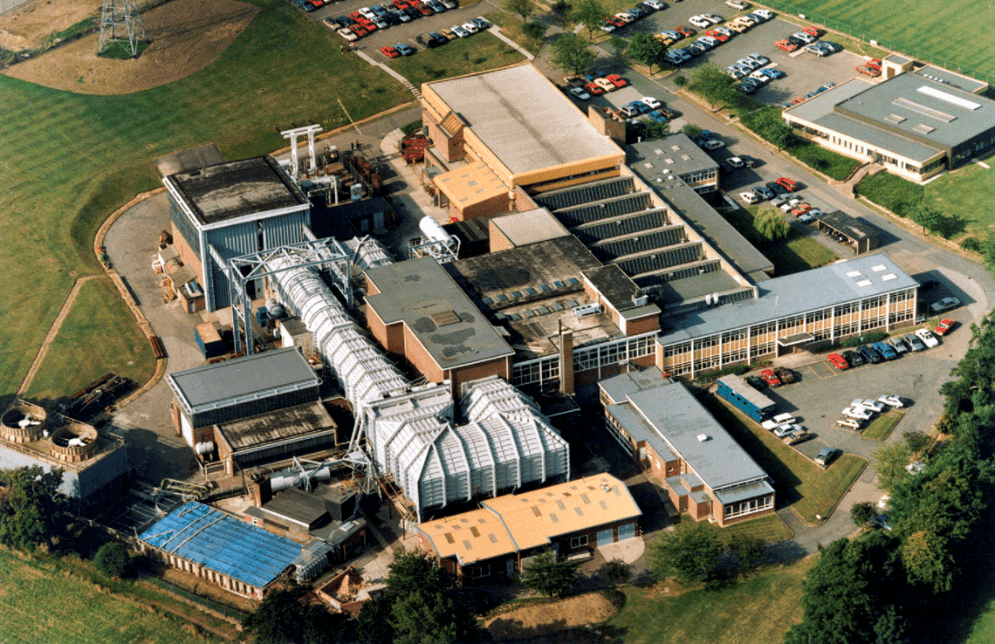
Thorne & Derrick were approached by an independent research facility who had a requirement for ATEX certified heating and lighting for a Transonic wind tunnel. The client reached out to T&D as they were using solvent based paints, along with a variety of chemicals inside of the wind tunnel. This has led to a hazardous area assessment being carried out – the outcome of which deemed the current lighting and heating solutions unfit for purpose or compliant with the ATEX directive.
💡 What is a transonic wind tunnel? A type of high-speed tunnel used to study high-speed aerodynamic flows around aircraft, capable of testing near the speed of sound.
Adam Rowe (T&D Technical Sales Engineer & Hazardous Area Heating Expert) provided a consultative approach to the client and helped to specify a heating solution. Due to the size of the tunnel and the temperature requirements, the client needed a high power temporary solution so that they could direct hot air flows where it was needed.
The client is currently reviewing the heating options provided and also intends to take advantage of trailing the new LFH heater before a purchasing decision is made.
EXHEAT LFH
The EXHEAT LFH 15-440-T3-I Fan Heater is available from stock, and is ATEX & IECEx certified offering up to 38°C heat-up from inlet to outlet.
T&D are currently assisting an international organisation with the design and specification of safety showers for use in explosive atmospheres. Thorne & Derrick were approached to help the client with a one-off requirement for a trace heated ATEX certified safety shower. Following successful technical appraisal, the solution was passed onto another UK site who have since contacted Thorn & Derrick to procure a shower.
The client required a Frost Protected Emergency Safety Shower to ensure safety of workers in the hazardous area environment. Safety Showers typically provide on the spot decontamination for anyone who has been involved in an accident that has resulted in any part of their body coming into contact with hazardous chemicals. According to COSSH, the government’s health and safety regulations, emergency showers are essential equipment for labs, construction sites, factories, chemical plants and anywhere where hazardous substances are used.
Some client requirements for the safety shower were as follows:
Product must conform to all current Irish, EU and Northern Ireland Regulations and associated ISO EN Standards
Shower must be plumbed to a continuous supply of clean continual source of potable tepid running water.
Electrically rated for use in ATEX zones 1 & 2.
Stay-open valve. Operates without the person holding the valve or handle. Valve remains on until the user shuts it off.
Floor mounted trace-tape heated to prevent risk of water freezing
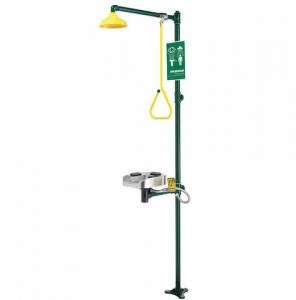
Thorne & Derrick provided the solution of a heavy duty trace heated safety shower, compliant with ATEX Zones 1&2, IIB T3 and is suitable for operation in temperatures of -30°C to +40°C. The Safety Shower selected contains a GRP eye bath to the left hand side of the shower, allowing workers to flush away hazardous substances that could cause injury. Smooth and efficient operation is ensured with 316 stainless steel stay open operating valves.
Following successful efforts to support with lighting designs, Thorne & Derrick have recently secured an order from an industrial Tier 2 COMAH site. Working closely with senior stakeholders, we provided a lighting solution for vehicle maintenance bays which were located on multiple large sites across the UK. Whilst the bays were not classified as an explosive area, the client wanted to maintain consistency across sites. Thorne & Derrick had previously supplied Raytec Spartan hazardous area light fittings to the client, and were asked to provide a lighting design and solution using Raytec Warrior fittings (The newly launched heavy industrial range).
Raytec Warrior Linear | LED Heavy Industrial Light Fitting
The WARRIOR Linear range is ideal for new installations or to retrofit existing fluorescent installations which require high performance, reliable, White-Light illumination. Using Raytec’s field-proven, long-life LED technology, the Linear is specifically designed to provide battery back-up illumination for challenging environments and operation.
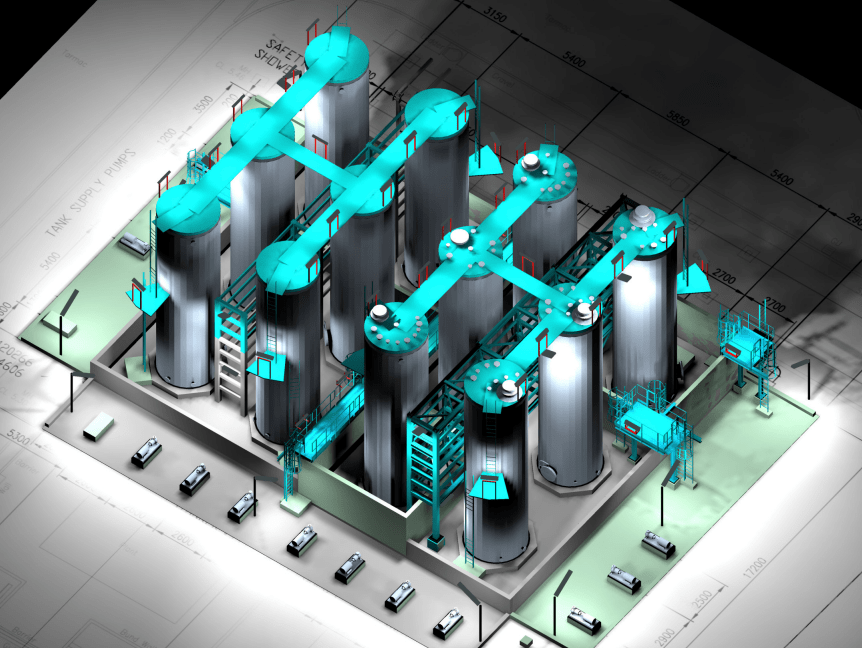
💡 Did you Know? Thorne & Derrick using latest software provide a FREE LIGHTING DESIGN SERVICE for the specification and supply of ATEX & IECEx light fittings to provide safe and reliable lighting in hazardous areas and industrial locations.
Pictured: Thorne & Derrick lighting design – produced as part of a contract to design and supply hazardous area lighting to a new build tank farm.
Following the successful specification, supply and installation of the light fittings to the the client, Thorne & Derrick have now been added to their approved vendor list – allowing the quick supply of future equipment.
INDUSTRY EVENT
Hazardex In The Regions | Swansea & Ellesmere Port
Swansea: 27 April 2022
Ellesmere Port: 18 May 2022
Thorne & Derrick are thrilled to announce that they will be exhibiting at the return of the one-day ‘Hazardex in the Regions’ events for 2022! On the back of exhibiting at HazardEx 2021 last year, Terry and the team will be showcasing a range of products that help to improve safety, increase reliability and optimise productivity in explosive atmospheres.
Featured products will include:
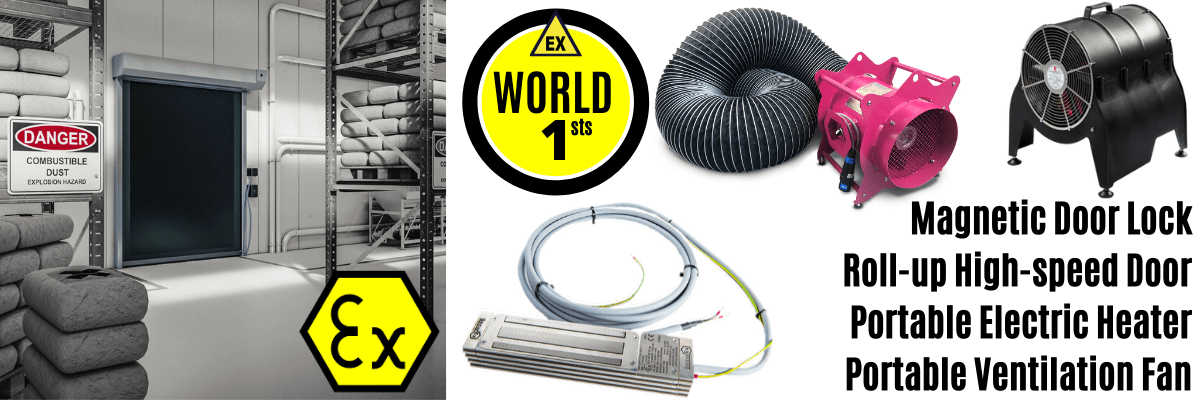
ATEX High Speed Roll-Up Door
ATEX Security Locks
NEW ATEX PIR Security Motion Detector
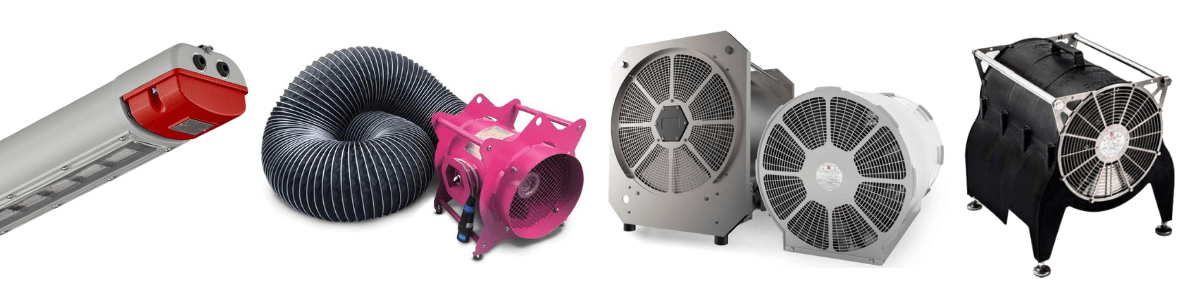
ATEX Ventilation Fans
Hazardous Area Heaters
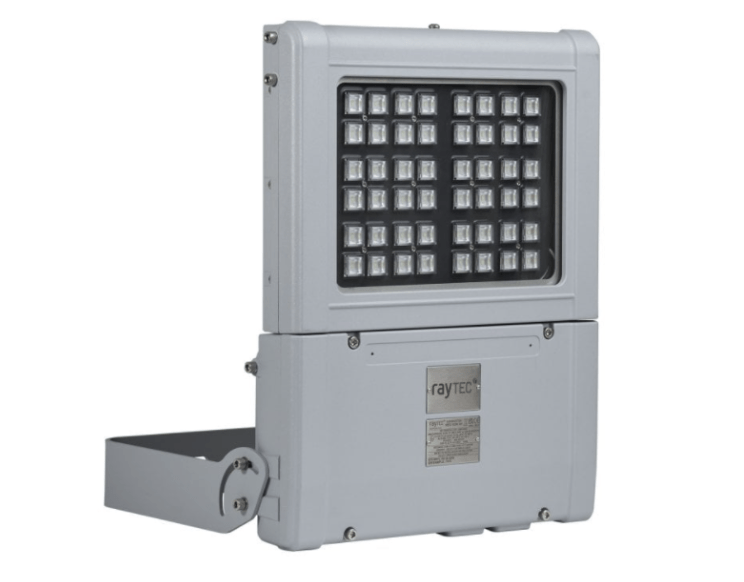
Hazardous Area Lighting (Including the NEW Raytec Mid Power Flood)
Raytec Midpower Flood – To be launched and stocked by T&D in the coming months.
The Hazardex regional events will be taking place on 27th April 2022 at the Village Hotel, Swansea – and on 18th May 2022at Ellesmere Port. Hazardex in the Regions will involve a premium conference programme including several high-profile speakers, such as the UK Health & Safety Executive and the Tank Storage Association, presenting essential guidance and insight of local & national relevance, as well as an exhibition consisting of leading high hazard industry companies.
For the first time ever, Thorne & Derrick are delighted to announce that our very own Terry McDonald will be speaking at Ellesmere Port. Topic TBC – look out for further details in the next edition of VISION.
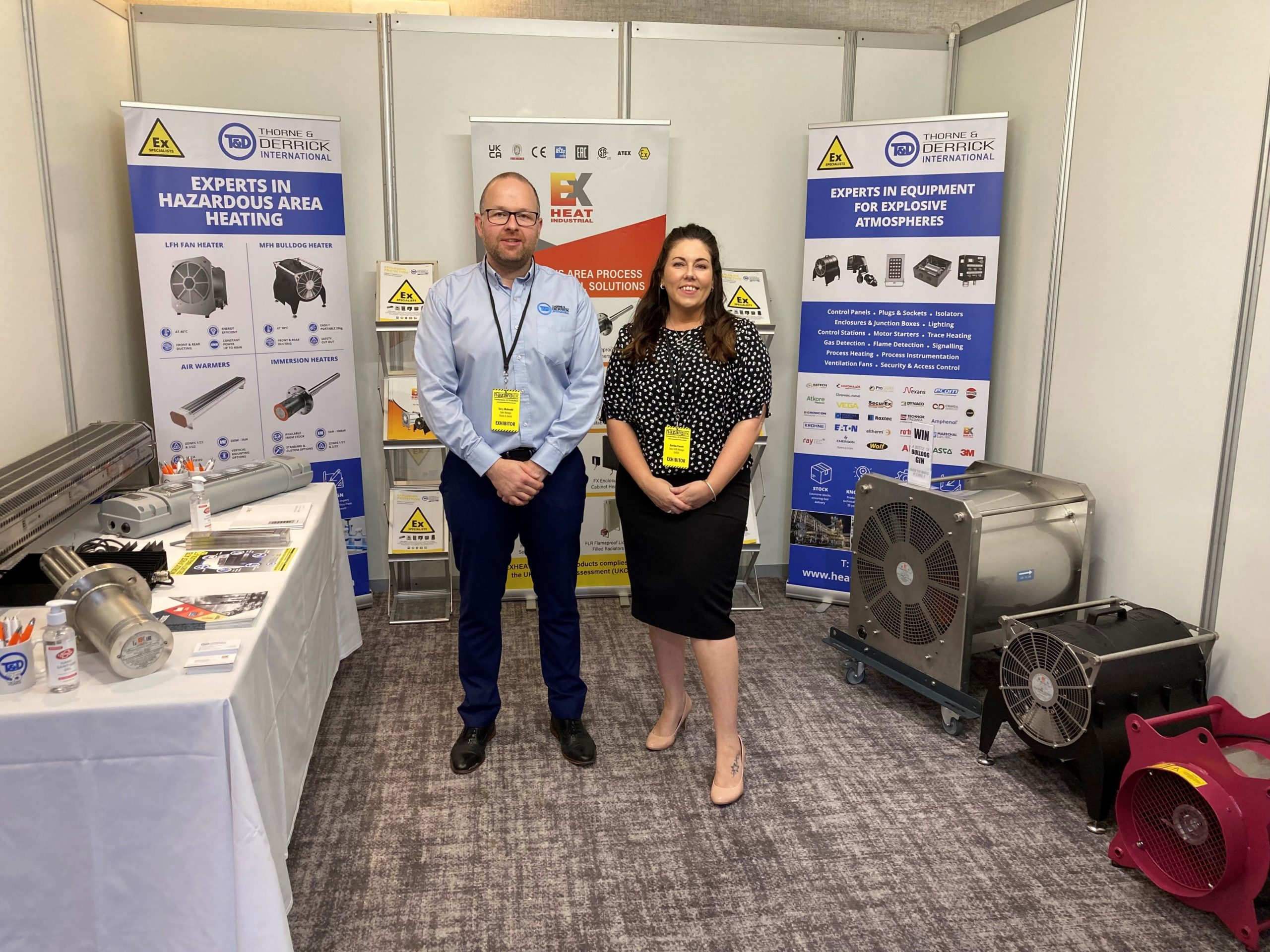
Terry McDonald with Katrina Parrott (Sales & Business Development Manager | EXHEAT) displaying the most extensive range of Hazardous Area Electrical Heating products including their Bulldog, The World’s First Portable ATEX Heater, at Hazardex 2021. To maintain the highest levels of customer service Thorne & Derrick hold the largest stocks of electrical heating products for explosive atmospheres in the UK.
A View From Site
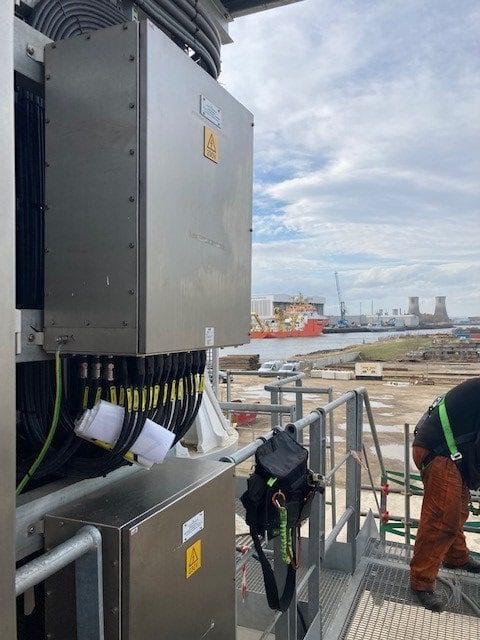
Pictured: A view from site. The River Tees can be seen in the background with the FTAI M/V Pride Module.
At Thone & Derrick, we enjoy getting out onto site to see our products installed. Terry McDonald recently visited our client to assist with some minor snags. Terry commented: “T&D are proud to have been involved with this project, and it was a pleasure to finally get to see it close up”.
Credit: https://www.thenorthernecho.co.uk/
FTAI OCEAN’s Smart Tower System (STS) facilitates safe, flexible and effective well intervention and plug & abandonment operations. The design optimises performance by combining proven modular well intervention technology with innovative sub-system design.
Terminology Explained
Every industry has its own language, terms and acronyms. Below is a selection of the common terms in use in the Explosion industry today and how they are employed in current directives.
This month’s selections:
Intrinsic Safety: Intrinsic safety designs equipment to operate using minimal energy, insufficient to cause ignition.
Explosion-proof: A type of protection that utilises an enclosure that is capable of withstanding an explosive gas or vapor within it and or preventing the ignition of an explosive gas or vapor that may surround it and that operates at such an external temperature that a surrounding explosive gas or vapor will not be ignited thereby.
Non-incendive: A type of protection in which the equipment is incapable, under normal conditions, of causing ignition of a specified flammable gas or vapor-in-air mixture due to arcing or thermal effect.
VISION! BY,
EXPERTS IN EQUIPMENT FOR EXPLOSIVE ATMOSPHERES
LEADERS IN ATEX INNOVATION TO THE HAZARDOUS AREA INDUSTRIES
Thorne & Derrick are leaders in the development and distribution of Product Innovations that deliver significant improvements to clients plant, people and operational safety in the explosive atmosphere industries.
Your proactive problem solvers experienced in succession planning for the replacement of obsolete, non-conformant and legacy equipment in hazardous areas.
Your first-choice provider of innovative and competitive solutions to ensure ATEX & IECEx Compliance for Hazardous Area Electrical, HVAC & Process Instrumentation Equipment to UK and international projects.
Thorne & Derrick are thrilled to announce that they will be exhibiting at the return of the one-day ‘Hazardex in the Regions’ events for 2022! On the back of exhibiting at HazardEx 2021 last year, Terry and the team will be showcasing a range of products that help to improve safety, increase reliability and optimise productivity in explosive atmospheres.
The Swansea regional event will be taking place on 27 April 2022 at the Village Hotel. Hazardex in the Regions: Swansea will involve a premium conference programme including several high-profile speakers, such as the UK Health & Safety Executive and the Tank Storage Association, presenting essential guidance and insight of local & national relevance, as well as an exhibition consisting of leading high hazard industry companies.
This year, Hazardex has made the decision to take our renowned HazLoc safety events on the road by bringing back our one-day regional events for 2022. The events are taking place around the UK at key geographical areas for operators in the UK high hazard industry in order to make it easier for more local attendance and reduce the need for travel.
Please keep an eye on our blog and social media accounts for further updates from what to expect when you visit our stand.
The event’s tabletop exhibition area will consist of many leading high hazard industry-related companies showcasing their latest products and services. There will be exceptional opportunities for networking, with attendees from government agencies, regulators, certification bodies & training providers, consultants and product manufacturers meeting up with senior engineers and safety managers from the high hazard and process industry owner/operators to share their experiences.
Attendees are senior engineers and safety managers from owners/operators, government agencies, regulators, certification bodies, training providers, consultants and product manufacturers who meet up to share their experiences & network.
Thorne & Derrick will be featuring a range of products and solutions including innovations in Power, Heat, Ventilation, Lighting & Security for use in harsh industrial and hazardous area environments – helping to improve our clients’ operational efficiency and safety.
For further information about Hazardex in the Regions please contact:
Contact Hazardex Event Director Russell Goater
Tel: +44 (0) 1732 359990
Terry McDonald with Katrina Parrott (Sales & Business Development Manager | EXHEAT) displaying the most extensive range of Hazardous Area Electrical Heating products including their Bulldog, The World’s First Portable ATEX Heater, at Hazardex 2021. To maintain the highest levels of customer service Thorne & Derrick hold the largest stocks of electrical heating products for explosive atmospheres in the UK.
Thorne & Derrick are delighted to announce that we have been voted Winners of the Award for ‘Best Customer Service’ at the annual HazardEx Gala Dinner on 6th October 2021. The competitive Award category at the prestigious event was for providing excellent customer service over the last two years.
LEADERS IN ATEX PRODUCT INNOVATIONS
POWER | HEAT | VENTILATION | SECURITY
Thorne & Derrick are leaders in the development and distribution of Product Innovations that deliver significant improvements to clients plant, people and operational safety in the explosive atmosphere industries.
Your proactive problem solvers experienced in succession planning for the replacement of obsolete, non-conformant and legacy equipment in hazardous areas.
Your first-choice provider of innovative and competitive solutions to ensure ATEX & IECEx Compliance for Hazardous Area Electrical, HVAC & Process Instrumentation Equipmentto your UK and international projects.
Over the last 3 years, Thorne & Derrick have introduced several products which have led to improved efficiency, reliability and productivity in the hazardous area and process industries.
Hazardous Area Lighting For Confined Spaces
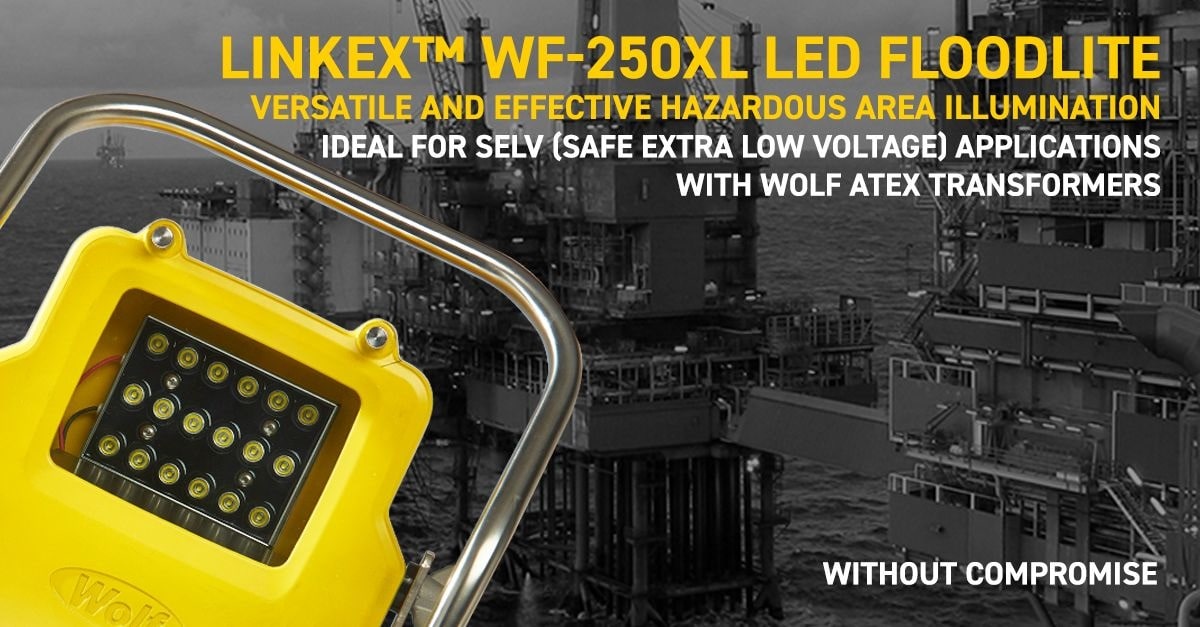
LinkEx™ WF-250XL LED Floodlite
If you’ve ever been dazzled by floodlight glare in a pitch black tank then Wolf Safety have developed the ideal solution – their robust, compact and lightweight floodlight – the WF-250XL.
Truthfully, a totally enclosed tank in a hazardous area which needs inspecting, cleaning or repairing is never going to win any prizes for workplace of the month. You need good portable hazardous area lighting just to see where you’re going, let alone carry out the task.
WF-250XL is useful when working as part of a team as the floodlights can be used in different locations within the tank preventing being dazzled by the glare of your own light or those of your colleagues.
The LinkEx™ WF-250XL LED Floodlite is designed to give the optimum level of light for working in smaller hazardous area confined spaces. Available in high and low voltage models, it is ideal for 24 volt applications with a limited power supply, where up to 8 floodlights can be connected from just one Wolf transformer.
The robust LinkEx™ WF-250XL Floodlite, is easy to carry and more economical than comparable units. It produces over 3,000 lumens of white light, which is more than enough to illuminate a 5m square tank or a similar sized space without dazzling.
Confined Spaces | HEAT | VENTILATION | POWER | LIGHT
“Users tell us our more powerful WF-300®XL Floodlite, which provides over 6,000 lumens, is ideal in most hazardous area applications but can be too intense when working in small spaces,” said Michael Morley, our Technical Director.
“The WF-250XL LED not only solves that problem but also offers great lighting performance in confined spaces.”
“It effectively illuminates those smaller work areas when using a limited power supply, providing the optimum level of lightfor working in confined spaces at lower cost. It’s also lighter and more compact than similar products, is easily carried and consumes less electrical power.”
Versatile & Effective Hazardous Area Lighting Ideal For Safe Extra Low Voltage Applications With Wolf ATEX Transformers
Fully compliant with the latest ATEX and IECEx standards, including OPIS (optical intrinsic safety), the unit is fitted with a highly reliable LED array designed to provide at least 100,000 hours of working life. The product’s design and construction incorporate cooling fins which ensure effective heat dissipation for the LED array.
Robust and easily maintained, it features Wolf’s unique SOVI™ safety technology, and both the HV and LV floodlights are certified safe down to 0 volts.
Designed with long term maintenance in mind, a full range of certified spares ensures that most parts of the floodlight can easily be replaced in a safe area on site by a competent electrician.
With full application support being available from our technical team, the WF-250XL offers an efficient, cost effective and highly versatile lighting solution for use in potentially explosive atmospheres, even in the world’s harshest environments.
Manufactured from marine grade powder coated aluminium the unit’s enclosure is tough enough to take the knocks, while its lens is made from toughened glass which is scratch, impact and chemical resistant.
Its stainless steel frame ensures that the light can be directed at the work area and provides additional protection for the lamp.
When clear vision and brilliant LED light is required in hazardous area locations or confined spaces with potentially explosive atmospheres, Wolf Safety lights provide bold, bright and unfailing portable and temporary lighting. Since 1912, Wolf has been trusted to light the world’s most hazardous and hostile environments – with ATEX & IECEX certified portable lights to provide safe lighting in explosive atmospheres.
Press Release Date: 02.04.2020 uploaded by Chris Dodds (T&D Sales + Marketing Manager) World’s First Fully Certified ATEX Doors Thorne & Derrick International, the Experts in Equipment for Explosive Atmospheres, today announce the signing of a Commercial Distribution Agreement...
Press Release Date: 04.07.2019 uploaded by Chris Dodds (T&D Sales + Marketing Manager) Category: Stockist Distributor Agreement Announcement Thorne & Derrick International announce that they have signed a Preferred Distributor Agreement with Raytec, the world leading manufacturer of LED...



















 Thorne & Derrick provided the solution o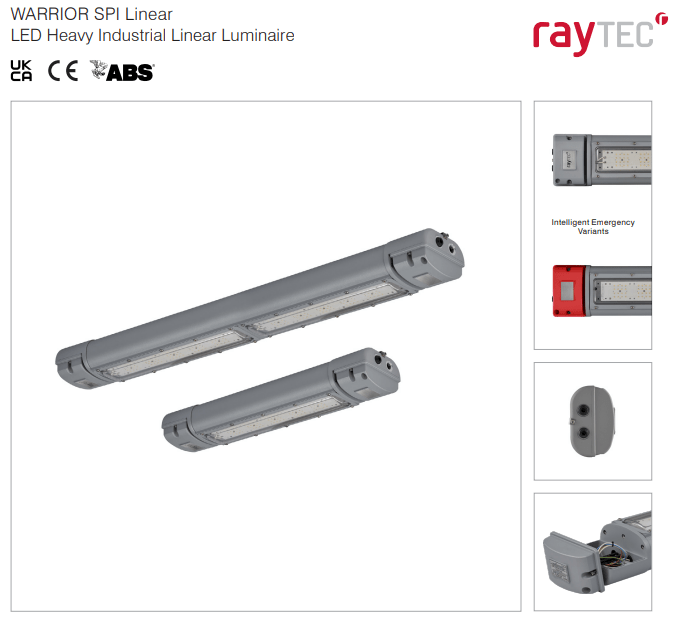






 Innovations