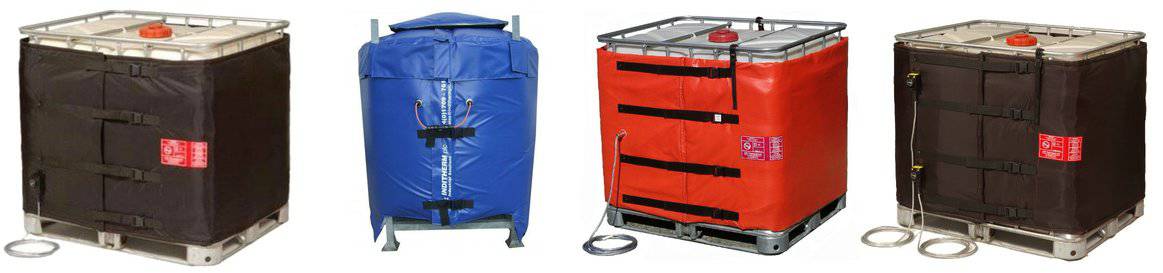
Thorne & Derrick International are the UK’s largest stockistand supplier of IBC Heaters providing excellent technical support and overnight delivery from stock for standard 1000 litre container heaters – the high quality UK manufactured electric heaters provide optimal thermal efficiency and highest levels of function safety. We can produce custom heating jackets designed to fit most shapes to deliver completely uniform surface heating over large areas without heat loss, hot spots or colds spots.
What Are IBC’s?
Intermediate Bulk Containers or IBCs are multi-use, reusable industrial-grade containers designed for the transport, handling and storage of liquids, pastes, semi-solids or solids.
These can include chemicals, food ingredients, sugars, solvents, oils, waxes, cosmetics, detergents and crop science products as well as hazardous class goods such as general and speciality chemicals, resins, paint and inks.
The contents of IBCs, particularly those which may become viscous at room temperature, often needs to be heated or kept at a certain temperature in order to prevent spoiling.
IBC Heaters For Heating Slush Syrup Stored In Containers
IBC Heaters for Heating Slush Syrup
Slush syrups are made by infusing a simple syrup with flavouring agents during the cooking process. Simple syrup is a basic sugar and water syrup made by stirring granulated sugar into hot water until the sugar is dissolved and then it is removed from the heat to cool. During the heating process it is important not to let the temperature of the slush syrup rise above 320 °F (160 °C) to prevent the sugar from caramelising.
Slush Syrup HEATING APPLICATION
Specified Product Solution: Heating Jacket
Heating Jacket Type: IBC Heating Jacket
Area Classification: Suitable for Industrial Areas (ATEX Heaters & Insulating Jackets for Hazardous Areas also available)
Heating Fluid, Medium or Contents: Food Ingredients (Liquid, Powdered, Granulated) – Slush Syrup
IBC Heater Application: To prevent caramelisation of slush syrup stored in 1000 litre containers
T&D – Largest UK Stockist of Heat Trace Cables – UK & International Delivery.
Thorne & Derrick International, based in the UK, can specify and supply from stock an extensive range of Electrical Heating Equipment for industrial and process heating applications – this includes temperature maintenance and frost protection (Winterisation) products for pipework, valves, IBC’s, drums, hoses, tanks and vessels. We produce custom silicone heaters for rapid and high temperature heat-up of complex shapes and surfaces – from concept, design to the delivery of standard or bespoke heaters on the shortest lead times. From the largest UK heat tracing cable stocks we deliver Electric Trace Heating Systems for pipework frost protection, ramp heating, roof/gutter snow melting and de-icing – enquire about our in-house design service.
Combustible dust explosions are a risk in many areas of a facility, but one of the most common locations is the dust collection system. Dust collectors are used both as collection and receiving vessels for solid dust. They separate dust from an air stream by using an array of filter bags or filter cartridges. These usually collect the finest and therefore the most easily ignited dust in a process.
According to FM Global, about 50% of dust explosions occur in the dust collector. For this reason, dust collectors are typically the most commonly protected equipment in a facility.
Many collectors handle dust loadings that are below the explosible limit. However, when filter components are cleaned, either by reverse jet or by shaking, explosible concentrations can be reached. In these conditions, an ignition source can be present and thus trigger an explosion. An ignition source may come through: static electricity, mechanical sparking or by incoming burning dust from upstream equipment such as mills or dryers.
In any hazardous area, special precautions have to be taken to ensure that ignition sources are not present and to ensure compliance with ATEX & DSEAR regulations. This includes installation of appropriate electrical equipment, which should only be undertaken by competent personnel, e.g. CompEx certified electricians.
Questions About Your Dust Collection System
General Process Questions
1. Is there a possibility of flammable vapours entering the dust collectors? i.e. Wet solvent layered dust – if so, is the dust collection system suitably ATEX rated?
2. Is there any potential for toxic and hazardous emissions being released at the outlet of the dust collector?
3. Are there regular inspection hatches across piping and ductwork to allow for cleaning of dusts? Is there a robust formal housekeeping and monitoring regime for dusts in your collection system?
Questions on the Explosion Protection System
4. Is there an explosion protection system on your dust collector? Is there an adequate isolation, containment and suppression system?
5. Is there a system to detect overpressure due to blockages and or on the onset of explosion? How often are instrumentation for this safety system maintained and tested?
6. Are explosion panels present on your dust collectors? Is it correctly sized based on the flammability data of the finest powders collected?
7. Where is the explosion relief material being discharged to? Is it in a safe location away from personnel and building structures? Dust Collectors outside of a facility, with explosion relief panels facing a building wall
Questions on the Control of Electrostatic Discharges
8. Is the dust collection equipment and associated pipework suitably grounded to earth?
9. Is there a maintenance schedule to check at regular intervals to ensure electrostatic continuity to earth is maintained?
10. Are operators given proper DSEAR training and are aware of the importance of controlling potential ignition sources for the dust collection system?
Decades of Combined Process Safety Experience
Benefits of Sigma-HSE Services
The service offered by our experienced team at Sigma-HSE, is much more than a standalone test result.
Over 100 years of combined testing and consultancy experience to ensure that our accurate and methodically generated test data is applied to your process safety applications correctly to protect your staff, your site, the environment and your brand reputation
Free technical advice to ensure the correct solution is selected for your needs
Complementary after sales support, to ensure you are happy with the data and understand the implications for you project
Practical and cost-effective interpretation is where Sigma-HSE Consulting Engineers can also bring a wealth of expertise from many years’ experience providing process safety solutions to national and multi-national companies. Our range of Process Safety Consultancy services extends to:
Provision and Use of Work Equipment Regulations (PUWER)
Specialist Services
Expert Audit Support
Expert Witness
Incident Investigation
Technical Training
Bespoke in-house training covering:
Dust Explosion Hazards
Fire & Explosion Hazards
Electrostatic Hazards
Establishing a Basis of Safety
ATEX / DSEAR
Hazardous Area Classification (HAC)
Process Safety in your Plant
Identifying Process Hazards
COMAH / Seveso III
HAZOP
LOPA / QRA
Incident / Near Miss Investigation
For further information on how Sigma-HSE can partner with your company to create a safer working environment
call our Technical Team on +44 (0)1962 840570.
A full list of services can be found on our website at www.sigma-hse.com.
Contact Details
Sigma-HSE (UK) Ltd, Unit 2 Moorside Point, Moorside
Road, Winchester, Hants., SO23 7RX
Tel: +44 (0)1962 840570
Web: www.sigma-hse.com
About Sigma-HSE (UK) Ltd
Sigma-HSE was formed in 2012 in Winchester, UK. Our vision is to provide a single source of expert knowledge regarding process safety in the work environment. Our broad range of consultancy services include, ATEX/DSEAR Assessments, HAZID/HAZOP Studies, SIL/LOPA Assessments. We have the expertise to facilitate COMAH needs and to meet Process Safety Management requirements.
Sigma-HSE is a fast-growing organisation in the fields of health & safety and the environment, with bases in Europe, Asia and the Middle East, and have associated partnership in USA.
EXPERTS IN EQUIPMENT FOR EXPLOSIVE ATMOSPHERES
leaders in ATEX Innovation To The Hazardous Area Industries
Thorne & Derrick are leaders in the development and distribution of Product Innovations that deliver significant improvements to clients plant, people and operational safety in the explosive atmosphere industries.
Your proactive problem solvers experienced in succession planning for the replacement of obsolete, non-conformant and legacy equipment in hazardous areas.
Your first-choice provider of innovative and competitive solutions to ensure ATEX & IECEx Compliance for Hazardous Area Electrical, HVAC & Process Instrumentation Equipmentto UK and international projects.
Q1 What is the significance of MIE (with inductance) and MIE (without inductance). Which one of them is lower?
A1 MIE (without inductance) simulates a purely capacitive electrostatic discharge such as from isolated conductors in an industrial situation. MIE (with inductance) simulates longer duration discharges as the introduction of the inductor into the circuit, delays the spark discharge to earth, hence this corresponds to MECHANICAL SPARK SENSITIVITY.
As the spark duration is shorter for “pure” static electric discharges so the probability of ignition is less than for the MIE (with inductance) and therefore, in many cases the MIE (with inductance) produces a lower value of MIE. A review of your facility will determine whether electrostatic spark discharges or mechanical sparks need to be assessed and the corresponding MIE test performed.
A2 The maximum surface temperature of enclosure for equipment located in hazardous zones is based on Minimum Ignition Temperature (MIT of a dust cloud) and Layer Ignition Temperature (LIT of powder layer).
After establishing these values, then the lowest value of the two is selected to give the maximum surface temperature after applying a factor of safety as follows:
For MIT data, Max. Allowable Surface Temperature = 2/3 * (MIT)
For LIT data, Max. Allowable Surface Temperature = LIT – 75o
Methods of protection along with Ingress Protection are equally important along with the maximum allowable temperature of equipment.
Q3 What is the significance of particle size for dust explosions. What is the smallest particle size where a dust explosion could not occur?
A3 As the particle size distribution decreases so the explosion properties of the powder changes, sometimes dramatically. Explosion severity will increase, for example aluminium with a particle size of 150µm will have a Pmax of 8 barg and a Kst value of 150 bar.m.s-1 whereas at < 10µm the Pmax rises to 17 barg and the Kst to > 650 bar.m.s-1.
The same applies to explosion sensitivity where the material becomes more sensitive to ignition especially with MIE.
Using the same example of aluminium then the MIE value drops from 100 mJ to <10 mJ as particle size distribution decreases. Usually it is accepted that when the particle size distribution is > 500µm then ignition of a dust cloud cannot occur. However, even where a powder has a large particle size distribution, attrition can occur which can result in fines being present.
Due to their nature these fines will remain in suspension in air for a considerable period of time and should be taken into consideration when performing a risk assessment.
DSEAR Assessment
Q4 What is the difference between St1, 2, 3 and St0 H, 1H, 2H?
A4 Explosion severity is quantified in terms of the Maximum Explosion Pressure and the Max. Rate of Pressure Rise (which in-turn relates to the Kst using Cubic Law, i.e. (dP/dt)max * V1/3= Dust Constant or Kst).
As can be seen Kst is a measurement that is used as it is a constant and does not change with vessel volume. The St Class is based on Kst value, i.e. St 1 (Kst<200 bar.m.s-1 ), St 2 (200bar.m.s-1 < Kst< 300 bar.m.s-1 ) and St 3 (Kst > 300 bar.m.s-1 ).
The complete explosion severity test is normally carried out in a 20 Litre Sphere, although the 1m3 vessel can also be used.
Sometimes, for screening purposes (St 0H, 1H, 2H determination), you can use the Modified Hartmann tube apparatus (1.2 L), which can indicate Explosibility and dust explosion class.
The MIE tube is fitted with a hinged lid and a constant arc ignition source. When an ignition occurs, the lid opens to various angles depending upon the severity of the explosion. Therefore, the results are not accurate but do provide an indication of explosion violence.
St 0H – No explosion – St 0
St 1H – indicates an explosion which indicates a St 1 powder
St 2H – indicates an explosion which indicates a St 2 powder.
Note: there is no ST 3 indication and design of Explosion Protection Measures cannot be defined based on Modified Hartmann tube apparatus results. This can only be achieved with full 20L Sphere testing.
Q5 What explosion protection measures should be selected, such as Explosion Pressure Relief Venting, Explosion Suppression and Explosion Containment?
A5 All Explosion Protection Measures serve the same purpose and can be used depending on feasibility with the process. Explosion Venting is the most common example that is being used in industry.
The important aspect is that all three measures must be designed using Explosion Severity data of the material being handled. Another important aspect is that explosion isolation needs to be provided along with explosion protection measures to prevent explosion propagation to unprotected systems.
Also, it is necessary to assess the specific requirements for any operation. Explosion venting needs to be designed and installed correctly and it may not be suitable for materials of a toxic nature, explosion suppression is expensive to install and maintain but can be used in places where venting is not an option.
Explosion containment needs to be maintained over the longevity of the process and maintenance engineers must understand the complexities of the system. As stated previously, all three methods of protection will require explosion severity data (20 litre sphere) to ensure safe design.
About Sigma-HSE (UK) Ltd
Sigma-HSE was formed in 2012 in Winchester, UK. Our vision is to provide a single source of expert knowledge regarding process safety in the work environment. Our broad range of consultancy services include, ATEX/DSEAR Assessments, HAZID/HAZOP Studies, SIL/LOPA Assessments. We have the expertise to facilitate COMAH needs and to meet Process Safety Management requirements.
Sigma-HSE is a fast-growing organisation in the fields of health & safety and the environment, with bases in Europe, Asia and the Middle East, and have associated partnership in USA.
EXPERTS IN EQUIPMENT FOR EXPLOSIVE ATMOSPHERES
leaders in ATEX Innovation To The Hazardous Area Industries
Thorne & Derrick are leaders in the development and distribution of Product Innovations that deliver significant improvements to clients plant, people and operational safety in the explosive atmosphere industries.
Your proactive problem solvers experienced in succession planning for the replacement of obsolete, non-conformant and legacy equipment in hazardous areas.
Your first-choice provider of innovative and competitive solutions to ensure ATEX & IECEx Compliance for Hazardous Area Electrical, HVAC & Process Instrumentation Equipmentto UK and international projects.
The Dangerous Substances and Explosive Atmospheres Regulation (DSEAR) 2002 has been a compliance requirement within industry for many years but one of the biggest issues is actually maintaining compliance.
Businesses do not change aspects of the process on one particular day every year, so why do we review our DSEAR compliance in the same way?
Staff switch roles, take holidays, go on shared paternity leave and sometimes, unfortunately, become ill and need extended periods of convalescence. Do you have support (a nominated stand-in) for every key person in your process and knowledge skills matrix? Is their knowledge recorded somewhere and is it easily accessible to process staff?
Here are just some of the reasons why you should be considering updating or maintaining your DSEAR / ATEX assessment:
Changes to the Process
Old equipment decommissioned with new plant/equipment being added or modified
Change of supplier for raw materials or new products being manufactured
Variability in the materials supplied for processing or requirement for new material flammability data
Changes in storage conditions, IBC or silo etc
Changes to conveyancing methods
Review and Audit
New product lines introduced through existing plant or new plant brought on-stream
Electrostatic hazards for low energy ignition risk dust, gas or vapour
Changes in the electrostatic properties of flooring, Personal Protection Equipment (PPE), process equipment Earthing review of equipment, transfer pipes, IBC/FIBC, PPE, overshoes, etc
Dust / Powder hazards
Thermal decomposition hazards
Electrostatic properties
Dust extraction systems and explosion hazards (basis of safety)
Non-routine operations such as maintenance / cleaning, changes in production cycles
Suitability of maintenance / inspection equipment for hazardous areas
Waste containers and waste materials handling storage and disposal (often overlooked)
Recording of all changes and reviews. Allocation of responsibilities
Change of Personnel, Competence Management and Site Contractor Risk
Operator and supervisor competence and training review
Hazard and risk awareness of shutdown and start-up processes
Gap analysis of competence and expertise following loss of skilled personnel following retirement or staff reduction. Are site electricians CompEX certified
Assessment of on-site Contractor safety training.
Review of incident and near miss records.
Review of Contractors risk assessment prior to nonroutine repairs (probably the cause of more incidents in industry than any other process risk).
Decades of Combined Process Safety Experience
Benefits of Sigma-HSE Services
The service offered by our experienced Process Safety Consultancy team includes:
Over 100 years of combined testing and consultancy experience to ensure that our accurate and methodically generated test data is applied to your process safety applications correctly to protect your staff, your site and your brand reputation
Free technical advice to ensure the correct test package is selected for your needs
Complementary after sales support, to ensure you are happy with the data and understand the implications for you project
The SIGMA-HSE testing laboratory has state of the art equipment and is operated by senior laboratory staff with decades of testing knowledge. Internationally recognised standards are followed such as those adopted by the EU (BS & EN standards) and also ASTM standards as adopted within the USA.
Our laboratory testing quality is ISO/IEC 17025 Accredited so we can ensure that all results are accurate with traceable test data. However data alone is only one part of a process safety plan and must be used with both caution and expertise for it to be effective.
Interpretation and implementation is where Sigma-HSE Consulting Engineers can also bring a wealth of expertise from many years’ experience providing process safety solutions to national and multi-national companies. Our range of Process Safety Consultancy services extends to:
• Major Accident Prevention Policy (MAPP)
• Occupied Building Risk Assessment (OBRA)
• Safety Management Systems (SMS)
• Environmental Assessment
• Emergency Response
• Safety Report Assessment Manual (SRAM)
Specialist Safety
• Quantitative Risk Assessment (QRA)
• Hazards & Operability Study (HAZOP)
• Process Hazard Assessment (PHA)
• Hazard Identification Study (HAZID)
• Layers of Protection Analysis (LOPA)
Functional Safety
• Safety Instrumented Systems
• Safety Integrity Level (SIL)
Health & Safety
• Occupational Safety
• Control of Substances Hazardous to Health (COSHH)
• Provision and Use of Work Equipment Regulation (PUWER)
Specialist Services
• Expert Audit Support
• Expert Witness
• Incident Investigation
Technical Training
• Bespoke in-house training covering:
o Dust Explosion Hazards
o Fire & Explosion Hazards
o Electrostatic Hazards
o Hazardous Area Classification (HAC)
o HAZOP
o Incident / Near Miss Investigation
For further information on how Sigma-HSE can partner with your company to create a safer working environment
call our Technical Team on +44 (0)1962 840570.
A full list of services can be found on our website at www.sigma-hse.com.
Contact Details
Sigma-HSE (UK) Ltd, Unit 2 Moorside Point, Moorside
Road, Winchester, Hants., SO23 7RX
Tel: +44 (0)1962 840570
Web: www.sigma-hse.com
About Sigma-HSE (UK) Ltd
Sigma-HSE was formed in 2012 in Winchester, UK. Our vision is to provide a single source of expert knowledge regarding process safety in the work environment. Our broad range of consultancy services include, ATEX/DSEAR Assessments, HAZID/HAZOP Studies, SIL/LOPA Assessments. We have the expertise to facilitate COMAH needs and to meet Process Safety Management requirements.
Sigma-HSE is a fast-growing organisation in the fields of health & safety and the environment, with bases in Europe, Asia and the Middle East, and have associated partnership in USA.
EXPERTS IN EQUIPMENT FOR EXPLOSIVE ATMOSPHERES
leaders in ATEX Innovation To The Hazardous Area Industries
Thorne & Derrick are leaders in the development and distribution of Product Innovations that deliver significant improvements to clients plant, people and operational safety in the explosive atmosphere industries.
Your proactive problem solvers experienced in succession planning for the replacement of obsolete, non-conformant and legacy equipment in hazardous areas.
Your first-choice provider of innovative and competitive solutions to ensure ATEX & IECEx Compliance for Hazardous Area Electrical, HVAC & Process Instrumentation Equipmentto UK and international projects.
Thorne & Derrick International are the UK’s largest stockistand supplier of IBC Heaters providing excellent technical support and overnight delivery from stock for standard 1000 litre container heaters – the high quality UK manufactured electric heaters provide optimal thermal efficiency and highest levels of function safety. We can produce custom heating jackets designed to fit most shapes to deliver completely uniform surface heating over large areas without heat loss, hot spots or colds spots.
What Are IBC’s?
Intermediate Bulk Containers or IBCs are multi-use, reusable industrial-grade containers designed for the transport, handling and storage of liquids, pastes, semi-solids or solids.
These can include chemicals, food ingredients, sugars, solvents, oils, waxes, cosmetics, detergents and crop science products as well as hazardous class goods such as general and speciality chemicals, resins, paint and inks.
The contents of IBCs, particularly those which may become viscous at room temperature, often needs to be heated or kept at a certain temperature in order to prevent spoiling.
IBC Heaters To Heat Cleaning Chemicals
IBC Heaters for Heating Cleaning Chemicals
Many chemicals need to be stored within a certain temperature range, with a minimum temperature and a maximum temperature that they can be stored at.
If the temperature strays outside of the assigned minimum or maximum parameters, the chemical could be adversely affected and may be no longer usable or worse still, may become volatile and dangerous.
Cleaning Chemicals HEATING APPLICATION
Specified Product Solution: Heating Jacket
Heating Jacket Type: IBC Heating Jacket
Area Classification: Suitable for Hazardous Areas (ATEX Heaters & Insulating Jackets for Industrial Areas also available)
Heating Fluid, Medium or Contents: Chemicals used to produce cleaning products
IBC Heater Application: Temperature maintenance of chemicals stored in 1000 litre containers
T&D – Largest UK Stockist of Heat Trace Cables – UK & International Delivery.
Thorne & Derrick International, based in the UK, can specify and supply from stock an extensive range of Electrical Heating Equipment for industrial and process heating applications – this includes temperature maintenance and frost protection (Winterisation) products for pipework, valves, IBC’s, drums, hoses, tanks and vessels. We produce custom silicone heaters for rapid and high temperature heat-up of complex shapes and surfaces – from concept, design to the delivery of standard or bespoke heaters on the shortest lead times. From the largest UK heat tracing cable stocks we deliver Electric Trace Heating Systems for pipework frost protection, ramp heating, roof/gutter snow melting and de-icing – enquire about our in-house design service.
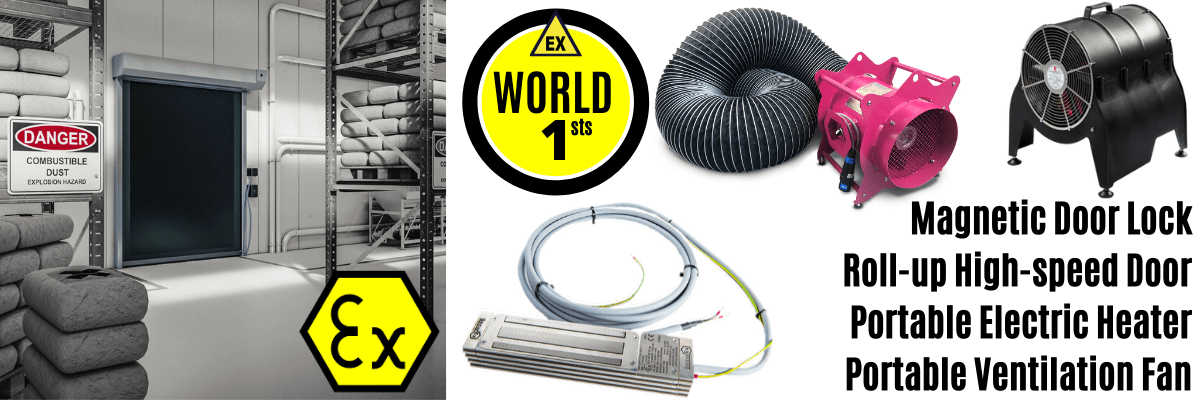
Press Release Date: 02.04.2020 uploaded by Chris Dodds (T&D Sales + Marketing Manager) World’s First Fully Certified ATEX Doors Thorne & Derrick International, the Experts in Equipment for Explosive Atmospheres, today announce the signing of a Commercial Distribution Agreement...
Press Release Date: 04.07.2019 uploaded by Chris Dodds (T&D Sales + Marketing Manager) Category: Stockist Distributor Agreement Announcement Thorne & Derrick International announce that they have signed a Preferred Distributor Agreement with Raytec, the world leading manufacturer of LED...