Uploaded by Chris Dodds | Sales Marketing Manager at Thorne & Derrick
Republished with kind permission of CSA Group | HazardEx 2020 Speakers Guidance On Fixed Gas Detector EN 60079-29-3 – the following Whitepaper titled Guidance of Fixed Gas Detection (FGD) Systems for use in Safety Instrumented System was presented by Hassan El-Sayed at the HazardEx 2020 Exhibition & Conference.
The original and only global information site for the hazardous area safety community | Register & Sign-up.
Below outlines all areas on the subject of gas detection in the following Whitepaper:
1. Scope of IEC 60079-29-3
2. Gas Detection System Architecture
3. Sensor Locations
4. Functional Safety Management (FSM)
5. FSM – Competency Requirements
6. General Requirements – All SILs
7. System Architecture, PFD & PFH Values
8. Factory Acceptance Testing FAT
9. Installation & Commissioning
10. Site Acceptance Testing SAT
11. Operation & Maintenance
12. System Modification, Decommissioning & Documentation
13. Typical Applications
♦ CSA Group certifies products against European and International Standards for explosion protection and functional safety, ISO 9001, ISO 14001 and ISO 45001 management systems and personnel competence certification in the fields of explosion safety, hazardous areas and environmental product installation.
Hazardous Areas & Explosive Atmospheres | Learn more about CSA
Complying with Ex protection concepts using IEC/EN 60079 series demonstrate electrical safety compliance
What about the gas performance tests!
What about the performance of the software systematic assessment!
What about positioning of the gas detectors to capture the maximum area coverage
What about the setting points configuration (LEL) to get these detectors performing satisfactory during their use when installed to perform a safety related loop
Which standard to follow? IEC 61511 or IEC 60079-29-3 or both?
Which one is more appropriate for fixed gas detectors when used in safety instrumented system
Factors are likely to affect the integrity of the overall SIS than the required SIL capability
Factors such as the number of sensing points, location, gas density, setting, redundancy, maintenance, response checking or calibration
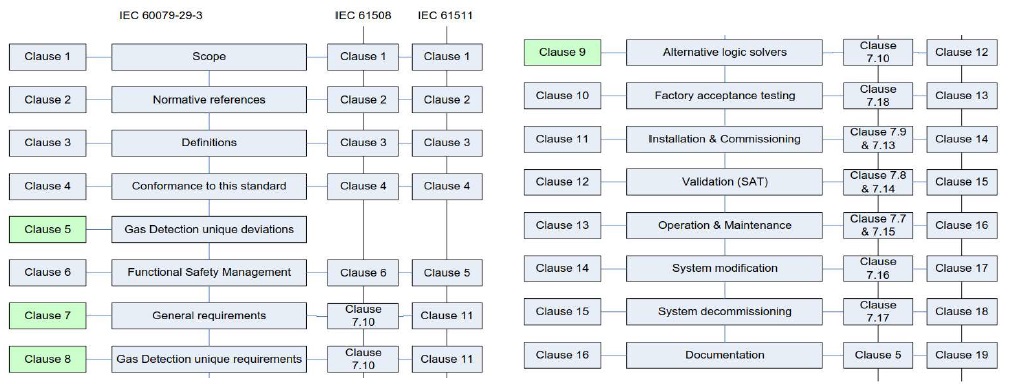
IEC 60079-29-3 provides guidance on fixed gas detectors, it follows the safety lifecycle adopted in IEC 61508
IEC 60079-29-2 is pertinent to gas detection coverage or transport of gas to the measuring points
IEC 60079-29-3 specifies requirement that persons or companies who are involved in the supply chain of a fixed gas detection system should run under FSM
It provides a framework required for gas detectors when IEC 61508 / IEC 61511 are applied
IEC 60079-29-3 addresses the performance integrity levels of FGD where either a risk reduction target stated or used as additional safe guarding system
IEC 60079-29-3 is not applicable to portable gas detector, if no risk reduction target sated, no need for fixed gas detection
It covers the design and use of a complete fixed gas detection system, including associated and/or peripheral gas detection equipment which is the overall safety system
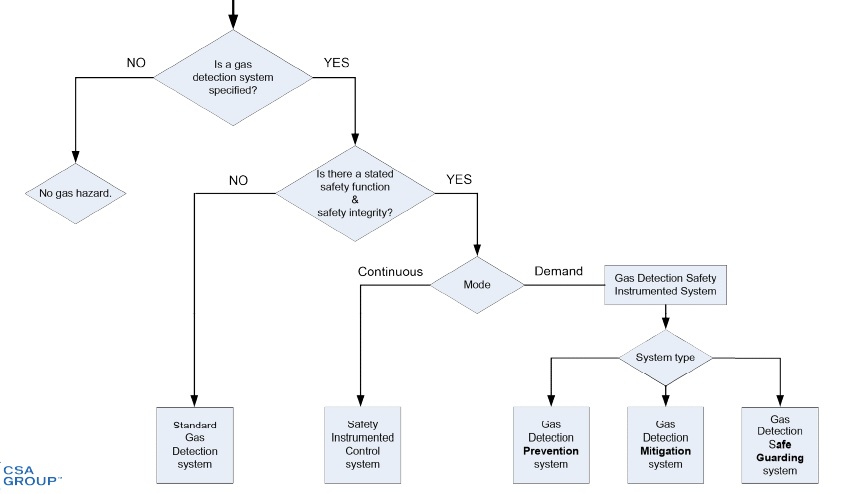
Before applying this 60079-29-3, understanding and categorising the use of the fixed gas detection system. There are three main applications:
A) as a prevention system: the total instrumented control loop has a safety function and safety integrity level clearly defined
B) as a mitigation system : the total instrumented control loop has a safety function and safety integrity level clearly defined
C) As an additional safe guarding system – this covers those fixed gas detection control loops which operate in parallel (secondary) to SIS if primary safety system fails
The ATEX Directive | Since July 2003, manufacturers of Ex products that are placed on the European market must declare compliance with the ATEX Directive (ATEX 94/9/EC, up to 19/04/2016 and 2014/34/EU from 20/04/2016). CSA Group in the UK has been issuing ATEX certificates since 1999, 4 years before the “deadline” of July 2003. In that time CSA have supported thousands of organisations to meet their hazardous area certification goals. With one of the largest teams of qualified Certification Engineers anywhere in the world, and the leading issuer of ATEX approvals, CSA Group can offer an end-to-end certification service to meet your needs.
Gas Detection ‘Safety Instrumented’ System Standards
IEC 61508 – Gas Detection Device Manufacturers
IEC 61511-1, IEC 61511-2, IEC 61511-3 – System Integrators & Gas Detection System Integrators
IEC 60079-29-3 System Integrators & Gas Detection System Manufacturers & Integrators
Clauses Note: *** Most appropriate ** Advisable * Useful
Definitions
Conformance
GD Unique Features
Functional Safety Management
General Requirement
FGD Unique Requirements
Alternative Control Units (LS)
FAT
Installation & Commissioning
SAT
IOM
System Modification
System Decommissioning
Documentation
Consultant, Vendor, SI, Manufacturer
***
***
General management
*
*
*
*
*
*
*
*
**
**
**
*
*
Design engineering management
***
*
***
***
***
***
*
*
*
***
***
**
**
System engineer
***
*
***
***
***
***
***
**
**
*
***
**
**
Commissioning /installation engineer
**
*
**
**
*
*
***
**
*
***
**
**
**
Service / quality / operation engineer
**
*
***
***
***
*
***
**
***
***
***
***
***
Training officers
***
*
***
***
***
**
*
*
*
***
*
*
**
Gas Detection System
Gas Sensor Location
Gas sensors do not have direct contact with source of gases, hence Fixed Gas Detection must be positioned where maximum gas leak / vapour can reach the sensing element as per IEC 60079-29-2
Gas sensors (passive) fitted with a passive filter element to protect the sensor membrane from airborne dust, dirt or moisture, require scheduled inspection and proof testing
Gas sensors (active) fitted with catalyst filter, do not have a defined life time, behaves like passive filters, require scheduled inspection and proof testing
Measuring performance of all sensors should be tested against the suitability of the application. Sensors may become poisoned, inhibited, saturated, less sensitive, hydrated, sleep effect, optical interference, optical blockage, etc
Sensors failures can be detected by diagnostics (DD) and others cannot be (DU), therefore, proof testing and calibration is required
Some sensors (catalytic) suffer from CCF, such as adverse chemical reactions
Gas sensors must be inspected for negative reading (caused by drift)
Hazard and risk analysis should consider all hazards associated with other gases and vapours, which include short term and long term effects
Most gas detection sensors suffer from cross sensitivities which may increase or decrease the response to gas detection
Conformance with metrological performance standards is required for all SIL levels
Handling of fault signals shall be clearly defined in the safety function. It is not desirable of a fixed gas detection system to generate a false (spurious trip), shutdown / evacuation process
Sensors shall be capable to generate an over-range measurement
Calibration shall be advised by the manufacturer and clearly described in the IOM
Maximum and minimum alarm set points shall be recommended to guard against spurious trips
Functional Safety Management (FSM)
A functional safety management system shall be in place during each phase of the fixed gas detection system life cycle, details of all the SIFs shall be provided, SIL target, organisation management activities, responsibility identified, competency records, knowledge and experience of applicable standards, protections systems, safety planning, H&RA associated with any fixed gas detection system.
Independent review for all SIL target and it shall be as defined in accordance with IEC 61508, part 1 clause 8
No SIL (0)
SIL 1
SIL 2
SIL 3
Gas Detector
A
A
HR
M
Sub-system Supplier
A
HR
M
M
Gas Detection System Supplier
A
M
M
M
System Integrator or Equivalent
A
M
M
M
A = Advisory HR = Highly Recommend M = Mandatory
FSM – Competency Requirements
Competence is the ability to undertake responsibilities to perform activities to a recognised standard on a regular basis. Evidence must be provided.
Understanding the potential consequences of a failure.
Training or competency in FS/SIL assessment for control systems. All qualifications shall be documented.
General Requirement…
Designing of Fixed Gas Detection (FGD) system shall be in accordance with safety requirement specification.
All elements shall conform to IEC 61508, and IEC 61511 may be used.
A FGD system shall be designed to ensure easy operation, maintainability and testability.
The action of a FGD system under special state or gas alarm condition should not automatically switch to a safe state.
The SRS shall clearly define which functions of the fixed gas detection system have an allocated safety integrity level, define safety and non-safety functions.
General Requirements – All SILs
Behaviour of FGD under dangerous failures by diagnostics or proof tests shall be referenced to SRS, and results in initiation of a specified action to achieve a safe state or brought to operator to initiate a safe state, or repair action to keep safety function available within the MTTR. If SF cant be repaired within MTTR, the end user is responsible for initiating additional risk reduction actions.
Behaviour of FGD under safe failure conditions, same actions as above.
Power supply is not part of the safety function when the entire FGD system is designed to operate in a fail-safe mode. If fail safe is not included, then reliability of the PWR Supply should be included.
System with 1 single PWR supply, a fault signal shall be initiated when power supply fails.
System with redundant PWR SPLY, no loss of safety function shall occur during switching.
System supported with UPS, no loss of safety function shall occur during transition.
A gas detector (including sensor) shall conform to IEC 61508-1,2 and 3, metrological performance to (IEC 60079-29-1 or 4).
A gas detector control unit (Logic Solver) including SW shall conform to IEC 61508-1/2/3 and shall conform to pertinent metrological performance standards, such as (IEC 60079-29-1, / 4) . • Final element shall conform to IEC 61508-1/2/3.
Visual indication shall be provided to display status under normal, abnormal, alarm state, special state, maintenance, and shall be unambiguous and may include, units measured, range, over range, special state, diagnostics data, peripheral equipment.
Switching outputs provide alarms, and special state signal, or may initiate safe actions, fault outputs shall be fail safe.
All switching output configuration shall be specified in the SRS.
System architecture, PFD and PFH values.
All alarms shall remain tripped until a manual reset is initiated.
All switching outputs shall be capable of operating under full load conditions.
The architectural constraints as defined by IEC 61508 apply to a fixed gas detection system. Each gas detector, sub-system and complete system shall conform.
For process industries, IEC 61511 may be used, the Probability of Failure on Demand (PFD) values as defined by IEC 61508 apply to a fixed gas detection system.
The total sum of all sub-system PFD values used in a single gas detection safety loop shall conform to the safety integrity target as stated in the safety specification.
Proof of systematic capability shall be part of the conformity assessment.
Factory Acceptance Testing FAT
FAT should be specified during the validation plan, it may include the following tests:
a) pass/fail criteria, procedures for test records data/results,
b) HW/SW versions of the EUT, corrective actions, system modifications,
c) configuration management, external suppliers, testing equipment,
d) types of gases, persons competencies, and description of black box test.
FAT should be executed as per the FAT test plan, verification shall :
a) be performed to all supporting document for completeness,
b) correct revision approval, impact analyses showing root cause of any failure
c) justification of changes if required
Installation and Commissioning
Installation methods and commissioning procedures should be specified during the design phase of the FGD system and should include as a minimum:
The installation activities;
the person, department or organisation responsible for the installation activities;
precautions to take when the installation is within an hazardous area;
electrical tests required to satisfy the electrical installation is correct (before the system is energised);
the types of tests to be performed on system start-up;
the PASS/FAIL criteria, including when to abort the tests subject to a single or multiple test failures;
procedures for the recording of test data/results and the HW/SW versions of the EUT
procedures for corrective actions; for system modifications or changes; for conflict management;
test equipment to be used, supported by valid equipment calibration certificates;
test gases to be used, supported by valid gas composition certificates;
test persons’ competencies and persons in attendance;
Execution of Fixed Gas Detection Systems
The installation should be conducted in accordance with the installation plan.
The commissioning should be conducted in accordance with the commissioning plan.
Before installation and commissioning, all documentation shall be checked as above.
Site Acceptance Testing SAT.
System Validation
System Validation Test should be specified during the design development phase of the fixed gas detection system and should include as a minimum:
validation methods to ensure that the installed FGD system performs the safety function as stated in the SRS
validation methods to show the FGD operates correctly under, normal, abnormal, special state condition and fault condition
procedures to manage system modification as shown in FAT
competencies records for the persons conducting the work
procedures for recording test data/results and HW/SW versions of the EUT
Execution of Fixed Gas Detection Systems
The System Val. test should be conducted in accordance with the System V. Test plan.
Before the System Val. Test, all documentation shall be checked for completeness, rev etc.
Operation and Maintenance
Outline the minimum routine service requirements, including proof testing which should be executed during the phase of operation and maintenance.
Planning Phase
Should be specified during the design phase of the FGD system and should include as a minimum:
detailed records of the system’s performance during normal and abnormal operation,
the number of demands placed on the system;
the frequency of scheduled system maintenance activities;
the maximum number of safety loops which are in override during any maintenance
detailed maintenance records including faults found, corrective or repair actions taken, spare parts used,
consumables used and any changes of system performance which may, in the future, affect the safety function;
detailed proof test results; and
detailed corrective actions taken if a proof test fails
Execution
The FGD system shall be operated as detailed in the overall system safety manual.
The proof test will be dependent upon how close to the “as new” condition the system is restored.
For effective proof test, it is necessary to detect 100 % of all dangerous failures. In practice 100 % is not easily achieved for other than low-complexity E/E/PE safety-related systems, this should be the target.
Cross referencing between IEC 61508 & IEC 61511.
System Modification, Decommissioning & Documentation
Modifications to any fixed gas detection system shall be planned, reviewed and authorised prior to any modification being perform. It shall include:
Impact analysis, ensuring alternative measures available for maintaining SIL, any associated Ex documentation, validation methods for the implemented change, verify any associated functions (not modified) not been affected, competency, documentation control process, etc.
A modification / decommission activities shall not commence without proper authorisation.
Documentation: all single documents, including individual instrument operating manuals, safety manuals, electrical schematics, parts lists, data sheets etc., should be:
fit for purpose and applicable to the application;
accurate and easy to understand; revision controlled, structured, clearly defined information for each part of the life cycle;
contain all results from FAT, Commissioning and Site Validation (SAT)
Include recommended maintenance activities, complete with a supporting test program and record sheets;
Include recommended proof test activities, complete with a supporting test program and record sheets; and list recommended operational spare parts.
A total Safety Manual should be compiled which includes as a minimum the following: safety function and integrity per safety loop, restrictions of use (including consumable parts e.g. filters), operational procedures, maintenance procedures, a fault finding guide and override procedures.
All product certificates should be supplied with the associated test report where available.
Revision control of all documents should clearly state the product or system to which it applies, including the hardware revision and software version of the product or system.
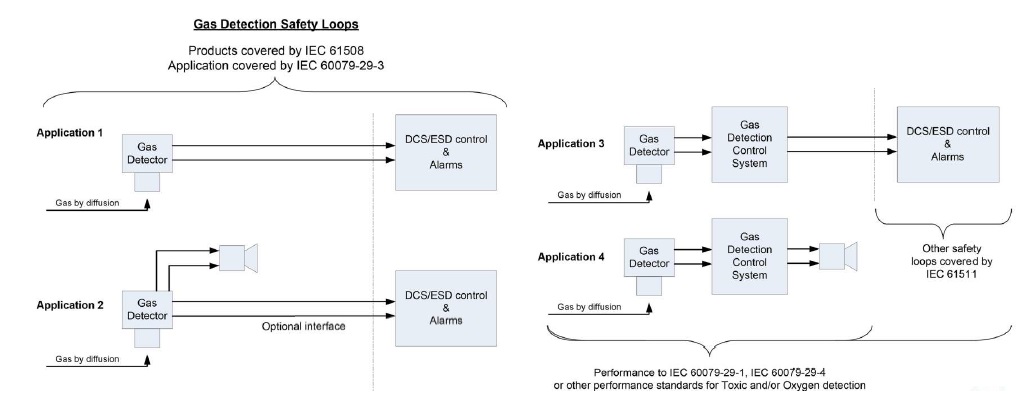
Typical Applications
Typical Applications
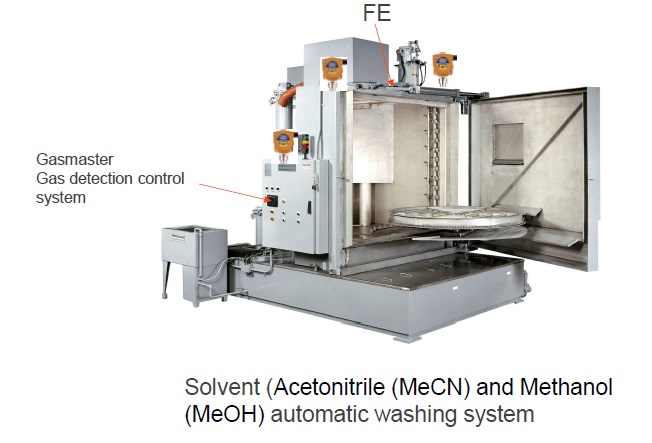
Typical Application (Automated Washing System for Pharmaceutical use)
Glossary of Gas Detection Standards
IEC 60079-29-3: Explosive Atmospheres – Part 29-3: Gas Detectors – Guidance on Functional Safety of Fixed Gas Detection Systems
IEC 60079-29-2: Explosive Atmospheres – Part 29-2: Gas Detectors – Selection, Installation, Use & Maintenance of Detectors for Flammable Gases & Oxygen
IEC 61511-1:2016 Functional Safety – Safety Instrumented Systems for the Process Industry Sector – Part 1: Framework, Definitions, System, Hardware & Application Programming Requirements
Thorne & Derrick are Crowcon Distributors – manufacturers of high-quality portables and fixed gas detection product with a reputation for reliability and technical innovation in hazardous areas and explosive atmospheres.
Follow our Showcase Page on LinkedIn to receive hazardous area product innovations, industry news, whitepapers, videos, technical tips and training webinars for professionals involved in the explosive atmosphere industries.
A Masterclass Webinar In Explosion Protection
Presented & Hosted By Mike Marrington | Partner at IndEx Middle East FZE
Uploaded By Chris Dodds | Sales Marketing Manager at Thorne & Derrick
In this Webinar Mike provides an authoritative and technical presentation covering the complexity of the Explosion Protection Concept Ex d – an expert and essential session for professionals involved in hazardous areas the resource covers:
What are the 2 different types of Ex d?
What is the difference between Flameproof & Explosion Proof (XP)?
Can I freely use one or the other?
What is and where is the flamepath?
What new ideas are there for Ex d?
Q&A session
Run Time 1:30:24
Experts | 20+ Years of Experience in Explosion Protection
IndEx Middle East FZE
IndEx Middle East FZE are an internationally accredited IECEx compliance service provider to hazardous areas engineering in the Gulf Region. IndEx Middle East is an accredited IECEx compliance service provider – the first one in the Middle East offering full IECEx compliance services from the initial project concept to handover. IndEx deliver full IECEx scheme compliance services, competence training and equipment assessment based upon the latest IEC international standards – this includes the inspection and audit of existing brownfield installations and Ex rated equipment. Assisting and sharing responsibility in the determination of proper hazardous area located Ex rated equipment and installations with project and site based maintenance personnel. Get in touch.
Hazardous Area Classification HAC
Gases, vapours, mists and dusts can all form potentially explosive atmospheres with air.
Hazardous Area Classification (HAC) is used to identify places where, because of the potential for an explosive atmosphere, special precautions over sources of ignition are needed to prevent fires and explosions. Hazardous area classification should be carried out to identify places (or areas) where controls over ignition sources are needed and those places where they are not. Hazardous areas are further classified into Zones / Class & Divisions / Classes & Zones, which distinguish between places that have a high chance of an explosive atmosphere occurring and those places where an explosive atmosphere may only occur occasionally or in abnormal circumstances. Learn more.
Experts In Equipment for Explosive Atmospheres with ATEX & IECEx Certification
LEADERS IN Ex d & fLAMEPROOF pRODUCTS
for Hazardous Areas
T&D are your first-choice provider of innovative and competitive solutions to ensure ATEX & IECEx Compliance for Hazardous Area Electrical, HVAC & Process Instrumentation Equipmentto your UK and international projects.
We can specify and supply from stock an extensive range of Explosion Proof Ex d Equipmentto provide safe flameproof lighting, power distribution, isolation and cable termination in explosive atmospheres.
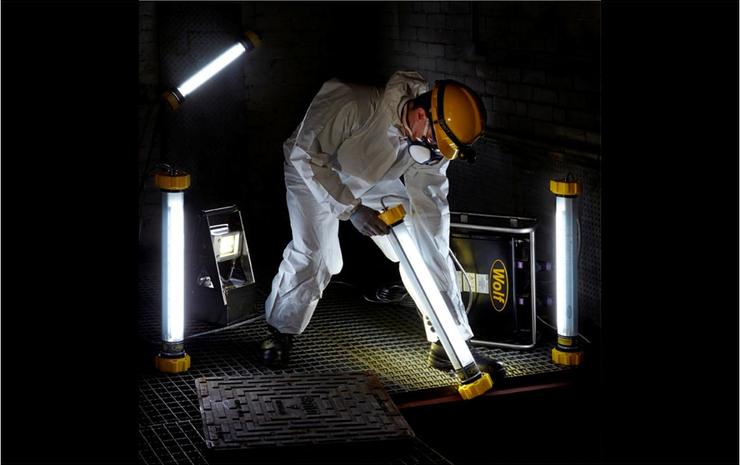
Hazardous Area Certified Lighting for Confined Spaces
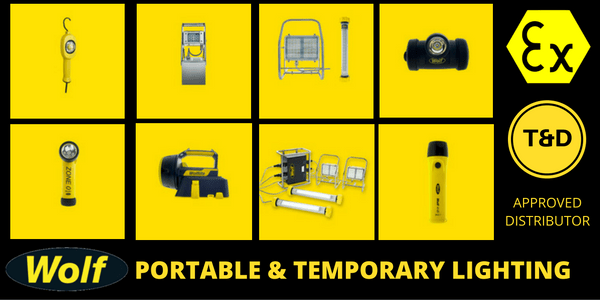
Portable & Temporary Lighting | From Stock | Competitive Prices
Lighting Confined Spaces In Hazardous Area Workplaces
uploaded by Chris Dodds | Sales & Marketing Manager with Thorne & Derrick International
David Lyon, Sales Manager with Wolf Safety Lamp, was approached by one of Europe’s largest passenger airlines requiring ATEX lighting in a confined space as they needed to safely illuminate the interior of a jet airliner’s fuel tank.
Specifically he was asked to provide a safe ATEX certified hands free lighting solution for maintenance staff carrying out vital inspection, maintenance and repair operations inside the potentially explosive atmosphere of the aircrafts’ fuel tanks.
This meant that routine operations were taking too long to complete and pressure was mounting to reduce aircraft turnaround time.
A certified portable hazardous area tank lighting solution was needed which would supply much higher quality, brighter lighting within the fuel tanks and would leave operators’ hands free to concentrate on the inspection and repair work. The light source must have the correct ATEX certification to counter the potential risk of explosion and take into account the physical challenges of the aircraft’s structure, including the narrow entrances and confined nature of the tanks themselves.
The Confined Space Lighting Challenge
The airline’s current practice involved technical staff using handheld torches as they crawled and worked inside the pitch-black tanks. This had two major disadvantages:
The torches simply weren’t bright enough to illuminate the confined space tank
Operators need both hands to manoeuvre through the confined space of the tanks and carry out maintenance and repair tasks
Hazards of Airplane Fuel Tank Entry | Chemical & Physical
A large percentage of the work involved in properly inspecting and modifying airplane fuel tanks and their associated systems must be done in the interior of the tanks. Performing the necessary tasks requires inspection and maintenance personnel to physically enter the tank, where many environmental hazards exist. These potential hazards include fire and explosion, toxic and irritating chemicals, oxygen deficiency, and the confined nature of the fuel tank itself. In order to prevent related injuries, operator and repair station maintenance organizations must develop specific procedures for identifying, controlling, or eliminating the hazards associated with fuel-tank entry.
Maintenance personnel who enter airplane fuel tanks to inspect or modify them face several potential hazards. These include exposure to flammable and toxic chemicals, potentially harmful atmospheric conditions, and the confined interior structure of the tank. Operators and repair stations can protect maintenance personnel from these hazards by developing safety procedures for fuel-tank entry personnel. To successfully prevent related injuries, both operators and maintenance personnel must understand the following:
Fuel-tank hazards
Preparation for entry
Conditions required for entry
Emergency response plan
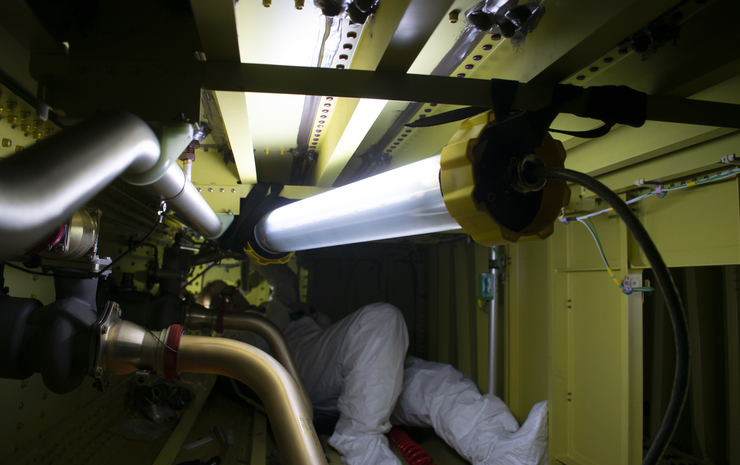
Image: S7 Technics | Undertaking a Complex Set of B737NG Tank Inspections – fuel tank working and the selection of confined space lighting is safety critical where relatively small amounts of a chemical inside one of these enclosed spaces can create significant levels of flammable or toxic vapor.
Stockists & Suppliers of Wolf Safety Lamp | Portable & Hazardous Area Lighting
The Lighting Solution
Following an on-site assessment and testing inside the aircraft the ideal solution was found to be a lighting kit for each aircraft containing 3 linkable LED luminaires to provide bright ambient lighting for the tanks with 2 handheld leadlamps for close up inspection work.
The luminaires would be suspended (by the hanging straps which are supplied with the lamps) along the length of the fuel tank, at 2 metre intervals.
The first lamp in the chain would have a 10 metre cable to allow it to be connected it to the 110V power source outside the aircraft. Subsequent lights would have 2 metre cables, allowing them to be positioned exactly where needed whilst keeping cabling to a minimum within the confined space.
The handheld leadlamps would be hooked up inside the tanks and taken down for close inspection work where, and as, required.
Hazardous area lighting solution provided by Wolf Safety Lamp comprised of 3 X Wolf LinkEx LX-400 and 2 X LinkEx SP-600 Handheld Inspection Leadlamps.
Confined Space Lighting
The confined space lighting kit consisted of:
1 x Wolf LX-400 LinkEx™ LED 360° 110V ATX Linkable Temporary Luminaire – 10 metre cable
2 x Wolf LX-400 LinkEx™ LED 360° 110V ATX Linkable Temporary Luminaire – 2 metre cable
2 x Wolf SP-600 ATEX LED Inspection Leadlamp – 10 metre cables
Pictured:Wolf LinkEx | Temporary Portable Lighting for Confined Spaces with Hazardous Areas & Explosive Atmospheres
The range of LinkEx LED Temporary Luminaires manufactured by Wolf Safety Lamp provides high quality ambient lighting. Each light utilises two arrays of high power LEDs suitable for T4 temperature class applications in hazardous areas
Benefits
The benefits from the new portable lighting kits were immediately felt with the maintenance team being able to move and work hands free in the now brightly lit confined space of the fuel tank. The high quality light from the 360° diffused lamps lessened shadowing substantially and reduced the difficulty and time taken to carry out work tasks – the result of which is a reduced aircraft turnaround time and all resulting cost benefits to the airline. Three hazardous area lighting kits were purchased initially by the airline, before rolling out the solution to the rest of the fleet for use in confined spaces.
Experts In Equipment for Explosive Atmospheres with ATEX & IECEx Certification
EXPERTS IN EQUIPMENT FOR EXPLOSIVE ATMOSPHERES
leaders in ATEX Innovation To The Hazardous Area Industries
Thorne & Derrick are leaders in the development and distribution of Product Innovations that deliver significant improvements to clients plant, people and operational safety in the explosive atmosphere industries.
Your proactive problem solvers experienced in succession planning for the replacement of obsolete, non-conformant and legacy equipment in hazardous areas.
Your first-choice provider of innovative and competitive solutions to ensure ATEX & IECEx Compliance for Hazardous Area Electrical, HVAC & Process Instrumentation Equipmentto UK and international projects.
Article Republished with Kind Permission of SGS Baseefa | 1 of 5 Articles
Uploaded by Natalie Lundie | Supply Chain: Marketing Lead at Thorne & Derrick International
Complying With Requirements For Hazardous Atmospheres
Helping To Protect Employees & Plants from the Risk of Explosion in Hazardous Areas
Thorne & Derrick, the Experts in Equipment for Explosive Atmospheres, with the permission of SGS Baseefa are providing a series of articles to advocate the importance of independent services that ensure the protection of employees and property from explosion risk in hazardous areas – this is achieved through the provision of training and ensuring that equipment intended for use in potentially explosive atmospheres is correctly certified according to ATEX and IECEx international classifications by a accredited Notified Body.
Part 1
When dangerous substances are released in the atmosphere, they can ignite or create explosions, causing damage to property, serious injury or loss of life. The Dangerous Substances and Explosive Atmospheres Regulations (DSEAR) in the UK, and similar regulations elsewhere, are aimed at minimising the risk of fire, explosions and related events caused by explosive substances in hazardous areas.
See the following blogs in this series by clicking the links below: ATEX certification and IECEx certification, as well as risk assessment, training and competence, can reduce the risk of such incidents in hazardous areas.
SGS Baseefa can support an organisation’s compliance with the following certification schemes and regional requirements:
ATEX: a European legal framework that manufacturers must follow in order to sell equipment intended for use in areas with a potentially explosive atmosphere. Manufacturers of products for use in explosive atmospheres that are placed on the European market must declare compliance with the ATEX Directive (previously ATEX 94/9/EC and now 2014/34/EU). Manufacturers often require ATEX certification from an ATEX Notified Body such as SGS Baseefa in order to meet these requirements
IECEx: a system used to facilitate international trade in equipment and services for use in explosive atmospheres, while maintaining the required level of safety. IECEx Certification is a voluntary scheme in most parts of the world and can be used to help prove compliance with regional requirements. Organizations often ask for ATEX Certification and IECEx Certification to be carried out at the same time, as part of one cost-effective project
North America: testing, assessment and certification for Class and Division, and Class and Zone applications for the US and Canadian Hazloc market. Certification can be issued for the US (SGSus), Canada (SGSc), or most commonly both (cSGSus). Often ordinary location standards must be met along with hazardous location standards for equipment to be accepted into this market. We are accredited for both types of standard
Requirements for other regions, including China, Korea, Japan, Russia and the Eurasian Customs Union, Brazil and South Africa. If ATEX certification or IECEx certification has already been achieved, the process of obtaining these approvals can be simplified and completed subsequent to your ATEX/IECEx certification
ATEX & IECEx Certification | hazardous area equipment certification from SGS meets the legal requirements for products used in explosive atmospheres.
In addition to product certification, they ensure that personnel are equipped with the knowledge and skills to design and operate equipment safely, minimising risk to projects and plants. They offer:
Training: to educate those working in the explosive atmospheres industry and ensure that their knowledge is accurate and up to date. Our training allows both individuals and their organisations to be safer, better equipped and more productive by providing an in-depth understanding of subjects such as DSEAR, the ATEX Directives, and protection methods. It plays an important role in the development of competence
Where a more specific requirement exists, we offer a dedicated technical advice service, with face to face meetings with our staff who will be able to guide you through how various standards might apply to you produce, or service, and help you to evaluate the options available to you. However, we cannot offer design consultancy, as that would be incompatible with our certification body status. It is recognised by our accreditation body that we need to be able to help customers understand how the standards are applied to their products
IECEx Certificate of Personnel Competence Scheme (CoPC): to verify the capabilities of personnel working in explosive atmospheres. With the human factor being a major contributor to incidents in hazardous area, personnel competence is a prerequisite for correct performance. Qualifying your and your team’s competence is an important step toward ensuring you have the necessary knowledge, experience and expertise required for working in hazardous areas
ABOUT SGS BASEEFA
Research work into explosions in hazardous atmospheres has been carried out at our Buxton site since the 1920s. SGS Baseefa is now one of the largest organisations in the world with a laboratory dedicated to certification in this area and a world leader in the field.
In Europe, SGS Baseefa is one of the most recognised Notified Bodies for issuing the certification required by the European ATEX Directive. We are at the forefront of international product certification within the IECEx Equipment Certification Scheme, having issued more certificates in this field than any other certification body in the world.
Beyond certification we also provide an accessible yet authoritative source of expertise in many related areas. With extensive experience and knowledge of the application of industry standards in many areas we actively participate in committees formulating standards both at the European and international levels.
Through our global network we can offer a truly worldwide service to you, wherever you may be, providing documentation to support your sales throughout the world and to give your customers confidence in the products you sell.
Thorne & Derrick are leaders in the development and distribution of Product Innovations that deliver significant improvements to clients plant, people and operational safety in the explosive atmosphere industries.
Your proactive problem solvers experienced in succession planning for the replacement of obsolete, non-conformant and legacy equipment in hazardous areas.
Your first-choice provider of innovative and competitive solutions to ensure ATEX & IECEx Compliance for Hazardous Area Electrical, HVAC & Process Instrumentation Equipmentto UK and international projects.
Servicing Explosive Atmosphere Industries Since 1985.
Hazardous Area Lighting – Raytec
Hazardous Area Lighting
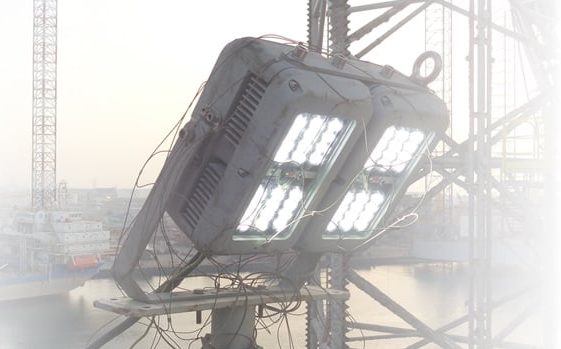
Raytec are world leaders in LED lighting for hazardous area environments – the Raytec SPARTAN range of hazardous area lighting is globally certified Ex LED lighting, approved for all ATEX and IEC Ex Zone 1 and Zone 2 hazardous area environments, including UL /CSA C1D2 installations.
In this EX Lighting Focus we look at Ex lighting requirements for ports and terminals and identify some of the key features to consider when specifying luminaries for these environments with hazardous area locations and potentially explosive atmospheres.
Hazardous Area EX Lighting
For Ports And Terminals
Ports and terminals are being used to handle and store increasing levels of crude oil, LNG and bulk grains, all of which increase the requirement for hazardous area lighting to be used on-site. The nature of port applications, and their coastal location, provides a challenging environment when specifying lighting.
In this Blog we look at:
Some of the typical areas within ports and terminals where Ex lighting is required.
How to overcome some of the challenges.
Key things to consider when specifying lighting in these applications.
A light capable of withstanding the conditions of a challenging environment is essential.
This is because it will commonly be exposed to marine conditions, often similar to an offshore application.
Furthermore, major ports that act as a hub for imports and exports will likely have a significant amount of hazardous substances (such as oil and gas products, but also bulk grains which carry an explosion risk) passing through on a daily basis, or being held in storage facilities on-site. Port owners must therefore ensure the site is compliant by having the necessary equipment on-site to safely handle and store these substances; this is where hazardous area lighting becomes so important.
Hazardous Area Lighting – Requirement Areas
Docking Areas
Docking areas are where tankers or cargo ships will discharge. Discharging of explosive substances, such as crude oil or LNG (Liquefied Natural Gas), means that using explosion protected equipment on and around the docks is critical. With operations happening 24 hours a day, safe and effective lighting solutions are vitally important.
Storage Facilities
Tank farms or storage warehouses are a major part of modern ports. This is where commodities such as bulk grain will be held until they can be distributed elsewhere. With the storage of oil and gas products, major ports are now often linked directly to refineries via pipelines, requiring significant infrastructure for storage and distribution at the port itself.
It is extremely important that Ex certified lighting (hazardous area lighting) is installed in these types of application to maintain flexibility, functionality and safety on-site.
Lighting For Ports
Choosing EX LED Lighting
The benefits of LED over conventional lighting technology are well documented but are especially relevant for port applications.
Lighting Lifetime & Maintenance
Capable of 100,000+ operating hours, without the need for re-lamping, LED offers significantly longer lifespan and reduced maintenance in comparison to conventional lighting. For busy ports operating 24 hours a day, where access to light fixtures on docks and storage facilities can be challenging, this is a major benefit.
Light Pollution
Like many industries, ports and terminals are under increasing pressure to reduce light pollution to help protect the nights sky and reduce the impact on local wildlife. The directional nature of LEDs can help significantly with this problem, ensuring light is only directed where needed.
Light Quality
With typically higher colour temperatures, and improved colour rendering compared to conventional lighting, the installation of LED luminaires can help to have a significant impact on working conditions within the port, and ultimately improve overall efficiencies.
Energy Costs
Reducing energy costs is a constant challenge for the ports sector. Installing LED luminaires in areas such as grain stores is extremely beneficial for the end user. With conventional lighting, users tend to leave the lights switched on permanently. This is as a result of the warmup time that the luminaire needs to restart. With LEDs, there is an instant light output when required, so the luminaries can be turned off when not being used. Not only does this reduce energy costs, it prolongs the life of the luminaire.
Easy Maintenance
LED technology can help to significantly reduce maintenance costs for ports and terminals, but the way an LED light has been designed can also have a large impact on how easy maintenance is to carry out, and how long the port will be left without light should a problem arise.
Ensuring Easy Access
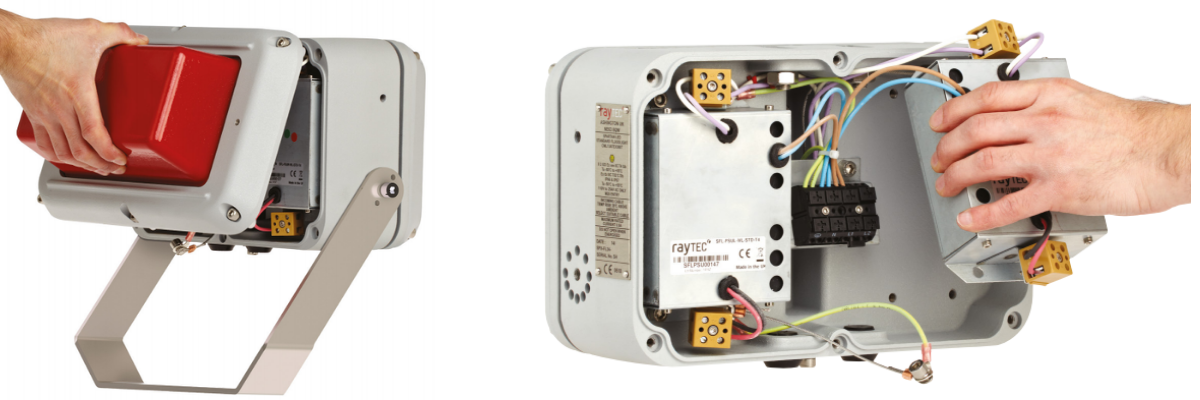
Choosing an LED luminaire with a removable PSU (Power Supply Unit) can help to make access for maintenance much easier
Luminaire’s such as the SPARTAN High-Power Flood & High-Power Bay, allow the PSU to be removed from the main body of the luminaire, so all wiring and serviceable parts can be positioned in easy-to-access locations. Ultimately this means maintenance can be done quicker, and at a lower cost.
A Removable Power Supply Unit Allows For Easy Access
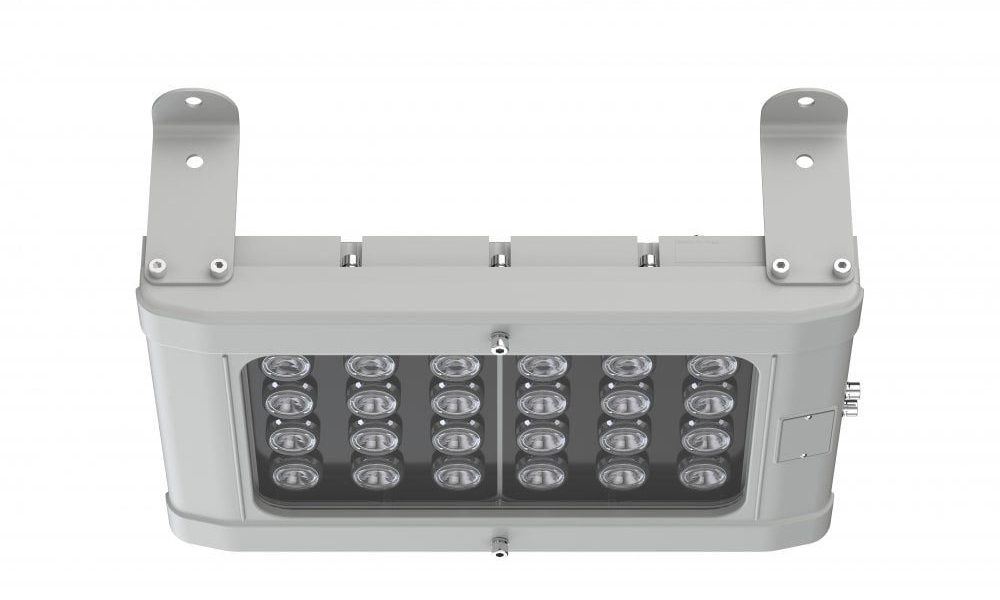
SPARTAN High Bay | Floodlight Zone 1 – with high lumen output of up to 10,000 delivered lumens. SPARTAN floodlights are globally certified for all Zone 1, Zone 2 and Industrial lighting applications
Reducing Lighting Downtime
With ports operating 24 hours a day, light failure can have significant impact on a day-to-day activity. The faster light can be restored, the less disruption is caused. The way Ex lighting has been designed can have a significant impact on the length of downtime if a problem does occur.
Modular hazardous area lighting, like SPARTAN, are designed to make maintenance easier and faster to carry out. Interchangeable key components can be replaced independently, allowing maintenance to be carried out on-site and light to be restored within minutes. In contrast, some Ex LED luminaires are ‘sealed for life’, meaning any failures cannot be rectified by onsite engineers (doing so would invalidate the certification). Therefore, the light must be returned to the manufacturer, costing the port time and money.
The Correct Hazardous Area Lighting Is Crucial For Work At Ports And Terminals
Emergency Lighting
Ports and terminals are high-risk environments and rely on the use of emergency lighting to ensure the safety of everybody on-site, should a power failure occur.
Duration & Output of Lighting
It’s important to check the emergency duration of lighting to ensure it provides back-up illumination for a sufficient length of time, but you should also consider the percentage light output of the luminaire in emergency mode. It is common for output to drop significantly when switching to emergency mode.
Most SPARTAN emergency luminaires provide 25% light output for 3 hours as standard, but if required can run at up to 100% light output for shorter durations. This provides the ultimate performance and flexibility for emergency lighting in hazardous areas.
Prior to installation, it’s recommended to complete a lighting design scheme based on both normal and emergency conditions. This will ensure sufficient light levels are being achieved and the correct number of luminaire’s have been specified.
Automated Testing
Modern emergency luminaires, such as SPARTAN Intelligent Emergency, are helping to make emergency systems more reliable. Designed to ensure optimum battery performance, they provide a self-testing function which automatically cycles the battery to ensure its health and to measure its capacity.
Ports and terminals often represent an unforgiving environment for the lighting installed on-site. The conditions in some areas of a port will be very similar to what would be expected in offshore applications, and lighting must be specified accordingly. There are three major environmental issues that companies face when installing hardware for a port application;
Corrosion – exposure to sea spray and salty air means a greater risk of corrosion. The risk is greater in locations like docking areas, where exposure to sea spray is greater, but all areas around ports provide a higher risk of corrosion than inland applications. The hardware installed must therefore be specified to withstand these conditions. Our Raytec SPARTAN range is designed for offshore use in-mind; made with marine grade aluminium, stainless steel fixings and ABS-approved to marine standards.
Extreme Weather – with high wind and rain levels, extreme weather conditions at ports is a regular occurrence. A luminaire with a high IP rating is essential to prevent water ingress which could damage internal components. While the majority of hazardous area fittings will be rated to at least IP65, we would recommend specifying to IP66 or IP67 for port applications.
Sun– depending on where the port is located, prolonged exposure to ultraviolet rays (UV) can cause issues with luminaires with a GRP housing (glass reinforced plastic). Over time the GRP can degrade and become brittle, which could invalidate the light’s hazardous area certification, rendering it useless.
HAzardous Area Lighting Considerations
Dust-Only Certification
Protecting against dust is a key factor for any area of a port where bulk grain is being handled or stored. If the only explosion risk in these areas comes from dust, i.e. grain, a smart specification can save costs by specifying an Ex luminaire certified for protection against dust only (unlike most lights which are certified for gas and dust).
A number of SPARTAN Ex products are available as a dedicated Zone 21 variant for exactly these kinds of applications, providing a cost-effective solution in areas where there is no explosion risk from gas, only dust.
Hazardous Area Lighting Design
Lighting design should be considered an essential part of specifying lighting for port applications. With larger ports utilising thousands of operators, achieving the correct light levels on-site will improve safety and operational efficiency. For specifiers, going through the design process will also ensure confidence in the final solution, meaning there are no surprises when it comes to the actual installation.
Thorne & Derrick’s hazardous area lighting design service is completely free of charge, providing you with a visual 3D representation of the final lighting solution, with detailed lux levels and a true indication of lighting performance. Our lighting design experts will guide you through the entire process, ensuring the optimum solution is achieved.
leaders in ATEX Innovation To The Hazardous Area Industries
Thorne & Derrick are leaders in the development and distribution of Product Innovations that deliver significant improvements to clients plant, people and operational safety in the explosive atmosphere industries.
Your proactive problem solvers experienced in succession planning for the replacement of obsolete, non-conformant and legacy equipment in hazardous areas.
Your first-choice provider of innovative and competitive solutions to ensure ATEX & IECEx Compliance for Hazardous Area Electrical, HVAC & Process Instrumentation Equipmentto UK and international projects.
Press Release Date: 02.04.2020 uploaded by Chris Dodds (T&D Sales + Marketing Manager) World’s First Fully Certified ATEX Doors Thorne & Derrick International, the Experts in Equipment for Explosive Atmospheres, today announce the signing of a Commercial Distribution Agreement...
Press Release Date: 04.07.2019 uploaded by Chris Dodds (T&D Sales + Marketing Manager) Category: Stockist Distributor Agreement Announcement Thorne & Derrick International announce that they have signed a Preferred Distributor Agreement with Raytec, the world leading manufacturer of LED...




























 Further Reading |