A White Paper from ASCO by Bob Cadwell, Gerry Longinetti, and James Chiu
Introduction To Solenoid Valves
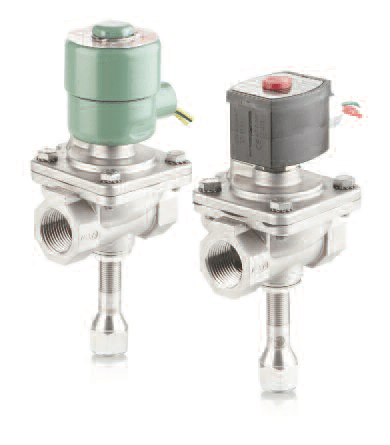
Low-temperature stainless steel fuel shutoff valves are usually utilised for on/off control of fuel gas within gas fuel trains in process heating system burners. These systems are widely used by oil and gas firms as well by as original equipment manufacturers (OEMs) which produce gas heating equipment or burner management systems (BMSs) and controls in upstream oil and gas pipelines and tanks.
For valve manufacturers, like ASCO, these uses present a relatively specialised and rather challenging application. Environmental conditions at the point of use are often difficult. Ideally, valves should deliver reliable operation despite any constraints on factors ranging from power consumption to service availability. Conversely, outdated controls can pose problems including poor performance, noncompliance with current regulations, and triggering of environmental concerns.
In recent years, a new generation of solenoid valve technology has been changing the shutoff valve game. Their modern designs provide pipeline and tank heating systems with robust, durable performance; safety; and regulatory compliance – all while increasing efficiency and productivity.
The problems with older technology
A safety shutoff valve plays a crucial role within a heating system. Simply put: if the valve doesn’t work, then nor does the heater. And heater failure can quickly have a mission-critical impact: slowing or halting oil or gas flow in a pipeline, preventing offloading from tank to truck, or stopping separation of particulates from extracted heavy oil.
These crucial parts have for the most part been pneumatically operated shutoff valves. But OEMs and users have long been unhappy with this increasingly dated technology. These units require pilot valves to control them and they usually need other equipment and piping at additional expense to operate.
Pneumatically operated valves often use casing gas from the well. So when opened and closed, these valves exhaust methane (a greenhouse gas) to the atmosphere. This burdens user companies with large carbon footprints that work against campaigns to make oil and gas processing greener. These valves’ relatively high power consumption can be ill-suited for remote pipeline or wellhead tank locations.
Many of these valves are not designed to cope with the broad range of supply pressures that differ from site to site on pipeline and tank heating applications. Furthermore, they suffer from relatively high costs.
Finally, many installed systems using these older valve technologies are non-compliant with current safety regulations.
The advantages of newer solenoid valves
Many operators, in North America and beyond, are moving away from using pneumatically operated shutoff valves on their pipelines and tank heaters. They are instead replacing them with valves introduced over the last decade by a few manufacturers – all based on solenoid shutoff valve technologies.
The design aims of these solenoid valves are easily outlined.
They should first be compliant with safety regulations, including both current and pending gas code requirements.
They should be more environmentally responsible; unlike pneumatic controls, they shouldn’t vent gas to the atmosphere. This alone would eliminate a source of greenhouse gas emissions and help reduce a users’ overall carbon footprint. Solenoid technology should render them inherently more reliable and deliver substantially longer service life than is possible with pneumatically operated valves. It should also decrease costs by requiring less supporting equipment, lower maintenance levels, and so on.
Finally, these solenoid valves should make operation more efficient, saving energy and increasing equipment up-time. However, even when utilising the latest solenoid technologies, designing valves for this unique application remains a challenge. Surveying the available offerings, it becomes clear that not all solenoid shutoff valves are created equal. Look for models that harness the best technology to maximise efficiency, safety, and service life in harsh or corrosive environments, and that incorporate the following advantages.
Low-temperature operation
Maintaining tight shutoff in low temperatures represents a particularly demanding design challenge. Doing so while meeting strict regulatory approvals is even tougher. Also, the remote locations where these valves are often utilised make servicing or replacement very difficult. Pneumatic controls have often struggled in these conditions.
Today, even some solenoid valves can experience challenges in delivering reliable operation in low temperature environments. Look for valves which are rated for the range of operational temperatures likely to be encountered at your deployed location.
For example, ASCO solenoid shutoff valves are rigorously tested in low-temperature conditions, rated to perform down to -40° F (-40° C), and proven to deliver reliable performance under those conditions in installations worldwide.
Wide pressure range
When specifying gas shutoff valves for your application, pay special attention to operating pressures.
Some solenoid valves require a pressure “assist” to open and stay open. If the pressure supply to the valve falls below this minimum pressure differential (often on the order of 3 psi), the valve will close, thus shutting off heat to the pipe or tank.
The Problem: some sites have inherently low supply pressure. In these locations, solenoid-based shutoff valves requiring a pressure assist may struggle, cause nuisance shutoffs, or fail to operate at all. By contrast, valves with lower maximum pressure ratings may be poor fits for sites with high supply pressures. Make sure your valve’s maximum operating pressure rating suits the operating pressures at the intended location of your heating system.
If you have multiple wells with differing pressure requirements, look for valves that can provide satisfactory service across the widest possible range of operating pressures. For example, ASCO valves are rated to operate with zero minimum differential pressure. This is a definite plus in environments that are characterised by low supply pressure, such as remote pipelines or tanks.
As a bonus, valves that handle wide ranges of pressures can actually allow some users to reduce component sizes. Downsizing your fuel train in this way can yield welcome cost savings, simply from specifying the right shutoff valve.
Low power consumption
At remote installations, power is often in short supply, so that valves may draw electrical power from generators, solar arrays or battery packs. Valves that don’t use wellhead gas for pneumatic power require added equipment such as compressors, filters, regulators, and lubricators.
Therefore users often prefer control equipment that minimises power consumption as much as possible. Most early solenoid valves utilised in these applications continuously drew over 20 W of power: a distinct drawback for many users. In succeeding years, valve designers re-engineered their products, striving to cut power consumption for remote applications. Almost all models are now much improved.
Example: ASCO solenoid shutoff valves provide the lowest power consumption in their class, featuring peak and hold technology that sustains power draw as low as 0.5 W. At this level, with multiple valves, it may even be possible for users to consider downsizing solar panels or batteries.
Reliable performance
Before processing, most gas contains some impurities or entrained particulates. These can pose problems for reliable shutoff operation.
For example, experience in Canada indicates that clogging due to these particulates was a source of user complaints about solenoid shutoff valves for pipeline and tank heating equipment. Of course, few if any solenoid valves can handle really “dirty” gas. But some solenoid valve makers produce more forgiving designs.
Example: ASCO offers shutoff valves that are fitted with an optimised internal pilot orifice designed to perform reliably with wellhead gas.
Proof of closure
Safety regulations in many jurisdictions require that valves utilise proof of closure (POC) when used in burner systems within certain firing rates. With POC, an electrical contact is provided when the valve seal is in the fully closed position enabling an electrical signal (contact closure) to be interlocked with the controller safety circuit.
Confirming the valve’s closed position is an important consideration when starting and stopping larger pipeline and tank heating systems. On BMSs up to 5 million Btu/Hr, some regulations require two shutoff valves used in series (for redundancy), or one shutoff valve with POC. Burner systems from 5 million to 12.5 million Btu/Hr typically require two shutoff valves in series, one with POC. BMSs above 12.5 million Btu/Hr demand two shutoff valves in series, both with POC.
Until recently, POC was available solely in actuated valve packages. However, users have been trying to move away from these older technologies for reasons already mentioned.
Finally, OEMs and users can find solenoid valves with POC built in. New ASCO low-temperature stainless steel solenoid shutoff valves with POC are now available – the first of their kind on the market. So users can specify an ASCO valve with POC on their burner systems to help increase savings, performance, and production efficiency.
Regulatory compliance
In North America and around the world, governments have been tightening regulations, and increasingly demanding third-party validation of burner management equipment.
Experts predict more regulations in more markets in coming years, plus greater enforcement of regulations already in place. All due to concerns about code compliance, the environment, plus worker and community safety. This makes it imperative to consult with your manufacturer or supplier, making sure that critical components such as gas shutoff valves meet all appropriate certifications for your application and location.
For example, in Canada, safety shutoff valve standards and regulations include CSA B149.3-10 Field Approval for Fuel Related Components; Automatic Gas Valves Z21.21 CSA 6.5 C/I; C22.2 No. 139 Electrically Operated Valves; and ANSI/ISA 12.27.01 Single Seal. Valves also require Canadian Registration Numbers (CRNs) and must meet provincial inspections.
In the U.S., valves are governed by UL (Underwriters Laboratory), FM (Factory Mutual) and NFPA (National Fire Protection Agency) standards.
Users can also help ensure compliance and reliable performance by making sure valves are properly tested. Query a prospective supplier about the development and testing regimen a given valve has undergone: Is it extensive? Does it test all production units, or only a few? Does it subject tested units to extreme conditions? Do tested conditions match those found on your sites?
Note that many inspection agency personnel, when asked by users, give ASCO shutoff valves high marks for compliance and reliability.
Conclusion
Tightening regulations, continuing safety concerns, and industry-wide efforts to achieve greater efficiency are all fuelling a move from pneumatic to solenoid shutoff valve technology in heating system applications. Fortunately, ongoing improvements mean this category now offers a number of excellent products that deliver innovative performance benefits. Evaluate how well a prospective valve meets your site’s and application’s needs for low temperature performance, wide pressure ranges, power consumption savings, proof of closure, regulatory approvals, and more. With careful selection, you can choose a solenoid safety shutoff valve that provides your heating system with regulatory compliance, reliable performance, and savings.
Takeaways
Safety shutoff valves based on solenoid technology can offer substantial improvements over older air-operated models
Not all solenoid shutoff valves offer the same level of performance
Consider these important capabilities when selecting a solenoid shutoff valve: operating temperatures,pressure ranges, power consumption, reliable performance, and proof of closure
Evaluate prospective solenoid shutoff valve models closely to ensure regulatory compliance with your location and application
Process Instrumentation
Explosive Atmosphere Experts
Thorne & Derrick are Specialist Distributors of Hazardous Area Electrical, HVAC & Process Instrumentation Equipmentwith IECEx & ATEX Certifications to the onshore and offshore oil, gas, petrochemicals and process industries.
We supply major UK and international infrastructure projects and also MRO (Maintenance, Repair, Operations) requirements for both planned and unplanned plant shutdowns – we react with a rapid response to customer demand to ensure downtime is minimised and reliable Power, Light & Heat is restored or provided.
We distribute Innovative products to manage the planned replacement of legacy equipment conformant with international classifications including ATEX and IECEx.
For both original equipment manufacturers (OEMs) and users, there is considerable interest and focus today on production machine safety.
Manufacturing companies must ensure the health and safety of employees who are involved in the installation, operation, adjustment, and maintenance of production equipment.
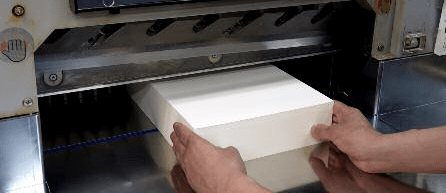
This emphasis on safety includes all industries using machines which incorporate pneumatic systems such as automotive, pharmaceutical, process, packaging, stamping, tyre production, assembly operations and general machining.
OEMs and end users must work together in the quest to achieve an accident-free workplace. While it is the end-user which is responsible for training employees in safe work practices, the OEM must design and build a machine that is both safe and compliant with government and industry regulations and directives.
In order to accomplish this task, an OEM must conduct a Risk Assessment to identify which health and safety risks exist. Then the machine must be designed and constructed using methods to reduce the potential risk.
Over the last 2 decades, standards have evolved a great deal to guide OEMs in producing safe equipment. In Europe, Machinery Directive 2006/42/EC became law in 2009. This Directive is intended for manufacturers, importers, and dealers of machinery and safety components and applies to all new machines either built or used in Europe. It coordinates the level of safety of products designed and produced by different manufacturers.
The Machinery Directive is supported by various standards. For example, ISO 13849-1 covers the design and construction of safety-related parts of control systems for machinery. These include basic concepts, principles for design, and engineering aspects that can be applied to production equipment to satisfy machinery safety.
ISO 13849-1 introduces three key concepts for the design of machinery and their safety functions:
The use of a risk analysis prior to design
Consideration of the quantitative aspects of the safety functions as well as a qualitative approach
The use of performance levels (PL) to assess the ability of safety-related parts of control systems to perform a safety function under foreseeable conditions. They are defined in terms of probability of dangerous failure per hour
Even though the Directive has been implemented in Europe, there is still some confusion about applying it in North America.
When designing machinery which uses pneumatic components, engineers typically employ discrete safety circuits with redundant dump valves to meet the obligatory safety requirements. While this approach has been successfully used for many years, it can add some complexity to machine designs.
In response to this, a new concept has emerged called Zoned Safety.
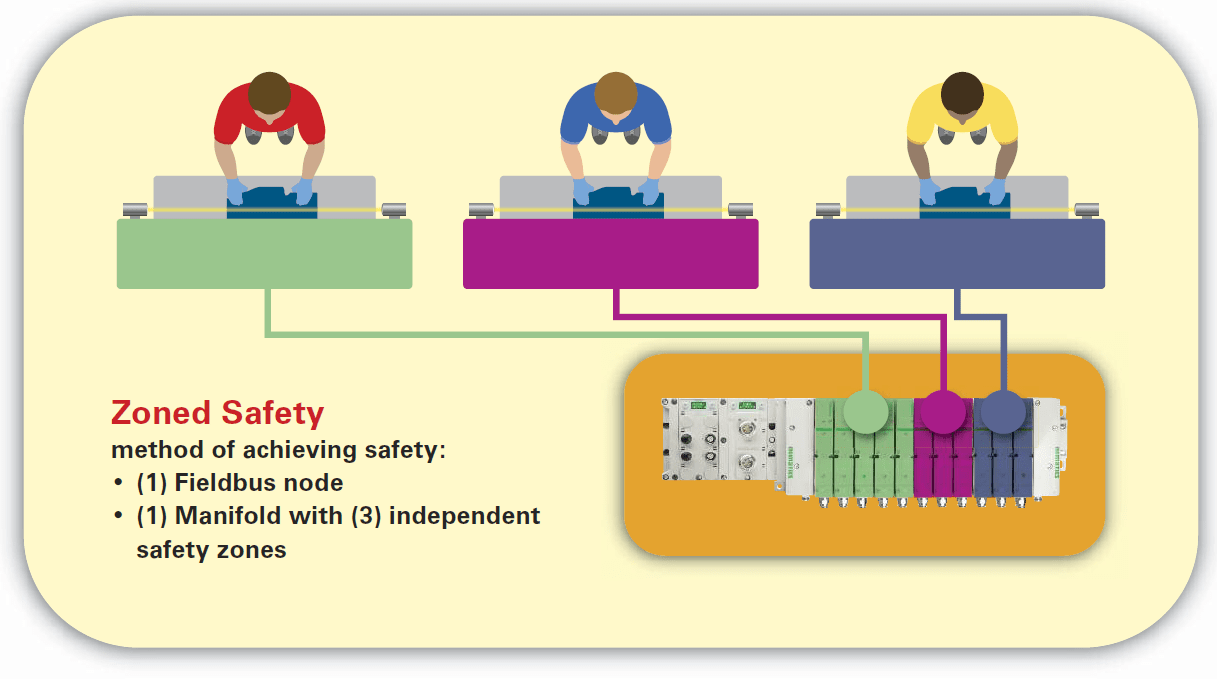
This concept allows the integration of safety functionality within a pneumatic valve manifold. It gives the designer the capability to create multiple zones or sections within a manifold that can be dedicated specifically to safety functionality.
Zoned safety allows the designer to “zone” one or more sections of the manifold to render a specific part of the machine safe. This zoned safety manifold concept provides for operation or functionality while also allowing for a “safe” condition within a zone or section of a machine where and when an operator may be present.
This approach should not be confused with Lockout-Tagout (LOTO), which is a mode used when a machine is being serviced. In this mode, maintenance personnel engage the dump valve in the machine’s pneumatic system, removing and exhausting compressed air energy. Then, the machine power is disconnected and a physical lock is installed on the dump valve. This ensures that the machine’s pneumatic system cannot be inadvertently restarted.
Zoned safety offers many benefits over traditional discrete safety circuits, while allowing for adherence to the Machine Directive and ISO 13849-1 requirements.
Traditional Pneumatic Safety Circuit Design – Using Redundant Safety Dump Valves
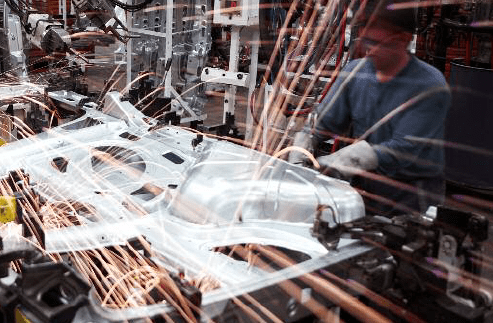
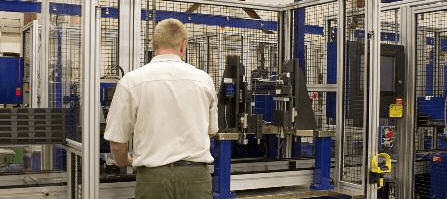
Imagine a production line with an operator loading a part inside a welding machine. When the operator enters or reaches into the machine environment, all equipment motion must stop in order to ensure the safety of the operative.
Previously, this has been done by dumping the air to the entire machine’s pneumatic system. To do this, equipment designers typically employ redundant safety dump valves and other complementary products at each operation. These components implement the safety circuitry which shuts off the pneumatic system’s air supply, dumps the air and disables the operation.
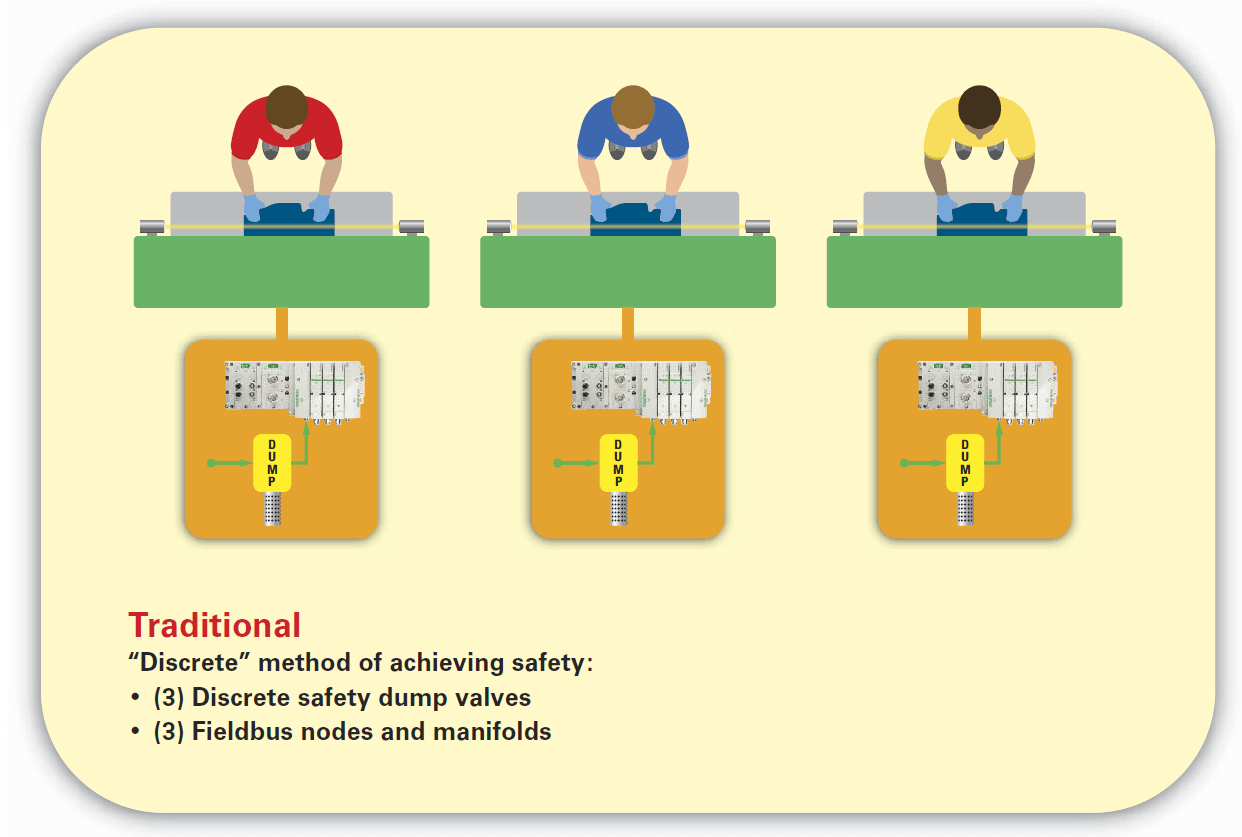
However this solution can add significant complexity to the design, manufacture, and installation of the machine. Also worth noting, when used in a continuous cycle fashion as identified below (figure 1), a redundant dump valve’s life cycle capability may not allow the user to achieve the required PL level.
Employing a redundant safety dump valve at each operation to meet the ISO 13849-1 standard also adds unnecessary cost.
Figure 1: Traditional Method
A Better Way to Achieve Safe Machine Operation
Although dumping air to an entire machine has historically met safety requirements, we know there are times when only one section of the machine needs to be safely disabled while keeping the rest of the machine in operation.
With this goal in mind, ASCO Numatics engineers have pursued a simpler and less expensive approach to safety that would meet the requirements of the Machinery Directive and ISO 13849-1. The result was the Numatics 500 Series zoned safety manifold, an integrated scalable approach to safety control. This means multiple safety zones have the ability to have separate and redundant features for each of the safety circuits, whilst allowing non-safe zones to co-exist on the same zoned safety manifold. This taking full advantage of the existing communications and I/O components.
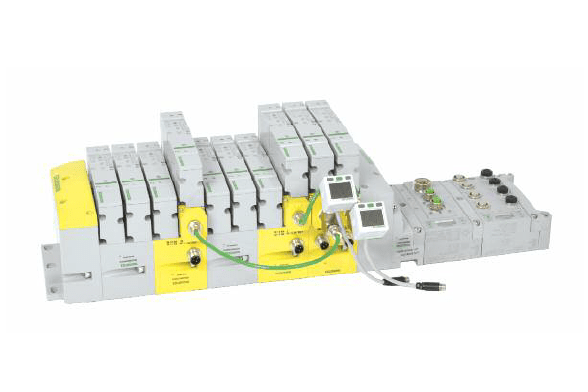
The Numatics 500 Series valve manifold with G3 fieldbus electronics is the platform that delivers zoned safety. It has the ability to control and reliably disable multiple and independent groups of pneumatic valves that operate a section of a machine.
By using the 500 Series’ capability to integrate up to three electro-pneumatic safety zones within one manifold assembly, both air and power are disabled only to the components in the zones that control equipment that will come in contact with the operator. The rest of the machine can remain in operation when these safety circuits are enabled. (See figure 2.)
Figure 2: Zoned Safety Method
As zoned safety capability is designed into the standard Numatics 500 Series valve manifold platform, no redesign or safety redundant dump valve is required for zone control and the user has a range of choices when selecting valve options, accessories, and flow requirements. The assembled product is very similar to a standard manifold that has been used by OEMs and machine builders for many years.
The Benefits for OEMs and End-Users
There are multiple benefits to be derived from the zoned safety manifold concept. The most important is the ability to greatly simplify the design of a redundant pneumatic safety circuit by using a manifold system.
No longer is a discrete safety circuit, with multiple redundant dump valves and other components which add complexity and expense, required to isolate sections of the machine safely. Multiple independent safety circuits can easily and cost effectively be designed into a single pneumatic valve manifold. This can reduce the number of safety system components by up to 35%. It also optimises the use of safety networks and requires less plumbing.
The zoned safety approach can shrink the size of the safety system and frees up valuable space within the machine and manifold to be used for other purposes.
For most OEM machine builders, designing multi-zoned safety circuits with a Numatics 500 Series manifold will be a familiar and user-friendly experience. Only the ability to redundantly remove power and pilot air to the safety system valves has been added. In addition, the product selection and ordering process is very similar to purchasing a standard Numatics 500 Series valve manifold.
For equipment operators and owners, zoned safety will simplify and reduce costs while still optimising the safety of their machines. Best of all, productivity and asset availability will be improved, as the user does not have to shut down the entire machine when safety circuits are enabled.
Conclusion
The implementation of the Machine Directive 2006/42/EC and ISO 13849-1 has put an emphasis on the design and manufacture of safe production equipment.
Traditionally, discrete pneumatic safety circuits use dump valves and other components to achieve diverse redundancy. However, these safety systems are complex, costly, and frequently require the shutdown of the entire production machine.
ASCO engineers have developed a new approach called zoned safety. This concept leverages the unique capabilities of the Numatics 500 Series valve manifold.
The 500 Series can create up to three independent electro-pneumatic safety zones, while also allowing independent non-safe sections to co-exist within one manifold assembly. Air and power are disabled only to the components controlling equipment that might come in contact with the operator. The rest of the machine can remain in operation when these safety circuits are enabled. Zoned safety greatly simplifies safety circuit design and reduces the number of system components.
Its use is strongly recommended for any pneumatically controlled production equipment requiring Machine Directive 2006/42/EC and ISO 13849-1 compliance.
ASCO Valves
Applying Zoned Safety in an Automotive Workflow
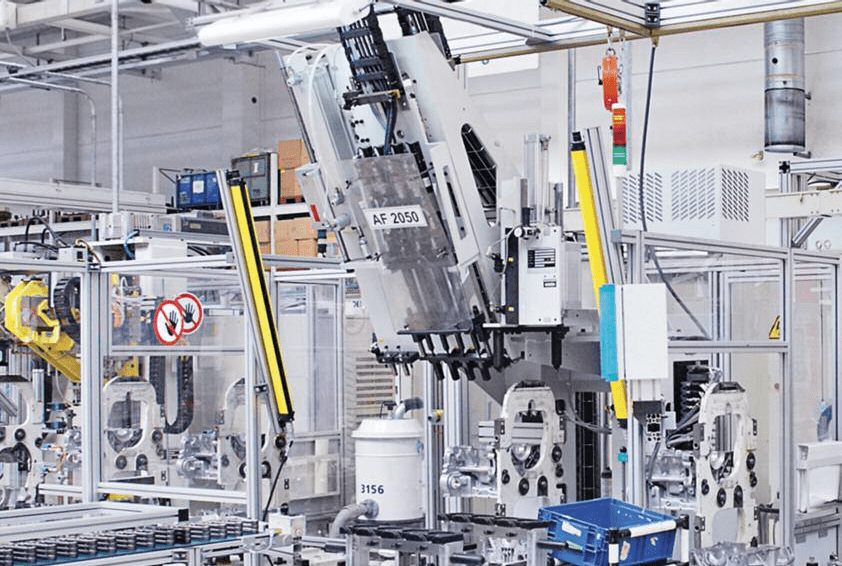
An automated machine has three loading stations. As parts move down the line, an operator adds a stamped metal part to the welded assembly. In order to avoid injury, the operator should not put his hands into the active loading area. To ensure safety, the operator must walk through a light curtain that disables the power and pilot air (only to the redundant pneumatic valves controlling the moving components in the work station), preventing unwanted motion. He loads the part into a fixture, walks back out through the light curtain, initiates operation, and the machine restarts.
The operator’s safety must be guaranteed while in the loading zones per the Machine Directive and ISO 13849-1.
The conventional way to implement a safety function would be to have one manifold dedicated to the safety circuit in the first loading station. Feeding that manifold would be an expensive redundant safety dump valve. A duplicate manifold and dump valve would be installed for the safety circuits in the second and third loading zones, as well.
With the zoned safety approach, a much simpler design is possible which allows safety operation without the need to dump air to the entire manifold.
Three independent zones within a single Numatics 500 Series manifold would independently control the safety function in the three loading stations. The additional manifolds, dump valves, and fieldbus nodes shown in Figure #1, would not be required.
Process Instrumentation
Explosive Atmosphere Experts
Thorne & Derrick are Specialist Distributors of Hazardous Area Electrical, HVAC & Process Instrumentation Equipmentwith IECEx & ATEX Certifications to the onshore and offshore oil, gas, petrochemicals and process industries.
We supply major UK and international infrastructure projects and also MRO (Maintenance, Repair, Operations) requirements for both planned and unplanned plant shutdowns – we react with a rapid response to customer demand to ensure downtime is minimised and reliable Power, Light & Heat is restored or provided.
We distribute Innovative products to manage the planned replacement of legacy equipment conformant with international classifications including ATEX and IECEx.
IECEx Certification for Industrial Fans | Hazardous Areas & Explosive Atmospheres
Uploaded by Natalie Lundie |Supply Chain: Marketing Lead at Thorne & Derrick International
Republished with kind permission of Woodcock & Wilson and IEC e-tech | News & Views from the IEC
IECEX Fans
Woodcock & Wilson are manufacturers of the worlds first Independently certified ATEX & IECEx fan for safe ventilation of hazardous area workplaces and potentially explosive atmospheres.
e-tech talked to Scott Harding, Sales Director and Joint Owner of Woodcock & Wilson, one of the world’s leading industrial fan manufacturers, on ATEX and IECEx certification for industrial fans.
Why industrial fans?
Proper ventilation is a must for almost all industrial facilities not only to protect the health and safety of their employees but also to provide temperature control and mitigate the risks of fire.
And this is of particular importance in explosive (Ex) environments.
Power generation, oil and gas, mining, metal manufacturing and processing, petrochemical, food processing, automotive are some of the sectors that use industrial fans for ventilation, aeration, exhaust, cooling, air cleaning and drying and much more. Gyms, warehouses, and underground parking garages are also among those requiring industrial fans to ensure the health and safety of those using the facilities.
The main function of industrial fans is to provide a large flow of air or gas to various parts of buildings or other structures.
A first
In September 2019, IECEx, the IEC System for Certification to Standards Relating to Equipment for Use in Explosive Atmospheres, certified Woodcock & Wilson, for its range of industrial fans. This is the first fan manufacturer to obtain IECEx non-electrical certification for its centrifugal and axial fans.
To meet the demands of major players in the oil and gas sector, the decision was made to look at IECEx certification when in 2016, the System announced that it had begun to issue certificates for non-electrical (mechanical) Ex equipment.
The company applied for its first IECEx certificate in 2017, one year after the publication of ISO 80079-36 and ISO 80079-37, two international standards issued by IEC Subcommittee 31M: Non-electrical equipment and protective systems for explosive atmospheres.
♦ ISO 80079-36:2016 Explosive Atmospheres – Part 36: Non-Electrical Equipment for Explosive Atmospheres – Basic Method & Requirements
♦ ISO 80079-37:2016 Explosive Atmospheres – Part 37: Non-Electrical Equipment for Explosive Atmospheres – Non Electrical Type of Protection Constructional Safety “c”, Control of Ignition Source “b”, Liquid Immersion “k”
IECEX | International Standards & Conformity Assessment for all electrical, electronic and related technologies used in explosive atmospheres and hazardous area industries.
Self-Certification vs Third-party
Harding explains that the majority of their work is for oil and gas, petrochemicals and pharmaceuticals. He adds that about 75% of their work is ATEX. Any manufacturing that involves equipment used in hazardous areas has a fan and ATEX has a standard, EN 14986, for the design of fans working in potentially explosive atmospheres. The company is also on the CEN Technical Committee responsible for the standard. And, most importantly, is one of the only fan manufacturers that provides third party ATEX certification.
The ATEX Directive 2014/34/EU covers equipment and protective systems intended for use in potentially explosive (Ex) atmospheres. The directive, mandatory within the European Union, defines the essential health and safety requirements and conformity assessment procedures to be applied before Ex products can be sold in the EU or internationally.
Under ATEX, manufacturers are allowed to self-certify their products. However, self-certification is not without risks: Harding explains that “it can become a ‘race to the bottom’ with commercial pressures leading to the cutting of corners with regard to construction and adherence to specifications.” He adds that “Woodcock & Wilson is different from its competitors in that all its products have third-party certification, thus avoiding potential technical fails. Product safety has to be the responsibility of the manufacturer.
End-users should not be made to take risks and pay the price of potential malfunctions. According to Harding, “ATEX is basically a good product but, because of its minimal legal requirements, it can be misused by manufacturers hoping to cut costs and speed up market roll-out.”
Education is key
Unlike ATEX, IECEx certification is voluntary and always third-party; the System does not allow self-certification. All Ex equipment must be independently tested by an accredited laboratory (ExTL) and certified by an accredited certification body (ExCB). Moreover, IECEx ensures complete transparency since all certificates are available on the IECEx website and accessible to all.
Harding says that going to IECEx certification has raised some issues: for instance when people, who have an ATEX-certified fan with an IECEx-certified motor, claim that their equipment has full IECEx certification. They don’t realize that IECEx now certifies non-electrical (mechanical) equipment in compliance with international standards. “This means that we have to educate people to make sure they understand the whole process.”
“There is a definite interest in IECEx but the problem is the disconnect between manufacturers, engineering procurement and construction (EPC) end-users and our products. Our competitors sometimes manage to convince their potential customers, who don’t know better, that IECEx certification for non-electrical products is not available, and they win the bid.
They claim their products are safe and comply with the relevant standards but all they’re after is to win projects over safety. Industrial fans are very unique as mechanical products, classified as ‘safety critical’. And of course, forgoing independent inspection may put end-users at risk – they don’t realize the product they buy may be flawed.”
Raising awareness
“Cost may be an issue for some,” says Harding. “It may cost four or five percent more to have IECEx certification but, while having IECEx certification may seem more expensive, people don’t realize that, in the end, the price to pay is much less than what they thought. They need to have only one test and one certificate, accepted everywhere, thus eliminating the financial burden of additional testing.
IECEx certification provides confidence that the equipment is built in compliance with IEC International Standards, and consequently increased security and safety in all types of Ex areas. In addition, the United Nations, through the UN Economic Commission for Europe (UNECE), has endorsed IECEx as the internationally recognized certification system for promoting the safety of equipment, services and personnel associated with devices, systems and installations used in explosive areas.” To sum up, with IECEx there is no doubt that the equipment has been independently certified using best practice in accordance with international standards.
For Harding the main issue is risk awareness. And that can only be addressed through an educational process. To that end, Harding takes every opportunity to introduce IECEx in his presentations to companies and explain how the System brings product and equipment safety and confidence to a higher level. People have to know what their options are when they have to decide to go with ATEX or IECEx.
“It gives a level of authority, of understanding true safety products. Our big problem is that the majority of industry still doesn’t realize there are mechanical standards. ATEX was in the late 1990s and it’s almost 23 years and I gave lots of presentations about ATEX and now it’s ATEX and IECEx to a number of engineers and inspectors who actually don’t understand there’s a mechanical side to it”.
Scott Harding
Scott Harding, who has worked in the fan sector for 27 years, joined Woodcock & Wilson eight years ago as Sales Manager. He was later promoted to Sales Director and since December 2019, he has become a joint owner of the company after a management buyout from the previous owner. His background is in business management, specializing in design concepts and speed of manufacture for assembly and products.
Introducing A World First in Ventilation
for Hazardous Areas & Explosive Atmospheres
Exstream fans are the market-leading ATEX fan to provide powerful and portable ventilation in hazardous areas – specified for safe and reliable extraction and blowing of dangerous gases and vapors in explosive atmospheres with airflow capability up to 7750m3/hr. Both ATEX & IECEx dual certified to Electrical & Non-Electrical Standards (Mechanical) for Zone 1 & Zone 2 ventilation applications.
Class Leading Airflow: Up to 7750m3/hr
Robust: Mild Steel or Stainless Steel Casing
Low Power Consumption: <8A FLC
Low Noise Output: 49db
Easy to Use: Plug & Play Fan
Voltage Options: 110V/230V & 3-Phase Options Available
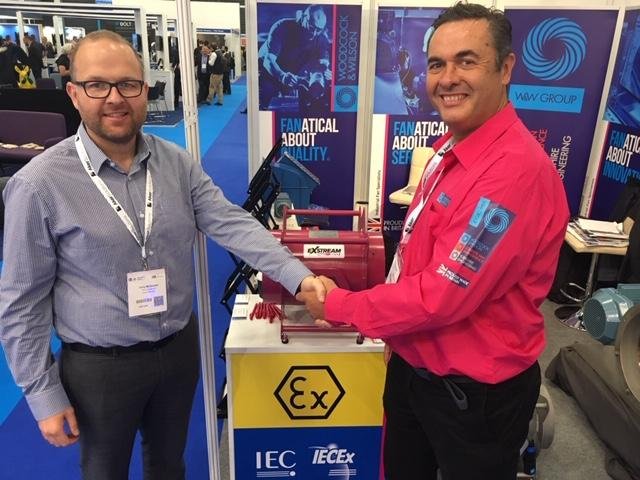
At Offshore Europe 2019, Thorne & Derrick signed an Exclusivity Agreement with Woodcock & Wilson to distribute their new Exstream portable ventilation fan – a world-first product with ATEX & IECEx certification.
Pictured Terry McDonald (T&D Business Development Manager) & Scott Harding (Woodcock & Wilson Ltd).
Exstream | Distributed by Thorne & Derrick | World’s First Dual Certified ATEX & IECEx Dual Certified Portable Ventilation Fan
EXPERTS IN EQUIPMENT FOR EXPLOSIVE ATMOSPHERES
leaders in ATEX Innovation To The Hazardous Area Industries
Thorne & Derrick are leaders in the development and distribution of Product Innovations that deliver significant improvements to clients plant, people and operational safety in the explosive atmosphere industries.
Your proactive problem solvers experienced in succession planning for the replacement of obsolete, non-conformant and legacy equipment in hazardous areas.
Your first-choice provider of innovative and competitive solutions to ensure ATEX & IECEx Compliance for Hazardous Area Electrical, HVAC & Process Instrumentation Equipmentto UK and international projects.
The LED Hazardous Area Linear Lighting Fitting With ATEX Certification | Raytec SPARTAN
Hazardous Area Lighting
Webinar with Raytec
uploaded by Natalie Lundie: Supply Chain: Marketing Lead at Thorne & Derrick International
Thorne & Derrick International, based in the UK, are Preferred Distributors and Stockists for the Raytec SPARTAN range of ATEX lighting using LED technology for the illumination of hazardous area locations and potentially explosive atmospheres.
SPARTAN Linear, manufactured in the North East of England by Raytec, offers the ideal LED lighting solution for new installations, or as a retrofit for existing fluorescent luminaires.
The Raytec webinar gives you a hands-on demonstration of their impressive SPARTAN Linear. They walk you through all the key features, and show you how easy it is to install and maintain. Hazardous area experts also answer product questions with a Q&A session. Watch the recording here.
Industry leading manufacturers of Lighting Products for hazardous areas | Raytec
SPARTANis a full range of Ex LED luminaires and lighting approved for all ATEX and IEC Ex Zone 1 and Zone 2 hazardous area environments, including UL /CSA C1D2 installations. The hazardous area lighting products are designed for the most extreme environments – Flood, Linear, Bulkhead, Bay & Crane luminaires with emergency and industrial lighting versions are also available from Thorne & Derrick International.
Hazardous Area Lighting with ATEX & IECEx Certification
Hazardous Area Lighting Design
Thorne & Derrick’s hazardous area lighting design service is completely free of charge, providing you with a visual 3D representation of the final lighting solution, with detailed lux levels and a true indication of lighting performance. Our lighting design experts will guide you through the entire process, ensuring the optimum lighting solution is achieved.
leaders in ATEX Innovation To The Hazardous Area Industries
Thorne & Derrick are leaders in the development and distribution of Product Innovations that deliver significant improvements to clients plant, people and operational safety in the explosive atmosphere industries.
Your proactive problem solvers experienced in succession planning for the replacement of obsolete, non-conformant and legacy equipment in hazardous areas.
Your first-choice provider of innovative and competitive solutions to ensure ATEX & IECEx Compliance for Hazardous Area Electrical, HVAC & Process Instrumentation Equipmentto UK and international projects.
Follow our Showcase Page on LinkedIn to receive hazardous area product innovations, industry news, whitepapers, videos, technical tips and training webinars for professionals involved in the explosive atmosphere industries.
Appleton PlexPower Fiber Panel | Panelboards for Hazardous Areas
Republished by Thorne & Derrick with kind permission of Emerson Appleton
Uploaded by Chris Dodds | Sales Marketing Manager Thorne & Derrick International
Panelboards for Hazardous Areas
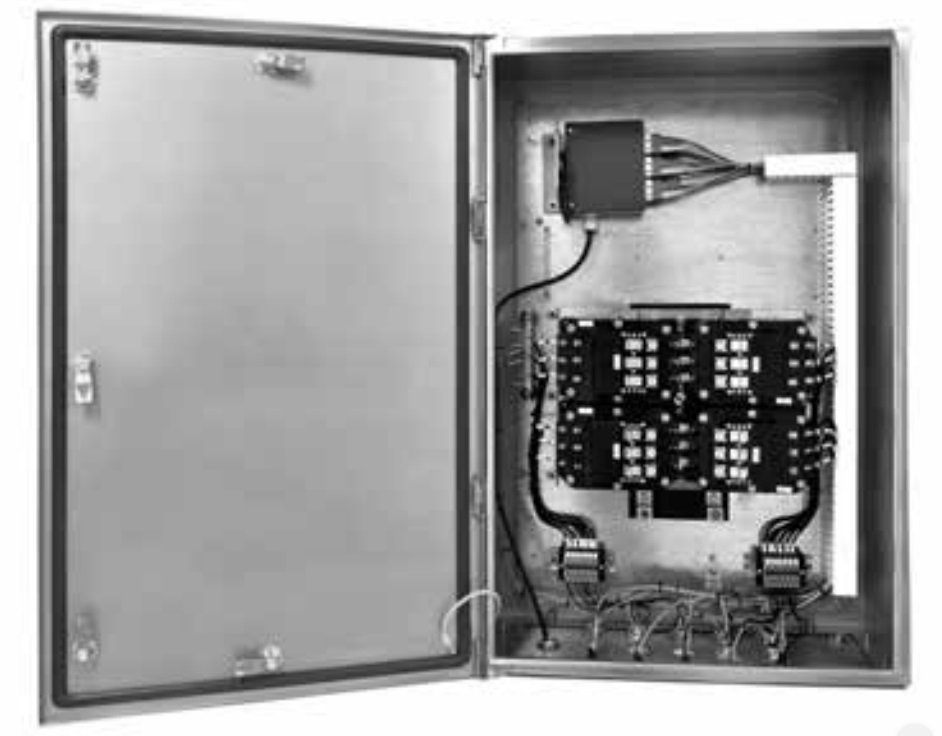
Appleton PlexPower Fiber Panel
Class I, Zone 1 IIB+H2, and Class I, Division 2, Groups B, C, D Certifications
The Appleton PlexPower Fiber Panel is the first hybrid certified panelboard for hazardous locations.
This solution combines power and data into a single steel enclosure serving as a single point of control for both power and fiber communication cables to help users achieve significant savings – help users save up to 77% in installation, commissioning and maintenance costs.
“We conducted extensive research with end users and customers and found that many have struggled with the complexity of routing hundreds of feet of dedicated power and fiber cables from separate enclosures. They want a simplified, cost effective connectivity solution to accelerate their adoption of IIoT technologies into their operations,” said Mark Garton, senior product marketing manager, Emerson Automation Solutions. “The Appleton PlexPower Fiber Panel fills that unmet need in the marketplace by centralizing control of electrical circuits and communication patch panels in one enclosure located in the hazardous areas, resulting in reduced cabling costs, increased power safety, greater configuration flexibility and a more reliable IIoT infrastructure.”
The Appleton PlexPower Fiber Panel incorporates Belden MIPP fiber splice boxes that minimise installation time for fiber patching and enable hassle-free access during routine maintenance. It provides easy access for organizing and managing up to 12 ST (Straight Tip connector), SC (Subscriber Connector) and LC (Lucent Connector) type fiber connections, making it ideal for use in a wide range of industrial networking applications requiring maximum system reliability and flexibility.
The Appleton PlexPower Fiber Panel simplifies IIoT in petrochemical plants, chemical plants, wastewater treatment centers, pulp/paper facilities, corrosive indoor and outdoor environments, or where flammable gases or vapors are present.
Appleton PlexPower Fiber Panel
Features & Benefits
Provides indoor and outdoor protection and control of electrical circuits in hazardous environments such as petroleum and chemical plants, refineries, wastewater treatment plants, paper and pulp industries, and other process facilities
Ideal for placement in wet, corrosive environments or where flammable gases or vapors are likely to be present
Suitable for use on applications where both power and communication wiring is required
No external conduit or cable seals required thus making installations faster, easier, and less costly
Ground-breaking design that uses individual breaker housings to minimize the downtime and costs associated with servicing circuit breakers in hazardous locations
PlexPower™ breakers accommodate off-the-shelf breakers, making replacements readily available
Standard models offer 12 circuit and 24 circuit panelboard configurations, internal actuators, dead front for internal actuation and standard hard drawn, tin plated, copper bus bar for superior corrosion resistance
Branch circuit breakers available in single pole. Current ratings on branch breakers is 120/240 Volts, 60 Amps maximum
Breaker modules supplied with stainless steel bolts, ground and or neutral bars and external/internal ground lug
Branch and main breakers can be padlocked in either the “On” or “Off” position
Bus Bar Panel with Main Breaker – Internal View
Driven by the need for improved efficiencies, applications in the petrochemical industry will greatly benefit from this hybrid cabling technology. It will help to automate operational management of boilers, tanks, pumps, control valves and meters with intelligent sensors that collect maintenance and flow information, among other data.
Like the original Appleton PlexPower Series panelboard, the new Appleton PlexPower Fiber Panel uses circuit breaker modules that provide explosion-proof protection for standard off-the-shelf breakers, eliminating the need for a heavy-cast enclosure.
Component-level protection means the panelboard enclosure is lighter, more compact and easier to install. Breakers can be easily replaced, upgraded or added in the field with no bolted cover to remove, no need for sealing or rewiring and no danger of compromising flame path integrity. The enclosure is 316L stainless steel featuring stainless steel hardware and a hard drawn, tin-plated, copper bus bar for corrosion resistance and maximum reliability.
The Appleton PlexPower Fiber Panel is available with multiple design options, giving end users flexibility and convenience in configurations, with a smaller, lightweight footprint.
Specifications
NEC/CEC Certifications and Compliances – Class I, Zone 1, AEx d e op pr IIB+H2 T3/T5 Gb; Ex d e op pr IIB+H2 T3/T5 Gb; Class I, Division 2, Groups B, C, D; Class II, Division 1, Groups F, G; Class III; IP66; Type 4X
Standard Materials – 316L stainless steel enclosure with stainless steel hardware and hard drawn, tin plated, copper bus bar
Operating Temperature – -20ºC to +40ºC (-4ºF to +104ºF)
Hazardous Area & Explosion Proof Electrical Equipment
About Appleton
Since 1903, the Appleton brand has been the hallmark for electrical products designed to protect people and equipment while delivering reliable power. They supply the widest range of lighting fixtures, electrical fittings, plugs and receptacles, control stations, distribution panels and more. All are manufactured with the highest quality materials and finishes.
With the addition of ATX hazardous area product lines and ongoing new product introductions, Appleton offers certified protection for any environment, from ordinary commercial settings to hazardous locations (NEC, CEC, IEC, ATEX, and more) and the harshest industrial conditions – onshore or offshore, in any region of the world.
Thorne & Derrick are leaders in the development and distribution of Product Innovations that deliver significant improvements to clients plant, people and operational safety in the explosive atmosphere industries.
Your proactive problem solvers experienced in succession planning for the replacement of obsolete, non-conformant and legacy equipment in hazardous areas.
Your first-choice provider of innovative and competitive solutions to ensure ATEX & IECEx Compliance for Hazardous Area Electrical, HVAC & Process Instrumentation Equipmentto UK and international projects.
Press Release Date: 02.04.2020 uploaded by Chris Dodds (T&D Sales + Marketing Manager) World’s First Fully Certified ATEX Doors Thorne & Derrick International, the Experts in Equipment for Explosive Atmospheres, today announce the signing of a Commercial Distribution Agreement...
Press Release Date: 04.07.2019 uploaded by Chris Dodds (T&D Sales + Marketing Manager) Category: Stockist Distributor Agreement Announcement Thorne & Derrick International announce that they have signed a Preferred Distributor Agreement with Raytec, the world leading manufacturer of LED...












 The operator’s safety must be guaranteed while in the loading zones per the Machine Directive and ISO 13849-1.