When electrical equipment is used in, around, or near an atmosphere that has flammable gases or vapours, flammable liquids, combustible dusts, ignitable fibres or flyings, there is always a possibility or risk that a fire or explosion might occur.
Those areas where the possibility or risk of fire or explosion might occur due to an explosive atmosphere and/or mixture is often called a hazardous (or classified) location/area. Currently there are two systems used to classify these hazardous areas; the Class/Division system and the Zone system.
The Class/Division system is used predominately in the United States and Canada, whereas the rest of the world generally uses the Zone system. However, the United States and Canada are trending more towards the Zone System.
Class/Division System for Hazardous Area Locations
Hazardous locations per the Class/Division system are classified according to the Class, Division, and Group.
Class—The Class defines the general nature (or properties) of the hazardous material in the surrounding atmosphere which may or may not be in sufficient quantities.
a. Class I—Locations in which flammable gases or vapours may or may not be in sufficient quantities to produce explosive or ignitable mixtures.
b. Class II—Locations in which combustible dusts (either in suspension, intermittently, or periodically) may or may not be in sufficient quantities to produce explosive or ignitable mixtures.
c. Class III—Locations in which ignitable fibres may or may not be in sufficient quantities to produce explosive or ignitable mixtures.
Division—The Division defines the probability of the hazardous material being able to produce an explosive or ignitable mixture based upon its presence.
a. Division 1 indicates that the hazardous material has a high probability of producing an explosive or ignitable mixture due to it being present continuously, intermittently, or periodically or from the equipment itself under normal operating conditions.
b. Division 2 indicates that the hazardous material has a low probability of producing an explosive or ignitable mixture and is present only during abnormal conditions for a short period of time.
Group—The Group defines the type of hazardous material in the surrounding atmosphere. Groups A, B, C, and D are for gases (Class I only) while groups E, F, and G are for dusts and flyings (Class II or III).
a. Group A—Atmospheres containing acetylene.
b. Group B—Atmospheres containing a flammable gas, flammable liquid-produced vapor, or combustible liquid-produced vapor whose MESG is less than 0.45 mm or MIC ratio is less than 0.40. Typical gases include hydrogen, butadiene, ethylene oxide, propylene oxide, and acrolein.
c. Group C—Atmospheres containing a flammable gas, flammable liquid-produced vapor, or combustible liquid-produced vapor whose MESG is greater than 0.45 mm but less than or equal to 0.75 mm or MIC ratio is greater than 0.40 but less than or equal to 0.80. Typical gases include ethyl either, ethylene, acetaldehyde, and cyclopropane.
d. Group D—Atmospheres containing a flammable gas, flammable liquid-produced vapor, or combustible liquid-produced vapor whose MESG is greater than 0.75 mm or MIC ration is greater than 0.80. Typical gases include acetone, ammonia, benzene, butane, ethanol, gasoline, methane, natural gas, naphtha, and propane.
e. Group E—Atmospheres containing combustible metal dusts such as aluminium, magnesium, and their commercial alloys.
f. Group F—Atmospheres containing combustible carbonaceous dusts with 8% or more trapped volatiles such as carbon black, coal, or coke dust.
g. Group G—Atmospheres containing combustible dusts not included in Group E or Group F. Typical dusts include flour, starch, grain, wood, plastic, and chemicals.
Hazardous Area Zone System
Hazardous locations per the Zone system are classified according to its Zone which can be gas or dust. For gas atmospheres electrical equipment is further divided into Groups and Subgroups.
Zone—The Zone defines the probability of the hazardous material, gas or dust, being present in sufficient quantities to produce explosive or ignitable mixtures.
Gas
a. Zone 0—Ignitable concentrations of flammable gases or vapours which are present continuously or for long periods of time.
b. Zone 1—Ignitable concentrations of flammable gases or vapours which are likely to occur under normal operating conditions.
c. Zone 2—Ignitable concentrations of flammable gases or vapours which are not likely to occur under normal operating conditions and do so only for a short period of time.
Dust
a. Zone 20—An area where combustible dusts or ignitable fibres and flyings are present continuously or for long periods of time.
b. Zone 21—An area where combustible dusts or ignitable fibres and flyings are likely to occur under normal operating conditions.
c. Zone 22—An area where combustible dusts or ignitable fibres and flyings are not likely to occur under normal operating conditions and do so only for a short period of time.
Group—Electrical equipment is divided into three groups.
Group I—Equipment intended for use in mines susceptible to firedamp (flammable mixture of gases naturally occurring in a mine).
Group II—Equipment intended for use in places with an explosive gas atmosphere other than mines susceptible to firedamp. Group II equipment is subdivided into three subgroups.
– Group IIA—Atmospheres containing propane, or gases and vapours of equivalent hazard.
– Group IIB—Atmospheres containing ethylene, or gases and vapours of equivalent hazard.
– Group IIC—Atmospheres containing acetylene or hydrogen, or gases and vapours of equivalent hazard.
Group III—Equipment intended for use in places with an explosive dust atmosphere. Group III equipment is subdivided into three subgroups.
– Group IIIA—Atmospheres containing combustible flyings.
– Group IIIB—Atmospheres containing non-conductive dust.
– Group IIIC—Atmospheres containing conductive dust.
Protection Techniques and Methods
Various protection techniques and methods have been developed and employed, thus reducing or minimising the potential risks of explosion or fire from electrical equipment located in hazardous locations. Not all methods are listed.
Class/Division System for Hazardous Area Locations
Explosion-proof—A type of protection that utilises an enclosure that is capable of withstanding an explosive gas or vapor within it and or preventing the ignition of an explosive gas or vapor that may surround it and that operates at such an external temperature that a surrounding explosive gas or vapor will not be ignited thereby.
Intrinsically Safe—A type of protection in which the electrical equipment under normal or abnormal conditions is incapable of releasing sufficient electrical or thermal energy to cause ignition of a specific hazardous atmospheric mixture in its most easily ignitable concentration.
Dust Ignition-proof—A type of protection that excludes ignitable amounts of dust or amounts that might affect performance or rating and that, when installed and protected in accordance with the original design intent, will not allow arcs, sparks or heat otherwise generated or liberated inside the enclosure to cause ignition of exterior accumulations or atmospheric suspensions of a specified dust.
Non-incendive—A type of protection in which the equipment is incapable, under normal conditions, of causing ignition of a specified flammable gas or vapor-in-air mixture due to arcing or thermal effect.
Hazardous Area Zone System
The below concepts are high-level protection concepts. There are also sub-levels of protection that may or not be applicable to each type. Also, some equipment may combine multiple types of protection such as hazardous area lighting:
Flame-proof—A type of protection in which an enclosure can withstand the pressure developed during an internal explosion of an explosive mixture and that prevents the transmission of the explosion to the explosive atmosphere surrounding the enclosure and that operates at such an external temperature that a surrounding explosive gas or vapor will not be ignited there. This type of protection is referred to as “Ex d”.
Intrinsically Safe—A type of protection in which the electrical equipment under normal or abnormal conditions is incapable of releasing sufficient electrical or thermal energy to cause ignition of a specific hazardous atmospheric mixture in its most easily ignitable concentrations. This type of protection is referred to as “Ex i”.
Increased Safety—A type of protection in which various measures are applied to reduce the probability of excessive temperatures and the occurrence of arcs or sparks in the interior and on the external parts of electrical apparatus that do not produce them in normal service. Increased safety may be used with flame-proof type of protection. This type of protection is referred to as “Ex e”.
Type n—A type of protection applied to electrical equipment such that in normal operation it is not capable of igniting a surrounding explosive atmosphere. This type of protection is referred to as “Ex n”.
Type t—A type of protection in which the electrical equipment is equipped with an enclosure providing dust ingress protection and a means to limit surface temperatures. This type of protection is referred to as “Ex t”.
Type h—Refers to one of three different types of protection: (1) where constructional measures are applied to protect against the possibility of ignition from hot surfaces, sparks and compression generated by moving parts; (2) ignition protection where mechanical or electrical devices are used in conjunction with nonelectrical equipment to manually or automatically reduce the likelihood of a potential ignition source from becoming an effective ignition source; or (3) protection where potential ignition sources are made ineffective or separated from the explosive atmosphere by either totally immersing them in a protective liquid, or by partially immersing and continuously coating their active surfaces with a protective liquid in such a way that an explosive atmosphere which may be above the liquid, or outside the equipment enclosure, cannot be ignited. Non-electrical equipment often apply “Ex h” protection methods.
Equipment Protection Level (EPL) Markings
The EPL marking indicates the level of protection that is given to equipment based on the likelihood of its becoming a source of ignition and distinguishing the difference between explosive gas atmospheres, explosive dust atmospheres, and the explosive atmospheres in mines susceptible to firedamp.
Temperature Code (T Code)
A mixture of hazardous gases and air may be ignited by coming into contact with a hot surface. The conditions under which a hot surface will ignite a gas depends on surface area, temperature, and the concentration of the gas. The same can be said about combustible dusts. The T code or T class rating of a product denotes the maximum surface temperature that a given product will not exceed under a specified ambient temperature. For example, a product with a T code of T3 means that its maximum surface temperature will not exceed 200°C provided it is operated in a ambient temperature defined by the manufacturer.
Nomenclature
Class/Division System
Approved equipment is marked according to which Class (I, II, or III), Division (1 or 2), Group (A, B, C, D, E, F, or G), and temperature code (T1 through T6) that it is rated for. For intrinsically safe equipment the words “Intrinsically Safe” or “IS” will precede the actual approval marking to indicate it as being intrinsically safe. Examples are listed below:
Class I Division 1 Group B,C,D T5
CL I Div 2 GP ABCD T5
IS CL I,II,III Div 1 GP ABCDEFG
CL II,III Div 1,2 GP EFG T4
Zone System for Hazardous Area Locations
Approved equipment is marked according to the protection concept for which it has been designed (Ex i, Ex d, Ex n, and etc.), the group (I, IIA, IIB, IIC, IIIA, IIIB, or IIIC), and temperature code (T1 through T6) that it is rated for. For the United States it will be preceded by which Class and Zone it is approved for. Examples are listed below:
Ex ia IIC T5
Ex d IIB+H2 T6
Ex nA IIC T6
Class I Zone 2 AEx nC IIC T5
Additional Terminology
Although the following terminology is not permitted for markings it is commonly used to describe the various types of approvals or when speaking of them.
XP—Flameproof approval for Class I Division 1
EXP—Flameproof approval for Class I Division 1
NI—Non-incendive approval for Class I Division 2
DIP—Dust Ignition Proof approval for Class II Division 1
S—“Suitable For” for Class II Division 2
IS—Intrinsically Safe
Approval Agencies
Generally speaking, most countries require that products intended for installation in a hazardous location be approved by a recognized authority or approval agency (governmental or independent) which that country has established by various laws, regulations, or codes. See table 1 for an overview of approvals and approval agencies.
North American Approvals
Of the 15 national testing laboratories (NRTL’s) in the United States, only a few are qualified to approve products for use in hazardous locations. Two such agencies are; Factory Mutual (FM) and Underwriters Laboratories (UL). In Canada, products are approved by the Canadian Standards Association (CSA).
European Approvals
Each country belonging to the European Union has established one or more “Notified Bodies” for product approval. Notified Bodies not only approve products for use within their own country, commonly called national certifications/approvals, but also for any other country within the union, known as CENELEC certifications/approvals. CENELEC is the acronym for European Committee for Electrotechnical Standardization. A product which has been CENELEC certified or approved by any of the Notified Bodies is automatically accepted for use within all of the participating union countries. In July 2003 a European Directive, called the ATEX Directive, which pertains to equipment for explosive atmospheres, was adopted. All equipment intended for use in explosive atmospheres must comply with the ATEX Directive in order to be sold into the European Union.
International Approvals for Hazardous Area Locations & Explosive Atmospheres
Countries participating in the IECEx Scheme (International Electrotechnical Commission on explosion protected equipment, known as “Ex”) can issue either an international certification or a national certification of explosion protected equipment. Each country within the IECEx scheme establishes an ExCB (Ex Certification Body) which can approve products. ExCB’s can issue the national certification for their country based upon the IECEx standards (including any national deviations) and the international certification. Currently, Australia is the only country accepting international certifications for use in their country.
Table 1. Approval Agencies
Approvals¹
Approval Agencies Used²
Approvals Accepted
FM
FM—Factory Mutual
North America
CML
CML—Certification Management Limited
Japan
CSA
CSA—Canadian Standards Association
North America
ATEX
Baseefa—British Approvals Service for Electrical Equipment in Flammable Atmospheres
KEMA—NV tot Keuring van Elektrotechnische Materialen
LCIE—Laboratorie Central des Industries Electriques
European Union
IECEx
CSA—Canadian Standards Association
Baseefa—British Approvals Service for Electrical Equipment in Flammable Atmospheres
International
SAA
SAA—Standards Association of Australia
Australia
NEPSI
NEPSI—National Supervision and Inspection Centre for Explosion Protection and Safety of Instrumentation
China
TIIS
TIIS—Technology Institution of Industrial Safety
Japan
INMETRO
INMETRO—National Institute of Metrology, Quality and Technology
Brazil
CUTR
FGUP Certification Centre: SC VSI VNIIFTRI
Certification Body: OS VSI VNIFFTRI
Russia, Belarus, Kazakhstan & America
¹ Fisher™ products may carry additional approvals. Contact T&D for additional approval information.
² Fisher product approvals may be certified by other agencies. Contact T&D for additional information.
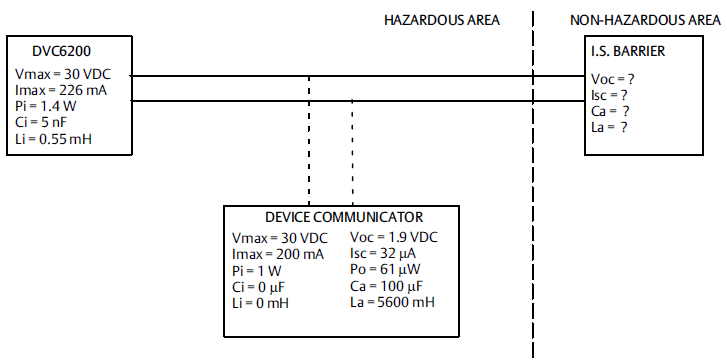
Figure 1. Typical I.S Installation
Guidelines for Selecting Intrinsic Safety Barriers Using Entity Ratings
Selecting an intrinsic safety barrier with the required entity ratings depends upon the combined effects of the instrument, its cabling, and any instrument accessories such as the AMS Trex™ Device Communicator. Determine the barrier entity ratings using the following guidelines:
Voc ≤ Vmax
Isc ≤ Imax
Ca ≥ Ci + Ccable
La ≥ Li + Lcable
where:
Voc = Barrier open circuit voltage
Vmax = Instrument Vmax
Isc = Barrier short circuit current
Imax = Instrument Imax
Ca = Barrier acceptable connected capacitance
Ci = Instrument total unprotected internal capacitance
Ccable = Signal cable total capacitance
La = Barrier acceptable connected inductance
Li = Instrument total unprotected internal inductance
Lcable = Signal cable total inductance
The values Voc, Ioc, Ca, and La are specified by the barrier manufacturer for any given barrier. The values of Ccable and Lcable for the signal cable must be determined for the specific cable used.
Example barrier entity ratings calculation
A system is comprised of a FIELDVUE™ DVC6200 digital valve controller (FM approved), a Device Communicator (FM approved), and 1000 feet of cable with 60 pF/ft capacitance and 0.2 μH/ft inductance. Calculate the barrier entity ratings.
Figure 1 shows a typical I.S. installation.
Calculate Ccable and Lcable
Ccable = 60 pF/ft x 1000 ft
= 60 nF
Lcable = 0.2 μH/ft x 1000 ft
= 0.2 mH
Determine Ca and La for the barrier
Ca ≥ Ci (DVC6200) + Ci (TREX) + Ccable
≥ 5 nF + 0 nF + 60 nF
Ca ≥ 65 nF
La ≥ Li (DVC6200) + Li (TREX) + Lcable
≥ 0.55 mH + 0 mH + 0.2 mH
La ≥ 0.75 mH
Determine Voc and Isc of the barrier. Note that in this example the output of the Trex (Voc (TREX) and Isc (TREX)) must also be considered because it can also add energy to the loop besides just the barrier itself. Voc of the barrier plus any additional voltage that could be added to the loop from each device must be subtracted from Vmax for each device. Isc of the barrier plus any additional current that could be added to the loop from each device must not exceed Imax for each device.
Voc of the barrier must meet all of the following conditional requirements.
Isc of the barrier must meet all of the following conditional requirements.
Isc ≤ Imax (DVC6200) + Isc (TREX) → 226 mA + 0.032 mA → 226.032 mA
Isc ≤ Imax (DVC6200) → 226 mA
Isc ≤ Imax (DVC6200) → 200 mA
Isc ≤ 200 mA
The contents of this publication are presented for informational purposes only, and while every effort has been made to ensure their accuracy, they are not to be construed as warranties or guarantees, express or implied, regarding the products or services described herein or their use or applicability. All sales are governed by our terms and conditions, which are available upon request. We reserve the right to modify or improve the designs or specifications of such products at any time without notice. Emerson.
EXPERTS IN EQUIPMENT FOR EXPLOSIVE ATMOSPHERES
Zone 1/2 Gas & Zone 21/22 Dust
Thorne & Derrick are leaders in the development and distribution of Product Innovations that deliver significant improvements to clients plant, people and operational safety in the explosive atmosphere industries.
Your proactive problem solvers experienced in succession planning for the replacement of obsolete, non-conformant and legacy equipment in hazardous areas.
Your first-choice provider of innovative and competitive solutions to ensure ATEX & IECEx Compliance for Hazardous Area Electrical, Heating, Lighting & Process Instrumentation Equipmentto UK and international projects.
Drums can be manufactured from new, recycled or reconditioned steel or plastic with standard 205 litre capacity (45 gallons) and can be used to store many things including grains, food ingredients, oils and lubricants, liquids, sand or aggregates, solvents, chemicals and pharmaceuticals.
The drums can be effectively heated with a drum heater to prevent freezing in cold climates, to reduce viscosity or to control the temperature of the medium being stored inside.
Drum heaters safely warm the contents of drums protecting against frost damage and deformation of contents – providing optimum and uniform heating to drums ensuring viscosity control, freeze protection, temperature maintenance and melting of solids.
T&D International are the UK’s largest supplier and worldwide exporter of the most extensive range of Drum Heating Jackets,Drum Base Heaters& Custom Insulated Drum Heating products – this includes both non-hazardous (“safe area”) and hazardous area certified drum heaters with ATEX and IECEx certification suitable for Zone 1 and Zone 2 potentially explosive atmospheres.
Drum Heaters To Heat Sealants
Many sealants and adhesives may be susceptible to freezing when stored in drums outdoors on site, for example.
If the ambient temperature was to drop below 0°C (32°F) this can affect the overall cure adhesion and the ultimate performance of the sealants.
Therefore the sealant must be kept warm whilst being stored or be heated up for 24 hours prior to use.
Drum Storage Application
Required to gently heat up sealant and adhesive stored on site in 205L steel drums.
Contents or Medium To Be Heated
Sealant & adhesive
Area Classification
Non Hazardous Area (ATEX Heaters & Insulating Jackets for Hazardous Areas also available)
T&D supply Drum Heaters for all industrial steel and plastic drums
Electrical Heating Specialists
Thorne & Derrick International, based in the UK, can specify and supply from stock an extensive range of Electrical Heating Equipment for industrial and process heating applications – this includes temperature maintenance and frost protection (Winterisation) products for pipework, valves, IBC’s, drums, hoses, tanks and vessels. We produce custom silicone heaters for rapid and high temperature heat-up of complex shapes and surfaces – from concept, design to the delivery of standard or bespoke heaters on the shortest lead times. From the largest UK heat tracing cable stocks we deliver Electric Trace Heating Systems for pipework frost protection, ramp heating, roof/gutter snow melting and de-icing – enquire about our in-house design service.
ATEX IECEx LED Rechargeable Mini Worklite | Wolf WL-50
Wolf WL-50 Mini Worklite
Hazardous Area Lighting
When the operators of one of a major oil company’s North Sea oil rigs needed to safely illuminate some of the darkest, most difficult hazardous areas on board the platform they came to Wolf Safety Lamp to solve the problem.
Wolf’s ATEX LED Rechargeable Mini Worklite successfully solves the problem of illuminating dark, difficult-to-access spaces on board North Sea oil rigs.
The Lighting Challenge
With only a 440V power supply being available on the rig, operators needed a lightweight, battery powered ATEX Zone 1 certified lamp. It had to be bright enough to illuminate the work areas, and sufficiently lightweight to move around the platform easily. The battery duration should be long enough for the light to work for a full shift, and the recharge time should be no more than eight hours.
The lights currently being used were not bright enough, and were too heavy for operators to easily move around the rig.
It was clear to everybody that a new solution was needed so Wolf Safety was approached to provide a solution.
The WL-50 illuminates a particularly dark and inaccessible area of the rig
The Lighting Solution
Just weeks after the first contact David Lyon, Wolf’s Sales Manager (Scotland), made a presentation to 5 of the oil company’s key decision makers who agreed to recommend the new WL-50 ATEX LED Mini Worklite™ to their Oil & Gas Maintenance Contractor for trials on one of their North Sea platforms.
A few weeks after that, and following a product demonstration to 7 of the contractor’s key personnel, details for an offshore trial were agreed by all parties.
Before and After! Just one lamp can make all the difference
Results
The month long trial was highly successful, with the work light being very well received by both the contractor and the operator.
Operators on a North Sea oil rig were delighted with the performance of the WL-50 ATEX/IECEx LED Mini Worlkite™ during recent trials.
Their official report stated the: ‘Overall rating of this light is excellent.’
Its key features were described in the report as:
Lightweight
Bright
Wireless
Versatile
Long Battery Life (up to 8 hours including breaks)
The official report stated Overall rating of this light is excellent
The ATEX & IECEx certified WL-50 & WL-50HT light weight mini Worklite™ from Wolf is a high output LED floodlight for use in harsh, remote and hazardous area lighting applications. They are easy to carry, rechargeable and at just over 9kgs, it weighs around half the weight of the WL-80 and WL-85 worklites, while providing the same outstanding level of light.
Building on the success of the market leading Wolf Worklites and Floodlites, the WL-50 shares the same strong, robust and proven powder coated die-cast construction as the Wolf LinkEx range.
Wolf Safety Lamp Hazardous Area Lighting
EXPERTS IN EQUIPMENT FOR EXPLOSIVE ATMOSPHERES
leaders in ATEX Innovation To The Hazardous Area Industries
Thorne & Derrick are leaders in the development and distribution of Product Innovations that deliver significant improvements to clients plant, people and operational safety in the explosive atmosphere industries.
Your proactive problem solvers experienced in succession planning for the replacement of obsolete, non-conformant and legacy equipment in hazardous areas.
Your first-choice provider of innovative and competitive solutions to ensure ATEX & IECEx Compliance for Hazardous Area Electrical, HVAC & Process Instrumentation Equipmentto UK and international projects.
Follow our Showcase Page on LinkedIn to receive hazardous area product innovations, industry news, whitepapers, videos, technical tips and training webinars for professionals involved in the explosive atmosphere industries.
T Sure T-Rating Labels
T-Rating Monitoring
T Sure Labels for Hazardous Area Zones & Explosive Atmospheres
Special thanks to Gareth Turner Managing Director at Blayds
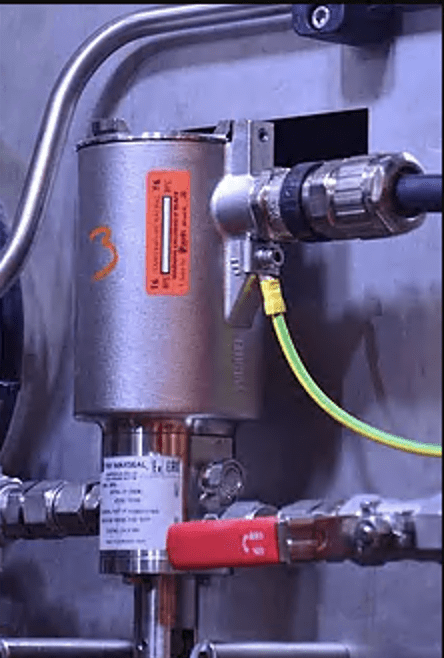
The TSure T-Rating labels are a low-cost, totally passive, maintenance free monitor, providing instant and permanent visual feedback that equipment has reached and/or breached its specified T-Rating. They are designed specifically to prevent catastrophic failures ultimately protecting equipment and life in potentially explosive atmospheres.
The label is simply affixed to the equipment in a Zone 1, 2, 21 or 22 hazardous area (Gas & Dust) providing a visual indication during routine inspections as to whether the T-rating has been exceeded at any time during operation.
This will work for 3+years (though should be changed at the 3 yearly inspection interval) and will change colour from white to black permanently if the equipment runs hot.
This unique visual indicator provides feedback allowing remedial action to take place.
As you will be aware, simply because the equipment is certified at a specific T-Rating does not stop overtemperature events from occurring due to any number of factors: loose connections, incorrect cable crimping, overcurrent, water ingress, poor installation and maintenance practices etc.
The label itself is simple to install and is maintenance-free.
Once applied to a clean, grease free surface a permanent irreversible colour change from silver white / orange (depending on label type) to black indicates that the rating has been reached. The T Sure™ can be fitted both internally and externally offering un-rivalled ease of use.
T Sure Labels
How does it work
T Sure™ thermally reactive T-Class rating labels produce an irreversible colour change if the specified T-Rating is met or exceeded.
Manufactured from anti-static durable oil & water resistant materials, the T Sure™ labels offer a unique visual safeguard in Hazardous Areas, helping to monitor temperatures 24-7 in a simple, low-cost, passive (non-powered) and non-maintained label.
Once fitted to the hazardous area equipment, such as a lighting fixture, enclosure, control station, cable etc the T Sure™ T-Rating indicator strip will change from a silver/white to black, producing an irreversible colour change if activated.
This will ensure that if the T-Rating has been exceeded at any time during operation, this can be seen during routine inspection and maintenance and therefore rectified – eliminating a future explosion risk.
Available in T6 85°C, T5 100°C, T4 135°C and T3 200°C.
T Sure Labels
Features & benefits
Low cost labels
Suitable for Zones 1,2,21 & 22 hazardous areas
Maintenance free
Passive – no power source required
Oil, water and Steam resistant
Anti-static labels
Tolerance of +/- 1°C for T6, +/- 1.5 °C for T5 & T4 and +/- (1% +1 °C) for T3
Immediate response time & irreversible reaction
Custom text / branding available upon request
About Blayds
Blayds Group Ltd helps to remove the Hazards from Hazardous Area cable terminations, through innovative products and industry expertise.
With over 20 years experience of ATEX, IECEx, NEC, EAC certified products including Hazardous Area Cable Glands, Electrical Enclosures, Lighting, Plug and Socket Ex Connectors, Control Stations and more, the experts at Blayds Group Ltd are committed to develop products to help maintain safety in Hazardous Areas across the globe.
EXPERTS IN EQUIPMENT FOR EXPLOSIVE ATMOSPHERES
Thorne & Derrick are leaders in the development and distribution of Product Innovations that deliver significant improvements to clients plant, people and operational safety in the explosive atmosphere industries.
Your proactive problem solvers experienced in succession planning for the replacement of obsolete, non-conformant and legacy equipment in hazardous areas.
Your first-choice provider of innovative and competitive solutions to ensure ATEX & IECEx Compliance for Hazardous Area Electrical, HVAC & Process Instrumentation Equipmentto UK and international projects.
You can Follow our Showcase Page on LinkedIn to receive updates about more hazardous area product innovations, industry news, whitepapers, videos, technical tips and training webinars for professionals involved in the explosive atmosphere industries.
Experts In Equipment for Explosive Atmospheres | Leaders in ATEX Innovation
Marechal Ex products including their range of plugs & sockets are marked in accordance with the 2014/34/EU directive and in compliance with EHSR (Essential Health and Safety Requirements).
The safety of an installation in a hazardous area is the result of a co-operation of the equipment manufacturer, the installer and the end user. This directive is concentrating on the duties of the end user.
Workers should be trained on hazardous area issues by the employer
Authorization should be delivered to each employee who is working in hazardous areas
Explosion protection measures should be taken and an explosion protection document (EPD) has to be established
Employer should endure co-ordination procedure in case of maintenance in hazardous areas from different ‘origin’. When an equipment has to be
repaired the end user has the responsibility to select an appropriate repair shop.
Zone 0 or zone 20 requires Category 1 equipment
Zone 1 or zone 21 or zone 22 with conductive dust requires Category 1 or Category 2 equipment
Zone 2 or zone 22 requires Category 1 or Category 2 or Category 3 equipment
Here is the marking explanation:
Manufacturer identification:
– Name and/or trademark
– Address
Conformity to all relevant European directives and/or North American standards
Product type
Temperature class
The certificate number endings:
– none: OK to use without specific recommendations
– X: equipment with special condition(s) for safe use
– U: component (complementary certification needed for use)
Mark for product in the scope of directive 2014/34/EU and in compliance with ERSH Directive 2014/34/EU marking:
II: Equipment group = surface industry
2: Equipment category
G D: Gas or Dust atmosphere
Out With The Old, In With The New.Contact T&D to arrange a UK site demonstration or survey of your power distribution requirement. No obligation. No cost.
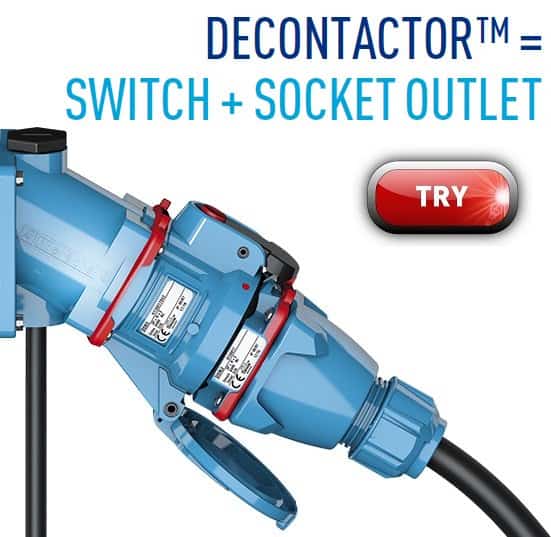
Marechal plugs and sockets (decontactors) provide low voltage power supply for high current, high temperature and hazardous area (Zone 1 & Zone 2) ATEX power distribution applications – this includes power plugs for electric generator sets, motors, machines, distribution boxes, pumps and electric cabinets.
Thorne & Derrick, Experts in Equipment for Explosive Atmospheres, are Specialist Distributors of Marechal plugs and sockets in the UK including ATEX and IECEx certified decontactors for LV electrical power distribution.
EXPERTS IN EQUIPMENT FOR EXPLOSIVE ATMOSPHERES
Thorne & Derrick are leaders in the development and distribution of Product Innovations that deliver significant improvements to clients plant, people and operational safety in the explosive atmosphere industries.
Your proactive problem solvers experienced in succession planning for the replacement of obsolete, non-conformant and legacy equipment in hazardous areas.
Your first-choice provider of innovative and competitive solutions to ensure ATEX & IECEx Compliance for Hazardous Area Electrical, HVAC & Process Instrumentation Equipmentto UK and international projects.
You can Follow our Showcase Page on LinkedIn to receive updates about more hazardous area product innovations, industry news, whitepapers, videos, technical tips and training webinars for professionals involved in the explosive atmosphere industries.
Experts In Equipment for Explosive Atmospheres | Leaders in ATEX Innovation
Press Release Date: 02.04.2020 uploaded by Chris Dodds (T&D Sales + Marketing Manager) World’s First Fully Certified ATEX Doors Thorne & Derrick International, the Experts in Equipment for Explosive Atmospheres, today announce the signing of a Commercial Distribution Agreement...
Press Release Date: 04.07.2019 uploaded by Chris Dodds (T&D Sales + Marketing Manager) Category: Stockist Distributor Agreement Announcement Thorne & Derrick International announce that they have signed a Preferred Distributor Agreement with Raytec, the world leading manufacturer of LED...













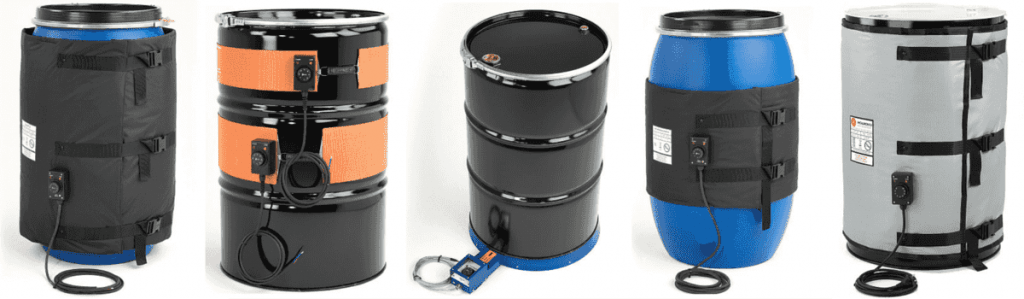 Heating Sealants & Adhesives
 Drum Heaters To Heat Sealants