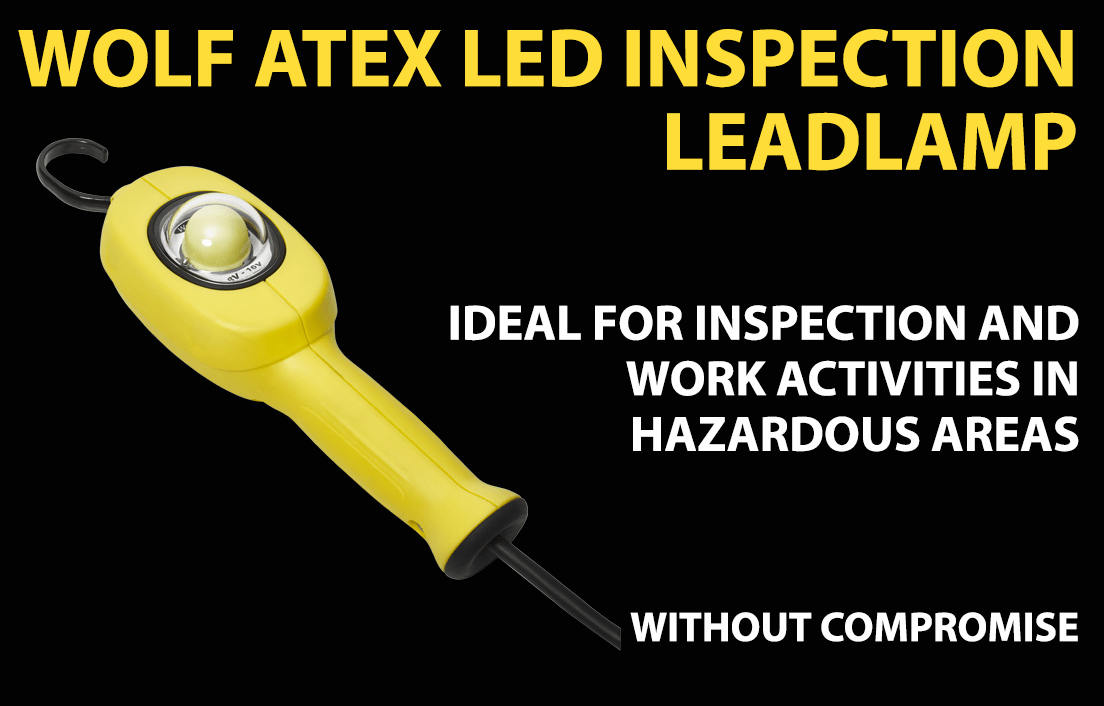
Wolf SP-600 ATEX LED Inspection Leadlamp
Hazardous Area Lighting
Wolf SP-600
ATEX LED Inspection Leadlamp | Hazardous Areas Zone 1 & 2, Zone 21 & 22
The SP-600 ATEX LED Inspection Leadlamp from Wolf is a cable-powered, versatile and lightweight handheld light with an impressive LED light output, making it ideal for inspections and work activities within ATEX certified hazardous areas.
Suitable for use in hazardous area Zone 1 & 2 as well as Zone 21 & 22, it has an exceptional, even, ultra-wide angle light which minimises shadows and enhances visibility to provide optimum illumination when working in close proximity. With a 360° swivel hook, the Wolf SP-600 can be suspended for hands-free use or magnet mounted using optional accessories.
This ATEX leadlamp is extremely robust and durable, with an impact resistant anti-static enclosure. It has an impact resistance rating of IP67 and has a scratch and chemical resistant polycarbonate hardcoat lens which means the LED lamp can withstand the rigours of heavy industrial use. Further protection is possible by fitting a fully certified stainless steel cage guard for enhanced mechanical protection, making it ideal for use in the most demanding conditions.
Wolf SP-600 ATEX LED Inspection Leadlamp
technical Specification
The Wolf SP-600 leadlamp range is CE marked to the ATEX directive and IECEx certified safe for use in Zone 1 potentially explosive gas atmospheres, where a T4 temperature class permits, and Zone 21 potentially explosive dust atmospheres, with a maximum surface temperature of 95°c, as well as Group I mining applications.
A ‘fitted for life’ high power LED light source produces a forward facing, high efficiency output of up to 470 lumens – The large diffused light source minimises eye discomfort when viewed directly.
Lightweight, compact and ergonomically friendly, these Inspection Leadlamps are designed for handheld use, with an “easy-grip” handle for user comfort and all lamps are fitted with 10m HOFR cable as standard.
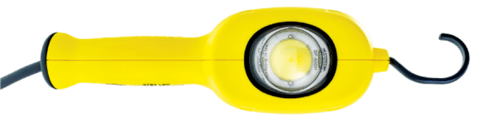
The Leadlamp is available in three voltage input ranges:
- Wolf SP-600H – High 90-264VAC for general applications,
- Wolf SP-600L – Low 18-54VAC/20-54VDC,
- Wolf SP-600EL – Extra low 9-16VAC/DC for use in confined space applications, such as metal tanks.
Product Reference
|
SP-600H |
SP-600L |
SP-600EL |
Product Description
|
ATEX LED Inspection Leadlamp |
| High (H) |
Low (L) |
Extra Low (EL) |
Hazardous Area Code
|
I M2 Ex eb mb I Mb (-30°C to +55°C)
II 2G Ex eb mb IIC T4 Gb IP67
II 2D Ex mb tb IIIC T95°C Db |
Type of Protection
|
‘eb’ Increased Safety, ‘mb’ Encapsulation,’tb’ Dust Ignition Protection by Enclosure |
Area of Classification (Gas)
|
Zones 1 & 2 Gas Groups IIA, IIB & IIC |
Temperature Classification (Gas)
|
T4 |
Area of Classification (Dust)
|
Zones 21 & 22 Dust Groups IIIA, IIIB & IIIC |
Max Surface Temperature (Dust)
|
T95°C |
Ambient Temperature
|
-30°C to +55°C |
Certificate
|
SIRA15ATEX3317X
IECEx SIR15.0115X |
Enclosure
|
High Impact, Anti-Static Polypropylene |
Lens
|
Polycarbonate, Scratch and Chemical Resistant Hardcoat |
Light Source
|
Type |
High Power LED |
| Output |
470 lumens (at source) / 403 lumens (from leadlamp) |
Life
|
60,000 hrs
|
Power Source
|
Voltage |
90-264VAC |
18-54VAC20-54VDC |
9-16VAC/DC |
| Plug |
No plug supplied as standard |
| Cable |
10m HOFR 2 core x 1.5 mm² |
Weight
|
1.785 kg |
Ingress Protection
|
IP67 |
Wolf Sp-600 Accessories – Mounting & Protection
Wolf SP-600 range of accessories includes cages and magnets for the SP-600 ATEX LED Inspection Leadlamp and gives operators a wide range of flexible temporary installation solutions and added equipment protection for using temporary lighting in ATEX & IECEx certified hazardous areas.
Mounting Magnet
With a 66mm Diameter Magnet (SP-624) the leadlamp can be positioned to grip on a flat ferrous metal surface for secure mounting almost anywhere – putting the leadlamp exactly where it is needed.
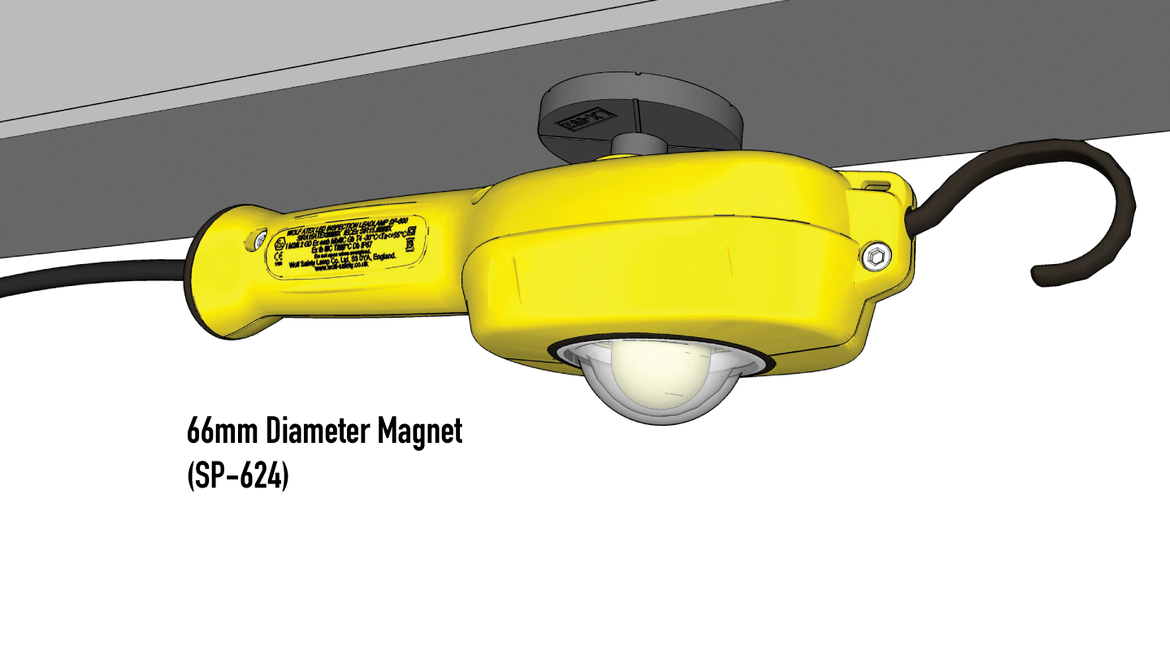
Wolf SP-600 Accessories | 66mmm Diameter Mounting Magnet (SP-624)
Cage Guard
The stainless steel Cage guard offers enhanced mechanical protection to the leadlamp when fitted to ensure its longevity in harsh working conditions. The Cage is supplied in two forms:
- Cage with Fixing Bolt (SP-620)
- Cage with 88m Diameter Magnet (SP-626)
The 88mm diameter magnet has a greater clamp force than the 66mm diameter magnet and will offer higher levels of retention on surfaces with poor finishes and must only be used with the cage accessory.
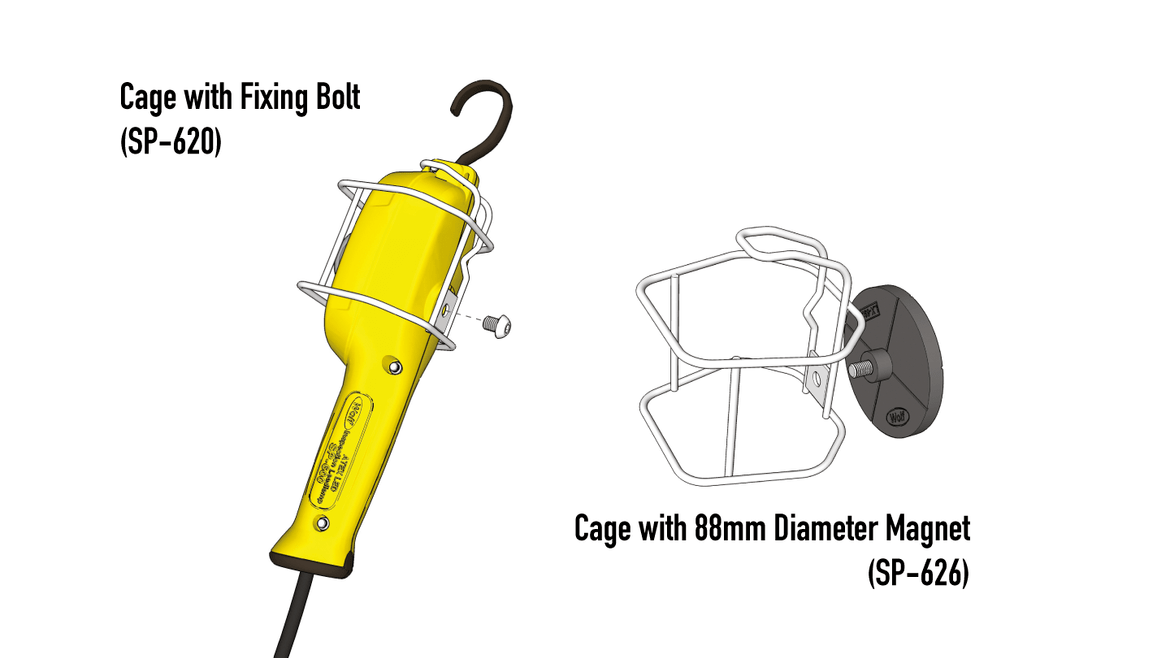
Wolf SP-600 Accessories | Steel Cage Guard (SP-620 SP-626)
➡ All accessories have been assessed safe for use in hazardous area locations with potentially explosive atmospheres, and are covered within the SP-600 ATEX (CML 19ATEX3021X) and IECEx (IECEx CML19.0005X) certificates. Only genuine Wolf accessories will maintain ATEX/IECEx compliance of the product.
➡ For further information, technical specifications and hazardous area ATEX certificates, please see the Wolf Handheld Leadlamps product sections below. Visit portable and temporary lighting for more information about the full range of Wolf Lighting products.
Portable & Temporary Hazardous Area Lighting
When clear vision and brilliant LED light is required in hazardous area locations or confined spaces with potentially explosive atmospheres, Wolf Safety lights provide bold, bright and unfailing portable and temporary lighting. Since 1912, Wolf has been trusted to light the world’s most hazardous and hostile environments – with ATEX & IECEX certified portable lights to provide safe lighting in explosive atmospheres.
Thorne & Derrick are hazardous area lighting specialists stocking a complete range of portable and permanent fixed lighting including both fluorescent and LED technology in standard linear light fittings, wellglass, high bay and floodlight design certified by ATEX for both Zone 1 and Zone 2 hazardous areas.
➡ Technical Resources | Hazardous Area Zones | T Class Temperature Ratings | Explosive Atmospheres (Defintions)
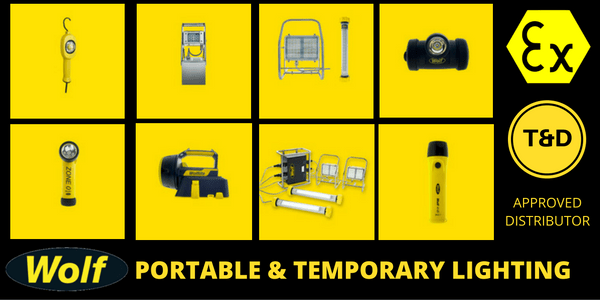
Contact Thorne & Derrick for the competitive supply of the complete range of Wolf Safety Lamp portable & temporary lighting products including handlamps, torches, warning lights, tank lighting and floodlights.
EXPERTS IN EQUIPMENT FOR EXPLOSIVE ATMOSPHERES
leaders in ATEX Innovation To The Hazardous Area Industries
Thorne & Derrick are leaders in the development and distribution of Product Innovations that deliver significant improvements to clients plant, people and operational safety in the explosive atmosphere industries.
Your proactive problem solvers experienced in succession planning for the replacement of obsolete, non-conformant and legacy equipment in hazardous areas.
Your first-choice provider of innovative and competitive solutions to ensure ATEX & IECEx Compliance for Hazardous Area Electrical, HVAC & Process Instrumentation Equipment to UK and international projects.
Control Panels | Plugs | Isolators | Enclosures & Junction Boxes | Lighting | Control Stations | Motor Starters | Heat Trace | Gas Detection | Flame Detection | Process Instrumentation | Process Heating | Ventilation Fans | Security Access Control

Competitive Prices | Extensive Stocks | Technical Support | Express Delivery
Follow our Showcase Page on LinkedIn to receive hazardous area product innovations, industry news, whitepapers, videos, technical tips and training webinars for professionals involved in the explosive atmosphere industries.
LED Lighting | Hazardous Areas
Switching to LEDs
Frustrated by frequent maintenance, poorly lit areas, and high-energy consumption, you’ve decided to upgrade your facility’s lighting. You’ve obtained the manager’s approval for the retrofit and are eager to begin the switch to LEDs, but before you purchase the luminaires and jump into installation, consider the following factors.
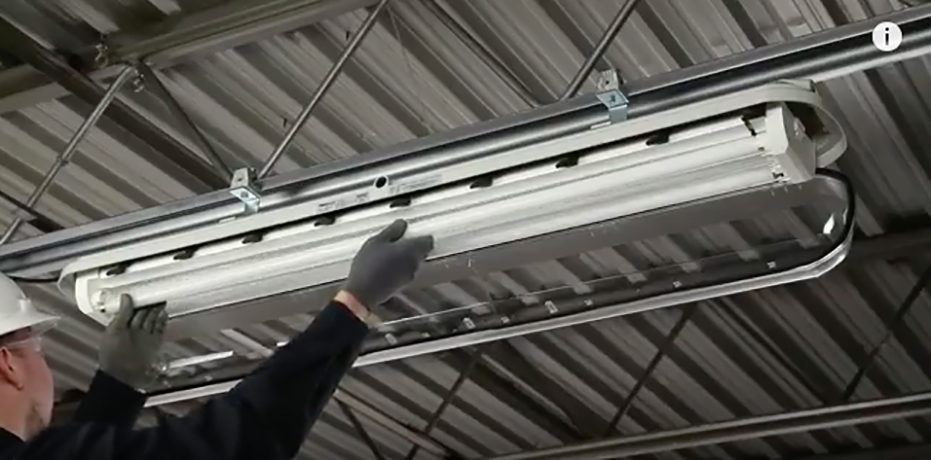
Thorne & Derrick International, based in the UK, are the leading supplier of ATEX Lighting for safe and reliable lighting of hazardous areas and locations – this includes Lighting for hazardous areas certified by the ATEX Directive for use in Zone 1 and Zone 2 (Gas) potentially explosive atmospheres in both onshore and offshore locations.
A complete range of portable lighting for temporary applications with ATEX and IECEx Certification is also available.
Here are the top 10 factors to contemplate before performing an LED retrofit.
1. Request sample units. Have you evaluated a sample luminaire? If not, always request a sample prior to settling on a design. Nothing compares to seeing a luminaire hung in the actual application, and most manufacturers have a sample program to “try out” a unit prior to making a large investment. Enhancements in color rendering — and a variety of choices in color temperatures, optics, and brightness levels — allow you to truly customize your lighting design to meet the needs of your specific application.
2. Research rebates and incentives. Are there rebates available in your area? Do the luminaires you’re considering appear on the DesignLights Consortium’s Qualified Products List (DLC QPL)? Most agencies require a luminaire to appear on this list in order to be considered eligible for state and utility energy efficiency program incentives. The Database of State Incentives for Renewables & Efficiency (DSIRE) is another great resource tool for finding incentives in the United States.
3. Consider reliability and lifespan. How long do you plan on keeping your luminaires? How often are you willing to perform maintenance tasks, such as driver replacement? For many, the ultimate objective is to upgrade their lighting — reducing maintenance and manpower requirements while maintaining or increasing levels of uniformity and comfort. When evaluating new lighting systems, consider both the total system power consumption and the expected luminaire life in order to evaluate energy and maintenance costs and savings.
4. Don’t forget about color temperature options. Do you have a color temperature preference for your facility? What type of work is being performed, and what are the mounting heights of the luminaires? It is important to remember different color temperatures create different effects. Cool white has a crisp, bluish appearance, with the highest perceived brightness. It is a great choice for floodlights, especially at higher mounting heights. However, a warmer or neutral color temperature LED luminaire produces a softer glow and might be a better choice for lower mounted task lights.
5. Double check the power system requirements for your facility’s lighting. What voltages are your lights running on? Is your power clean, or is it affected by surges and dips from nearby equipment? New IEEE standards recommend a minimum of 6kV of surge protection for outdoor solid-state lighting with a recommendation of 10kV for high-risk areas.
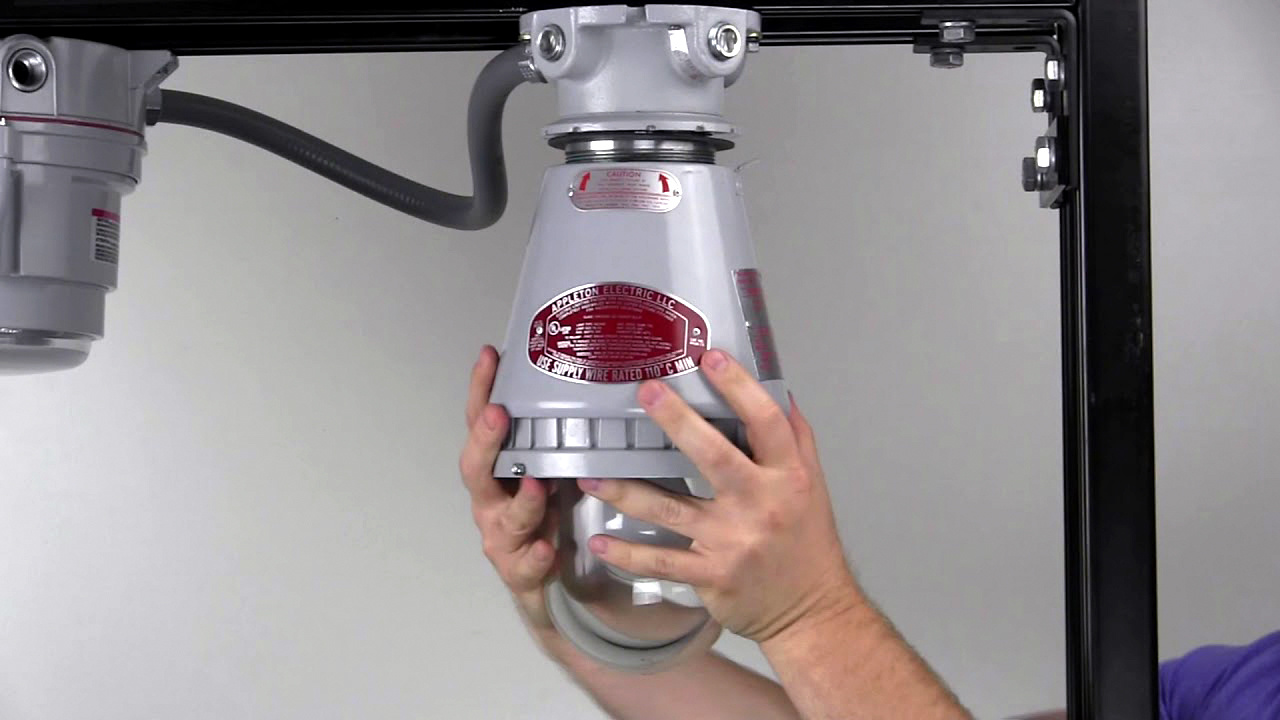
Make sure you install luminaires that meet the certifications and code requirements appropriate for the space
6. Research true 1-for-1 retrofit solutions. Is the LED solution you’re considering a true 1-for-1 retrofit for your facility? If not, do you have enough circuits available to add more luminaires? Labor costs are a key factor in any retrofit project. Can you mount directly to the existing mounting hoods? If so, this can save a significant amount of labor and cost.
7. Reconsider facility obstructions. Are there any obstructions in the ceiling that might block light or prevent access to the luminaires? Consider alternate mounting means for the luminaires, such as pendant mount. For example, many task luminaires have multiple mounting hoods to ensure the luminaire is installed in the ideal location to properly light the area.
8. Review light levels (IES, RP540). What illumination level are you targeting? Are you following a standard such as IES RP7 for industrial lighting, or API RP540 for petroleum applications? Make sure your layout provides the appropriate illumination level. Most luminaire manufacturers have a variety of lumen outputs, so choose the right illumination level to meet the needs of the area. Too much light can be just as debilitating as not enough. Also remember that LEDs are directional, which means you can achieve required light levels with much fewer lumens and watts. For example, a 5,000-lm LED task light can replace a luminaire with a 150W HPS lamp, which generates about 15,000 lm of light.
9. Evaluate mounting heights. How high do you intend to hang your luminaires? For higher mounting heights, high-lumen floodlights are a great choice. When mounted higher up on a structure, these floodlights can be used to “wash light” over lower areas, providing uniform general illumination while minimizing the need for task lighting.
10. Assess area locations. Do the locations of your retrofit have hazardous or environmental ratings? What are the area classifications for your retrofit? Are there other certifications or environmental considerations, such as damp locations, marine ratings, or elevated ambient temperatures that the fixtures need to address? When you purchase lighting for a harsh or hazardous industrial location, you need to know that your lights are going to hold up against the environment. Products should be rugged and durable, in addition to meeting all of the certifications and requirements appropriate to your environment, whether it be wet location, marine, hazardous, or harsh industrial.

ATEX Lighting | Raytec Hazardous Area Lighting for Zone 1 & Zone 2 (Gas) and Zone 21 & Zone 22 (Dust) Explosive Atmospheres
Ellen Helm is director of Emerson Automation Solutions, Rosemont, Ill. She has nearly two decades of experience in electrical and lighting technology, and holds a BSEE from Valparaiso University and an MBA from the University of Colorado.
About EC&M
EC&M for Subscribers:
Providing expertise and insights into the latest electrical systems products, solutions and technologies being used in commercial, industrial and institutional building applications.
EC&M for Marketers:
Leveraging high-quality content to drive brand awareness, build marketing pipeline and generate leads for marketers wanting to connect with electrical professionals who design, construct, operate and maintain electrical systems.
HAZARDOUS AREA LIGHTING DESIGN
Thorne & Derrick’s hazardous area lighting design service is completely free of charge, providing you with a visual 3D representation of the final lighting solution, with detailed lux levels and a true indication of lighting performance. Our lighting design experts will guide you through the entire process, ensuring the optimum lighting solution is achieved.
 Further Reading |How to Achieve Energy Efficiency With Carbon Reductions by ATEX LED Lighting Upgrades
EXPERTS IN EQUIPMENT FOR EXPLOSIVE ATMOSPHERES
LEADERS IN ATEX INNOVATION TO THE HAZARDOUS AREA INDUSTRIES
Thorne & Derrick are leaders in the development and distribution of Product Innovations that deliver significant improvements to clients plant, people and operational safety in the explosive atmosphere industries.
Your proactive problem solvers experienced in succession planning for the replacement of obsolete, non-conformant and legacy equipment in hazardous areas.
Your first-choice provider of innovative and competitive solutions to ensure ATEX & IECEx Compliance for Hazardous Area Electrical, HVAC & Process Instrumentation Equipment to UK and international projects.

Follow our Showcase Page on LinkedIn to receive hazardous area product innovations, industry news, whitepapers, videos, technical tips and training webinars for professionals involved in the explosive atmosphere industries.

Hazcon Inc.
Explosion Protection
& Hazardous Area Equipment
Hazcon Inc. provides a full suite of consulting services for manufacturers of electrical equipment for hazardous locations and explosive atmospheres.
Their primary focus is to help manufacturers prepare for all phases of certification of these products – from product design, approval and installation to certification maintenance.
Electrical equipment must carry the official mark or label of an accredited certifying agency, which indicates that the product has been independently assessed for safety. Equipment nameplates provide a brief summary of the characteristics of the equipment.
For electrical equipment intended to be used in classified areas (known as hazardous locations), the information on markings and nameplates is critical. Such information for equipment used in hazardous locations is intended to enable:
- The end users to procure the correct equipment for a specific application
- The installers (electrical contractors) to install the equipment correctly as per field wiring installation rules for hazardous locations
- The Authority Having Jurisdiction (AHJ) to inspect, approve and enforce the requirements of the Code/Standards related to that piece of equipment
Unclear markings may lead to the incorrect piece of equipment being purchased, installed and inspected for the application and might cause a catastrophic loss. The marking of hazardous location equipment may be complex and confusing, especially in terms of the intended Division or Zone locations, and even more so if multiple methods of protection and both Class/division and Zone markings are used.
“Division” and “Zone” refer to the two distinct classification systems in North America: the Class/division system and the Zone System. The Class/division system is mainly used in North America.
The Zone system of classification originated with the International Electrotechnical Commission (IEC) and is now also commonly used in North America. The intention of both systems is the same – to classify hazardous locations in such a way that the safety of the equipment for use in such locations can be determined.
Manufacturers of electrical equipment seeking North American certification may choose either Class/division marking or Zone marking. However, getting dual markings (both Class/division & Zone markings) is desirable so that the product may be installed in both Division and Zone hazardous areas in North America.
Dual marking helps to makes products more competitive, but keep in mind that there are additional technical requirements and rules and procedures to follow. These rules are outlined in the Standards related to hazardous locations.
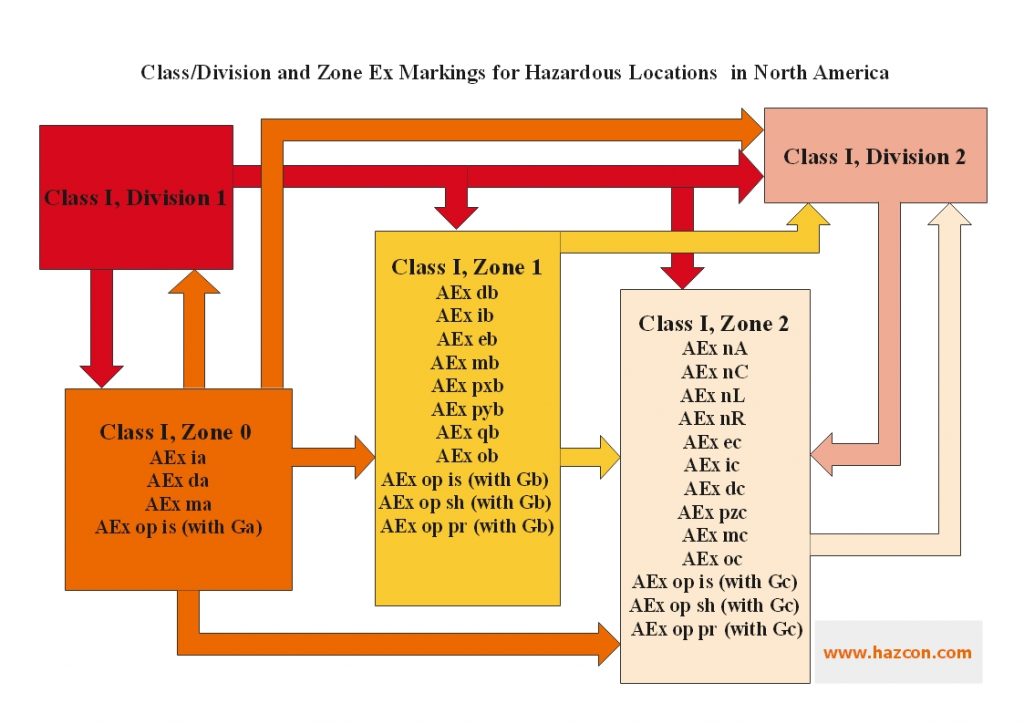
Class Division and Zone Ex Markings for Hazardous Locations in North America
Standards Applicable to Hazardous Locations
The requirements related to the installation of hazardous location products are found in Canada in the Canadian Electrical Code (CEC) and in the US in the National Electrical Code (NFPA 70).
Canadian Standards
The installation requirements for Class/division hazardous areas are provided in Appendix J of the Canadian Electrical Code. Section 18 of the Canadian Electrical Code identifies the installation requirements of electrical equipment in Zones hazardous areas.
US Standards
Article 501 of NFPA 70 identifies the installation requirements of hazardous location equipment in Class I, Division 1 and Division 2. Article 505 identifies the installation requirements for Ex Equipment for installation in Zone 0, Zone 1 and Zone 2. The installation requirement of electrical equipment using the Intrinsic safety protection technique is detailed in Article 504 for both Zone and Class/division installation in the USA.
Both the CEC and NFPA 70 permit the installation of Zone-marked products within a Class/Division area in North America and also the installation of Division-marked products in Zones hazardous areas. However, there are some restrictions and limitations for this interchangeable installation between the Division and Zone systems.
Hazcon Inc. has provided a simplified diagram to show the correlation of Class/division & Zones certified products into Division or Zone areas. This diagram will help installers and manufacturers to have a better understanding of how hazloc products can be installed in hazardous areas in North America.
Further Reading
Information Courtesy
Behzad Nejad, P. Eng. (Hazcon)
Director & Consulting Engineer at Hazcon Inc.; Hazardous Locations Consulting Services; IECEx, ATEX, CEC & NEC
Specializing in the design, safety and approval of electrical equipment for hazardous locations.
Mr. Nejad has over 15 years of experience as an Electrical Engineer and is a sought after professional in the hzardous area and explosion protection industry. He is fully-qualified at the advanced level of all hazardous locations protection techniques including Intrinsic Safety & Non-incendive, Explosion Proof & Flame proof, Increased Safety, Non-arcing, Purging and Pressurization, Encapsulation, Optical Radiation, and Dust-tight enclosures. Mr. Nejad’s tenure in the industry includes six years at the CSA certification agency, working closely with manufacturers (Emerson, GE, ABB, Siemens, Endress-Houser, VEGA etc.) as a technical and certification engineer for Hazardous locations equipment.
EXPERTS IN EQUIPMENT FOR EXPLOSIVE ATMOSPHERES
leaders in ATEX Innovation To The Hazardous Area Industries
Thorne & Derrick are leaders in the development and distribution of Product Innovations that deliver significant improvements to clients plant, people and operational safety in the explosive atmosphere industries.
Your proactive problem solvers experienced in succession planning for the replacement of obsolete, non-conformant and legacy equipment in hazardous areas.
Your first-choice provider of innovative and competitive solutions to ensure ATEX & IECEx Compliance for Hazardous Area Electrical, HVAC & Process Instrumentation Equipment to UK and international projects.
Control Panels | Plugs | Isolators | Enclosures & Junction Boxes | Lighting | Control Stations | Motor Starters | Heat Trace | Gas Detection | Flame Detection | Process Instrumentation | Process Heating | Ventilation Fans | Security Access Control
Competitive Prices | Extensive Stocks | Technical Support | Express Delivery
Wolf Linkex LED Floodlites
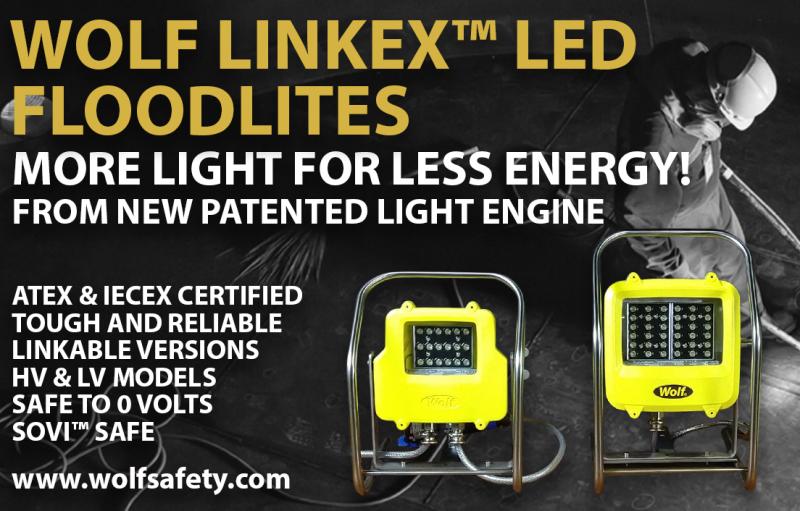
Wolf Linkex LED Floodlites
SOVI Technology
The WF-300 Floodlite, supplied by Wolf, was the best temporary hazardous area floodlight available for almost a decade.
But, having developed our innovative new PATENTED light engine and re-designed our floodlight to make it even better – the new WF-300®XL gives you more light output for less energy consumption!
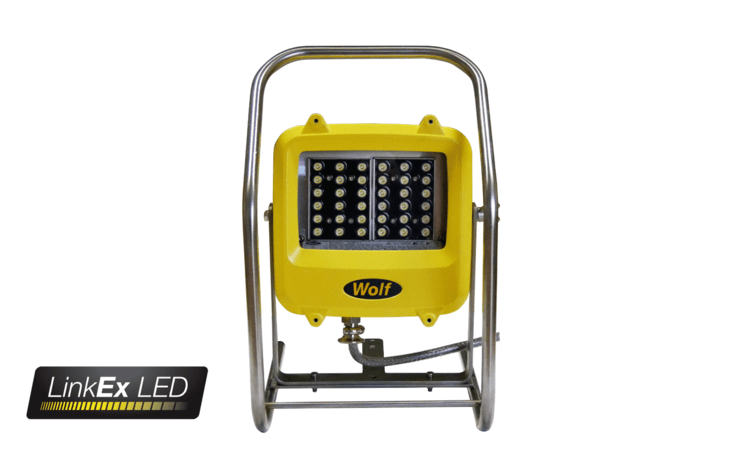
Wolf LinkEx LED Floodlite | WF-300XL
It’s strong – drop and impact tested – with an aluminium enclosure and a tough glass lens. It’s more lightweight and fully portable, even with the lamp switched on – to help you work more safely.

Wolf WF-250XL
If you need an even more compact, easily portable floodlight for even tighter spaces, with light output specifically designed for close confined spaces – no problem! Use the little brother, the new WF-250XL – it’s just as tough and reliable, and only weighs around 5kgs.

World Leading UK Manufactured Hazardous Area Portable & Temporary Lighting.
SOVI Technology
Wolf SOVI™ technology stands for Safe Optimal Voltage Indicator that gives you the confidence that the correct voltage is being supplied. Unique to Wolf products, SOVI™ removes all doubt. It tells you it’s safe and it keeps you safe.
This innovative technology is incorporated into our ATEX and IECEx certified Hazardous Area Temporary Lighting range, further enhancing safety in potentially explosive atmospheres.
Mains voltage versions T4 85V-264V:
- If operating over 264V/AC/DC, the light will pulse dim – do not use;
- If operating below 85V AC/DC, the light will pulse brighter. Light output will reduce incrementally as the input voltage falls below 90V AC/DC and the luminaire will shut down if the supply voltage continues to fall.
Low voltage versionsT4 18V-50V:
- If operating over 50V/AC/DC, the light will pulse dim – do not use;
- If operating below 18V AC/DC, the light will pulse brighter. Light output will reduce incrementally as the input voltage falls below 19V AC/DC and the luminaire will shut down if the supply voltage continues to fall.
Contact Thorne & Derrick for the competitive supply of the complete range of Wolf Safety Lamp portable & temporary lighting products including handlamps, torches, warning lights, tank lighting and floodlights.
EXPERTS IN EQUIPMENT FOR EXPLOSIVE ATMOSPHERES
leaders in ATEX Innovation To The Hazardous Area Industries
Thorne & Derrick are leaders in the development and distribution of Product Innovations that deliver significant improvements to clients plant, people and operational safety in the explosive atmosphere industries.
Your proactive problem solvers experienced in succession planning for the replacement of obsolete, non-conformant and legacy equipment in hazardous areas.
Your first-choice provider of innovative and competitive solutions to ensure ATEX & IECEx Compliance for Hazardous Area Electrical, HVAC & Process Instrumentation Equipment to UK and international projects.
Control Panels | Plugs | Isolators | Enclosures & Junction Boxes | Lighting | Control Stations | Motor Starters | Heat Trace | Gas Detection | Flame Detection | Process Instrumentation | Process Heating | Ventilation Fans | Security Access Control
Competitive Prices | Extensive Stocks | Technical Support | Express Delivery
Follow our Showcase Page on LinkedIn to receive hazardous area product innovations, industry news, whitepapers, videos, technical tips and training webinars for professionals involved in the explosive atmosphere industries.

Gas Detectors
Flammable & Toxic Gases in Hazardous Locations
Crowcon Xgard Bright is a versatile fixed gas detector offering detection of flammable gases,and toxic gases and oxygen monitoring, while providing ease of operation and reduced installation costs.
Fixed gas detection uses the latest technology to ensure the safety of plant and personnel at all times. In the event of a gas concentration reaching a preset high level, fixed gas detectors have alarms, lights and indicators that act as a warning signal to alert the user of the gas risk hazard in both safe and hazardous area zone locations.
The Client
The client in this case study is a long-established, state-owned energy company in Taiwan, providing electricity to the island’s 23 million residents and many enterprises. This places the firm at the very heart of Taiwan and makes it fundamental to domestic life, traditional industries and emerging high-tech businesses.
The energy company currently operates three nuclear and five coal power plants, as well as various smaller plants based on hydro, wind, thermal and solar power. There are plans to decommission the coal-fired plants and move to natural gas by 2023; the coal plants are largely old, with dated equipment and increasing maintenance costs, the price of fossil fuels has been consistently high for some time and demand for low-carbon energy has risen. The enterprise now favours a policy of energy conservation and carbon reduction.
The Requirement
Coal power plants create several challenges related to hazardous gases and their detection. Firstly, the transportation and pulverisation of coal makes plants incredibly dusty and this poses a high risk of combustion. Fine, bituminous coal dust becomes suspended in air and highly explosive.
The smallest spark, for example from plant equipment, can ignite the dust cloud and cause and explosion that sweeps up more dust, which explodes in turn and so on in a chain reaction. This can cause serious harm to both people and property.
Secondly, coal power plants generate large volumes of carbon monoxide (CO), which is both highly toxic and flammable, and must be accurately monitored. Other dangerous gases found on site include methane (CH4) and hydrogen (H2).
These risks make gas detection extremely important for the customer in this case, which became clear when a 2014 tender for the phased replacement of dated gas detectors – a contract that was supposed to support the energy company through a six-year upgrading project – did not deliver.
Back then, Crowcon did not tender for the project because it called for detectors with ATEX flammable dust certification. At that point, Crowcon did not have dust certification. The customer appointed another supplier, but things did not go well. The competitor’s detectors proved unstable and readings ‘drifted’, also the output (4–20mA) was not scalable.
The Approach
With the launch of Xgard Bright, Crowcon was able to meet the client’s dust certification requirement and provide a solution to their gas detection problems. In 2017, Crowcon offered the energy company a trial of Xgard Bright, which has dust certification and scalable outputs.
Conventionally, signal output follows sensor range, but this firm wanted a range of 0–100% LEL with an output of 0–25% LEL . Xgard Bright can do this.
The company was also conscious of the risks arising from dust and flammable gases – Xgard Bright has ATEX flammable dust certification, as well as gas certification and the ability to detect multiple flammable and toxic gas hazards. The many gases it can detect include those of particular interest to this client, namely methane (CH4), hydrogen (H2) and carbon monoxide (CO).
The energy firm’s trial of Crowcon’s Xgard Bright was very successful, and the company now specifies Xgard Bright of its plant renewal program.
Outcome and Benefits
Crowcon has delivered 150 units of Xgard Bright detectors for use in the customer’s new plant and will provide another 150 later in the year as part of their plant renewal program.
The arrangement between this prominent Taiwanese energy firm and Crowcon includes maintenance support and spares provision, and Crowcon’s Taiwanese distributor has provided excellent local support, leading to great outcomes all round.
‘We provide gas detectors that meet the customer’s specific requirements; they have both gas and dust certifications and provide bespoke sensor and output ranges. Part of the scope of supply is maintenance support and spares availability, and our Taiwanese distributor has provided excellent local support.’ – Gix Lee, Area Sales Manager, Crowcon
More gas detection Reading
Flame, Heat, Gas Detectors & Detection Systems

Hazardous area industries including offshore oil/gas platforms and FPSOs, onshore oil refineries, processing plants, pipelines, storage farms and LPG/LNG plants all utilise or produce a wide range of hazardous flammable liquids and gases that can be detected using correctly specified flame and gas detectors.
Detecting toxic and flammable gases requires the detectors to be classified and certified according to the specific IECEx or ATEX standard – we distribute flame and fire detectors manufactured by Spectrex to operate in the harshest environmental conditions including self-contained stand-alone devices designed for direct connection to control and alarm systems or automatic fire extinguishing systems.
Our range of Hazardous Area Fire & Gas Detection System products also includes Explosion Proof Warning Systems & Hazardous Area Lighting – comprehensive range of intrinsically safe, flameproof and explosion proof alarm sounders, sirens, bells and horns, loudspeakers and beacons.
♦ LV Power Products | Junction Boxes & Enclosures ATEX | Plugs ATEX | Control Stations ATEX | Isolators ATEX
Experts in Equipment
for Explosive Atmospheres
Follow our Showcase Page on LinkedIn to receive hazardous area product innovations, industry news, whitepapers, videos, technical tips and training webinars for professionals involved in the explosive atmosphere industries.