IBC Heater Jackets In The Food And Beverage Industry
By Chris Dodds : estimated reading time 5 minutes
IBC Heaters
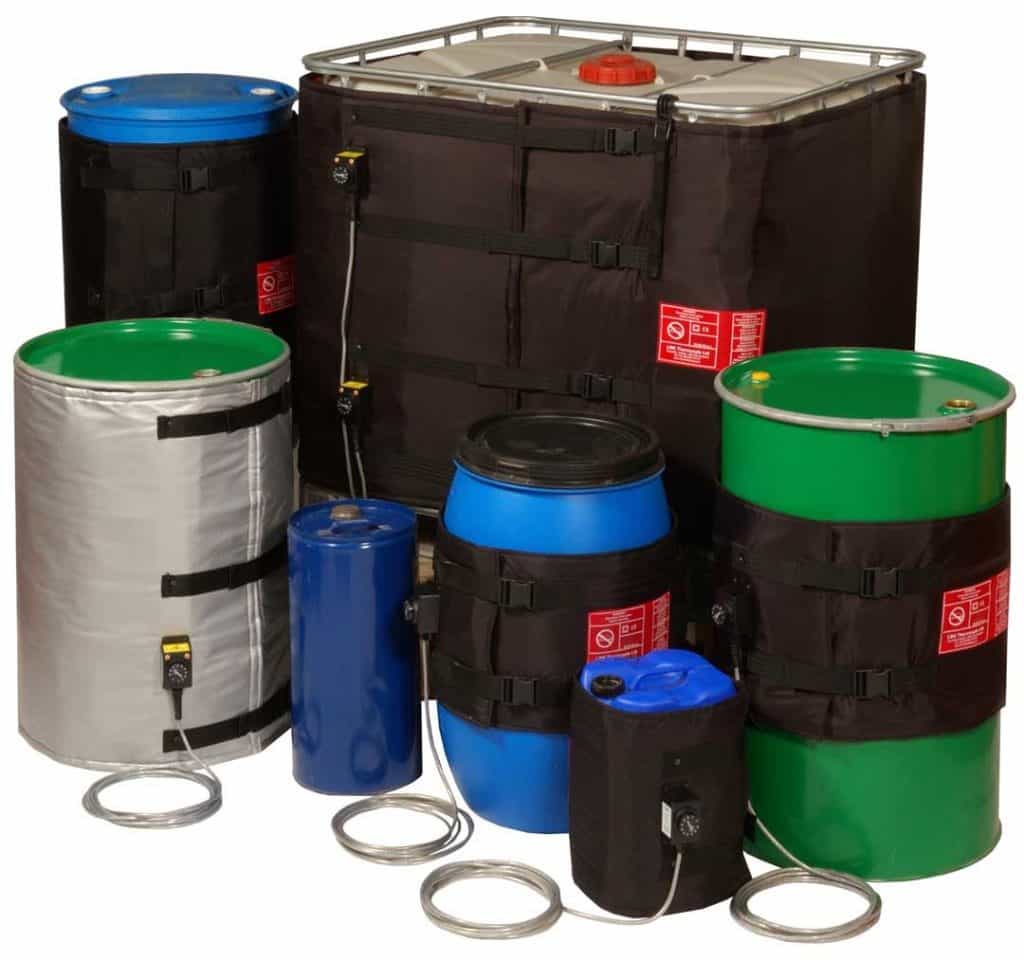
T&D are major distributors of IBC Container & Process Heating Products to the food and beverage industry supplying major customers with bespoke solutions to overcome heating challenges faced with consistent and reliable production – our range of IBC heaters provide reliable surface heating to bulk containers ensuring optimum contents viscosity, frost protection and temperature maintenance.
The range of Electrical Process & Drum Heating products that T&D supply can be used to ensure consistency, hygiene and guaranteed plant performance which is absolutely vital in the food processing industry.
IBC heating jackets and systems provide effective electric surface heating for food industry containers and drums:
Dairy
Beverages
Tea, Coffee & Cocoa
Bakery (Flour, Yeast, Bread products)
Breakfast Cereals
Soups & Sauces
Flavours & Fragrances
Colourants
Nutraceuticals
Common heating applications include IBC’s, containers or drums storing honey, corn sugar, palm oil and molasses.
Explosive Dust Atmospheres
Powders including flour and sugar are routinely stored on site at bakeries – when mixed with air, they can form a potentially explosive mixture and are classified as Zones 20 / 21 under ATEX guidelines.
T&D distribute ATEX IBC heaters for safe use in both hazardous area gas (Zone 1 & Zone 2) and dust (Zones 20, 21 & 22) atmospheres – typical food industry applications include wheat starch, gluten, wheat gluten production, grain processing and sugar production.
Other combustible dusts include:
Most solid organic materials (wood, flour, grass, paper, cereals, etc.)
Many powdered metals (such as aluminium, magnesium and titanium)
Certain non-metallic inorganic materials (although less common)
Low Voltage IBC Heaters
Fox’s Biscuits
Thorne & Derrick are distributors and stockists of low voltage IBC heating jackets which provide a consistent heating solution at safe low voltages of either 24V or 48V.
Low voltage IBC heating jackets have been used in the past in a case study for Fox’s Biscuits. Fox’s Biscuits manufacture a wide range of premium quality biscuits within the UK and are part of the Northern Foods PLC.
The client required a heating method to maintain an IBC containing glucose at 35ºC to ensure consistent flow during production and had previously used trace heating to achieve this but found that heat tracing cables did not provide an even temperature across the large surface area of the IBC.
To provide a more suitable solution a low voltage IBC heater jacket was provided which wrapped around the IBC covering the entire surface area, along with an insulated PVC lid. Additionally, custom sized low voltage heater jackets were supplied to fit around 40 metres of associated process pipework.
Using IBC heater jackets, the client was able to achieve a constant heat, ensuring the glucose could be fed through the pump and at the optimum temperature production.
Sugar Glucose – sugars provide sweetening, texture, bulk, colour and act as preservative agents in the food and beverage industry.
Low Voltage IBC Heater Jacket Benefits
Accurate temperature control and monitoring
Even temperature distribution across the IBC container – no hot or cold spots
Safe – Low Voltage (24V-48V ac)
Low Power Consumption – provides energy cost savings – up to 72% reduction
T&D also provide heat tracing cables for the temperature maintenance of food industry process pipework.
IBC Heating Jackets Used To Heat Up Caramel
IBC Heaters – HIBC/A
T&D have supplied Nestle Bulgaria with an IBC heater to heat up liquid caramel. Our client required a process heating method to maintain the temperature of the caramel between 40 and 50ºC to reduce the viscosity of the caramel and approached T&D to supply IBC heating jackets.
The client held the caramel within ‘bag-in-a-box’ style IBC containers to which HIBC/A IBC heating mats are ideal for providing surface heating.
HIBC/A silicone IBC heater mats are placed underneath the container before filling and provide heat through the container. Insulated IBC jackets and insulated lids help to reduce heat loss from the container.
HIBC/A heating mats have a PTC temperature sensor which can be connected to a digital temperature controller to allow for accurate monitoring and control of the temperature.
Bag In A Box – IBC Heaters
Bag In Box IBC Heaters
Bag in box IBC systems offer safety and hygiene with replaceable liner bags – the reusable bulk container protects the liquid contents providing ideal transportation conditions. T&D provide IBC heating jackets to suit all type of plastic or steel containers.
EXPERTS IN WINTERISATION SOLUTIONS FOR INDUSTRIAL & HAZARDOUS AREA ENVIRONMENTS
Thorne & Derrick hold the largest UK stocks of frost protection & winterisation equipment to help keep your plant and personnel operational during the winter months.
Thorne & Derrick understand that prolonged periods of low ambient temperatures can bring operations to a standstill costing thousands of pounds in lost downtime.
Experts in heating solutions for use in industrial & explosive atmospheres, Thorne & Derrick have the knowledge & expertise to help clients prevent unnecessary down time this winter.
We can provide overnight delivery of Trace Heating Cables at the most competitive prices to guarantee frost protection of your pipelines and mechanical services.| Ask About Our Heat Trace Design Service.
💡 Contact us today and our skilled and friendly team can provide technical support as well as reliable, fit for purpose and compliant solutions to suit your exact requirements.
➡See our Winterisation blog TOP PICKS, including our most read articles about Trace Heating and the requirement for electrical heating products and systems to combat and mitigate Winter weather effects.
T&D – Crowcon Distributors. Hazardous Area Gas Detectors (ATEX) For Zone 1 & Zone 2.
ATEX Directive – the Ex logo indicates that the gas detection equipment is suitable for use in a Flammable Atmosphere, Typically Zone 1 or Zone 2 hazardous area.
We begin by generally reviewing the 3 stages of the oil and gas process and focussing on the specific gas risks.
4 types of Crowcon gas detectors often deployed in Zone 1 and Zone 2 hazardous areas (ATEX) forming their hazardous area gas detector range for the detection and monitoring of flammable or toxic gases are highlighted for each of the 3 sectors.
Upstream industry – discovers and produces crude oil and natural gas and is commonly referred to as the exploration and production (E&P) sector.
Midstream industry – processes, stores, markets and transports commodities such as crude oil, natural gas, natural gas liquids (NGLs, ethane, propane and butane) and sulphur. The midstream oil and gas sector provides the vital link between often remote petroleum producing areas and the population centres where most consumers are situated. Transmission pipeline companies are a key part of the midstream petroleum industry.
Downstream industry – oil refineries, petrochemical plants, petroleum products distributors, retail outlets and natural gas distribution companies. The downstream oil and gas industry connects consumers providing thousands of products such as gasoline, diesel, jet fuel, heating oil, asphalt, lubricants, synthetic rubber, plastics, fertilizers, antifreeze, pesticides, pharmaceuticals, natural gas and propane.
Hazardous Area Gas Detectors
Zone 1 & Zone 2 Crowcon Gas Detectors – Personal, Portable & Fixed Detectors For Toxic & Flammable Gases.
1. gas detection for Upstream OIL & GAS
The upstream sector includes exploration and drilling for potential oil and gas fields, followed by the recovery and production of crude oil and natural gas if it is viable. Gas hazards in the upstream sector are compounded by the very harshest of environments providing challenges for the reliable detection of harmful gases.
Enhanced oil recovery (EOR) technologies and unconventional methods are allowing access to new geographic areas, as well as improving the level of recoverable resources within known reservoirs.
Fixed and portable gas detectors are required to protect plant and personnel from the risks of flammable gas releases (commonly methane gas detection) as well as high levels of hydrogen sulphide particularly from sour wells. Oxygen depletion, sulphur dioxide and volatile organic compounds (VOC’s) are also among the most common gas risks.
originaldate 1/1/0001 6:00:00 AMwidth 370height 305Crowcon XgardIQ Gas Detector – intelligent fixed-point Crowcon gas detector, increases safety by minimising the time operators must spend in Zone 1 and Zone 2 hazardous areas.
originaldate 1/1/0001 6:00:00 AMwidth 5421height 4469Crowcon Triple+ Plus Gas Detector – latest generation of the respected Crowcon "Triple" family of toxic, oxygen and flammable gas detectors. Over 90,000 units sold to oil and gas, chemical, utility and manufacturing companies worldwideoriginaldate 1/1/0001 6:00:00 AMwidth 370height 305
2. GAS DETECTION FOR MIDSTREAM OIL & GAS
The main components of the midstream process are transportation and storage. Raw products are held in storage areas until ready for the next process or to be transported to a refinery.
Maintaining the integrity of storage and transportation vessels as well as protecting personnel during cleaning, purging and filling activities are a constant challenge within the midstream sector.
Fixed monitoring of flammable gases situated close to pressure relief devices, filling and emptying areas deliver early warning of localised leaks. Multigas portable monitors maintain personal safety especially during confined space work as well as supporting hot work permit area testing.
Infrared technology supports purging with the ability to operate in inert atmospheres, and delivers reliable detection in areas where pellistor type detectors would fail due to poisoning or volume level exposure.
Portable laser methane detection allows leak location at distance for hard to reach areas, reducing the need for personnel to enter potentially dangerous environments or situations while performing routine or investigative leak monitoring.
CROWCON GAS DETECTORS : MIDSTREAM OIL & GAS
3. GAS DETECTION FOR DOWNSTREAM OIL & GAS
The downstream sector refers to the refining and processing of raw natural gas and crude oil, and subsequently distribution and sale of the products derived from this. Such products can include jet fuel, diesel fuel, asphalt and petroleum coke.
The desire to reduce energy consumption, increasing operational efficiency, has driven device manufacturers to innovate both detection principals and the way in which power is used. Gas detectors employ state-of-the-art technologies to deliver industry leading power consumption per device.
The volume of personnel on plant and high number of toxic and flammable gases used and manufactured increase the potential hazards. Some risks can be mitigated by ensuring rugged and reliable portable gas detectors and monitors are used, that are well suited to individual on-site requirements. Fleet management tools such as bump test stations deliver exceptional reporting to track site compliance and calibration status.
The ongoing demand to reduce facility down-time whilst ensuring safety, especially during shutdown and turnaround operations, ensures that gas detection manufacturers must deliver solutions offering ease of use, simple training, reduced maintenance times with local service and support.
Hazardous area industries including offshore oil/gas platforms and FPSOs, onshore oil refineries, processing plants, pipelines, storage farms and LPG/LNG plants all utilise or produce a wide range of hazardous flammable liquids and gases that can be detected using correctly specified flame and gas detectors.
Detecting toxic and flammable gases requires the detectors to be classified and certified according to the specific IECEx or ATEX standard – we distribute flame and fire detectors manufactured by Spectrex to operate in the harshest environmental conditions including self-contained stand-alone devices designed for direct connection to control and alarm systems or automatic fire extinguishing systems.
Our range of Hazardous Area Fire & Gas Detection Systemproducts also includes Explosion Proof Warning Systems & Hazardous Area Lighting – comprehensive range of intrinsically safe, flameproof and explosion proof alarm sounders, sirens, bells and horns, loudspeakers and beacons.
Follow our Showcase Page on LinkedIn to receive hazardous area product innovations, industry news, whitepapers, videos, technical tips and training webinars for professionals involved in the explosive atmosphere industries.
By Chris Dodds : estimated reading time 9 minutes
Directives such as ATEX and IECEx provide internationally recognised standards for the installation and use of electrical equipment in potentially explosive hazardous areas.
This article specifically focuses on Electrical Heating Equipment and has been written for all people who have an interest in understanding best working practices for installing and maintaining electrical heaters in potentially explosive atmospheres.
The European Directive 94/9/EC is in place to ensure manufacturers of process and hazardous area heaters, such as EXHEAT, meet stringent guidelines and only when these guidelines are satisfied can a product be certified for use in explosive atmospheres.
However, it is just as important that the end user knows and understands their responsibility for the safe installation, use and maintenance of such equipment.
EXHEAT Heaters Typical Hazardous Area Heating Applications.
In the UK, DSEAR (Dangerous Substances and Explosive Atmospheres Regulations) are provided by the HSE for employers with the aim “to protect people from fire and explosion risks related to dangerous substances and potentially explosive atmospheres. DSEAR places duties on employers to protect people from risks to their safety from fires, explosions and similar events in the workplace.”
From the resultant investigation two main issues were raised. First, although the heater was certified for use in hazardous area, it was not suitable for the corrosive atmosphere it was being used in. Secondly, the duty holder did not have a comprehensive list of all such heaters in use and could not therefore carry out a routine planned inspection and maintenance program.
Pictured below are some common types of EXHEAT electrical heaters used for space heating and process heating in hazardous area locations and explosive atmospheres.
All such heaters should be installed, used and maintained strictly in accordance with manufacturers recommendations and under any conditions stipulated under its Ex certification.
Electrical Heating In Hazardous Areas With EXHEAT
EXHEAT FAW Air Warmers – commonly used for space heating in paint stores or small plant areas storing flammable materials.
EXHEAT FLR Radiators – a flameproof radiator used for space heating in explosive areas such as laboratories, firework factories and ammunition stores.
EXHEAT Immersion Heaters– used for frost protection or pre-heating of oils, water and process liquids.
EXHEAT HEF Enclosure Heaters – anti-condensation and space heater for small enclosures such as control & instrumentation cabinets.
EXHEAT In Line Heaters – for frost protection and pre-heating applications including fuel oil heating to ensure pumping viscosity.
In order to appreciate the risks of electrical heating in hazardous areas, let’s first take a brief look at some of the fundamentals for understanding hazardous areas. If you’re an expert in this area you may wish to skip the next couple of paragraphs.
What Is A Hazardous Area?
Fire Triangle
To be specific a hazardous area is defined as “an area in which the atmosphere contains, or may contain in sufficient quantities, flammable or explosive gases, dusts or vapours.”
In such an atmosphere a fire or explosion is possible when three basic conditions are met.
This is often referred to as the “hazardous area” or “combustion” triangle.
Hazardous areas are assessed and defined by:
The types of hazard (gas, vapour, dust or fibre)
The likelihood that the hazard will be present in flammable concentrations (zoning)
Temperature Classification (Auto Ignition temperature)
There are many articles which go into great depth about hazardous areas, gas groups and zoning but I’ll skip past most of that and concentrate on Temperature Classification as this is particularly relevant to electrical heating equipment.
Temperature Classification (Auto Ignition Temperature)
To create an explosion you need fuel, oxygen and an ignition source. The ignition source is often thought of as a spark or flame. Obviously when using electrical equipment there is the risk of incendive arcs or sparks.
What also needs to be considered is the surface temperature of the equipment being used. All electrical equipment will give off some heat but the whole purpose of electrical heating equipment is to heat up and get HOT.
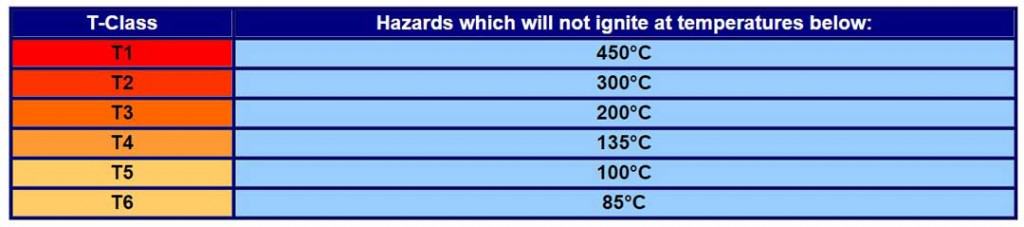
Hazardous Area Temperature (T) Classes
The T rating of an area refers to the temperature at which the flammable substance will auto ignite. See table above. For example, Acetylene has an auto ignition temperature of 300ºC and therefore the T classification for an area where Acetylene may pose a flammable risk would be T3 (Not T2, I’ll explain why in a moment).
This means electrical heating in hazardous areas should not be installed in that area unless it has a T classification of T3 or less.
T4, T5 & T6 would all be acceptable but T2 and T1 would not.
For example If you were to install a 30KW fan heater in such an area and the fan heater was rated T2, there is the potential for the fan heater surface temperature to reach 300ºC. Combine that with a flammable mixture of Acetylene and…. BANG.
Video – Acetylene Tanks Explode In Dallas Texas
Question
Could a T4 rated air heater be used in an area where Ethyle Nitrate is a flammable risk (the auto ignition temperature of Ethyle Nitrate is 90ºC)?
If you know the answer, you understand T-ratings, if you don’t, give T&D a call and we can assist.
Just because an electrical heater is rated T3, the user also needs to consider ambient temperature conditions. As with all hazardous area certified equipment, heaters are certified under certain conditions.
For example, an EXHEAT FWDT-T3 is rated at T3 but the equipment is only permitted for use in ambient conditions of 60ºC<Tamb<+40ºC (see certificate example). If the electrical heater is used in ambient conditions above the limit, there is a risk that the surface temperature will exceed 200ºC (T3).
Another risk is that any safety components (for example over temperature cut-out) may fail to operate if exposed to temperatures above or below the safe working range.
EXHEAT FWDT-T3 ATEX Certificate – Sample
EXHEAT FWD-T Flameproof Air Warmers – certified hazardous areas where the potentially explosive atmosphere is classified as a Zone 1 or 2 (IIA, IIB, IIC) gas group, or a Zone 21 or 22 (IIIA, IIIB, IIIC) dust group. If in about, call T&D.
Installation & Maintenance Of Ex Electric Heaters
Useful Information
Electrical heating in hazardous areas should only be used for its intended purpose and as per manufacturer’s instructions. Sometimes, EX certified products have conditions stipulated for their safe use. An X on the certificate number references this.
It is the duty holders’ responsibility to ensure these special conditions are taken into consideration. For example, an immersion heater may require to be fully immersed at all times during operation. In order for a duty holder to guarantee this, they would need to consider installation of low level monitoring in the tank to ensure the heater remained switched off if it was not fully immersed.
Installation Of Electric Heaters In Hazardous Areas
Inspection of heaters should be carried out on receipt of goods to ensure no damage has occurred during transit.
Before installation, insulation resistance tests should be carried out on the heating elements and the IR reading should be above acceptable value as stipulated by the manufacturer. This value will be clearly stated in the O&M literature.
Insulation Readings
💡 TIP – low insulation readings (IR) are often due to moisture in the enclosure terminal or in the heating elements. Silica gel packs can be used to draw out any moisture and the IR test should be repeated after 24hrs.
Electrical heating in hazardous areas should only be installed in the orientation intended. For example, horizontal immersion heaters should not be installed vertically. We have seen examples of clients mounting heaters, such as the FWDT, vertically as space did not permit horizontal mounting.
Space heaters should never be covered and airflow should not be restricted as it could prevent natural convection. Ambient temperatures should never exceed the safe working temperatures stipulated by the manufacturer.
Maintenance of Electric Heaters
Ensure the risk of flammable atmosphere is removed before any maintenance work is carried out. Electrical heating equipment where elements are exposed (space heaters) should be regularly checked for accumulation of dust which should always be removed.
Equipment should always be fully isolated before any work commences.
Only Manufacturers parts should be used for any repairs. Use of non-approved parts would invalidate any EX hazardous area certification.
Inspections should be routinely carried out 3 monthly, 6 monthly and annually. Manufacturers O&M manual will provide the necessary checks which should be carried out at each inspection.
For detailed guidelines on inspection and maintenance of electrical apparatus in explosive atmospheres, please refer to IEC/EN 60079-17.
IEC 60079-17:2013 applies to users and covers factors directly related to the inspection and maintenance of electrical installations within hazardous areas only, where the hazard may be caused by flammable gases, vapours, mists, dusts, fibres or flyings.
How Can We Help?
For equipment sales and specification guidance about electrical heating in hazardous areas please contact T&D.
T&D are Process & Hazardous Area Heating experts with over 30 years’ experience serving petrochemical, oil and gas, utilities, food and beverage and pharmaceuticals.
Working in partnership with EXHEAT, we are able to offer a full range of electrical heating equipment which is certified for use in explosive atmospheres – this includes immersion heaters, air/space heaters, fan heaters, line heaters, water heaters, oil heaters and drum heaters.
Together we take our design responsibility seriously and help to provide our clients with the necessary information to ensure electrical heating in hazardous areas is safe, reliable and conforming to the required classifications.
Invitation – network, engage, promote
Thorne & Derrick are inviting you to join LinkedIn’s fastest growing Discussion Group – Process & Hazardous Area Industries : Heat Tracing, Gas Detection, Fluid Control & Flow Measurement. News, projects, videos, promotions, whitepapers, jobs, webinars, press plus much more.
ABOUT US
Thorne & Derrick International are your single-source supplier of Electrical, Mechanical, Process & Instrumentation Equipment. T&D provide an outstanding service to UK and international customers – we are highly customer responsive and absolutely committed to providing a world-class service.
T&D supply utilities, power, renewable energy, construction, rail, manufacturing, food/beverage, mining, oil, gas and petrochemical industries – distributing 100,000+ products from 100+ manufacturers from multi-million pound stocks. Since 1985 we have established a solid reputation based on service, integrity and trust.
Press Release Date: 02.04.2020 uploaded by Chris Dodds (T&D Sales + Marketing Manager) World’s First Fully Certified ATEX Doors Thorne & Derrick International, the Experts in Equipment for Explosive Atmospheres, today announce the signing of a Commercial Distribution Agreement...
Press Release Date: 04.07.2019 uploaded by Chris Dodds (T&D Sales + Marketing Manager) Category: Stockist Distributor Agreement Announcement Thorne & Derrick International announce that they have signed a Preferred Distributor Agreement with Raytec, the world leading manufacturer of LED...