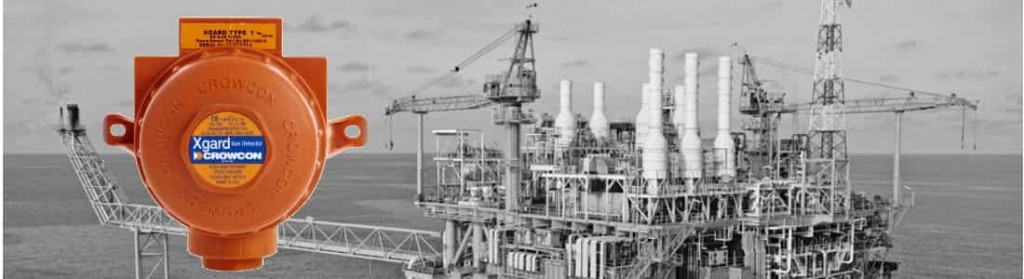
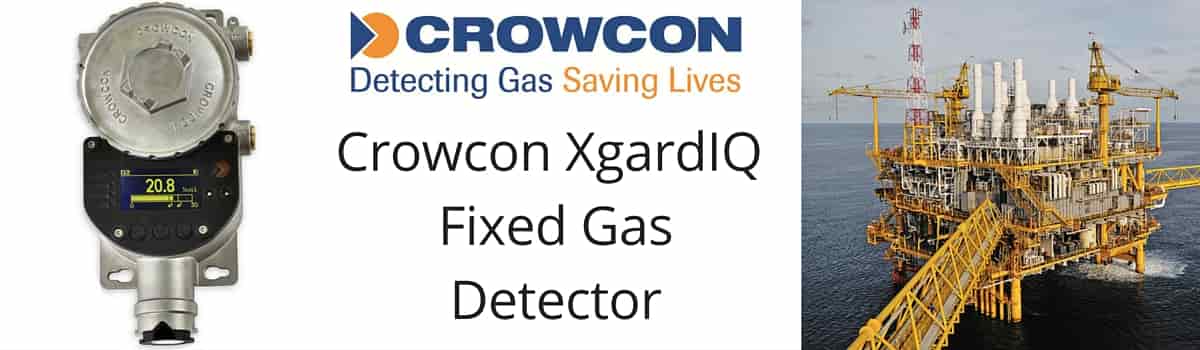
The Crowcon XgardIQ is the next generation of fixed gas detectors from Crowcon and has been manufactured to enhance site safety and minimise the time workers must spend in hazardous areas exposed to harmful gases.
The fixed gas detector is versatile, compatible with Crowcon’s full range of sensor technologies and is available fitted with a variety of flammable, toxic or oxygen gas sensors.
Andy Avenell, Senior Business development manager at Crowcon, said while explaining the product development;
“We spend a significant amount of time talking to engineers and operators in oil and gas facilities, petrochemical and chemical plants and other high risk areas. The experiences and insight gained from such sites has been instrumental in the specification development of Crowcon XgardIQ.”
When lives and real estate are at stake, the Crowcon XgardIQ provides reliable notification system of the presence of harmful, explosive and flammable gases. This minimises the amount of time that a worker must spend in a hazardous area.
Crowcon XgardIQ Fixed Gas Detector
Product Introduction
Hot Swappable Sensors
The XgardIQ minimises the amount of time spent between swapping sensors and performing routine maintenance. The gas detecting sensors can be ‘hot-swapped’ without the need for a hot work permit. The old module can be replaced with a new pre-calibrated one or removed for testing and calibration in a safe area.
Versatile sensor options
The modern plant environments often require a varying degree of gas detection diversification. The Crowcon XgardIQ can offer this versatility and wide application of gas detection with a single product.
Positive safety
Crowcon’s unique positive safety feature reassures operators that the XgardIQ is functioning properly by alerting when there are any irregular events that may effect the sensors performance. This puts the XgardIQ ahead of other sensors that may otherwise cease to function when exposed to extreme environmental conditions.
Compatability
The XgardIQ is compatible with virtually any control system including gas detection panels, PLC’s, DCS’s and SCADA systems. This makes the detector easier to install and reduces costs associated with installation.
Crowcon XgardIQ Fixed Gas Detection
Resetting To Zero
When calibrating the XgardIQ sensor, calibration gas must be applied used the calibration cap also available from Crowcon. Typically, a flow rate of 0.5 litres per minuter is appropriate however this may vary for different sensor types.
Calibration can be performed with a suitable gas concentration from 10% of the scaled sensor range to 100% of the maximum sensor range. The minimum calibration gas concentration that can be used is 10% of the scaled range.
Crowcon XgardIQ Fixed Point Gas Detector Calibration Procedure
Hazardous area industries including offshore oil/gas platforms and FPSOs, onshore oil refineries, processing plants, pipelines, storage farms and LPG/LNG plants all utilise or produce a wide range of hazardous flammable liquids and gases that can be detected using correctly specified flame and gas detectors.
Detecting toxic and flammable gases requires the detectors to be classified and certified according to the specific IECEx or ATEX standard – we distribute flame and fire detectors manufactured by Spectrex to operate in the harshest environmental conditions including self-contained stand-alone devices designed for direct connection to control and alarm systems or automatic fire extinguishing systems.
Our range of Hazardous Area Fire & Gas Detection Systemproducts also includes Explosion Proof Warning Systems & Hazardous Area Lighting – comprehensive range of intrinsically safe, flameproof and explosion proof alarm sounders, sirens, bells and horns, loudspeakers and beacons.
Follow our Showcase Page on LinkedIn to receive hazardous area product innovations, industry news, whitepapers, videos, technical tips and training webinars for professionals involved in the explosive atmosphere industries.
By Chris Dodds : estimated reading time 8 minutes
Exposure to hydrogen sulphide (H₂S) gas is a serious risk to people, even at low levels.
Portable gas detectors and fixed gas detectors from leading manufacturers such as Crowcon and Drager, provide a gas monitoring solution alerting the worker to the danger and preventing accidents or even death.
Hydrogen sulphide gas (H₂S) has a very distinctive smell – everyone has experienced the rancid stink bomb or rotten egg smell at some point.
H₂S can be a man made by-product and is commonly found in the refining of crude oil and the processing of “soured” natural gas. Other names for H2S include sewer gas, stink damp, swamp gas and manure gas.
The gas is also a by-product of the bio degeneration of organic matter posing a particularly high risk to those working in the sewage treatment industry.
H₂S can be deadly if workers are exposed to certain concentrations of the gas – it is not an option to rely on a person’s sense of smell when it comes to Health & Safety and the protection of life.
This is why portable and fixed gas detectors are used to protect people from the risk.
In one incident, three workers lost their lives whilst working on an oil transfer line in a corrosion coupon pit. A 4th worker was critically injured and air lifted to hospital – the cause of death was cited as exposure to a lethal concentration of H₂S gas.
Why is Hydrogen Sulphide Gas So Dangerous?
H₂S is a flammable gas when in high concentrations. However this is not the main danger. Just like CO₂, it is a toxic gas and poses a risk even at low exposure levels:-
2-5PPM – Nausea & Headaches
20PPM – Fatigue, Headaches, Loss of Memory, Dizziness
1000 – 2000PPM – Instant Death
PPM Parts Per Million
Ironically, one of the side effects of exposure to H₂S gas is depletion of the sense of smell meaning workers exposed to the gas may inadvertently continue to work despite initially being exposed to the “rotten egg” smell.
H₂S is heavier than air and therefore will sink to the floor meaning working in confined spaces like shafts or trenches is particularly dangerous.
Workers can be exposed to hydrogen sulphide gas in numerous process industries including mining, paper mills, iron smelting, petroleum refining and sewage treatment works.
Even low concentration levels of H₂S can be toxic if individuals are subjected to the gas for an extended period of time leading to fatigue, pulmonary edema, loss of consciousness and even death.
Occupational exposure to hydrogen sulphide typically occurs in oil, gas and petrochemical industries as the by-product of coke (blast-furnacing).
The warning signs of H2S exposure are easy to recognise with many parts of the body being affected. Eye irritation will occur with physical soreness, light sensitivity and pain experienced when viewing or looking towards a bright light; commonly known as ‘Gas Eye’.
Other symptoms include breathing irritation such as sore naval passages, a burning sensation on the lungs, headaches, confusion and nausea. The real danger with H2S is that it can kill at reasonable low levels.
Managing Hydrogen Sulphide In The Offshore Work Environment
Hydrogen sulphide is considered a broad spectrum poison and as such it can poison several systems in the body, however the most severely affected are the nervous and respiratory.
In addition to being toxic, H2S is highly flammable and therefore presents an extra risk in the offshore environment.
The gas is heavier than air and tends to accumulate in low lying areas, rapidly destroying the sense of smell which would be a first stage indicator of the presence of H2S. Hydrogen sulphide is toxic at breathable concentrations between 500-1000ppm however death is not instantaneous.
At concentrations of 1000ppm and above however, the lethal effects are much more instant as this causes strong stimulation of the central nervous system and rapid breathing, leading to a total loss of breathing.
The Health & Safety Executive (HSE) states that 800ppm is the generally accepted lethal concentration for 50% of an exposed human population for 5 minutes exposure to hydrogen sulphide gas. On an offshore installation, standards recommend a 3 tier approach to gas detection that are similar to the flammable hazardous area classification arrangements.
The three tiers of gas safety are classified as:
Category 0 – Areas where H2S will be present during normal working operations, such as confined spaces or vessels.
Category 1 – Areas in which H2S may be encountered during normal working operations. Entry is only allowed with a portable gas detector and fixed gas detection is recommended.
Category 2 – Areas which are free from H2S during normal operations but could be contaminated by a gas leak or equipment malfunction.
Gas detection installations in offshore environments typically operate with an alarm and action at least 20% and 50-60% LEL however some duty holders will operate their hydrocarbon detection systems at 10% and 25% LEL to provide a more sensitive system – it is recommended to operate hydrocarbon gas detection systems at the more sensitive values.
Crowcon X-Gard provides a fixed gas detection solution in the offshore oil and gas industry.
The Solution – Gas Detectors to Monitor H₂S & How To Reduce The Risks
Fixed gas detectors for H₂S are suitable for larger areas such as plant rooms where numerous detectors can be networked to a master control panel. In the event of H₂S reaching the preset exposure limit, visual and audible alarms will activate to alert the workforce to the danger.
The Crowcon Xgard and the Crowcon TXgard Plus can both be used for H₂S gas detection and offer a fixed, permanent detection solution.
Portable gas detectors for H₂S can also be used for personal protection and are especially useful when working in confined spaces. Easy to use, operated simply by one button and easily attachable to the workers clothing. Portable gas detectors offer a safe monitoring solution alerting the user when preset levels of gas/gases are detected.
Reducing The Risk Factors Of H2S Gas In The Workplace
Reducing the risks of Hydrogen Sulphide poisoning in the workplace is a key responsibility and can be managed by following these points:
Monitoring – By providing H2S monitors, gas levels can be managed and action taken when they reach potentially harmful levels. Where there is a risk of Hydrogen Sulphide exposure, it is vital to have adequate gas detection facilities in place.
Training and education – Workers must be educated to the dangers of H2S exposure, how to prevent and recognise H2S poisoning and how to effectively operate breathing apparatus.
Ventilation – Where practical, effective ventilation should be installed to reduce the levels of H2S and the potential threat posed to staff.
Storage – Any cylinders containing H2S should be clean, isolated and stored in a shaded and well ventilated area.
Confined space precautions – Any confined spaced must be tested, ventilated and deemed safe for use before any workers can enter.
Worker attitude – Workers are more likely to be harmed if they are unaware of the risks of H2S or become lax about their safety. This cements the need for thorough training and education about the dangers of this gas.
Regular maintenance – In order to reduce the risk posed by H2S, regular maintenance of drums, pipes, valves and containers must be carried out.
Emergency plans – An emergency action plan must be put in place where workers are trained to used emergency exits and equipment. This procedure must be practiced periodically to maintain standards and educate any new members of staff.
Useful information and guidance on H₂S gas detection and monitoring can be found at:-
Thorne and Derrick International are able to provide a wide range of Gas Detectors to monitor H₂S gas many other dangerous toxic and flammable gases – for more information or to discuss your requirements please contact us.
Hazardous area industries including offshore oil/gas platforms and FPSOs, onshore oil refineries, processing plants, pipelines, storage farms and LPG/LNG plants all utilise or produce a wide range of hazardous flammable liquids and gases that can be detected using correctly specified flame and gas detectors.
Detecting toxic and flammable gases requires the detectors to be classified and certified according to the specific IECEx or ATEX standard – we distribute flame and fire detectors manufactured by Spectrex to operate in the harshest environmental conditions including self-contained stand-alone devices designed for direct connection to control and alarm systems or automatic fire extinguishing systems.
Our range of Hazardous Area Fire & Gas Detection Systemproducts also includes Explosion Proof Warning Systems & Hazardous Area Lighting – comprehensive range of intrinsically safe, flameproof and explosion proof alarm sounders, sirens, bells and horns, loudspeakers and beacons.
Follow our Showcase Page on LinkedIn to receive hazardous area product innovations, industry news, whitepapers, videos, technical tips and training webinars for professionals involved in the explosive atmosphere industries.
ASCO Numatics FASTSHIP and SAMEDAY services offer access to selected ASCO solenoid valves and valve operators from stock. Confirm current availability and delivery times with Thorne & Derrick.
By Chris Dodds | Estimated reading time: 9 minutes
ASCO Solenoid Valves for Sour Gas Applications
Material selection plays a critical role in the safety and reliability of equipment used in sour gas environments. This article explains the risks associated with hydrogen sulphide (H₂S), including hydrogen embrittlement and sulphide stress cracking, and explores how engineers can select suitable ASCO solenoid valves for oil and gas applications.
Sour gas can expose valves and other process equipment to corrosive conditions, particularly when hydrogen sulphide and water are present. Engineers must consider material compatibility, operating conditions and applicable industry standards when specifying equipment for these environments.
This article covers:
How solenoid valves operate.
What sour gas is and why hydrogen sulphide presents a hazard.
The risks of hydrogen embrittlement and sulphide stress cracking.
The role of NACE MR0175/ISO 15156 in material selection.
The ASCO 327 Series case study described in the original article.
What Is a Solenoid Valve?
A solenoid valve controls the flow of a fluid, such as air, water, oil or gas. It typically combines an electrically operated solenoid with a valve body containing the internal components that regulate flow.
When an electrical current energises the coil, it creates a magnetic field that moves the valve’s internal mechanism. Depending on the valve design, this movement opens or closes the flow path.
ASCO Solenoid Valves
What Is Sour Gas?
Sour gas is natural gas that contains hydrogen sulphide (H₂S). Hydrogen sulphide is highly toxic and can cause serious corrosion-related damage to equipment under suitable environmental conditions.
Different standards and industry contexts use different criteria to define sour service. Engineers should therefore refer to the applicable specification and standard rather than rely on a single universal concentration threshold.
When hydrogen sulphide and water are present, susceptible materials may experience forms of damage such as hydrogen-induced cracking and sulphide stress cracking. These mechanisms can compromise the integrity of equipment used in oil and gas production.
Sour gas environments can cause several forms of material damage, including hydrogen-induced cracking and sulphide stress cracking.
Hydrogen Embrittlement and Sulphide Stress Cracking
What Is Hydrogen Embrittlement?
Hydrogen embrittlement occurs when hydrogen enters a susceptible metal and reduces its resistance to cracking. Depending on the material and conditions, this process can reduce ductility and fracture resistance, increasing the risk of failure.
Hydrogen can enter metals through several mechanisms, including certain manufacturing processes and exposure to corrosive environments. The resulting damage depends on factors such as the material’s composition, strength, stress level and exposure conditions.
One challenge is that hydrogen-related damage may develop without obvious external warning signs. Cracks can remain difficult to detect until they cause a significant loss of material integrity.
In onshore and offshore oil and gas facilities, a failure involving pressurised or hazardous process equipment can have serious consequences. Material selection and appropriate inspection therefore play an important role in managing risk.
Hydrogen-related damage can contribute to brittle fracture in susceptible materials, creating significant safety and reliability risks.
Video: Tesoro Anacortes Refinery Explosion
The following animation relates to the 2010 Tesoro Anacortes refinery incident, in which a heat exchanger failure caused an explosion and fire that killed seven workers. Investigators identified high-temperature hydrogen attack as the cause of the failure.
High-temperature hydrogen attack is a different damage mechanism from hydrogen embrittlement. However, the incident illustrates the serious consequences that material degradation can have in industrial facilities.
Hydrogen can also enter metals during certain manufacturing and surface-treatment processes, including electroplating, pickling and other treatments, if the process conditions allow it. In oil and gas applications, engineers must also consider the interaction between materials and the chemicals present in the operating environment.
What Is Sulphide Stress Cracking?
Sulphide stress cracking is a form of environmentally assisted cracking associated with susceptible materials exposed to hydrogen sulphide in the presence of tensile stress and suitable environmental conditions.
Hydrogen generated by corrosion can enter susceptible metals and contribute to cracking. The likelihood of failure depends on several factors, including material properties, hardness, stress and the conditions of exposure.
For oil and gas applications involving sour service, engineers must select materials that meet the requirements of the relevant service conditions and applicable standards.
NACE MR0175 / ISO 15156 and Sour Service Material Selection
NACE International developed industry guidance and standards for corrosion control. NACE MR0175, now associated with ISO 15156, addresses the selection and qualification of metallic materials for equipment used in H₂S-containing environments in oil and gas production.
The standard helps engineers assess whether materials are suitable for the intended sour service conditions. It supports material selection and qualification, but it does not replace the other design codes, regulations and requirements applicable to an installation.
When specifying a solenoid valve for sour service, engineers should check:
Material compatibility: Confirm that wetted and other relevant components meet the requirements for the service environment.
Operating conditions: Consider H₂S exposure, temperature, pressure, stress and other relevant environmental factors.
Manufacturer documentation: Request evidence of material compliance and suitability for the intended application.
Equipment certification: Check any separate hazardous-area and functional-safety requirements.
Solenoid valves perform several functions in oil and gas facilities, including actuator piloting, compressor unloading, redundant control systems and utilities control.
Offshore upstream installations can combine corrosive process conditions with potentially explosive atmospheres. Engineers may therefore need to specify valves that address both material compatibility and the hazardous-area requirements of the installation.
The original ASCO case study describes the development of a direct-acting solenoid valve intended for sour gas applications. The design objectives included:
Corrosion-resistant materials for upstream offshore conditions.
Material suitability for H₂S service, including relevant internal components.
Reliable operation with low electrical power consumption.
Suitable hazardous-area protection options for the intended installation.
ASCO WSCR327 Solenoid Valves
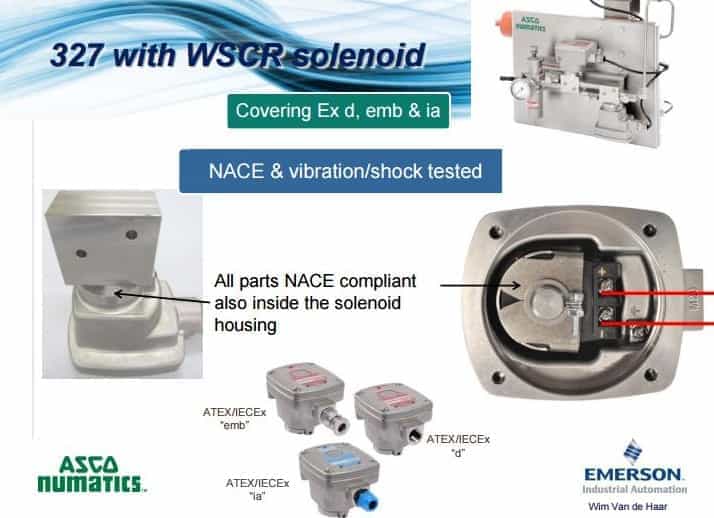
The original article identifies the ASCO WSCR327 as a solution developed for sour gas service. It describes a design using corrosion-resistant materials intended to meet NACE MR0175/ISO 15156 requirements.
The article also states that the design considers components that may encounter sour gas during installation and routine maintenance. Confirm the exact material specification and compliance documentation for the particular valve and configuration before selecting it for service.
ASCO Numatics
The original product information describes the valve as a 3/2 direct-operated design available in ¼-inch and ½-inch sizes, with flow rates of up to 1.8 m³/h. These figures are model-specific claims from the original article and should be checked against current manufacturer documentation.
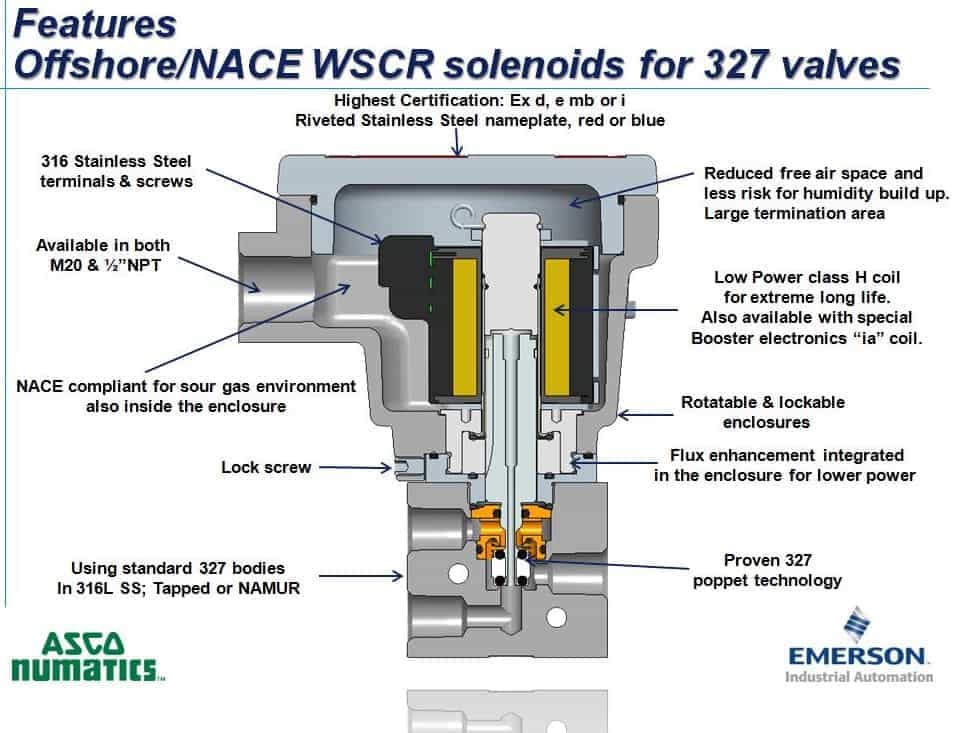
The article also describes a non-breathing design intended to limit the passage of contaminated ambient air through the valve. The valve is associated with the ASCO 327 Series solenoid valve range and uses a balanced poppet design.
The original article also identifies low-power solenoid operator options and describes potential configurations for hazardous-area and functional-safety applications. Confirm the exact protection method, certification and SIL capability of the complete valve assembly before using it in a safety-related system.
ASCO 327 Series: Offshore and NACE Design
The original article reports that ASCO WSCR solenoid valves underwent testing at a sour gas concentration of 50 ppm, both externally and inside the solenoid housing. Consult the manufacturer’s test reports to confirm the test conditions, scope and applicability to the valve configuration you intend to use.
Key Features Described in the Original ASCO 327 Article
Corrosion-resistant construction intended for sour service, including relevant solenoid internals.
Direct operation without the need for a pilot stage.
Different solenoid protection options described in the original article, subject to model and certification.
Compact construction for industrial installations.
Low-power operator options, with the original article citing values from 0.5 W to 1.8 W depending on configuration.
Functional-safety options described by the original article, subject to the exact certification and configuration.
These features are not necessarily available on every valve variant. Check current ASCO datasheets and certification records before specifying a product.
ASCO Solenoid Valves from Thorne & Derrick
Thorne & Derrick is an authorised distributor of ASCO Numatics products. We work with customers to identify solenoid valves for industrial fluid-control requirements, including applications in the oil and gas sector.
When selecting a valve for sour gas service, provide the operating conditions, process fluid details, material requirements and any hazardous-area or functional-safety specifications. This information helps the technical sales team identify suitable options for further verification.
Electrical and process instrumentation equipment for hazardous areas
Thorne & Derrick supplies hazardous-area and explosion-protection equipment to the onshore and offshore oil, gas, petrochemical and process industries. We support infrastructure projects and maintenance, repair and operations (MRO) requirements, including planned and unplanned plant shutdowns.
Working with customers and suppliers, we can help assess equipment requirements and plan the replacement of legacy products to meet applicable installation specifications and hazardous-area classifications.
T&D UK – largest stockist of Drum & IBC Heaters & Jackets. Delivering UK & Worldwide.
By Chris Dodds : estimated reading time 4 minutes
Vegetable Oils – Heaters For IBCs & Drums
Vegetable oils are a lifeblood of the food industry and provide essential fatty acids and an energy source to maintain human health and nutrition. Typical food processing applications requiring vegetable oils include frying, cooking and baking.
Oils are sensitive to heat, light and exposure to oxygen and all vegetable oils must be stored in a cool, dry place.
To ensure optimum yields and productive use it is important to maintain vegetable oil temperatures to avoid oil thickening and provide rapid heating for processing and melting applications – typically 1,000 litre IBC containers can be heated using our standard 2 kilowatt heaters with insulated lids. The heaters establish correct liquid viscosity of the vegetable oil reducing wastage to a minimum.
Rapid Heating
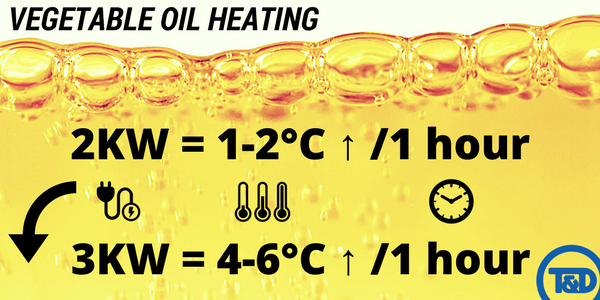
T&D test data indicates a temperature increase of 1-2°C per hour of IBC container contents using 2KW IBC heaters.
For applications requiring a more rapid heat-up time of vegetable oils contained in IBC’s we can provide a high power 3 kilowatt heater jacket which improves and accelerates the heating time to approximately 4-6°C per hour.
T&D provide Electric Heating solutions to the world’s leading food brands and companies.
Where Quality Counts & Service Matters
T&D International are the UK’s leading supplier of IBC & Drum Heating Equipment – since 1985 we have developed a strong reputation based on technical support, customer service and trust.
T&D heating jackets are UK manufactured and supplied with a 12 month warranty – competitively priced, delivered from stock and built to last.
Trusted Quality. T&D Drum & IBC Heaters: Made In The UK, Supplied Globally
Drum Heaters
For further information about electrical heating visit Drum & IBC Heaters– here follows a recent application case for heating vegetable oil using IBC heating jackets:
Medium Temperature Heating (21-50 degrees Celsius) ✓
High Temperature Heating (50 degrees Celsius+)
Other
IBC Heating Jackets – T&D supply heating and insulating jackets for plastic or steel metal cage IBC’s for bulk liquid storage.
HEATING JACKET VOLTAGE
110 Volt
230 Volt ✓
Low Voltage
HEATING APPLICATION : DRUM, IBC, TANK OR VESSEL
25 Litres
50 Litres
105 Litres
205 Litres
1000 Litres ✓
Other
VESSEL MATERIAL
Steel
Stainless Steel
Plastic ✓
Cardboard
Other
HEAT UP TEMPERATURE
0-5 degrees Celsius
5-20 degrees Celsius
20-50 degrees Celsius ✓
50-70 degrees Celsius
70+ degrees Celsius
N/A (Frost Protection)
HEAT UP TIME REQUIREMENT
0-4 Hours
4-12 Hours
12-24 Hours ✓
24-48 Hours
N/A (Frost Protection)
Contact T&D for specification, support and sales of Electrical Heating Equipment for safe, industrial and hazardous area plant and equipment – we provide process temperature heating and frost protection heating cable products for pipework, valves, IBC’s, drums and tanks.
Thorne & Derrick are inviting you to join LinkedIn’s fastest growing Discussion Group – Process & Hazardous Area Industries : Heat Tracing, Gas Detection, Fluid Control & Flow Measurement. News, projects, videos, promotions, whitepapers, jobs, webinars, press plus much more.
EXHEAT MFH The Bulldog – a portable ATEX fan heater introduced at HazardEx 2017.
EXHEAT MFH The Bulldog: Portable ATEX Fan Heater
Thorne & Derrick introduced EXHEAT MFH The Bulldog at the HazardEx 2017 Conference & Exhibition. Developed by EXHEAT Industrial, The Bulldog is a portable electric fan heater designed for specified hazardous area applications.
At the event, Thorne & Derrick showcased this heating solution as guests of EXHEAT Industrial, highlighting its potential for workplaces that need portable heat in challenging environments.
The EXHEAT MFH range was offered with supply options from 110V to 690V and power outputs from 2kW to 6kW, according to the original 2017 announcement.
Thorne & Derrick was appointed sole UK distributor for EXHEAT MFH and attended HazardEx 2017 as guests of EXHEAT Industrial.
HazardEx 2017 Conference & Exhibition
The HazardEx 2017 International Conference & Exhibition took place at the Holiday Inn Hotel in Runcorn, Cheshire, on 2–3 March 2017. The event brought together specialists in hazardous areas and process safety.
Thorne & Derrick attended with EXHEAT Industrial to introduce The Bulldog and discuss portable heating requirements with prospective customers.
Visitors to HazardEx 2017 could meet Terry McDonald, Sales & Business Development Manager, and Anthony Mitchinson, UK Sales Engineer.
The team welcomed enquiries about The Bulldog and its potential applications. Customers who could not attend the exhibition could contact Thorne & Derrick to discuss their portable hazardous area heating requirements.
“T&D are very excited about the EXHEAT MFH and foresee excellent opportunities to support our clients with their requirements for a long overdue portable heating solution for use in explosive atmospheres.
We believe the hazardous area heater is unrivalled in terms of capability, quality and performance.
Since introducing this ATEX fan heater to our clients, interest has been very high and first orders have now been received. T&D have over 25 years experience selling process heating equipment and this has to be one of the best innovations we have seen in that time.”
Katrina Parrott, General Manager at EXHEAT Industrial, explained the design approach:
“When developing The Bulldog we aimed to combine an efficient product design with simple functionality. The Bulldog is the world’s first truly portable heating solution for use in hazardous environments. It is a lightweight, tough and durable electric fan heater that can provide a stream of warm air up to 5 meters distance”.
She added:
“We listened closely to our customers and extensively researched the market in order to create a product that truly fills a gap in the hazardous area heating market. Initial client feedback has been extremely positive and, working alongside outstanding distributors such as Thorne & Derrick, we know The Bulldog will become an industry leading product.”
Portable heating for challenging environments – the original announcement promoted The Bulldog for onshore and offshore applications, including cold or confined spaces. Check the current product documentation to confirm suitability for your specific hazardous area.
Portable Heating for High-Voltage Electrical Work
Cold weather can make electrical installation and maintenance work more difficult. For cable jointers and utility workers, maintaining a comfortable working environment can help support dexterity and working conditions.
The EXHEAT MFH was promoted as a portable heating option for applications across the high-voltage and extra-high-voltage (HV-EHV) electrical power industry.
Potential application areas described in the original announcement include:
Underground HV-EHV cable vaults.
Cable jointing bays.
Cable termination towers.
Electrical substations.
Switchgear environments.
When specifying heating equipment for these locations, assess the hazardous area classification and any gas, vapour or combustible dust risks. Confirm that the complete heater configuration is certified and suitable for the intended installation.
For further information about sulphur hexafluoride (SF₆) and gas detection, read this related article on SF₆ gas detection equipment.
Portable electric heating for HV-EHV cable jointing bays and termination towers.
Heating for Cold and Confined Spaces
The Bulldog was promoted as a portable heating solution for cold working environments, including certain confined-space applications.
Before using any portable heater in a confined space or potentially explosive atmosphere, check the relevant risk assessment, ventilation requirements, hazardous area classification and product certification. Never assume that a heater is suitable for every confined space simply because it carries an ATEX marking.
The original HazardEx campaign also featured social media posts highlighting the product for cold-environment work.
EXHEAT Industrial manufactures electric heaters, hazardous area heating equipment, control systems and pre-engineered electrical heating solutions.
Thorne & Derrick distributes EXHEAT products for industrial applications. For further information about the manufacturer and its equipment, visit the EXHEAT manufacturer page.
For current product details, request the latest technical documentation to confirm available voltages, power ratings, temperature classifications, permitted hazardous area zones and certification.
About Thorne & Derrick
Thorne & Derrick International supplies electrical, mechanical, process and instrumentation equipment to UK and international customers.
Since 1985, the company has supported customers across utilities, power, renewable energy, construction, rail, manufacturing, food and beverage, mining, oil and gas, and petrochemical industries.
Its product portfolio includes equipment from a broad range of manufacturers, helping customers source products for industrial projects, maintenance work and hazardous area applications.
Press release date: 2 April 2020 | Originally uploaded by Chris Dodds, T&D Sales & Marketing Manager Dynaco ATEX Doors: Certified High-Speed Doors for Hazardous Areas Thorne & Derrick International announced an exclusive UK distribution agreement with Dynaco in...
Press Release Date: 04.07.2019 uploaded by Chris Dodds (T&D Sales + Marketing Manager) Category: Stockist Distributor Agreement Announcement Thorne & Derrick International announce that they have signed a Preferred Distributor Agreement with Raytec, the world leading manufacturer of LED...



















 in the sewage treatment industry.