In this four-part series Raytec have compared ‘modular’ and ‘sealed for life’ LED Ex luminaires, and considered how the design and certification of these different manufacturing methods impact how easily maintenance can be carried out.
In this final blog Raytec consider cost. Using the same offshore scenario for context, how will the long-term maintenance of a sealed for life fitting stack up against a modular luminaire?
Application:Offshore, Oil Rig
Scenario:A luminaire installed on the rig has failed and is no longer providing light output. The suspected cause is a failure of the luminaire’s PSU/driver.
Sealed for Life Luminaire
Transporting goods on and off a rig can be a difficult due to the nature of an offshore application. The customer will need to to pay for the luminaire to be returned to site even if the fault is covered by the warranty.
It is likely that the whole luminaire will need to be exchanged for a new one instead of just being repaired. If the cause of the PSU failure is found to a user error like over-voltage, the client will be required to pay for a whole new unit. This could be despite the fact a single, relatively inexpensive, component has caused the failure.
Modular Luminaire
On-site repair means there is no cost associated with sending the luminaire back to the manufacturer. Sometimes the PSU still needs to be sent back to the manufacturer for a closer inspection but the cost implications are far less than having to return the entire luminaire.
If the repair can’t be done under warranty the cost would still be less than if the full light fitting had to be returned to the factory.
This tells us that the lifetime cost of maintaining a modular luminaire will be significantly less than a sealed for life fitting. By minimising downtime, reducing the environmental impact, and ultimately reducing costs, selecting a modular luminaire which is maintenance friendly should therefore be a key consideration for any hazardous area lighting installation.
Raytec were the pioneers of maintenance friendly Ex lighting when first launching the SPARTAN range in 2014. Since then, every new SPARTAN product has featured the same unique modular design, with a focus on making maintenance as quick and easy as possible.
Thorne & Derrick are Specialist Distributors of Hazardous Area & Explosion Proof Equipment with IECEx & ATEX Certifications to the onshore and offshore oil, gas, petrochemicals and process industries.
In this 4-part series, Raytec compare between ‘modular’ and ‘sealed for life’ LED Ex luminaires, and how the design and certification of these different approaches impacts how easily maintenance can be carried out. In this first installment, we’ll look at what we actually mean by ‘modular’ and ‘sealed for life’ and identify the key differences in how these solutions have been designed.
Maintenance is an important consideration for lighting in hazardous areas. It is required to ensure the light fittings are compliant and are operating at their optimum. Maintenance can be tricky and expensive however by choosing an LED solution reduces downtime due to maintenance. It is worth noting that as with all hazardous area applications unscheduled maintenance checks are still a possibility.
Ensuring maintenance of the ex lighting can be carried out as swiftly and as simply as possible is therefore an important consideration. So the question is how do you know whether a luminaire is easy to maintain or not? Simply put, Ex luminaires can be categorised in two ways;
Sealed for LifeLuminaires – Many Ex lighting solutions are factory sealed (or encapsulated), primarily as a method of protection (as part of the light fitting hazardous area certification). Once sealed, the luminaire cannot be opened up and internal components cannot be accessed, i.e. ‘sealed for life’.
This design in terms of certification is recognised as a simple method of gaining ex approval but does have some drawbacks. For instance the factory seal can’t be opened without rendering the certification null and void and this is a critical part of the ex lighting’s hazardous area rating. Opening the unit could cause an explosion as the fitting would no longer be suitable for use in hazardous areas. As a result, maintenance of a sealed for life luminaires is very limited.
Modular Luminaires – In contrast, ‘modular’ luminaires are specifically designed in a way which allows them to be opened up and accessed for maintenance, without invalidating certification.
This is due to the fact the light fitting’s hazardous area rating isn’t linked to being factory sealed. While encapsulation may still form a part of the certification, this is likely to be at a component level (such as encapsulated drivers), rather than the entire luminaire. Without this restriction, maintenance becomes much easier and components can be changed or inspected without invalidating the luminaire’s certification.
Now we’ve established how the design and certification of Ex luminaires can be different, and how it impacts the ease of maintenance, the next question is, ‘Why is maintenance so important?’
In Part 2, Raytec look at downtime during maintenance, and how the design of these two solutions will affect the length of time a user is likely to be left without light during a common maintenance procedure.
Thorne & Derrick are Specialist Distributors of Hazardous Area & Explosion Proof Equipment with IECEx & ATEX Certifications to the onshore and offshore oil, gas, petrochemicals and process industries.
In this four-part series, Raytec compare ‘modular’ and ‘sealed for life’ LED Ex luminaires, and how the design and certification of these different approaches impacts how easily maintenance can be carried out.
In the penultimate part of the blog series now with the knowledge that a sealed for life luminaire needs to go back to the manufacturer for maintenance, Raytec now are going to consider the environmental impact; an increasing global concern.
Sealed for Life Luminaire
When a luminaire is sent back to the manufacturer for repair sometimes this isn’t possible as investigating the problem may be impossible without damaging it. Returning is more likely to be for fault identification purposes (and whether it can be covered under warranty). Usually in this scenario a brand-new unit will be offered with the existing housing scrapped regardless of whether the fault is due to a manufacturing or user error
Logistically it can be quite challenging shipping the luminaire and also have an impact on environmental footprint depending on the distance between where the ex lighting is installed and the location of the manufacturer. The best case is that the manufacturer has a local repair centre (to reduce shipping distance), but with many manufacturers the luminaire will have to be returned to a single global location.
Modular Luminaire
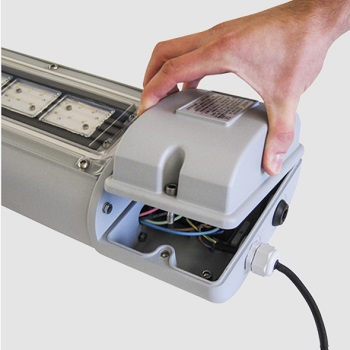
A modular luminaire has a lesser environmental impact then that of a sealed luminaire. This is because the components can be interchanged and a PSU failure doesn’t mean the whole luminaire is useless. There isn’t the need to return the luminaire to the manufacturer as once the faulty component is recognised the PSU from the unit can be removed in-situ.
The faulty PSU can then be returned to the manufacturer to identify the exact cause of failure and for warranty claims. This reduces the environmental impact as it is smaller just to return the PSU instead of the who and the ability to keep spare parts also means that the rig won’t be left without light
With a greater understanding of the environmental cost associated with maintenance, our next and final episode will round off by considering the costs associated with maintenance and luminaire design.
Thorne & Derrick are Specialist Distributors of Hazardous Area & Explosion Proof Equipment with IECEx & ATEX Certifications to the onshore and offshore oil, gas, petrochemicals and process industries.
In this four-part series, Raytec compare ‘modular’ and ‘sealed for life’ LED Ex luminaires, and how the design and certification of these different approaches impacts how easily maintenance can be carried out.
In the second blog of the series Raytec look at how the design affects downtime during a routine maintenance check. Let’s consider this in the context of a real scenario;
Application: Offshore, Oil Rig
Scenario: A luminaire installed on the rig has failed and is no longer producing a light output.
Cause: A failure of the luminaire’s PSU/driver.
Total or partial loss of light is common when a PSU fails. This could cause devastating consequences for the worker and all current operations will be halted causing major cost implications. A quick solution is urgently required.
Sealed for Life Luminaire
After a PSU failure the engineers on the rig can’t solve the problem if the luminaire is sealed as this would nullify the certification.The luminaire must therefore be returned to the manufacturer.
The luminaire must be removed, the relevant paperwork must be raised, and arrangements to return back to the manufacturer. Hopefully the ex lighting will be fixed asap but the rig will still be without
At best, the manufacturer will be proactive in replacing the luminaire, but the affected area of the rig will still be left without a light for a period until the replacement arrives. At worst, the manufacturer will ask for the luminaire to be returned and inspected before any corrective action is taken, meaning the rig will be left without light for longer.
Either way, a significant period is likely to pass until light can be restored.
Modular Luminaire
Conveniently modular ex lighting can be maintained on site as the internal components can be accessed without causing invalidation to the certification.
These components are also interchangeable so spare parts can be kept on-site to service the unit. The light can therefore be repaired so there is minimal disruption to operations as the rig’s engineers are able to change the PSU/driver quickly.
With the understanding that a sealed for life luminaire must be returned to the manufacturer, in part 3 we will consider how this, and other features of a luminaire, can impact the environment. Look out for Part 3 ‘Modular vs. Sealed for Life: Environmental Impact’
Thorne & Derrick are Specialist Distributors of Hazardous Area & Explosion Proof Equipment with IECEx & ATEX Certifications to the onshore and offshore oil, gas, petrochemicals and process industries.
Silicone Heating Pads | Technical Support | Design | Manufacture | Deliver| Best Prices | Ex Stock | Contact Us
what is silicone?
F. S. Kipping first coined the word silicone in 1901 to describe polydiphenylsiloxane by analogy of its formula, Ph2SiO, with the formula of the ketone benzophenone, Ph2CO.
Silicones are polymers, which are large molecules composed of many repeated sub-units. These polymers are made up of siloxane – a chain of alternating silicon atoms and oxygen atoms frequently combined with carbon and/or hydrogen.
Silicone is an element found in sand, where it is extracted from, and passed through, hydrocarbons. As it is made from sand, silicone is the second most abundant element on Earth. However despite being readily available the cost tends to be high in comparison to other rubbers such as Neoprene, EPDM or natural rubbers. The reason for this is that the process of converting sand into silicone is an expensive procedure. Investing in silicone rubber heaters will give you the satisfaction of a high-performance result in a sensible amount of time.
Why choose silicone?
The choice of silicone heaters is due to a mix of material characteristics and features.
There is a vast choice of rubbers available to engineers and designers on today’s market.
The sheer number of different choices can cause confusion as to which rubber is the most suitable to select for certain applications. Properties such as tear strength, compression set, temperature resistance and elongation may can all affect making a choice.
Silicone rubber is ideal for outdoor use as it has an excellent resistance to environmental conditions such as weathering from frost, snow and rain as well as stress from UV rays and the ozone.
Another benefit of silicone (sponge in particular) is low compression set. Meaning that if the silicone is under compression for a length of time, it recovers and maintains its original shape. This is particularly useful when used in confined spaces around pipework, valves and flanges.
As silicone is an inert polymer and mainly non-reactive, it is popular within the food and beverage industry as it has little to no effect on the products themselves. It is widely used in applications from dairy tubing to brewery hoses on a global scale. It is approved to FDA, BfR and WRAS standards which allow it to be in contact with food or beverages without causing contamination.
the benefits of using silicone for heating
Although it is a popular material for many applications, silicone is not used as widely as some other, cheaper materials so the economies of scale are low. However, for many businesses, the cost of using silicone is easily justified as it is the best-in-class elastomer for extreme temperature environments where other rubbers simply cannot function as well as being non-reactive, stable and resistant to harsh environments.
As it is a flexible material, silicone heaters are able to fit into small, difficult to reach spaces where other mainstream heaters cannot. Silicone heaters are commonly used in residential and commercial applications where space is an issue. What makes silicone so popular for use in so many heating products and applications is the wide variety of temperatures it can withstand whilst maintaining its physical structure and properties. Silicone is an ideal material for use in continuous temperatures as low as -60°C and up to as high as 230°C.
Resistant to Moisture & Chemicals
There are many special grades and forms of silicone rubber, many of which are suitable for use in hazardous areas including: steam resistant, metal detectable, high tear strength, extreme high temperature, extreme low temperature, electrically conductive, chemical/oil/acid/gas resistant, low smoke emitting, and flameproof.
Silicone is the perfect material for use in applications within heating and ventilation systems due to its excellent sealing protection and compression set. Its closed cell structure provides a high level of protection from water, dust and moisture ingress, making this material the ideal choice for preventing heat loss on pipe lines, valves, pumps and flanges as well as frost protection.
Silicone is known to be highly resistant to many dangerous chemicals, as well as the harmful effects that moisture can have on more traditional heating systems. With silicone being impervious to both chemicals and moisture, it is the perfect material to use for an effective transportable heating unit.
Increases Temperatures Quickly
Silicone heaters are constructed with either etched foil or wiring systems which can rapidly heat up to 350° Celsius, giving them enough power to heat up surfaces they come into contact with quickly. The thin construction of silicone heaters allows the material to heat up incredibly quickly. Both etched foils and etched wires create the perfect environment for a fast conduction process, thus improving their efficiency. As silicone is inherently heat-resistant, quickly reaching these high temperatures poses no risk to the heating unit itself.
Lightweight
On average, silicone weighs just over 2.5 grams per cubic centimetre. This means silicone heaters are able to be transported quickly and easily when required. More bulky heating units such as drum heaters, for example, are often large enough to hold over 50 gallons, however moving them from one work space to another can be cumbersome. Silicone heaters are not just lightweight, but they are also well known for their flexibility, making them much easier to store for future use.
Silicone Heater Mats
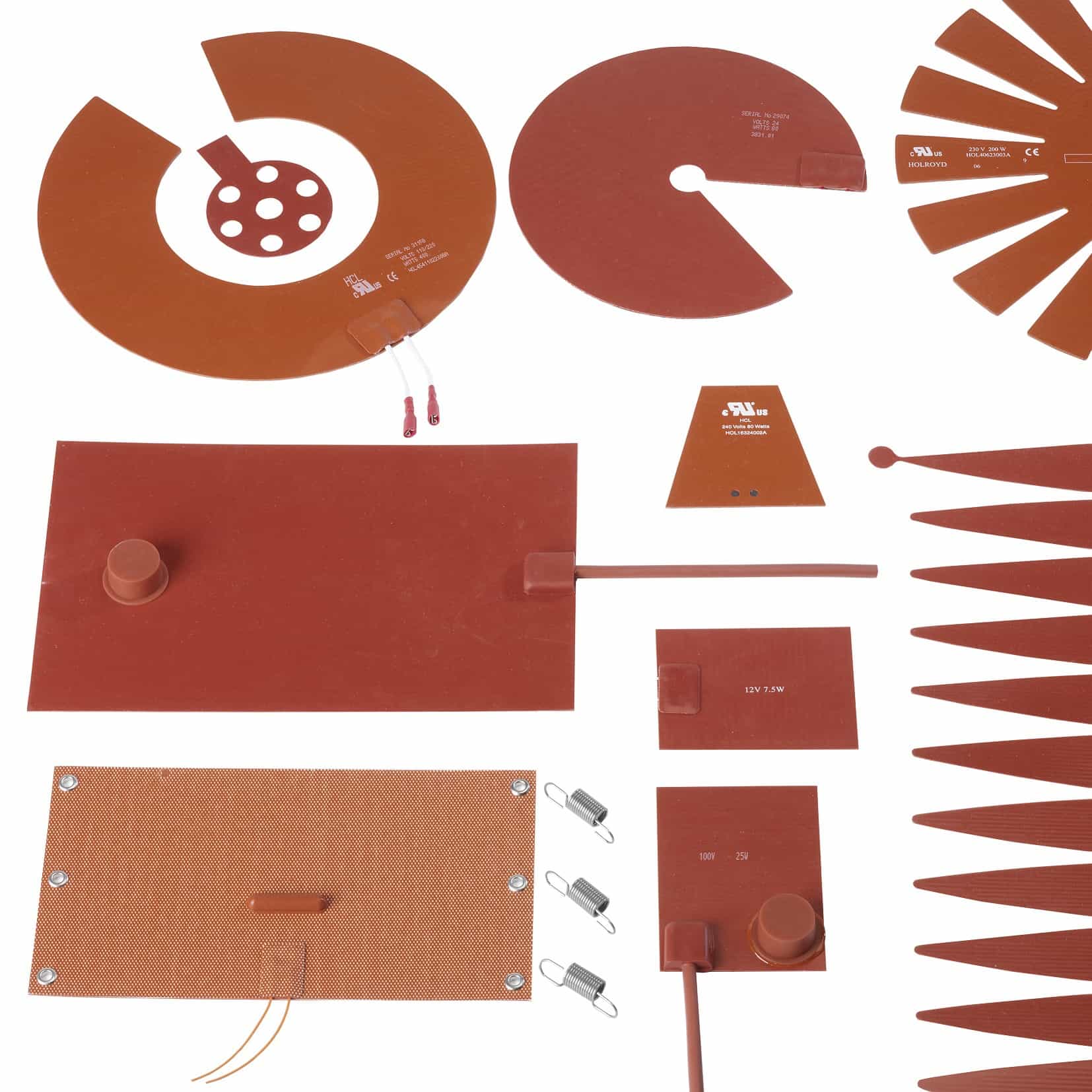
Silicone rubber has excellent insulation properties, a low thermal mass, high durability and is resistant to moisture, high temperatures and many chemicals. The use of silicone rubber to manufacture heater mats or heater pads enables the user to achieve more watts per square inch. The mats respond quickly to fluctuations in temperature and can be controlled by thermostats or temperature controllers to keep process temperatures accurate. Silicone heater mats can suit temperatures from -60°C up to +230°C.
Silicone Heater Mats and Pads are flexible heating devices consisting of wires or foil tracks which act as heating elements, between two thin layers of silicone rubber. This construction allows the heat to be evenly distributed across the surface of the mat. Silicone heater mats can be connected to heat control devices such as limit switches, thermocouples or heat sensorsto regulate the temperature provided by the heater mat.
There are several types of silicone heater mats available.
They are ideal for use with irregularly shaped structures or where space is limited and fasten to structures using either a special adhesive or hook and eyelet fastenings.
Wire Wound Silicone Heater Mats have evenly spaced resistance wires laminated between the sheets of silicone. This type of heater mats are robust and ideal for providing heating in applications where the heater is removed and reinstalled regularly. Typical applications for wire wound silicone heater mats include industrial catering such as ovens, battery warming, environmental control and aircraft and laboratory equipment.
Etched Foil Silicone Heater Mats have chemically etched, foil heating tracks between the sheets of silicone. These heater mats heat up quickly and produce an even and accurate heat. The etched foil tracks have a greater surface area and therefore can be used in applications which require higher power densities. However, the tracks can easily be damaged by bending so this type of silicone heater mats are not suitable for applications in which they would be subjected to flexing and bending. Typical applications for etched foil type silicone heater mats include laboratory equipment, anti-condensation heating, GRP pipe curing systems and satellite dish snow melting.
Spiral Pipe Heating Silicone Heaters have good resistance to weather & ageing, fungus & bacteria, acetone, alcohol, formic acid, brake fluid, acetic acid, greases, hydrochloric acid 10%, sulphuric Acid 10%, waxes and plasticisers. There are a wide range of uses for spiral heaters where a pipe surface temperature of up to 200°C is required as they are well suited to fit both straight or curved pipework. Spiral type silicone heaters are designed to suit a range of either rigid or flexible, small diameter pipes and are suitable for many applications including gas or fluid delivery, semi conductor processes,frost protection, anti condensation and heat loss maintenance.
Preformed Silicone Heaters are useful in applications where a heater mat is required to fit small diameter pipework for a more precise fit. Silicone heaters can be formed and vulcanised to fit the full or partial circumference of any pipe diameter. These heaters can be supplied with separate straps for fixing or can be permanently installed using room temperature vulcanising, silicone adhesive or self adhesive systems.
Kapton Heaters are manufactured from thin, flexible and semi-transparent heating material, Kapton Polymide, which is ideally suited for the production of heater elements. With fast and efficient heat transfer to surfaces, low thermal mass and excellent resistance to chemicals, weather and radiation Kapton allows for high power densities and offers fast response to temperature control. Where low profile, localised heating is required Kapton Heaters are the ideal solution.
Heating Mats and Jackets are flexible and provide optimum heat transfer with excellent surface heat distribution. They are the ideal solution for simple level surfaces when uniform heating with more than two levels is required – typical applications include OEM and the manufacturing industries where bespoke heating solutions are needed. Heaters can be designed to fit most shapes delivering completely uniform heating profiles across the entire surface over large areas without heat loss, hot spots or colds spots – precise, controlled and targeted heating with no temperature fluctuations.
Shaped Insulation Foam Silicone Heatersprovide high efficiency thermal insulation to help reduce heat loss from pipes, ‘T’ sections, flanges, valves and pumps. Typical applications for these silicone heaters include: frost protection, industrial catering, anti-condensation, GRP pipe curing systems, composite repair of aircraft, environmental control or electronics, heat loss prevention and temperature maintenance.
Custom Silicone Heaters made from closed cell insulation foam and provide a high efficiency barrier to help reduce heat loss from applications such as liquid or gas pipelines, frost protection, temperature critical pipe line assemblies and to reduce heat loss on valves, pumps and flanges. Silicone rubber products have an excellent resistance to oxidation, ozone, UV light, corona discharge, cosmic radiation and general weathering. The flame retardant pads are available in 3 mm, 5 mm, 8 mm and 12 mm thicknesses.
The heat trace cable ranges stocked and supplied by Thorne & Derrick International includes electric heating cables for process temperature maintenance, pipe and vessel freeze protection and roof and gutter de-icing applications where snow and ice removal is required – cables and systems are available for commercial, industrial safe area (non-hazardous area) and hazardous area heating applications with ATEX certification.
Electric heat tracing is a cable based system used to maintain, raise temperature and protect process pipework and vessels against freezing temperatures and associated frost damage.
Heat tracing systems utilising self-regulating, constant wattage and mineral insulated (MI) heating cables are available to provide the optimum electrical heating system for your application – we provide a trace heating system design service.
EXPERTS IN WINTERISATION SOLUTIONS FOR INDUSTRIAL & HAZARDOUS AREA ENVIRONMENTS
Thorne & Derrick hold the largest UK stocks of frost protection & winterisation equipment to help keep your plant and personnel operational during the winter months.
Thorne & Derrick understand that prolonged periods of low ambient temperatures can bring operations to a standstill costing thousands of pounds in lost downtime.
Experts in heating solutions for use in industrial & explosive atmospheres, Thorne & Derrick have the knowledge & expertise to help clients prevent unnecessary down time this winter.
We can provide overnight delivery of Trace Heating Cables at the most competitive prices to guarantee frost protection of your pipelines and mechanical services.| Ask About Our Heat Trace Design Service.
💡 Contact us today and our skilled and friendly team can provide technical support as well as reliable, fit for purpose and compliant solutions to suit your exact requirements.
➡See our Winterisation blog TOP PICKS, including our most read articles about Trace Heating and the requirement for electrical heating products and systems to combat and mitigate Winter weather effects.
Press Release Date: 02.04.2020 uploaded by Chris Dodds (T&D Sales + Marketing Manager) World’s First Fully Certified ATEX Doors Thorne & Derrick International, the Experts in Equipment for Explosive Atmospheres, today announce the signing of a Commercial Distribution Agreement...
Press Release Date: 04.07.2019 uploaded by Chris Dodds (T&D Sales + Marketing Manager) Category: Stockist Distributor Agreement Announcement Thorne & Derrick International announce that they have signed a Preferred Distributor Agreement with Raytec, the world leading manufacturer of LED...